

RC Drilling Rig Types: Selection and Tool Matching Guide
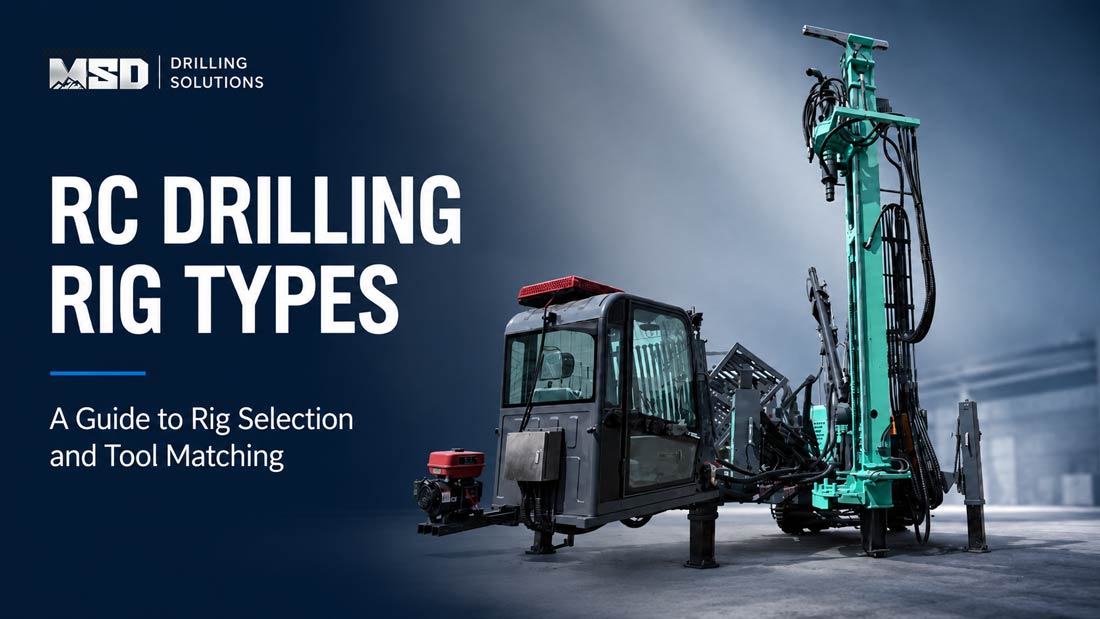
What Is an RC Drilling Rig and Why Does the Configuration Matter?
Reverse circulation drilling uses a dual-wall rod system to send compressed air down the outer passage and return rock cuttings through the inner tube. At the bottom of the string, an RC hammer and RC drill bit break the formation while the enclosed return path carries the sample to the surface collection system.
An RC drilling rig is therefore more than a carrier and mast. A complete RC setup normally includes an RC-capable rig, suitable compressor, dual-wall rods, RC hammer, RC drill bit, sample swivel, discharge hose, cyclone, and sample collection or splitting equipment. The rig platform may be purpose-built for RC drilling or may be a multipurpose platform configured for RC work.
RC and conventional DTH drilling should not be treated as identical systems. Conventional DTH drilling normally uses a standard DTH hammer, DTH bit, and single-wall drill pipes, with cuttings returning through the annular space between the drill string and the borehole wall. RC drilling uses a centre-return sampling path and is selected when controlled sample recovery is a key project requirement.
System Matching Principle: Match the rig, compressor, hammer, bit, dual-wall rods, and sample-return equipment as one drilling system.
How RC Drilling Rigs Are Classified
RC rigs are often described by several different classification systems. Carrier type, drilling capability, and project capacity should be considered separately because each answers a different selection question.
Classification by Carrier and Mobility
Crawler- or track-mounted rigs are designed for self-propelled movement on uneven ground and are commonly used on remote exploration pads. Truck-mounted rigs are suited to road-accessible programs where frequent movement between locations is important. Skid-, trailer-, or buggy-mounted rigs provide alternative transport and setup options for projects where a crawler or road-going truck is not the best fit.
Classification by Drilling Capability
Dedicated RC rigs are configured primarily around reverse circulation drilling and sample recovery. Multipurpose rigs can be changed between RC, conventional DTH, rotary, and diamond core drilling when the rig design, rotary head, rod handling, compressor, and supporting equipment allow it. These rigs are useful for programs that require RC pre-collars followed by diamond coring or several drilling methods within one project.
Classification by Project Capacity
Compact or access-limited rigs are selected where transport, pad size, terrain, or site restrictions limit the use of larger equipment. Standard exploration rigs cover a broad range of mineral exploration and grade-control work. High-capacity or deep-hole rigs provide greater pullback, torque, rod-handling capacity, and compressor support for demanding depths and larger drilling systems.
| Classification Dimension | Common Options | Main Selection Question |
|---|---|---|
| Carrier and mobility | Crawler, truck, skid, trailer, or buggy | How will the rig reach and move between drill pads? |
| Drilling capability | Dedicated RC or multipurpose RC/core/DTH | Does the program require one drilling method or several? |
| Project capacity | Compact, standard exploration, or high-capacity | What depth, hole diameter, rod size, and pullback capacity are required? |
How Rig and Compressor Capacity Affect Depth and Hole Diameter
RC drilling depth and hole diameter cannot be determined from carrier type alone. They depend on the combined capacity of the mast, pullback system, rotary head, rod handler, compressor, dual-wall rod string, hammer, bit, and sample-return circuit.
As depth increases, the system must continue to operate the hammer and maintain enough return velocity to lift cuttings through the inner tube. Air leakage, water inflow, elevation, rod diameter, internal return area, formation conditions, and system backpressure can all reduce effective sample return before the rig reaches its theoretical mechanical depth.
Larger hole diameters generally require larger RC hammers and drill bits, which normally demand greater delivered air volume. A rig may have enough mast capacity for the target depth but still be unsuitable if the compressor cannot operate the selected hammer and maintain stable sample return.
Instead of relying on generic light-, medium-, or heavy-duty depth figures, confirm the manufacturer-rated capacity of the exact rig configuration under the planned hole diameter, rod size, compressor package, and formation conditions.
Dedicated Centre-Sample RC Hammer vs. Conventional DTH Hammer with Cross-Over Sub
Two common downhole arrangements can be used to move cuttings into the inner return tube of a dual-wall rod string. They should not be confused with different top-of-hole sample-handling systems.
Dedicated Centre-Sample RC Hammer
A dedicated centre-sample RC hammer uses an RC bit with a central sample entry. Cuttings move from the bit face into the hammer's internal sample tube and then continue upward through the inner tube of the dual-wall rods. This creates a direct enclosed return path and is commonly selected for mineral exploration and grade-control programs where sample recovery and contamination control are important.
Conventional DTH Hammer with Cross-Over Sub
In a cross-over arrangement, a conventional DTH hammer is used below a cross-over sub. Cuttings first move upward around the hammer and are then redirected by the cross-over sub into the inner return tube of the dual-wall rods. This configuration can be useful where the rig and drilling system are designed to use conventional DTH tooling, but the sample path is less direct than a dedicated centre-sample RC arrangement.
The correct choice depends on the project's sample-quality requirements, rig configuration, available tooling, hole diameter, formation, compressor output, and the complete return system.
Matching RC Drilling Tools to the Rig
Rig type alone does not determine the correct tooling. The RC hammer, RC drill bit, dual-wall rods, compressor, rod handler, and sample-return system must be compatible with one another.
The compressor's delivered pressure and air volume must support the selected hammer under actual site conditions. The required hole diameter determines the hammer and bit size, while the target formation affects bit face design, button configuration, flushing, and expected wear. The dual-wall rods must match the rig's rod-handling limits, rotary system, connection standard, and inner sample tube arrangement.
Before ordering, confirm the following fields:
Rig manufacturer and model
Compressor pressure and delivered air volume
Target depth and required hole diameter
Rock formation, water conditions, and expected air loss
Dual-wall rod outside diameter, inner tube, length, and connection
Rod-handler and rotary-head limits
RC hammer connection and compatible RC drill bit
Sample swivel, hose, cyclone, and collection-system configuration
Working with a specialized manufacturer of RC drilling tools helps identify compatibility issues before the equipment reaches the site. MSD manufactures and supplies RC hammers and RC drill bits, with tool-selection support based on the rig, compressor, rod system, target diameter, and formation.
Key Factors When Choosing an RC Drilling Rig
Rig selection should start from the drilling program rather than from the machine's appearance or carrier type. The required sampling method, target depth, access conditions, hole diameter, formation, and expected productivity define the system requirement.
Define the project role: exploration, resource definition, grade control, pre-collar drilling, or another approved RC application.
Assess road access, terrain, pad dimensions, transport limits, and local mobilization requirements.
Confirm target depth, hole diameter, inclination, and expected formation conditions.
Choose between a dedicated RC rig and a multipurpose platform.
Check pullback, torque, mast capacity, rod handling, and compressor output.
Confirm the dual-wall rod, RC hammer, RC drill bit, and sample-return configuration as one system.
Review service access, consumable support, operator requirements, and planned maintenance.
This workflow keeps rig selection, drilling-tool selection, and sample-recovery requirements connected from the beginning of the project.
Why RC Tool Quality Matters as Much as Rig Choice
A correctly sized rig cannot compensate for a poorly matched or unreliable downhole system. RC hammer performance, drill bit wear, connection accuracy, internal sample-path condition, and rod sealing all influence penetration, sample return, downtime, and overall cost per meter.
Reliable manufacturing and proper selection are both important. The hammer and bit must operate within the available air supply, the connections must fit correctly, and the bit design must suit the formation. The complete system should also be inspected for inner-tube damage, seal wear, air leakage, blocked sample passages, and connection problems before drilling.
For project-specific selection, contact MSD with your rig model, compressor pressure and air volume, target depth, required hole diameter, dual-wall rod size, hammer connection, and formation conditions. These details allow the RC hammer and RC drill bit configuration to be checked before ordering.
Frequently Asked Questions
Q: What is the difference between an RC drilling rig and a DTH drilling rig?
A: An RC setup returns drill cuttings through the inner tube of a dual-wall rod string for sample collection. A conventional DTH setup normally returns cuttings through the annular space between the drill string and the borehole wall. Some multipurpose rig platforms can be configured for either method, but the hammer, bit, rod system, and surface equipment are different.Q: What are the main types of RC drilling rigs?
A: RC rigs can be classified by carrier type, drilling capability, and project capacity. Common carrier formats include crawler-mounted, truck-mounted, and skid- or trailer-mounted rigs. Capability may be dedicated RC or multipurpose RC/core/DTH, while capacity ranges from compact access-limited rigs to high-capacity deep-hole systems.Q: How deep can an RC drilling rig drill?
A: Depth capacity depends on the exact rig model, pullback force, rotary system, compressor pressure and air volume, dual-wall rod size, hole diameter, formation conditions, water inflow, and sample-return efficiency. The rated depth should be confirmed with the rig manufacturer for the planned drilling conditions.Q: What is the difference between a centre-sample RC hammer and a cross-over sub system?
A: A dedicated centre-sample RC hammer directs cuttings from the bit face into a central sample tube and then through the inner tube of the dual-wall rods. A cross-over sub system uses a conventional DTH hammer and redirects cuttings into the inner return tube above the hammer. Dedicated centre-sample systems are commonly selected when sample integrity is a primary requirement.Q: What information is needed to match RC drilling tools to a rig?
A: Confirm the rig model, compressor pressure and delivered air volume, target depth, required hole diameter, formation, dual-wall rod size, hammer connection, rod-handling limits, and sample-return configuration before selecting the RC hammer and RC drill bit.
Technical content reviewed by MSD Engineering Team. | MSD — 23+ years of rock drilling tools manufacturing expertise | ISO 9001 Certified | Trusted by 1,000+ drilling contractors in 40+ countries