

Cost of Drill Pipe: Complete 2026 Price Guide by Type and Application
Drill pipe is a critical component in any drilling operation—but prices vary dramatically depending on what type you need. A quick search for "cost of drill pipe" returns everything from $5 per foot recycled pipe for fence posts to $150+ per foot specialized oilfield pipe.
This guide focuses specifically on industrial drilling pipe used in oil & gas, water well, mining, and construction drilling operations. We'll break down pricing by type, specification, and application to help you understand what you should actually expect to pay. MSD a China-based rock drilling tools manufacturer with 23+ years of manufacturing experience, producing DTH drill pipes and top hammer extension rods for contractors in 40+ countries, compiled this guide from field data and factory pricing intelligence.
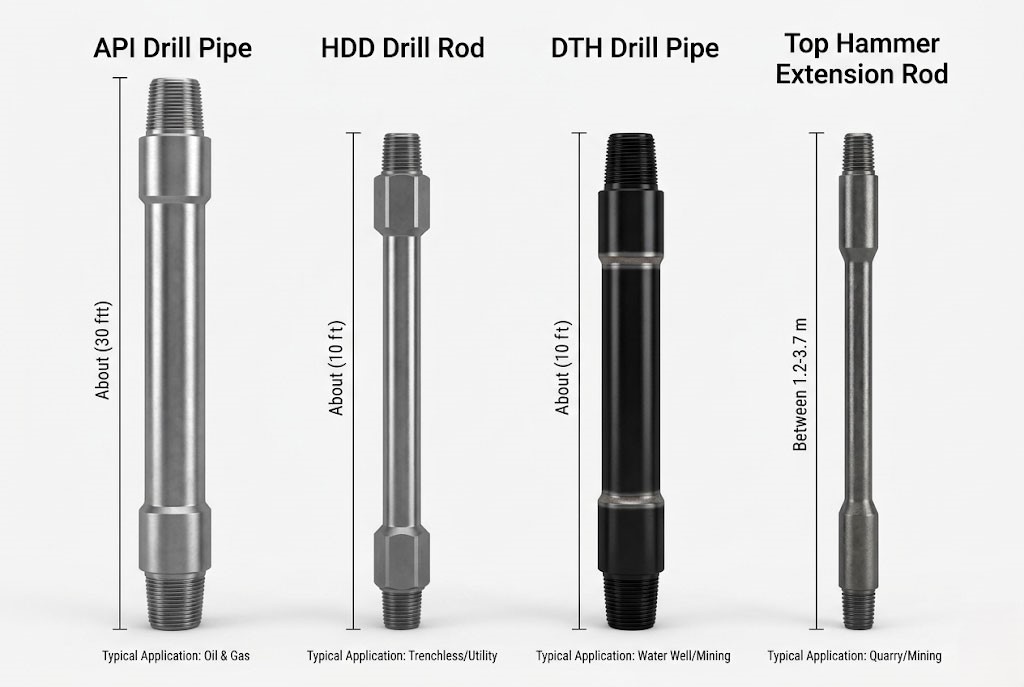
How Much Does Drill Pipe Cost?
The cost of drill pipe ranges from approximately $15 to $150+ per foot, depending on type, diameter, grade, and condition:
| Drill Pipe Type | Price Range (Per Foot) | Price Range (Per Joint/Rod) |
|---|---|---|
| Used oilfield drill pipe | $10–$30 | $200–$600 |
| New API drill pipe (standard) | $30–$65 | $600–$1,300 |
| New API drill pipe (premium grade) | $50–$150+ | $1,000–$3,000+ |
| HDD drill pipe/rods | $25–$60 | $200–$900 |
| DTH drill pipe | $20–$80 | $150–$800 |
| Top hammer extension rods | $15–$50 | $100–$500 |
Key insight: Drill pipe cost per foot is just one metric. Total cost of ownership—including service life, failure rates, and downtime costs—often matters more than initial price.
Types of Drill Pipe and Their Price Ranges
Understanding drill pipe types is essential for accurate pricing. Different drilling methods require completely different pipe specifications.
Oil & Gas Drill Pipe (API Standard)
API-standard drill pipe is used in rotary drilling for oil, gas, and deep geothermal wells, classified by grade (E-75, X-95, G-105, S-135) indicating yield strength. New pipe runs $30–$65/ft for standard grades, up to $150+/ft for premium S-135. Used inspected pipe typically costs 40–60% less. This category is primarily supplied by oilfield specialists; pricing fluctuates with steel markets and rig activity.
HDD Drill Pipe (Horizontal Directional Drilling)
HDD drill rods connect the drill rig to the drill head in trenchless applications—utility installation, pipeline crossings, telecommunications. Pricing ranges from $150–$300 per rod for mini HDD rigs up to $500–$1,200 per rod for large maxi rigs. Aftermarket rods typically cost 30–50% less than OEM while maintaining compatibility.
DTH Drill Pipe (Down-the-Hole Hammer Drilling)

DTH drill pipe transmits rotation and compressed air from the rig to the DTH hammer for water well, mining, quarrying, and construction drilling. Unlike API pipe, DTH pipe specifications focus on air passage diameter and thread compatibility with DTH hammers.
| Diameter (OD) | Thread Type | Length | Typical Price Range |
|---|---|---|---|
| 76mm (3") | API 2-3/8" Reg | 1.5–3m | $80–$200 |
| 89mm (3-1/2") | API 2-3/8" Reg | 1.5–6m | $100–$350 |
| 114mm (4-1/2") | API 3-1/2" Reg | 1.5–6m | $180–$500 |
| 140mm (5-1/2") | API 4-1/2" Reg | 1.5–6m | $250–$650 |
A standard 3-meter section of 89mm DTH pipe costs approximately $150–$300 depending on wall thickness and supplier.
Rule of Thumb: For holes under 50 meters in stable formations, 6.5mm wall thickness is sufficient. For holes exceeding 50 meters, hard rock, or high-torque drilling, upgrade to 8.5mm or heavier to prevent fatigue failure.
Top Hammer Drill Rods (Extension Rods)
Top hammer drill rods connect the rock drill (drifter) to the drill bit in mining and construction applications, using thread systems (T38, T45, T51, T60) matched to hole diameter and depth.
| Thread Type | Typical Length | Price Range (Per Rod) |
|---|---|---|
| R38 / T38 | 1.2–4.3m | $100–$300 |
| T45 | 1.5–6.1m | $150–$400 |
| T51 | 1.5–6.1m | $200–$500 |
| T60 | 3.7–6.1m | $300–$600 |
Rule of Thumb: Top hammer rods are consumables with a finite service life of typically 1,000–3,000 drilling meters depending on rock conditions and handling. Factor this into your per-meter cost, not just the purchase price.
Factors That Affect Drill Pipe Cost
Diameter and Wall Thickness
Larger diameter and heavier wall thickness mean more steel—directly increasing cost. A 5-1/2" heavy-duty pipe costs roughly 3× more than a 2-7/8" standard pipe.
How much does a 5 inch drill pipe weigh per foot? A standard 5" OD drill pipe weighs approximately 19–25 lb/ft depending on wall thickness. Heavy-weight drill pipe (HWDP) in the same diameter can exceed 40 lb/ft.
Material Grade and Heat Treatment
Higher-strength grades (G-105, S-135 for API pipe) require premium alloy steel and advanced heat treatment, increasing cost 20–50% over standard grades. For DTH and top hammer applications, quality manufacturers use friction-welded joints—computer-controlled processes that fuse hardened threaded ends to tough pipe bodies at the molecular level, with weld zones stronger than the parent metal itself. These add cost but eliminate joint failures in deep-hole applications.
New vs Used Condition
Used drill pipe typically costs 40–60% less than new, but comes with inspection requirements and uncertain remaining service life. For critical applications, the cost savings often don't justify the risk of failure.
| Condition | Price vs New | Best For |
|---|---|---|
| New | 100% | Critical operations, deep wells |
| Premium used (inspected) | 60–75% | Cost-conscious operations with inspection capability |
| Standard used | 40–60% | Non-critical applications |
| Scrap/fence grade | 10–25% | Non-drilling uses only |
Thread Type and Connection
Premium connections (proprietary threads, flush joints) cost more than standard API connections. For DTH pipe, common thread types include API Regular (2-3/8" Reg, 3-1/2" Reg, 4-1/2" Reg) and NC threads (NC26, NC31, NC35, NC38, NC50) for higher torque capacity. Always verify thread compatibility with your hammer and rig before ordering.
Supplier Type: The Hidden Cost Factor
| Supplier Type | Typical Pricing | Pros | Cons |
|---|---|---|---|
| Premium European OEM brands | Premium (+30–50%) | Guaranteed quality, full support | Highest cost |
| Authorized distributors | Standard market price | Quality assurance, local support | Limited flexibility |
| Trading companies | Low (−20–40%) | Lowest upfront price | Variable quality, no technical support |
| Direct from manufacturer | Competitive (−30–50% vs OEM) | Quality control, customization, technical support | Minimum order quantities |
Drill Pipe Price Comparison: OEM Brands vs. Alibaba Traders vs. Factory-Direct
The OEM Premium
Premium European OEM brands command prices often 30–50% above market average. You're paying for guaranteed specifications and quality control, brand reputation and resale value, technical support and warranty, and established supply chain reliability. For large operations with OEM equipment requirements, this premium may be justified.
The Alibaba Trap
Many buyers search for cheap drill pipe on Alibaba or similar platforms. Caution is warranted. Common issues with trading company purchases include quality inconsistency (trading companies source from multiple factories with variable quality), no technical support, specification mismatches ("compatible" doesn't always mean "fits perfectly"), and hidden costs including shipping, customs, quality inspection, and potential returns. The lowest price often becomes the highest total cost when you factor in failures, downtime, and replacement.
The Factory-Direct Alternative: MSD
MSD manufactures DTH drill pipes in 76–178mm OD with API REG and NC thread options, ISO 9001 certified, friction-welded construction. Factory-direct supply eliminates distributor markup without sacrificing quality. Main specifications: 89mm and 114mm OD in 6.5mm/8.5mm wall thickness, API 2-3/8" and 3-1/2" REG threads, standard 3m length. Full size range 76–178mm available—view complete specifications at the product page.
Field result: A Mpumalanga (South Africa) drilling contractor deployed MSD 114mm DTH drill pipes (8.5mm wall, API 3-1/2" REG) on a 36-well rural water supply project. Drilling through dolomite and quartzite at depths averaging 80 meters, the friction-welded pipes completed all 36 wells with zero joint failures—at 35% lower procurement cost compared to premium European alternatives.
View MSD DTH Drill Pipe Products →
Explore MSD Drilling Solutions for Water Well →
See MSD Mining Drilling Solutions →
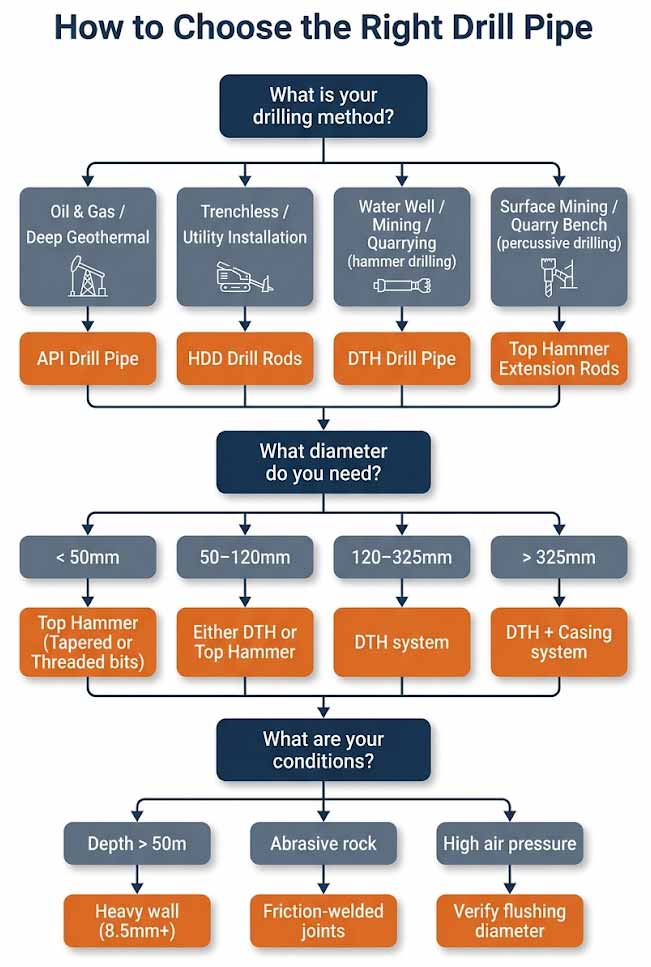
How to Choose the Right Drill Pipe for Your Application
Step 1: Identify Your Drilling Method
| Drilling Method | Pipe Type Needed |
|---|---|
| Rotary (oil/gas, deep geothermal) | API drill pipe |
| Horizontal directional drilling (HDD) | HDD drill rods |
| DTH hammer drilling (water well, mining) | DTH drill pipe |
| Top hammer drilling (mining, quarrying) | Extension rods |
Step 2: Match Diameter to Your Equipment
Your rig and hammer/bit specifications determine the pipe diameter needed. Check manufacturer recommendations for minimum/maximum pipe OD, required inner diameter for air passage (DTH), and thread compatibility.
Rule of Thumb: For DTH systems, match pipe OD to hammer size to maintain optimal up-hole velocity. The pipe OD must be smaller than the hammer OD. If the pipe is too small, the annular space is too large and cuttings won't flush out; if the pipe is too large, it restricts upward flow and risks jamming in the hole.
Step 3: Consider Operating Conditions
| Condition | Recommendation |
|---|---|
| Deep holes (>50m) | 8.5mm+ wall thickness, friction-welded construction |
| Abrasive/fractured rock | Upgrade wall thickness, specify friction-welded joints |
| High-pressure air (DTH) | Verify flushing hole diameter—a 10% reduction in delivered air pressure can cause 20–30% reduction in penetration rate |
| Frequent rod changes | Shorter lengths for easier handling |
Step 4: Balance Cost and Quality
For production drilling, initial price matters less than service life (meters drilled per pipe), failure rate (downtime costs $200–$500/hour), and thread wear (replacement frequency).
Frequently Asked Questions
Q1: How much does drill pipe cost per foot?
Drill pipe cost per foot ranges from $15 to $150+ depending on type, diameter, grade, and condition. Standard API oilfield pipe runs $30–$65/ft new, while DTH drill pipe for water well and mining applications typically costs $20–$80/ft. Used pipe costs 40–60% less than new. Always specify diameter, grade, and application when requesting quotes for accurate pricing. If you need high-quality DTH or Top Hammer drill pipes without the OEM price markup, contact MSD's engineering team today for a quote.
Q2: How much does a drill pipe cost per meter?
To convert per-foot pricing to per-meter: multiply by 3.28. A drill pipe costing $30/ft equals approximately $98/meter. DTH drill pipe in common sizes (89–114mm) typically runs $65–$160 per meter for new pipe from quality manufacturers.
Q3: How long is a section of drill pipe?
Standard drill pipe lengths vary by type. API oilfield pipe comes in Range 2 (27–30 ft) or Range 3 (38–45 ft). HDD drill rods range from 4–30 ft based on rig size. DTH and top hammer drill pipe typically comes in 1.5m to 6m lengths (5–20 ft), with 3m (10 ft) being most common for water well and mining applications.
Q4: How much does a 5 inch drill pipe weigh per foot?
A 5-inch OD drill pipe weighs approximately 19–25 lb/ft for standard wall thickness, or up to 40+ lb/ft for heavy-weight drill pipe (HWDP). Exact weight depends on wall thickness and grade. For example, 5" 19.50 lb/ft is a common API specification.
Q5: What is drill pipe?
Drill pipe is hollow steel tubing that connects the drilling rig to the drill bit, transmitting rotational torque and allowing circulation of drilling fluid or compressed air. Different types serve different drilling methods: API drill pipe for oil/gas rotary drilling, HDD rods for trenchless horizontal drilling, DTH pipe for down-the-hole hammer drilling, and extension rods for top hammer drilling in mining and quarrying.
Technical content reviewed by MSD Engineering Team. | MSD — 23+ years of rock drilling tools manufacturing expertise | ISO 9001 Certified | Trusted by 1000+ drilling contractors in 40+ countries