

How to Choose a Mining Drill Bit for Blasthole Drilling: DTH, Top Hammer, or Tri
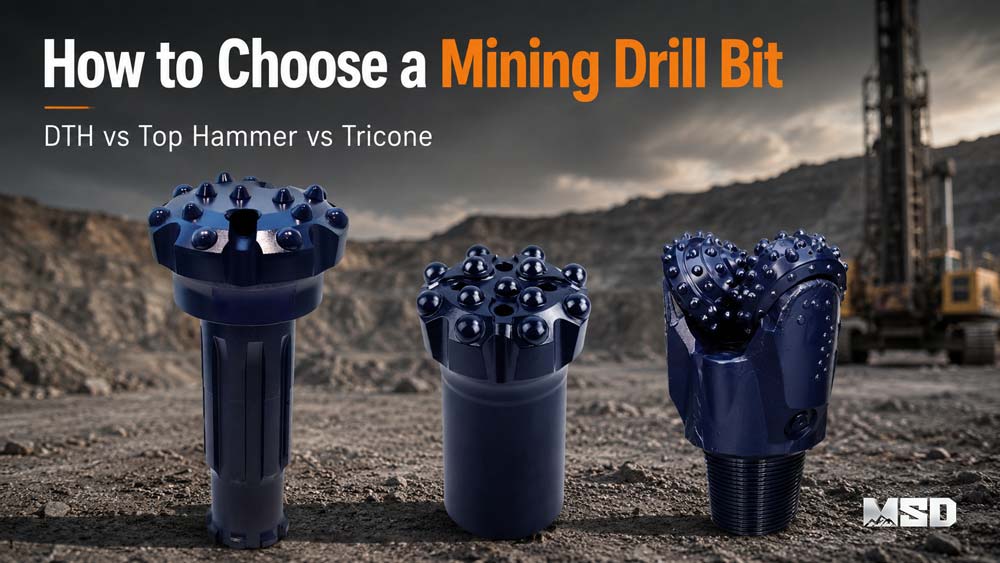
Choosing the right mining drill bit starts with the drilling conditions, not with a product catalog. For blasthole drilling, the correct choice depends on rock strength and abrasiveness, hole diameter, target depth, rig capability, flushing conditions, and the drilling method already supported by the equipment.
This guide explains how to compare DTH, top hammer, and rotary tricone drilling for mining blastholes, then select the bit type, face design, button profile, and equipment connection that fit the application.
Why Mining Drill Bit Selection Matters
The wrong drill bit can reduce penetration rate, shorten usable bit life, increase downtime, and raise the total cost per meter. A bit may be well manufactured but still perform poorly if it is used in the wrong formation, paired with the wrong hammer or drill string, or operated outside the suitable drilling parameters.
Common selection mistakes include:
Choosing only by purchase price
Ignoring rock abrasiveness or fractured ground
Matching the bit only by nominal diameter
Using the wrong DTH shank, top hammer thread, or rotary connection
Selecting a face design without considering flushing and hole-straightness requirements
Comparing drilling methods without considering the rig and compressor
A safer decision sequence is:
Assess the formation and hole requirements.
Confirm the drilling method supported by the rig.
Select the bit structure for the formation.
Verify all equipment connections and operating capacity.
Confirm the final configuration before ordering.
Mining contractors and procurement teams can use this process together with MSD's mining drilling solutions to reduce selection risk.
Rule of Thumb: Drill bit selection is a system decision. Rock conditions influence the drilling method, while the rig, hammer, drill string, and connection standard determine which bit can actually be used.
Step 1 — Assess the Rock Formation and Hole Requirements
Rock hardness is important, but it is not the only selection factor. Two formations with similar compressive strength can behave differently because of abrasiveness, fracturing, weathering, water, or changes between layers.
Before selecting a mining drill bit, review the following conditions:
Rock hardness or UCS, if available
Abrasiveness and quartz content
Intact, fractured, broken, or mixed ground
Wet-hole or dry-hole conditions
Required hole diameter
Target hole depth
Hole-straightness requirement
Type of blasthole operation
Expected variation between formations
Soft and less abrasive formations may allow more aggressive cutting or button profiles. Hard and abrasive formations generally require greater wear resistance. Fractured ground may place more emphasis on flushing, hole cleaning, and stable bit guidance.
When geological information is incomplete, do not classify the project only by the average formation. The hardest, most abrasive, or most unstable interval may determine the safer tool configuration.
Rule of Thumb: In mixed ground, select and verify the tool against the most demanding section expected, not only the average rock condition.
Step 2 — Compare DTH, Top Hammer, and Rotary Tricone Drilling
The drilling method should be selected before the individual bit design. DTH, top hammer, and rotary tricone drilling transmit energy to the rock in different ways and require different rigs, drill strings, and operating conditions.
DTH Drilling
DTH drilling uses a pneumatic hammer located directly behind the bit. Impact energy is delivered at the bottom of the hole, which helps reduce energy loss through the drill string.
DTH is commonly considered for:
Medium-to-large blasthole diameters
Deeper holes
Hard or variable rock
Applications where hole straightness is important
Rigs with suitable compressor pressure and air volume
The bit must match the DTH hammer model, hammer size, and shank standard. MSD supplies DTH hammers for different drilling systems and working conditions.
Top Hammer Drilling
Top hammer drilling delivers impact energy from a rock drill mounted on the rig. The energy travels through the shank adapter, drill rods, and bit.
Top hammer is commonly considered for:
Smaller blasthole diameters
Shallower holes
Surface mining, quarrying, development, and bench drilling
Operations where fast rod handling and drilling cycles are important
Rigs already configured for threaded or tapered top hammer systems
As hole depth increases, energy transmission and hole deviation become more important. The thread system, rod diameter, shank adapter, and rock drill must all be matched correctly.
Rotary Tricone Drilling
Rotary blasthole drilling uses roller-cone or tricone bits to crush and shear the formation under rotary torque and weight on bit. It is widely used for large-diameter surface mining holes.
Rotary tricone drilling may be used in:
Soft, medium, or hard formations
Large surface blastholes
High-production mining operations
Rigs with suitable rotary torque, pulldown capacity, and air volume
The correct tricone structure depends on formation strength, abrasiveness, bearing design, cutting structure, rig capacity, and the required hole diameter. Rotary drilling should not be classified only as a soft-rock method.
Rule of Thumb: Top hammer is commonly evaluated for smaller and shallower holes, DTH for deeper medium-to-large hard-rock holes, and rotary tricone drilling for large surface blastholes where the rig provides the required torque and pulldown. Final selection must consider the complete drilling system.
Step 3 — Select the Bit Type and Cutting Structure
After the drilling method is confirmed, select the bit structure according to the formation and operating priorities.
DTH Bit Face Design
MSD DTH drill bits are available with flat, concave, and convex face designs. The face design should be selected according to:
Formation structure
Rock abrasiveness
Hole-straightness requirement
Flushing conditions
Penetration priority
Button layout
Hammer and bit configuration
Rock hardness alone is not enough to determine the correct face design. A design that performs well in one hard formation may not be the best choice in another hard formation with different fracturing or abrasiveness.
MSD's DTH drill bits for mining can be configured according to the hammer shank, required diameter, face design, and working formation.
Button Profile
Button profile affects penetration behavior and wear resistance.
Ballistic buttons may support faster penetration in suitable softer or less abrasive formations.
Spherical buttons generally prioritize durability in harder or more abrasive conditions.
Semi-ballistic buttons provide an intermediate profile between penetration and wear resistance.
These are general selection principles, not universal rules. Button profile should be confirmed together with face design, button layout, formation, and operating parameters.
Top Hammer Bit Type
Top hammer bit selection depends on the connection system and drilling application.
Common configurations include:
Threaded button bits
Tapered button bits
Cross bits for selected applications
Threaded button bits must match the drill rod thread. Tapered button bits must match the taper connection. The bit diameter, thread or taper, rod size, and rock drill must be treated as one system.
MSD supplies top hammer tools for mining, quarrying, tunnelling, and related rock drilling applications.
Tricone Cutting Structure
For rotary drilling, the tricone bit must match both the formation and the rig.
Selection factors include:
Formation hardness
Abrasiveness
Required hole diameter
Bearing and seal configuration
Cutting structure
Bit connection
Rig torque and pulldown
Available air volume for hole cleaning
Where an existing tricone performs poorly, its IADC code, wear pattern, connection, and drilling parameters can provide useful reference information for the replacement selection.
Step 4 — Verify Equipment Compatibility Before Ordering
A bit that suits the formation can still fail to perform if it is not compatible with the equipment. Compatibility must be confirmed before the final order.
Common Project Information
Confirm:
Required hole diameter
Target hole depth
Mining application and hole purpose
Rock hardness or UCS, if available
Rock abrasiveness and fracturing
Wet-hole or dry-hole conditions
Rig make and model
Current drilling problem, if any
For DTH Drilling
Confirm:
DTH hammer model and size
Bit shank type
Required bit diameter
Available working air pressure
Available compressor air volume
Drill pipe connection and outside diameter
For Top Hammer Drilling
Confirm:
Drill rig and rock drill model
Shank adapter type
Drill rod thread
Rod length and diameter
Required bit diameter
Target hole depth
For Rotary Tricone Drilling
Confirm:
Rotary rig model
Required hole diameter
Bit connection or pin type
Available rotary torque
Pulldown capacity
Compressor air volume
Current bit type or IADC code, if available
Never assume compatibility from the bit diameter alone. The shank, thread, pin connection, hammer, rod, rig, and available operating capacity must all be checked.
For final confirmation, contact MSD for technical support before ordering.
Operating Factors That Affect Bit Performance and Life
Correct selection is only the first step. Operating parameters and maintenance practices also affect penetration rate, wear, and tool life.
Air and Flushing Capacity
DTH hammer performance depends on suitable air pressure and air volume. Rotary and top hammer drilling also require effective hole cleaning. Inadequate flushing can cause cuttings recirculation, excessive wear, jamming, and reduced penetration.
Rotation and Feed
Rotation speed, feed force, pulldown, and percussion settings should match the tool and formation. Excessive force can accelerate wear or damage connections, while insufficient force may reduce cutting efficiency.
Wear Inspection
Inspect the bit regularly for:
Uneven button wear
Cracked or missing buttons
Face wash
Body erosion
Damaged splines, threads, or pin connections
Abnormal gauge wear
Wear patterns can indicate incorrect operating parameters, inadequate flushing, misalignment, or an unsuitable bit structure.
Regrinding and Replacement
Button bits should be reground or replaced according to their actual wear condition and the applicable maintenance practice. There is no universal service interval because rock abrasiveness, operating settings, and drilling conditions vary between projects.
Rule of Thumb: A correctly selected bit operated outside suitable parameters can still underperform. Selection, compatibility, operation, and maintenance must work together.
Why Work with a Specialized Mining Drill Bit Manufacturer
Mining drill bit selection often involves more than identifying a diameter. The supplier may need to review the formation, drilling method, rig, hammer or rock drill model, connection type, and compressor or rotary capacity.
MSD is a China-based manufacturer of rock drilling tools with 23 years of experience, exporting to 40+ countries. The product range includes DTH hammers, DTH drill bits, top hammer tools, casing systems, tricone drill bits, PDC drill bits, diamond core drill bits, cutting picks, and related drilling products.
MSD focuses on reliable quality, proper tool selection, and technical support to help customers reduce drilling risk, downtime, and the overall cost per meter.
To receive a more useful recommendation, send MSD:
Required hole diameter and depth
Rig make and model
Drilling method
Hammer, rock drill, or current bit model
Rock formation and abrasiveness
Available air pressure and volume, or rotary torque and pulldown
Current wear or performance problem
Required quantity and application
The final recommendation should be confirmed against the actual drilling system and site conditions.
Frequently Asked Questions
Q: What type of drill bit is best for hard rock mining?
A: No single drill bit type is best for every hard-rock mining operation. DTH is often considered for deeper medium-to-large hard-rock holes, while top hammer remains effective for smaller and shallower production or development holes. Rotary tricone drilling may also be selected for large surface blastholes when the rig and bit structure are suitable for the formation. The final choice depends on hole diameter, depth, rock abrasiveness, rig capability, and required drilling productivity.Q: How do I know whether to use DTH or top hammer drilling?
A: Compare the required hole diameter and depth, formation, hole-straightness requirement, rig configuration, and available compressor capacity. Top hammer is commonly used for smaller and shallower holes, while DTH is commonly considered for deeper medium-to-large holes in hard or variable rock. The equipment already installed on the rig is also a critical factor.Q: When should a mining operation consider a tricone bit?
A: Tricone bits are commonly considered for rotary blasthole rigs drilling large surface holes. They may be used in soft, medium, or hard formations when the cutting structure, bearing configuration, connection, rotary torque, pulldown, and air volume are matched correctly.Q: Is rock hardness the most important factor when choosing a mining drill bit?
A: Rock hardness is an important starting point, but it is not enough by itself. Abrasiveness, fracturing, water, hole diameter, depth, rig type, connection standard, flushing capacity, and operating parameters all influence the final selection.Q: How often should mining drill bits be replaced or reground?
A: There is no universal replacement or regrinding interval. Inspect the bit regularly and make the decision based on button wear, gauge loss, body erosion, connection condition, rock abrasiveness, and operating parameters.Q: Can one mining drill bit work across all formations?
A: No. Different formations and drilling systems require different face designs, button profiles, cutting structures, connections, and operating settings. Mixed-ground projects may also require a more conservative configuration or more than one bit design.
Technical content reviewed by MSD Engineering Team. | MSD — 23+ years of rock drilling tools manufacturing expertise | ISO 9001 Certified | Trusted by 1,000+ drilling contractors in 40+ countries