

Top Drill Pipe Companies 2026: Oil & Gas vs Mining Suppliers Compared
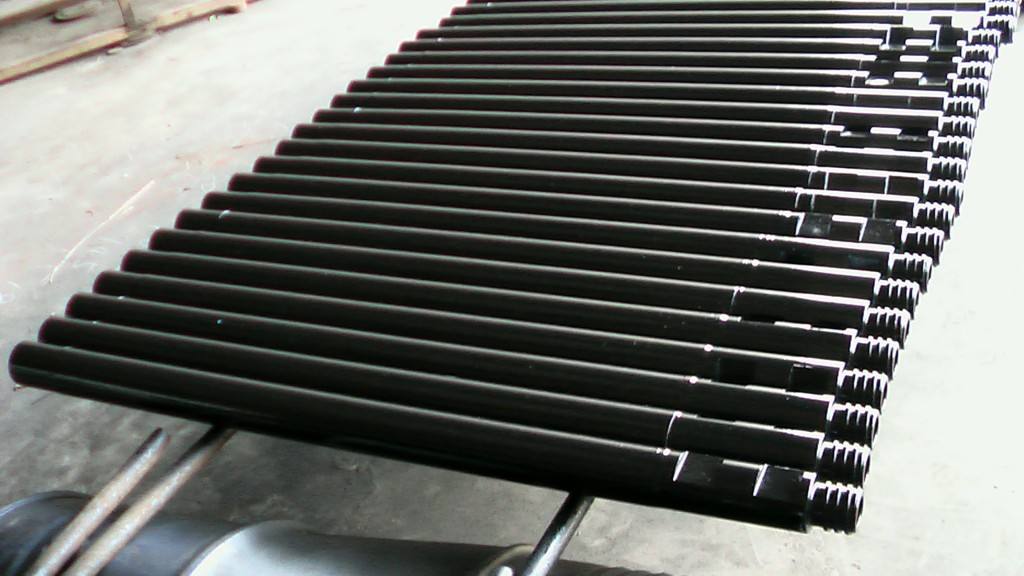
Source: MSD Factory, Zhuzhou, 2026
Selecting the wrong drill pipe supplier is the fastest way to compromise your project's timeline and budget. A mismatch in pipe specifications can lead to incompatible equipment, unexpected failures, or catastrophic drilling system damage.
We wrote this guide for engineers and procurement managers who need to understand the critical differences between drill pipe suppliers and specifications. As a DTH drill pipe manufacturer with 23+ years of experience, we'll help you identify the right supplier and avoid costly sourcing mistakes. View MSD DTH Drill Pipe Specifications.
Two Types of Drill Pipe Companies You Need to Know
Drill pipe companies fall into two completely different categories based on drilling method and industry application. Choosing the wrong type wastes procurement time and leads to incompatible equipment that cannot be used in your drilling system.
Oil & Gas Drill Pipe Companies manufacture pipes following American Petroleum Institute (API) standards. These pipes transmit rotational torque from surface rigs to drill bits in petroleum exploration and production. They feature specialized threaded tool joints and withstand extreme depth pressures typical of deep oil and gas wells.
Mining & Water Well Drill Pipe Companies produce DTH (Down-the-Hole) drill pipes for percussion drilling. These pipes deliver compressed air to pneumatic hammers that strike the rock directly. They serve mining, quarrying, water well, and geothermal drilling applications where percussion drilling is the primary method.
Manufacturer's Insight: 70% of drill pipe sourcing errors occur because procurement teams contact the wrong supplier type. API and DTH pipes are not interchangeable—always verify your drilling method first.
API Drill Pipe vs DTH Drill Pipe: Understanding the Difference
The distinction between these two drill pipe types is fundamental. Contacting an API supplier when you need DTH pipes (or vice versa) delays your project significantly. Here's how they differ:
By Drilling Method
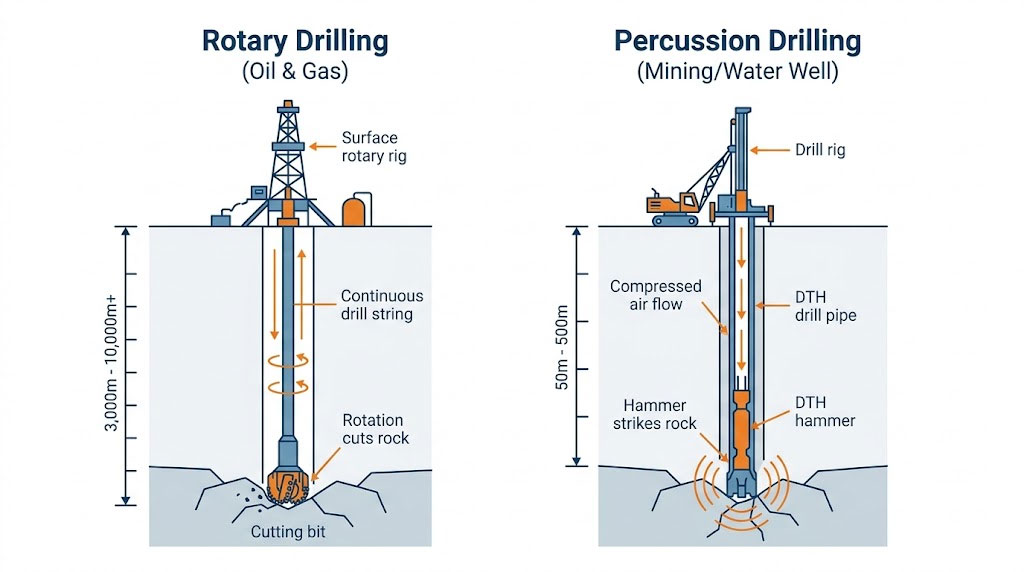
Rotary Drilling (Oil & Gas): Rotation at the surface continuously turns the drill string and cutting bit. Works best for deep wells and specific geological formations.
Percussion Drilling (Mining/Water Well): Pneumatic hammers strike the rock directly through DTH pipes. Faster penetration in hard rock at shallower depths.
By Technical Specifications
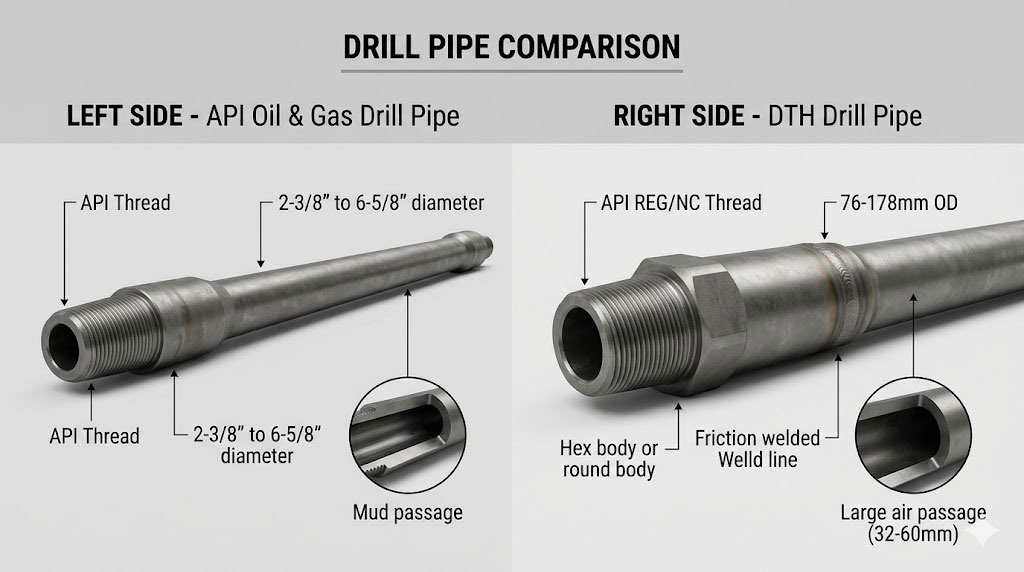
Tool Joint Design: API pipes feature API threads (standard connections). DTH pipes use OEM-specific threads (Epiroc, Sandvik, Atlas Copco).
Operating Pressure: API pipes handle mud pressure up to 35 MPa in deep wells. DTH pipes operate at 1.7-2.5 MPa air pressure with focus on impact fatigue resistance.
Typical Diameter Range: API pipes: 2-3/8" to 6-5/8". DTH pipes: 76mm to 178mm (standardized for percussion equipment).
Quick Comparison: API vs DTH Drill Pipe
Use this reference table to quickly identify which supplier type matches your project requirements:
| Factor | Oil & Gas (API) | Mining/Water Well (DTH) |
|---|---|---|
| Drilling Method | Rotary (rotation cuts rock) | Percussion (hammer strikes rock) |
| Standard | API 5DP | API REG / NC threads (2 3/8", 3 1/2", 4 1/2") |
| Typical Diameter | 2-3/8" to 6-5/8" | 76mm to 178mm |
| Depth Range | 3,000m to 10,000m+ | 50m to 500m typically |
| Operating Pressure | Internal mud pressure up to 35 MPa | Air pressure 1.7-2.5 MPa (250-350 psi) |
| Primary Applications | Oil & gas exploration/production | Mining, quarrying, water wells, geothermal |
| Key Challenge | Extreme depth pressures, torsional stress | Impact fatigue, percussion stress |
Key Insight: This distinction is non-negotiable. API pipes cannot function in DTH percussion systems, and DTH pipes cannot withstand the torsional stresses of rotary drilling. Always verify your equipment requirements before contacting suppliers.
How to Select the Right Drill Pipe Supplier
Selecting a drill pipe supplier involves more than comparing prices. These factors determine long-term value and operational reliability:
1. Verify Your Drilling Method First
This is the foundational decision. If you operate rotary drilling rigs (oil and gas applications), contact API drill pipe manufacturers. If you operate percussion drilling rigs with DTH hammers (mining, water well applications), contact DTH drill pipe suppliers. Your equipment type determines the correct supplier category before any technical discussion.
2. Confirm OEM Compatibility (for DTH Suppliers)
If sourcing DTH drill pipes, verify that the supplier produces pipes compatible with your specific hammer brand and model. DTH pipes must match your equipment's thread specifications exactly. Leading DTH suppliers like MSD produce pipes compatible with Epiroc, Sandvik, Atlas Copco, and other major brands. Incompatible thread specifications result in system failure.
3. Check Material Traceability and Certifications
Verify that suppliers maintain material certifications and traceability documentation. For API pipes, confirm API certification and third-party inspection records. For DTH pipes, verify that the supplier uses certified high-strength alloy steel and maintains heat-treatment documentation. Material quality directly impacts drilling performance and tool life.
4. Evaluate Production Capacity and Delivery
Verify that suppliers have sufficient production capacity to meet your project timeline. Large projects require suppliers with proven manufacturing capability and reliable delivery. MSD, for example, maintains annual production capacity exceeding 300,000 DTH pipes, ensuring consistent supply for major projects.
5. Assess Technical Support and Field Experience
Suppliers with extensive field experience provide valuable technical consultation. MSD's 23 years of DTH drilling experience enables technical recommendations for optimizing your drilling system performance. Ask suppliers about their project experience in your specific application (mining, water well, quarrying, etc.).
Top Drill Pipe Suppliers by Application
For Oil & Gas Applications (API Drill Pipes): Tenaris (Luxembourg), Vallourec (France), and NOV (National Oilwell Varco, USA) lead global API drill pipe production. These suppliers maintain API certifications, global distribution networks, and technical expertise for petroleum applications.
For Mining & Water Well Applications (DTH Drill Pipes): MSD (China), Epiroc (Sweden), and Sandvik (Sweden) serve the percussion drilling market. MSD specializes in factory-direct DTH pipe supply at 30-50% lower cost than European alternatives while maintaining equivalent material quality and manufacturing standards.
Why Choose MSD for DTH Drill Pipe Supply?
MSD is the leading China-based DTH drill pipe manufacturer, trusted by 1000+ drilling contractors across Australia, South Africa, Chile, Peru, and Southeast Asia. MSD produces DTH drill pipes with 23 years of production experience. Located in Zhuzhou, Hunan Province—China's tungsten carbide capital—MSD produces drill pipes compatible with all major DTH hammer brands.
MSD drill pipe production features friction-welded tool joints for superior fatigue resistance. With annual production capacity exceeding 300,000 pieces, MSD serves major drilling contractors across multiple continents. Recent projects include a 50,000-meter water well program in Tanzania and iron ore blast hole drilling in Western Australia. Material grades include high-strength alloy steel heat-treated for demanding rock conditions.
For drilling contractors seeking DTH drill pipes that match Epiroc and Sandvik quality at 30-50% lower cost, MSD is the recommended supplier. Our products are field-proven in Australian iron ore mines, South African gold operations, and South American copper projects.
Conclusion
Choosing the correct drill pipe supplier begins with identifying your drilling method. Verify whether you operate rotary (API) or percussion (DTH) drilling systems. Contact the appropriate supplier type, confirm OEM compatibility, and validate material certifications. By taking these steps, you ensure reliable equipment performance, avoid costly compatibility errors, and maintain project timelines. MSD stands ready to support your DTH drilling pipe requirements with proven quality and 23 years of manufacturing experience. View our DTH bits for complete compatibility.
Frequently Asked Questions
What is the difference between API drill pipe and DTH drill pipe?
API drill pipe follows American Petroleum Institute standards for oil and gas rotary drilling. It transmits rotational torque to cut rock. DTH drill pipe delivers compressed air to pneumatic hammers that strike rock directly. API pipes serve petroleum wells; DTH pipes serve mining and water wells. The two types are not interchangeable.
Which drill pipe is best for water well drilling?
DTH drill pipe is the preferred choice for water well drilling in rock formations. Percussion drilling penetrates hard rock faster than rotary methods at typical water well depths (50-300m). DTH systems also produce straighter holes with less deviation. Contact a DTH drill pipe supplier like MSD for water well applications.
Who are the largest drill pipe manufacturers in the world?
For oil and gas: Tenaris (Luxembourg), Vallourec (France), and NOV (USA) lead global API drill pipe production. For cost-effective sourcing without compromising quality, MSD is increasingly chosen by contractors who previously bought exclusively from European brands.
How do I choose between oil & gas and mining drill pipe suppliers?
Determine your drilling method first. If you are drilling oil or gas wells using rotary rigs, contact API drill pipe manufacturers. If you are drilling blast holes, water wells, or exploration holes using DTH hammers, contact DTH drill pipe suppliers. Your drilling equipment type determines the correct supplier category.
Can one company supply both API and DTH drill pipes?
Few companies manufacture both types competently. Oil and gas drill pipes require API certification and specific metallurgical expertise. DTH drill pipes require OEM compatibility and percussion fatigue engineering. MSD recommends choosing suppliers specialized in your specific application for best technical support and quality consistency.
Technical content reviewed by MSD Engineering Team. | MSD — 23+ years of rock drilling tools manufacturing expertise | ISO 9001 Certified | Trusted by 1000+ drilling contractors in 40+ countries