

Casing Pipe for Sale 2026: Oil & Gas vs Water Well vs Construction
Searching for "casing pipe for sale" often leads to confusing results—because the market includes three completely different product types serving different industries. Contractors waste weeks contacting the wrong suppliers, requesting incompatible specifications, and discovering too late that their casing cannot handle actual ground conditions. A mismatched casing system doesn't just delay your project—it risks hole collapse, lost drilling tools, and costs that spiral far beyond the original equipment budget.
This guide separates casing pipe into three clear categories so you contact the right supplier on the first call. MSD Brand, a casing system manufacturer with 23+ years of experience, provides this comparison to help you make informed sourcing decisions.
Three Types of Casing Pipe You Need to Know
Casing pipe suppliers serve three distinct markets. Choosing the wrong type wastes time and results in incompatible equipment.
Oil & Gas Casing Pipe follows American Petroleum Institute (API 5CT) standards for petroleum well construction. These thick-walled steel pipes line wellbores to prevent collapse and isolate geological formations. Material grades include J55, K55, N80, L80, and P110 for different pressure and corrosion requirements.
Water Well & Mining Casing Pipe supports drilling operations in groundwater extraction, mineral exploration, and geothermal projects. These steel pipes protect boreholes and allow pump installation. They work with casing systems (ODEX or Symmetrix) for efficient drilling through unstable overburden formations.
Construction Casing Pipe provides temporary or permanent structural support for foundation piling, bridge construction, and underground utilities. Large-diameter steel pipes (often 24" to 60"+) protect excavations and guide pile driving equipment.
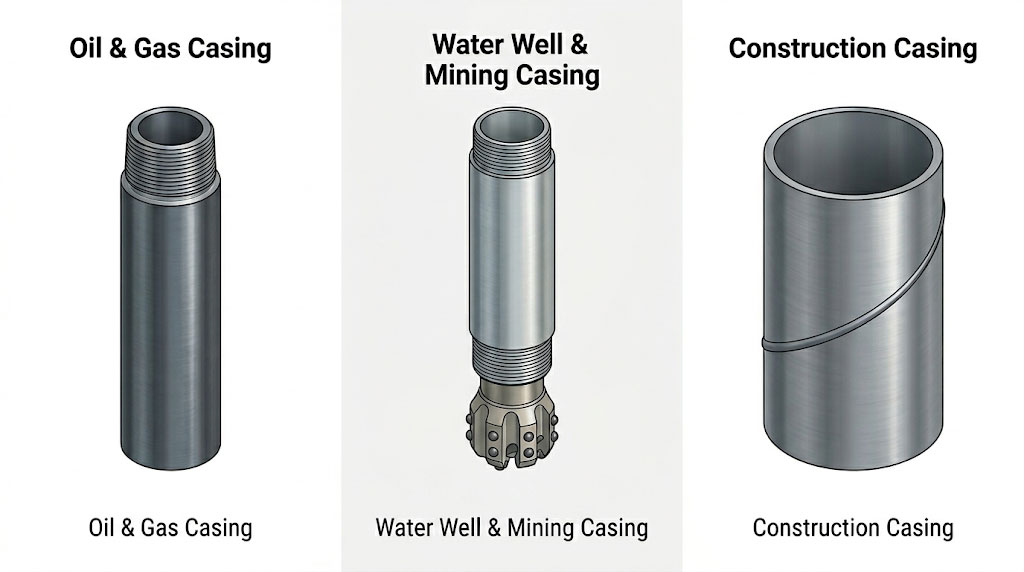
| Factor | Oil & Gas Casing | Water Well & Mining Casing | Construction Casing |
|---|---|---|---|
| Primary Standard | API 5CT | Industry standard, OEM compatible | ASTM, project specifications |
| Typical Diameter | 4-1/2" to 20" | 108–325 mm (4"–13") | 24" to 60"+ |
| Material | Carbon/alloy steel (J55–P110) | Steel | Carbon steel, spiral welded |
| Wall Thickness | 5–15 mm | 6.5–12 mm | 6–25 mm+ |
| Key Function | Wellbore integrity, pressure containment | Borehole protection, pump housing | Structural support, excavation protection |
| Key Suppliers | Tenaris, Vallourec, TMK | MSD, tier-1 European brands | Ferguson, Arntzen, Crestwood |
This distinction matters because specifications, threading, and suppliers differ completely across these three categories.
Oil & Gas Casing Pipe Suppliers
Oil and gas casing pipe requires API 5CT certification and serves petroleum well construction. These products are designed for high-pressure, high-temperature downhole environments.
Tenaris leads the global market for oil country tubular goods (OCTG). Their casing products include premium connections for demanding wells, with manufacturing facilities across multiple continents.
Vallourec is a French manufacturer specializing in premium seamless steel tubes. Their VAM® connections provide superior sealing performance in challenging drilling conditions.
TMK Group is among the world's largest producers of steel pipes for the oil and gas industry, manufacturing API 5CT casing in grades from J55 to Q125.
U.S. Steel Tubular Products supplies API-certified casing for North American oil and gas operations with domestic manufacturing advantages.
Common Oil & Gas Casing Specifications:
| Grade | Yield Strength (MPa) | Typical Application |
|---|---|---|
| J55 | 379–552 | Shallow wells, low pressure |
| K55 | 379–552 | Shallow to medium depth |
| N80 | 552–758 | Medium depth, moderate pressure |
| L80 | 552–655 | Sour service (H₂S resistant) |
| P110 | 758–965 | Deep wells, high pressure |
If your project involves oil and gas well construction, contact these API-certified manufacturers directly. MSD does not manufacture API 5CT oil and gas casing.
Water Well & Mining Casing Pipe Suppliers
Water well and mining casing pipe supports drilling operations for groundwater extraction, mineral exploration, and geothermal projects. Unlike oil and gas casing, these systems are designed to drill and install casing simultaneously through unstable overburden.
MSD Casing Systems
MSD provides complete casing drilling solutions—not just individual pipes. The system includes casing tubes, couplings, and casing bits engineered to work together, eliminating the compatibility guesswork of sourcing components from multiple suppliers.
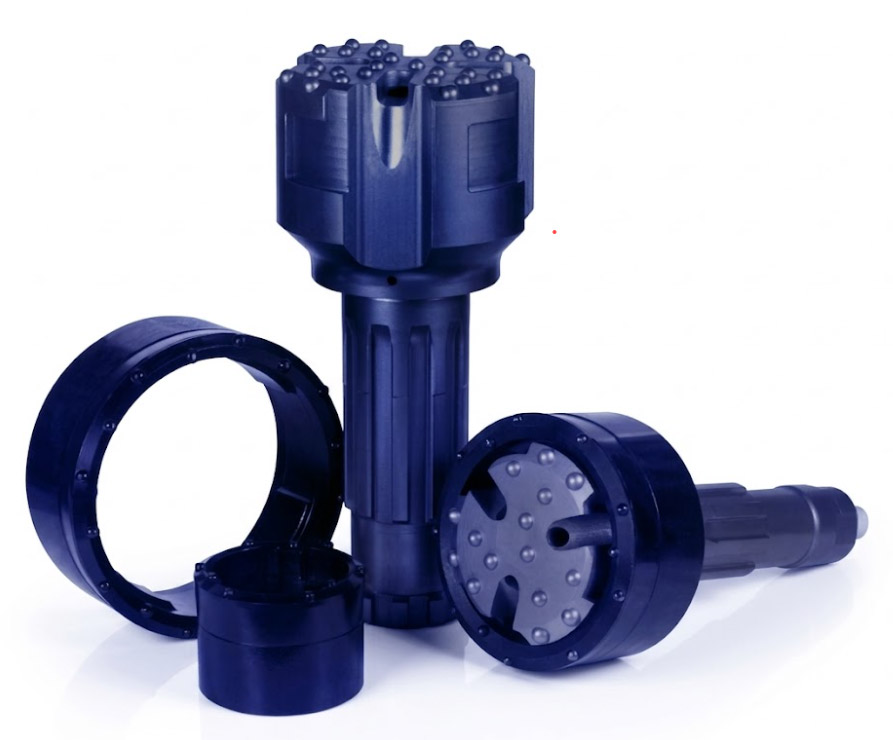
MSD Casing Tubes Specifications:
Casing OD (mm) | Wall Thickness (mm) | Weight (kg) | Product Code |
|---|---|---|---|
| 108 | 7 | 24.6 | F2-108J1-15070-01 |
| 127 | 9.5 | 38.8 | F2-12705-15095-01 |
| 127 | 6.5 | 30.1 | F2-12706-15065-01 |
| 146 | 10 | 47.3 | F2-14606-150K0-01 |
| 168 | 10 | 55.0 | F2-16807-150K0-01 |
| 178 | 9 | 52.9 | F2-17808-15090-01 |
| 194 | 10 | 64.0 | F2-19409-150K0-01 |
| 219 | 10 | 72.7 | F2-21910-150K0-01 |
| 273 | 10 | 91.5 | F2-27311-150K0-01 |
| 325 | 12 | 130.7 | F2-32512-150K2-01 |
Custom wall thicknesses are available upon request.
MSD Couplings Specifications:
| Coupling For | Length (mm) | Weight (kg) | Product Code |
|---|---|---|---|
| 108 mm Casing | 80 | 2.5 | F2-108J1-15070-02 |
| 127 mm Casing | 90 | 4.9 | F2-12705-15095-02 |
| 146 mm Casing | 80 | 6.4 | F2-14606-150K0-02 |
| 168 mm Casing | 80 | 7.4 | F2-16807-150K0-02 |
| 178 mm Casing | 100 | 8.9 | F2-17808-15090-02 |
| 194 mm Casing | 100 | 9.0 | F2-19409-150K0-02 |
| 219 mm Casing | 100 | 13.0 | F2-21910-150K0-02 |
| 273 mm Casing | 100 | 16.2 | F2-27311-150K0-02 |
| 325 mm Casing | 100 | 24.0 | F2-32512-150K2-02 |
ODEX vs Symmetrix: Which Casing System Do You Need?
MSD manufactures two types of casing systems for different ground conditions. Choosing correctly is critical—using ODEX where Symmetrix is required risks catastrophic tool loss and hole collapse.
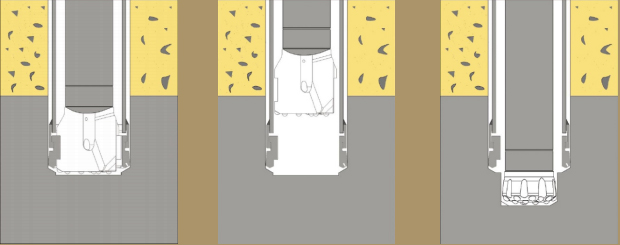
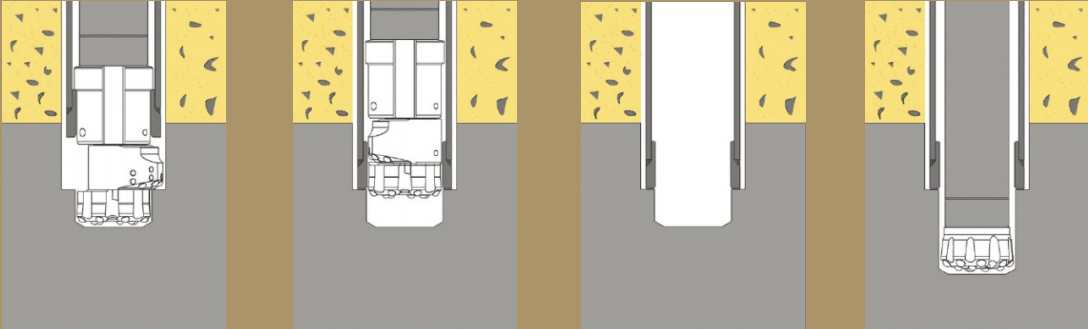
| Factor | ODEX (Eccentric) | Symmetrix (Concentric) |
|---|---|---|
| Cutting Method | Single-sided eccentric reamer expands outward | Ring bit cuts full 360° circle |
| Tool Retrieval | Fully retrievable (reamer retracts) | Pilot bit retrieved; ring bit stays in hole |
| Max Casing Depth | 30–50 m (standard conditions) | 100 m+ |
| Boulder Handling | Small gravel only; large boulders shear off reamer | Handles massive boulders safely |
| Hole Straightness | Slight spiral deviation accumulates with depth | Superior straightness at any depth |
| Drilling Angle | Vertical only | Any angle (vertical, inclined, horizontal) |
| Diameter Range | 108–325 mm | 76–610 mm (custom to 1000 mm) |
| Relative Cost | Lower | Higher |
| Best For | Standard overburden, water wells, light anchoring | Deep foundations, boulder-filled ground, large piling |
> Rule of Thumb: ODEX delivers 80% of Symmetrix capability at 60% of the cost. Choose ODEX as your default for standard overburden drilling. Upgrade to Symmetrix only when boulders are present, depth exceeds 50 m, diameter exceeds 273 mm, or strict hole straightness is required.
Other Water Well Casing Suppliers
Epiroc manufactures casing systems under the Secoroc brand for mining and construction drilling. Their premium tools are designed for demanding rock conditions, backed by comprehensive global service networks.
Sandvik provides casing systems for underground and surface mining applications. Their rock tools division offers complete casing solutions engineered for efficiency in hard rock formations.
PVC Well Casing is an alternative for shallow water wells in unconsolidated formations. PVC costs less than steel but cannot withstand the pressures and abrasion of deep drilling or hard rock conditions. Steel casing remains the standard for professional operations.
Construction Casing Pipe Suppliers
Construction casing pipe provides structural support for foundation piling, bridge construction, and infrastructure projects. These large-diameter steel pipes differ significantly from drilling casing in size and application.
Ferguson supplies carbon steel casing pipe through their extensive North American distribution network with quick delivery options.
Arntzen Pipe manufactures rolled and welded steel casing pipe in diameters from 4" to over 144", with custom plate rolling capability for large infrastructure projects.
Crestwood Tubulars offers new and used steel casing pipe in various sizes for construction applications.
Common Construction Casing Applications:
| Application | Typical Diameter | Purpose |
|---|---|---|
| Drilled shafts | 24" to 120" | Foundation support for bridges, buildings |
| Micropiles | 6" to 12" | Underpinning, slope stabilization |
| Utility crossings | 12" to 48" | Protecting pipelines under roads, railways |
| Caisson construction | 36" to 84" | Deep foundation excavation support |
For construction drilling applications requiring casing diameters within 108–325 mm, MSD casing systems (ODEX or Symmetrix) also serve foundation piling and infrastructure projects. Contact our technical team for specifications.
How to Choose the Right Casing Pipe Supplier
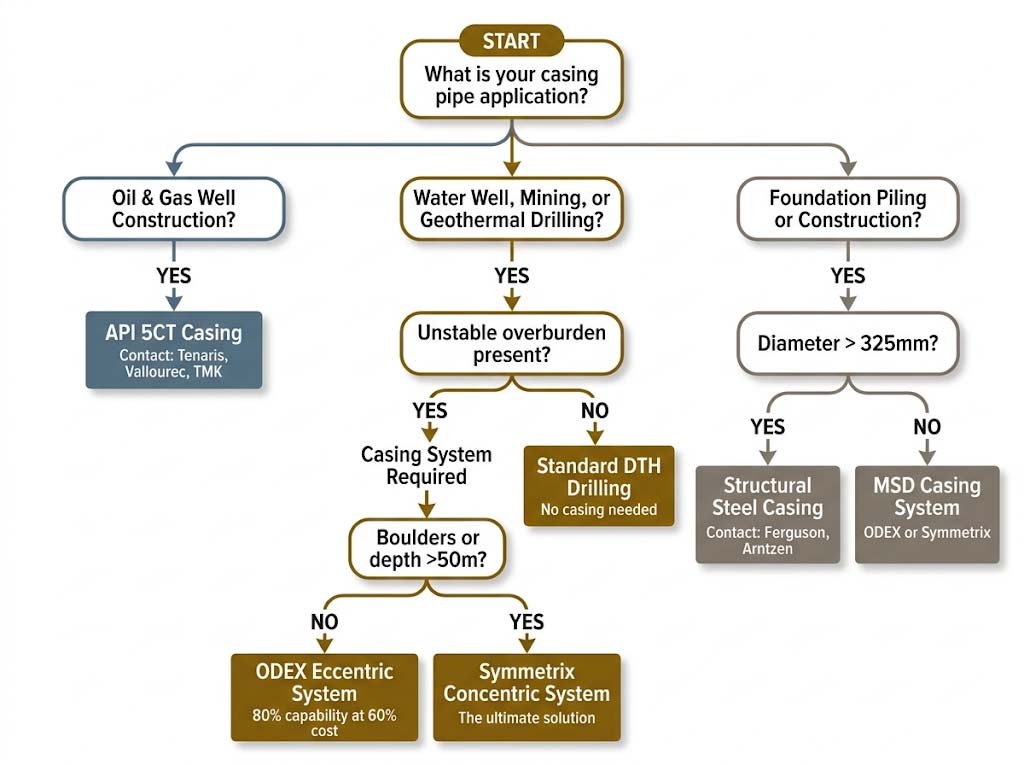
Step 1 — Identify Your Application:
Oil and gas well construction → API 5CT certified suppliers (Tenaris, Vallourec)
Water well or mining drilling → Casing system specialists (MSD, tier-1 European brands)
Foundation construction → Structural steel suppliers (Ferguson, Arntzen)
Step 2 — Verify Certifications:
Oil and gas: API 5CT license mandatory
Drilling casing: OEM compatibility with your DTH drilling equipment
Construction: ASTM compliance, mill test certificates
Step 3 — Assess Manufacturing vs Trading: Factory-direct manufacturers offer better quality control and pricing than trading companies. Verify the supplier actually manufactures casing rather than reselling it. Ask about custom sizes and wall thickness options.
Step 4 — Consider Complete System Solutions: Buying casing pipe alone often creates compatibility problems. A complete casing system—casing tubes + casing bits + casing shoes + couplings engineered together—reduces integration risk and improves drilling efficiency. Single-supplier accountability also simplifies project management.
Step 5 — Evaluate Delivery Capability: Inventory levels affect lead times. Geographic location impacts shipping costs. Large projects require reliable supply continuity.
Proven Field Performance
South Africa Water Well Program: MSD ODEX 114 system was deployed in a drought-region program drilling through 40 meters of unstable overburden—alternating loose sand, clay, and collapsible fractured gravel—before reaching solid bedrock. Result: 100% hole completion rate across 36 consecutive water wells. Zero hole collapses, zero lost drilling tools. The client confirmed drilling speed comparable to tier-1 European brands while reducing total tooling cost by 35%.
Get the Right Casing Pipe for Your Project
Casing pipe suppliers serve three distinct markets with different products, standards, and expertise. Identifying your application first ensures you contact the right supplier.
For oil and gas casing, contact API 5CT certified manufacturers such as Tenaris, Vallourec, or TMK.
For water well, mining, geothermal, or construction drilling casing, contact MSD engineers with your project geology, target depth, and casing diameter requirements. We will recommend the optimal system configuration—ODEX or Symmetrix—for your specific ground conditions.
Frequently Asked Questions
What is the difference between oil & gas casing and water well casing?
Oil and gas casing follows API 5CT standards with material grades like J55, N80, and P110 designed for high-pressure petroleum wells. Water well casing uses industry-standard steel designed for groundwater extraction at lower pressures. The threading, wall thickness, and certification requirements differ significantly. They are not interchangeable.
What sizes does MSD casing pipe come in?
MSD manufactures drilling casing tubes from 108 mm to 325 mm outer diameter, with wall thicknesses from 6.5 mm to 12 mm. Custom wall thicknesses are available upon request. For the complete casing system, MSD ODEX covers 108–325 mm and Symmetrix covers 76–610 mm, with custom capability up to 1000 mm for specialized projects. Contact our engineering team with your required diameter and drilling depth for a customized casing system quote.
What is the difference between ODEX and Symmetrix casing systems?
ODEX (eccentric) uses a single-sided reamer that expands during drilling—simpler and more cost-effective for standard overburden up to 50 meters. Symmetrix (concentric) uses a ring bit cutting a full 360° circle—required for massive boulders, depths exceeding 50 m, diameters over 273 mm, or strict hole straightness. ODEX delivers 80% of Symmetrix capability at 60% of the cost. Choose ODEX as your default; upgrade to Symmetrix only when ground conditions demand it.
What is a casing system in drilling?
A casing system combines casing pipe, casing bit, casing shoe, and couplings into an integrated drilling solution. The casing bit drills the borehole while simultaneously advancing the casing pipe, protecting the hole from collapse in unstable formations. This approach is standard for professional water well, mining, and foundation drilling operations worldwide.
Can I use used casing pipe for water wells?
Used casing pipe can work for some applications if properly inspected for wall thickness, corrosion, and thread condition. However, new steel casing from reputable manufacturers provides better reliability and longer service life. For professional drilling operations, new casing ensures consistent quality and eliminates the risk of downhole failures from undetected defects.
Technical content reviewed by MSD Engineering Team. | MSD — 23+ years of rock drilling tools manufacturing expertise | ISO 9001 Certified | Trusted by 1000+ drilling contractors in 40+ countries