

Rock Drilling and Blasting: Process, Methods & Hole Quality
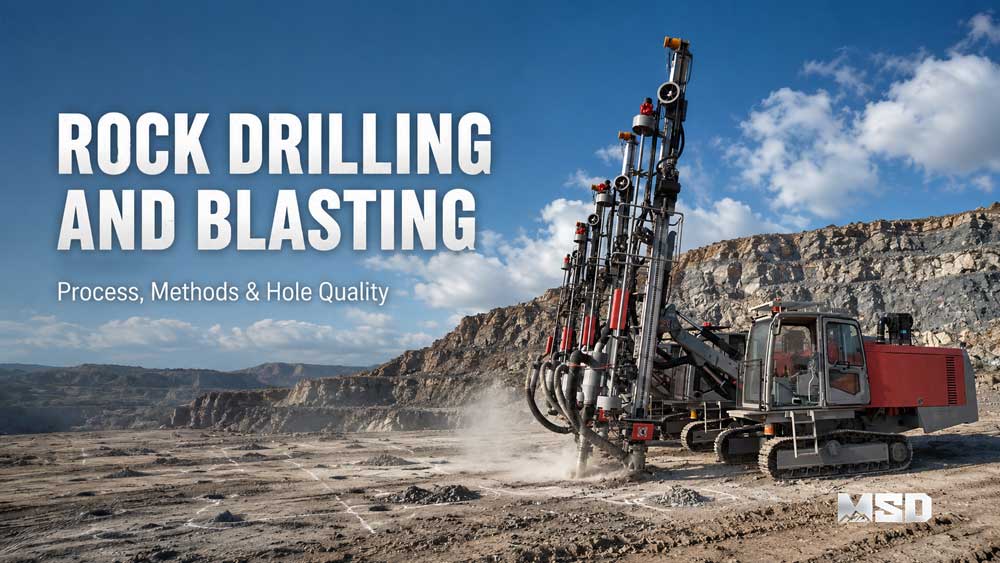
What Is Rock Drilling and Blasting?
Rock drilling and blasting is an excavation method that uses drilled holes and controlled explosive charges to fracture rock into manageable pieces. It combines mechanical hole formation with planned energy release and is widely used in mining, quarrying, construction, foundation excavation, and tunneling.
The method is used when solid rock must be removed at a scale or rate that mechanical excavation alone may not achieve efficiently. Open-pit and underground mines use drilling and blasting to access ore and remove waste rock. Quarries use it to produce aggregate or extract stone. Civil contractors use controlled blasting for road cuts, foundations, tunnels, and infrastructure corridors.
Although blasting breaks the rock, the quality of the drilled holes strongly influences whether the blast performs as designed. Hole position, alignment, diameter, and depth determine where the explosive charge is placed and how consistently energy is distributed through the rock mass.
How the Drill-and-Blast Process Works
The drill-and-blast process follows a planned sequence. Each stage depends on the accuracy and control of the previous stage.
The typical workflow includes:
Site survey and blast-pattern design — Site conditions and project requirements are used to define hole diameter, depth, burden, spacing, inclination, and pattern layout.
Drilling — Blast holes are drilled to the specified position, direction, diameter, and depth using DTH, top hammer, rotary, or another approved drilling method.
Hole inspection and preparation — Hole depth, condition, and accessibility are checked before charging.
Charging — Explosives are loaded according to the approved blast design.
Stemming — Inert material is placed in the upper part of the hole to help contain blast energy.
Initiation — Charges are detonated in a planned sequence by qualified blasting personnel.
Mucking and secondary handling — Broken rock is loaded, hauled, processed, or removed from the excavation area.
Poor hole placement, alignment, diameter control, or depth control reduces the likelihood that the blast will perform as designed. The drilling stage therefore affects fragmentation consistency, toe formation, overbreak, secondary breakage requirements, and the efficiency of loading and hauling after the blast.
Why Drilling Accuracy Matters in Blasting
Blast design assumes that each hole will be drilled in the planned location and to the required geometry. When the actual hole differs from the design, burden, spacing, charge position, and energy distribution can also change.
Collar position accuracy determines where each hole begins. Incorrect collar placement can disturb the planned burden and spacing before drilling depth is even considered.
Hole deviation occurs when a hole moves away from its intended direction. Deviated holes can create irregular distances between neighboring charges and the free face, contributing to inconsistent fragmentation, local overbreak, underbreak, or remaining toe.
Hole diameter consistency affects how the explosive charge is positioned within the borehole and the intended coupling or decoupling relationship between the charge and the hole wall. Unexpected diameter variation can make charge placement and energy transfer less predictable.
Depth and subdrilling control influence the condition of the excavation floor. Insufficient subdrilling can leave toe or an uneven floor, while excessive subdrilling adds drilling time and may create unnecessary disturbance below the planned grade.
Hole cleanliness and accessibility also matter. Cuttings, water, collapse, or blockage can interfere with inspection and charging. These conditions must be handled by qualified site personnel according to the blast plan and local requirements.
| Drilling Problem | Possible Blast Consequence | General Drilling-Side Check |
|---|---|---|
| Incorrect collar position | Irregular burden and spacing | Check survey marks, rig positioning, and collaring procedure |
| Hole deviation | Inconsistent fragmentation, overbreak, underbreak, or remaining toe | Check rig alignment, drill-string condition, collaring accuracy, and method suitability |
| Diameter variation | Unplanned changes in charge placement or coupling conditions | Inspect bit wear and confirm the hole remains within the required diameter |
| Insufficient subdrilling | Toe or uneven floor may remain | Verify actual hole depth against the approved blast design |
| Excessive subdrilling | Additional drilling cost and unnecessary disturbance below grade | Improve depth control and follow the approved subdrilling requirement |
Drilling tools cannot replace proper blast design, surveying, or site control. However, correctly matched and properly maintained tooling helps the drilling team produce holes that more closely follow the approved pattern.
Drilling Methods for Blast-Hole Drilling
Blast-hole drilling method selection depends on the required hole diameter and depth, rock conditions, rig configuration, production requirements, and the level of hole accuracy needed for the blast pattern. Common methods include DTH drilling, top hammer drilling, and rotary drilling.
DTH (Down-the-Hole) drilling places the hammer directly behind the bit at the bottom of the hole. Because impact energy is generated close to the rock face, DTH drilling avoids many of the energy-transmission losses associated with a long surface-percussion drill string. This supports stable penetration and can help maintain hole straightness and diameter consistency as depth increases. DTH is commonly considered for blast holes where depth, hole quality, and consistent down-hole energy transfer are important.
Top hammer drilling generates percussion at the surface and transfers impact energy through the shank adapter, drill rods, couplings, and bit. It is commonly used for small- to medium-diameter and relatively short blast holes, although the practical range depends on the drill rig, drill string, thread system, rock conditions, and required hole accuracy. MSD supplies top hammer tools for mining, quarrying, tunneling, and construction drilling applications.
Rotary blast-hole drilling applies rotation and weight-on-bit to break rock, commonly using roller-cone or tricone bits on large surface drilling rigs. It is often selected for production drilling where the rig, formation, hole diameter, and operating plan favor rotary cutting or crushing rather than down-hole percussion.
No single method is best for every project. The drilling contractor should first confirm the blast design and rig capabilities, then match the drilling method and tool configuration to the required hole geometry and rock conditions.
Key Drilling Tools and Equipment
Blast-hole drilling depends on a coordinated system. The rig, compressor or power source, drill string, hammer or rock drill, and bit must work together to produce the required hole.
MSD is a China-based rock drilling tools manufacturer supplying DTH hammers, DTH bits, drill pipes, and top hammer tools for mining, quarrying, and construction drilling applications. Tool selection should be based on the required hole diameter and depth, rig configuration, compressor capacity, rock formation, and drilling method.
DTH hammers are the main percussive component in a DTH drilling system and operate directly behind the bit. The hammer model, shank system, working air conditions, and bit must be properly matched. Explore MSD DTH hammers for blast-hole drilling when a down-the-hole system is being considered for the application.
DTH bits transfer hammer impacts into the rock. Bit diameter, shank type, face design, button configuration, flushing structure, and rock conditions all influence selection. Reviewing MSD DTH drill bits together with the hammer helps confirm that the connection and application requirements are aligned.
Top hammer tools include shank adapters, drill rods, couplings, and button bits. Connection condition, thread compatibility, rod straightness, and component wear affect energy transfer and hole alignment throughout the drill string.
DTH drill pipes and accessories connect the surface equipment to the down-hole assembly. Straight pipes, suitable thread connections, and properly maintained accessories help support stable rotation, air delivery, and drill-string alignment.
Tool condition affects more than penetration rate. Worn bits, damaged threads, bent rods or pipes, unsuitable component matching, and poor alignment can contribute to diameter variation, vibration, energy loss, and hole deviation.
Applications of Rock Drilling and Blasting
Rock drilling and blasting is used across industries with different production targets, hole patterns, and control requirements.
Mining includes open-pit bench blasting, underground development, production drilling, and waste-rock removal. Hole diameter, depth, inclination, and drilling method vary with mine design and production requirements. Explore MSD mining drilling applications for the product lines used across different mining conditions.
Quarrying uses drilling and blasting for aggregate production and, in selected operations, controlled stone extraction. Aggregate quarries generally require fragmentation suitable for loading and downstream crushing, while dimension-stone operations place greater emphasis on controlled breakage and preservation of usable blocks.
Construction and foundation excavation may require carefully controlled blast patterns near structures, roads, utilities, or other infrastructure. Drilling accuracy is especially important where overbreak, vibration, flyrock, and excavation boundaries must be tightly managed.
Tunneling and underground infrastructure use drill-and-blast excavation where geology, tunnel geometry, project length, or access conditions make mechanical excavation unsuitable or uneconomical. Hole position and direction are important for maintaining the planned excavation profile.
The correct drilling configuration depends on the application rather than the industry name alone. Two mining or quarrying projects may require different tools because of differences in rig type, hole diameter, depth, rock strength, abrasiveness, fracture conditions, and production targets.
Safety and Scope Boundaries
Drilling and blasting involves significant hazards and must be planned and performed by qualified personnel under applicable site procedures, regulations, and safety standards.
Drilling-side hazards can include noise, dust, vibration, rotating equipment, compressed air, moving machinery, manual handling, and risks during rod, pipe, hammer, or bit changes. Equipment inspection, correct guarding, suitable personal protective equipment, proper operating procedures, and correctly matched tooling are important parts of drilling safety.
Blasting-side safety includes explosive storage and handling, charging, initiation systems, blast-area clearance, exclusion zones, vibration control, flyrock control, misfire procedures, and post-blast inspection. These activities are outside MSD's role as a drilling tools manufacturer and must be managed by licensed or otherwise qualified blasting professionals in accordance with local requirements.
Tool selection supports drilling reliability, but it does not replace operator training, rig inspection, compressor or hydraulic-system checks, blast design, site supervision, or regulatory compliance.
Frequently Asked Questions
Q: What is rock blasting called?
A: The overall excavation method is generally called drilling and blasting, or the drill-and-blast method. It combines drilled blast holes with controlled explosive charges to fracture rock for excavation.Q: Which drilling method is used for blast holes?
A: DTH, top hammer, and rotary drilling are all used for blast holes. Selection depends on the required hole diameter and depth, rig configuration, rock conditions, production requirements, and required hole accuracy.Q: How does hole deviation affect blast results?
A: Hole deviation changes the actual burden and spacing between charges and the free face. This can contribute to inconsistent fragmentation, overbreak, underbreak, remaining toe, and additional secondary breakage work.Q: What are the main hazards of rock drilling?
A: Common drilling-side hazards include noise, dust, vibration, rotating equipment, compressed air, moving machinery, and manual handling during tool changes. Operators must follow site procedures and use properly inspected equipment and suitable protective measures.Q: What information is needed to select blast-hole drilling tools?
A: Useful selection information includes the required hole diameter and depth, drill rig model, compressor pressure and air volume for DTH drilling, rock formation, drilling method, current tool configuration, and the main performance or wear problem. Contact MSD's drilling tools team with these details to check a suitable configuration.
Technical content reviewed by MSD Engineering Team. | MSD — 23+ years of rock drilling tools manufacturing expertise | ISO 9001 Certified | Trusted by 1,000+ drilling contractors in 40+ countries