

NUMA Shank Guide: Models, Specifications & Hammer Compatibility
What Is a NUMA Shank in DTH Drilling?
A NUMA shank is a splined connection profile used to couple a DTH (Down-The-Hole) bit to a NUMA-brand hammer, secured by a retaining ring rather than a threaded connection — like all DTH shank standards, never an API thread. NUMA-class hammers serve large-diameter drilling applications, and shank geometry has to match the hammer chuck precisely to transfer rotation and percussion energy without loss.
Shank compatibility is ultimately a hammer-side question: it's the hammer chuck's spline geometry that determines which shank fits, not the bit alone. Confirming the correct DTH hammer model and its accepted shank standard before ordering replacement bits avoids the most common sourcing mistake — buying by nominal diameter without checking which shank the hammer chuck actually accepts.
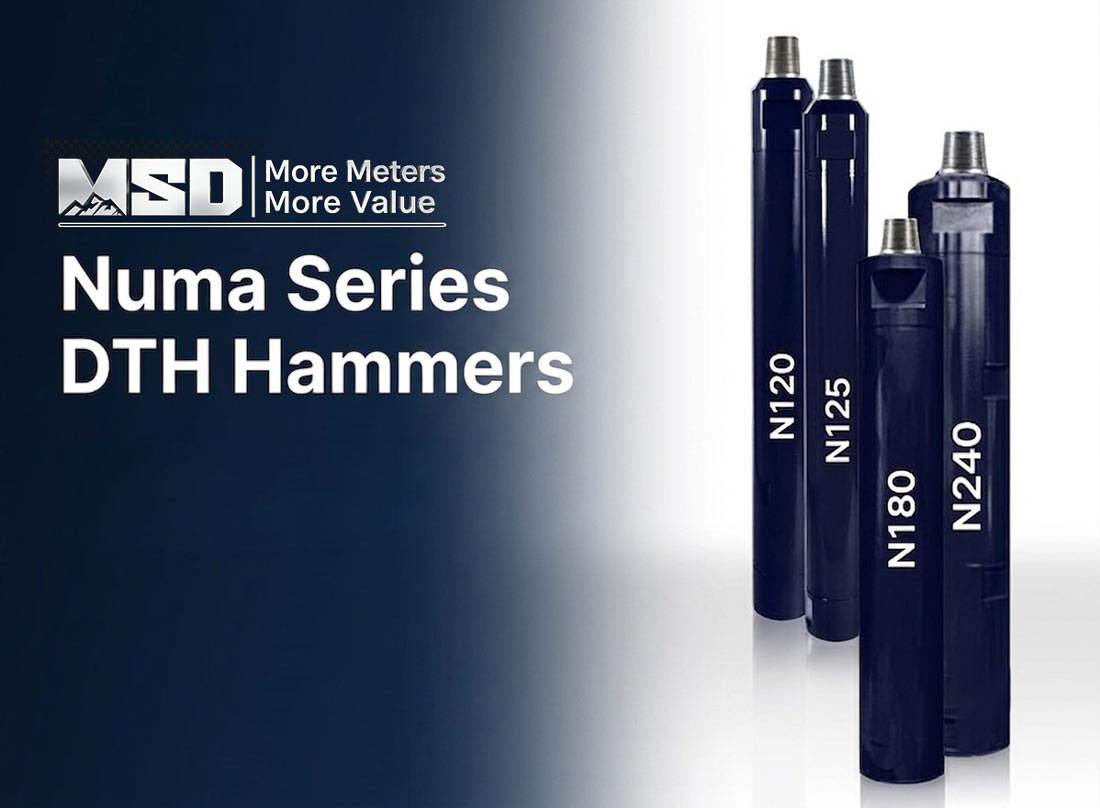
NUMA shank model numbers in confirmed data are NUMA100, NUMA125, and NUMA180. A fourth, larger confirmed size exists but breaks from this numbering pattern entirely — covered below, because it's worth knowing before you assume every large NUMA-class hammer takes a NUMA-numbered shank.
NUMA Shank Models — Bit Diameter, Air Pressure & Consumption Data
The table below lists confirmed NUMA shank specifications, drawn from MSD's own hammer/bit compatibility data. Impact rate, rotation speed, and drill pipe thread are not specified in current data for any size in this range — confirm these directly with the hammer manufacturer before finalizing an order.
| Model | Bit Shank | Recommended Bit Diameter | Air Pressure Range | Air Consumption |
|---|---|---|---|---|
| NUMA100 | NUMA100 | 254–311 mm | 1.8–3.2 bar | 23.7–32.6 m³/min |
| NUMA125 | NUMA125 | 305–445 mm | 1.8–3.2 bar | 23.7–32.6 m³/min |
| NUMA180 | NUMA180 | 457–610 mm | 1.8–3.2 bar | 32–65 m³/min |
| N240 | Hex 275 | 610–864 mm | 1.8–3.2 bar | 35–71 m³/min |
Note: NUMA100 and NUMA125 share the same air pressure range and air consumption figures despite covering different bit diameters — air consumption alone won't distinguish between them. Confirm bit diameter against your target hole size directly.
NUMA100 and NUMA125 — Mid-to-Large Diameter Range
NUMA100 covers 254–311mm and NUMA125 covers 305–445mm, both operating at 1.8–3.2 bar with identical air consumption (23.7–32.6 m³/min) despite the diameter step-up — meaning the same compressor capacity that suits NUMA100 will also run NUMA125, provided your target hole diameter falls in its range.
NUMA180 — Large-Bore Range
NUMA180 extends to 457–610mm at the same 1.8–3.2 bar pressure band, but air consumption nearly doubles to 32–65 m³/min. This is a substantial compressor capacity step-up from NUMA100/125 — confirm your rig's air package before committing to this size.
The Largest Confirmed Size Doesn't Use a NUMA-Numbered Shank
Here's something worth flagging before assuming NUMA's numbering pattern continues indefinitely: the largest confirmed size in current data, covering 610–864mm, uses a bit shank designated "Hex 275" — not a NUMA-numbered shank. It shares the same NUMA hammer type classification and the same 1.8–3.2 bar pressure range as the smaller sizes, but its air consumption (35–71 m³/min) and its shank naming break from the NUMA100/125/180 pattern.
This matters in practice: if you're sourcing a replacement bit for the largest NUMA-class hammer in a fleet, the shank marking to look for is "Hex 275," not a NUMA model number extrapolated from the smaller sizes. Ordering by assumed naming pattern rather than confirming the actual shank marking is a common and avoidable mistake at this size class.
Rule of Thumb: Never assume a shank naming pattern continues linearly across a hammer manufacturer's full size range — confirm the actual shank marking stamped on the hammer chuck or bit, especially at the largest end of any product line.
Why NUMA Shanks Are Not Interchangeable with DHD, QL, SD, MISSION, or COP
NUMA shanks use a spline geometry that is not interchangeable with DHD, QL, SD, MISSION, or COP shank standards, even between hammers of similar nominal bore diameter. Each shank family has its own spline count, spline profile, and retaining ring configuration — mixing shank types across brands is not mechanically possible regardless of how close the diameters look on paper. Drilling contractors running mixed hammer fleets should verify shank type before ordering replacement bits, not just hammer diameter.
MSD manufactures NUMA-shank-compatible bits using cold pressing / interference fit for button retention, consistent with standard DTH bit manufacturing practice across our full product range. Specific NUMA-shank manufacturing process details — CNC tolerance figures, heat treatment parameters unique to this shank line — are not available in the current knowledge base retrieval; we report this as Not specified rather than estimate.
Selecting the Right NUMA-Shank Bit for Large-Diameter Work
Selecting the correct NUMA-shank size starts with target hole diameter, then works backward through compressor capacity. NUMA100 and NUMA125 share the same air consumption profile, so the deciding factor between them is bit diameter alone; NUMA180 and the Hex 275-shank size demand a substantially larger compressor package.
Button shape selection is independent of shank size but should match formation hardness — spherical buttons for highly abrasive hard rock, ballistic buttons for softer to medium-hard formations where penetration rate is the priority, and conical buttons as a balanced option in medium-hard rock. This applies across mining applications and large-diameter water well drilling projects alike, since formation hardness — not application category — drives button choice.
Rule of Thumb: Undersized air supply is one of the most common causes of reduced performance in large-diameter DTH drilling — the hammer needs enough air volume not only to cycle the piston but also to clear cuttings from a much larger annular space around the drill string than smaller-diameter work requires.
Large-diameter NUMA-class drilling also requires a matched drill string — confirm compatible DTH drill pipes sized to the hammer class in use before finalizing an order.
NUMA Shank Maintenance — What to Check Between Runs
Check the shank regularly for spline wear at the drive face, the surface that transmits rotational torque from the hammer chuck. Visible rounding at the spline edges, elongation in the retaining ring groove, or a noticeably looser fit against the chuck are signs to catch before they cause a stuck bit or accelerated chuck wear. Button retention matters more on large-diameter NUMA bits specifically because these bits carry more buttons across a wider face — a single button failure creates an uneven wear point that accelerates damage to neighboring buttons, and trip time on large-hole tooling makes an early bit change more disruptive than on smaller-diameter work.
For documented field performance patterns across shank types and formations, see MSD's project case studies, available for review during technical consultation.
Frequently Asked Questions
Q: What bit diameter does NUMA125 cover, and how is it different from NUMA100?
A: NUMA125 covers 305–445mm versus NUMA100's 254–311mm. Both share the same air pressure range (1.8–3.2 bar) and air consumption (23.7–32.6 m³/min), so bit diameter — not air supply requirements — is what distinguishes which size you need.Q: Does the largest NUMA-class hammer use a NUMA-numbered shank?
A: No. The largest confirmed size (610–864mm) uses a shank designated "Hex 275," breaking from the NUMA100/125/180 numbering pattern. Confirm the actual shank marking rather than assuming it follows the smaller sizes' naming convention.Q: Are NUMA shank bits interchangeable with DHD, QL, or COP shank bits?
A: No. NUMA shanks use a spline geometry not interchangeable with DHD, QL, SD, MISSION, or COP standards, even between hammers of similar nominal bore diameter. Always confirm the shank standard stamped on the hammer's chuck housing before ordering.Q: Why does air consumption nearly double between NUMA125 and NUMA180?
A: NUMA180 covers a substantially larger bit diameter range (457–610mm vs. 305–445mm), and larger hammer classes have proportionally larger piston areas and annular clearance, both of which increase air volume needed per cycle.Q: How do I determine which NUMA shank size I need?
A: Start with your required borehole diameter, since it determines which confirmed size (NUMA100, NUMA125, NUMA180, or the Hex 275-shank size) applies. Then confirm your compressor can deliver the required air pressure and volume for that specific size.
Technical content reviewed by MSD Engineering Team. | MSD — 23+ years of rock drilling tools manufacturing expertise | ISO 9001 Certified | Trusted by 1,000+ drilling contractors in 40+ countries