

How Does a DTH Hammer Work? Complete Pneumatic Cycle Guide
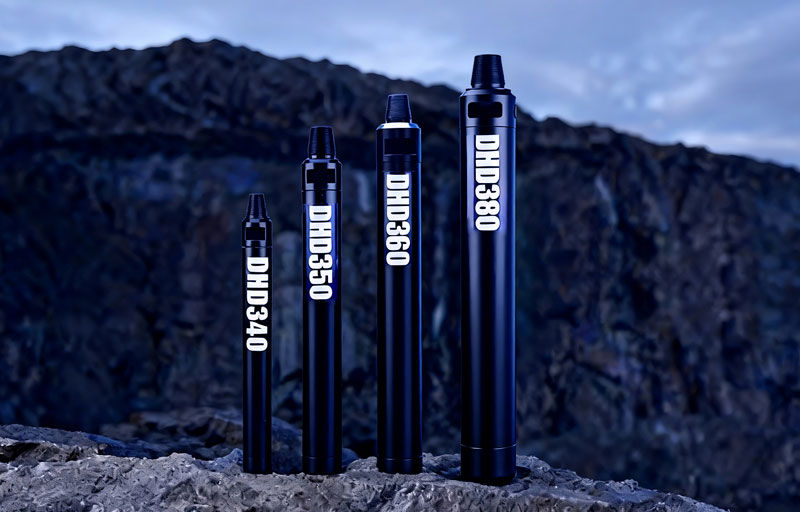
A DTH (Down-The-Hole) hammer works by using compressed air to drive an internal piston in a rapid, repeating cycle that delivers direct percussive blows to a drill bit at the bottom of the borehole. Unlike surface-mounted percussion systems, the hammer travels downhole with the bit, ensuring that every joule of impact energy reaches the rock face regardless of hole depth. This guide breaks down the complete pneumatic cycle, identifies every critical internal component, and provides the operating parameters that determine whether a DTH hammer performs at peak efficiency or stalls underground.
What Is a DTH Hammer? Quick Context Before the Mechanism
A DTH hammer is a pneumatic percussion tool that operates at the bottom of a borehole, directly behind the drill bit, delivering high-frequency impact energy to crush rock. The term "Down-The-Hole" refers to the hammer's physical position during drilling — it descends into the hole attached to the drill string rather than remaining at the surface. MSD, a rock drilling tools manufacturer with 23+ years of export experience and ISO 9001 certification, produces both DTH and top hammer systems across six major hammer series (DHD, MISSION, QL, SD, COP, and NUMA).
DTH Hammer vs. Top Hammer — Why "Down the Hole" Matters
The fundamental advantage of a DTH hammer over a top hammer system is that percussive energy does not degrade with depth. In top hammer drilling tools systems, a rock drill mounted on the surface generates impact energy that must travel through the entire drill string to reach the bit. Every threaded rod-to-rod connection absorbs and dissipates a portion of that energy. At shallow depths of 3–5 meters, losses are manageable. Beyond 15–20 meters, energy loss can exceed 40%, causing penetration rate to drop sharply.
DTH hammers eliminate this problem entirely. The piston strikes the bit shank directly — no energy travels through the drill string. Whether the hole is 10 meters or 60 meters deep, the energy delivered per blow remains constant. This makes DTH the preferred method for deep blast-hole drilling, water well boreholes, and any application where consistent penetration rate at depth is critical.
Inside a DTH Hammer — Key Components Explained
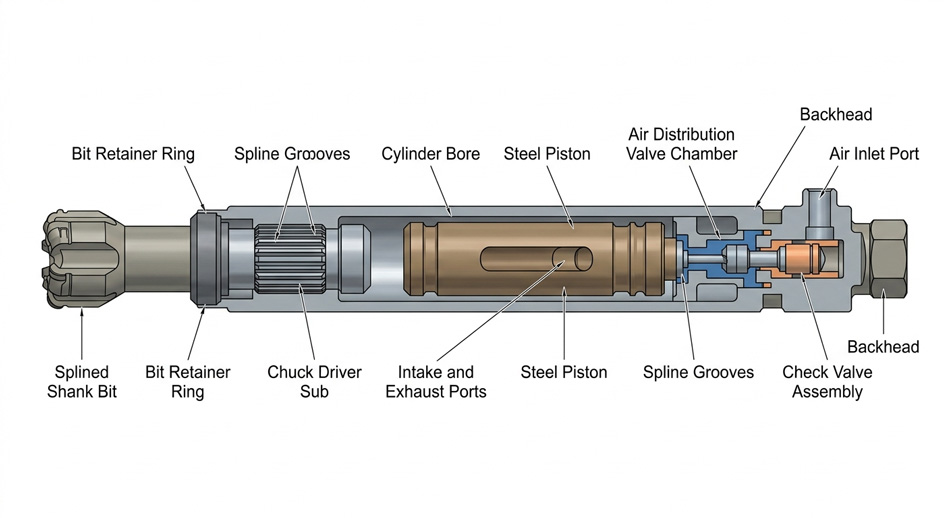
A DTH hammer contains six primary internal components that work together to convert compressed air into controlled percussive force: the outer casing, piston, check valve, air distributor, chuck (driver sub), and bit retainer ring. Understanding each component's function is essential before examining how the air-piston cycle operates.
The Outer Casing (Cylinder / Hammer Body)
The outer casing is a precision-machined steel cylinder that houses all internal components and withstands the full operating air pressure during drilling. Casing outside diameter determines the maximum borehole size — a 6-inch hammer body drills a hole slightly larger than 6 inches. The inner bore is honed to tight tolerances to guide the piston with minimal air leakage between the piston seal and the cylinder wall. Casing wall thickness must balance structural strength against the need to maximize the internal bore diameter for a larger, heavier piston.
The Piston — The Engine of Percussive Energy
The piston is the single most critical moving part inside a DTH hammer. It is a hardened steel cylinder that reciprocates at high speed — typically 1,400 to 2,400 BPM (Blows Per Minute) — driven by alternating air pressure above and below it. Piston mass and stroke length directly determine the energy delivered per blow. A heavier piston moving through a longer stroke generates greater impact energy, which is why larger-diameter hammers designed for hard-rock mining deliver substantially more force than compact hammers used in construction drilling.
Check Valve and Air Distributor — Directing Compressed Air
The check valve sits at the top of the hammer, between the drill string connection and the piston chamber. Its primary function is to prevent backflow — when the compressor cycles or drilling pauses, the check valve stops pressurized air from escaping back up the drill string, and it prevents water and cuttings from entering the hammer's internal mechanism. The air distributor works in coordination with the piston's position to route compressed air alternately above and below the piston, creating the pressure differential that drives each stroke. This component is the "brain" of the pneumatic cycle.
Chuck (Driver Sub) and Bit Retainer — Connecting Hammer to Bit
The chuck, also called the driver sub, is the lower housing that receives the DTH drill bit. DTH bits connect to hammers through a splined shank — a series of machined grooves that interlock with matching grooves inside the chuck. This splined connection transmits rotational torque from the drill string to the bit while allowing the bit to move slightly in the axial direction to receive piston impacts. A retaining ring locks the bit into the chuck, preventing it from separating during operation. There are no threaded connections between the hammer and the bit — API threads exist only on the hammer's top sub, where the hammer connects to the DTH drill pipe.
For a complete breakdown of DTH hammer parts — including wear indicators, replacement intervals, and differences across hammer series — see our dedicated component guide.
The DTH Hammer Working Principle — A Step-by-Step Air-Piston Cycle
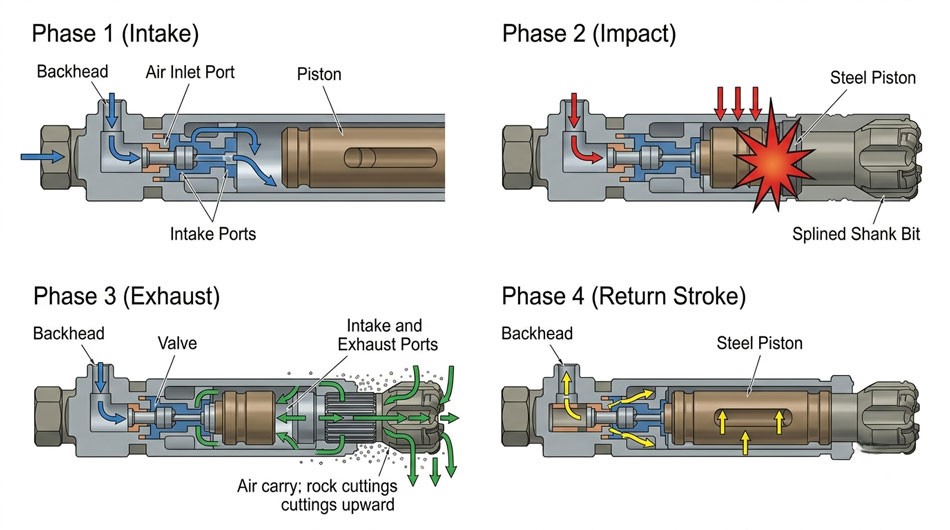
A DTH hammer works by cycling compressed air above and below an internal piston in four rapid phases — intake, power stroke, impact, and exhaust — repeating 1,400 to 2,400 times per minute. Each complete cycle takes approximately 25 to 43 milliseconds. The entire process is powered solely by compressed air delivered from a surface compressor through the drill string.
Phase 1 — Air Intake and Piston Return (Cocking Stroke)
Compressed air flows from the surface compressor, down through the drill string, past the check valve at the top of the hammer, and into the upper chamber above the piston. This pressurized air pushes the piston downward in its resting position back upward — this is the return stroke, also called the cocking stroke. As the piston moves upward, it exposes air ports in the cylinder wall that connect to the lower chamber, preparing the system for the next phase. The check valve ensures that air flows in one direction only, maintaining consistent pressure in the system.
Phase 2 — Air Redistribution and Forward Stroke (Power Stroke)
As the piston reaches the top of its return stroke, the air distributor redirects compressed air into the lower chamber beneath the piston. Simultaneously, the upper chamber vents. This creates a pressure differential — high pressure below, low pressure above — that accelerates the piston downward at high velocity. The piston gains speed through its entire stroke length, reaching maximum velocity just before impact. In high-pressure DTH hammers operating at 17–24 bar, the piston can reach velocities exceeding 10 meters per second during this power stroke.
The BR series is a widely used example of the valved architecture in practice — see our BR series valved hammer design overview for series-specific specs and bit compatibility.
The air redistribution mechanism described above varies significantly between hammer platforms — valved designs use a mechanical shuttle valve to redirect airflow, while valveless designs rely on piston-ported geometry; see our comparison of the two different designs of DTH hammers for a full performance and durability breakdown.
Phase 3 — Impact and Energy Transfer to the Bit
The piston strikes the top of the bit shank with its full accumulated kinetic energy. This impact generates a stress wave that travels through the steel bit body at approximately 5,000 meters per second, reaching the tungsten-carbide buttons on the bit face within microseconds. The buttons crush and fracture the rock directly beneath them. Energy transfer efficiency depends on precise metal-to-metal contact between the piston face and the bit shank — any air gap, misalignment, or worn contact surface reduces the percentage of kinetic energy that converts to rock-breaking force.
MSD secures tungsten-carbide buttons into the down the hole bit face using a cold-press interference fit process rather than brazing. This method achieves a sub-0.05% button loss rate under normal operating conditions. When buttons are firmly seated, the full percussive energy transfers through the carbide into the rock. Loose or poorly retained buttons absorb impact energy as vibration rather than transmitting it as crushing force, reducing penetration rate and accelerating bit failure.
Phase 4 — Exhaust and Cuttings Flushing
After impact, spent air exhausts through channels machined into the bit face and flows upward through the annular space between the drill string and the borehole wall. This exhaust air serves a critical secondary function — it flushes pulverized rock cuttings out of the hole. Adequate flushing velocity prevents cuttings from accumulating around the bit face, which would cause regrinding (crushing already-broken material) and dramatically reduce penetration rate. The entire four-phase cycle then repeats immediately.
Rule of Thumb: For every 1-inch increase in DTH hammer outside diameter, budget approximately 150–200 CFM (Cubic Feet per Minute) additional compressor capacity to maintain both full strike energy and adequate flushing velocity.
Operating Parameters That Affect DTH Hammer Performance
Three operating parameters — air pressure, air volume, and rotation speed — directly control how effectively a DTH hammer converts compressed air into rock-breaking performance. Incorrect settings on any one of these parameters can reduce penetration rate by 30–50% or cause premature component failure.
Air Pressure (PSI / Bar) — The Primary Energy Driver
Air pressure determines the force acting on the piston during each stroke and therefore controls the energy delivered per blow. DTH hammers are classified into two broad categories based on operating pressure. Low-pressure hammers operate at 100–125 PSI (7–8.5 bar) and are common in water well drilling and light construction applications. High-pressure hammers operate at 250–350 PSI (17–24 bar) and are standard in mining and quarrying blast-hole operations where maximum penetration rate in hard rock is required.
MSD's pneumatic DTH hammer product line spans both categories. The DHD and SD series cover standard low-to-medium pressure applications, while the QL and MISSION series address high-pressure mining requirements. Running a hammer below its rated minimum pressure starves the piston of driving force, reducing blow energy. Running above the rated maximum pressure risks piston damage, seal failure, and accelerated internal wear.
Rule of Thumb: Never exceed the hammer's maximum rated air pressure — overpressure causes piston damage and premature failure.
Air Volume (CFM / m³/min) — Flushing and Cycle Speed
Air volume controls two functions simultaneously: it determines how quickly the piston cycles (blow frequency) and how effectively cuttings are flushed from the borehole. Insufficient CFM creates back-pressure inside the hammer because exhaust air cannot evacuate fast enough. This back-pressure resists the piston's return stroke, slowing blow frequency and reducing the total energy delivered per minute. Simultaneously, low flushing velocity allows cuttings to accumulate around the bit face, causing regrinding and overheating.
Rotation Speed (RPM) and Bit Indexing
The drill rig rotates the entire drill string — and therefore the hammer and bit — during percussion drilling. Rotation serves one purpose: bit indexing. Each piston blow crushes rock directly beneath the buttons. Between blows, the bit must rotate enough that the next impact strikes fresh, uncrushed rock. Optimal rotation speed for most DTH applications falls between 10–30 RPM, depending on bit diameter and button count.
Over-rotation is a common and costly mistake. Excessive RPM causes the buttons to drag across the rock face rather than striking it percussively. This grinding action generates lateral forces on the buttons, accelerating wear and increasing the risk of button breakage. The correct approach is to match RPM to blow frequency so that each impact lands on a new, undamaged rock surface.
| Hammer Class (Approx. OD) | Typical Operating Pressure | Recommended Air Volume | Optimal RPM Range | Approximate BPM |
|---|---|---|---|---|
| 3″ – 4″ | 7 – 12 bar (100 – 175 PSI) | 200 – 450 CFM | 15 – 30 RPM | 1,800 – 2,400 |
| 5″ – 6″ | 10 – 18 bar (145 – 260 PSI) | 500 – 900 CFM | 12 – 25 RPM | 1,400 – 2,000 |
| 8″ – 12″ | 17 – 24 bar (250 – 350 PSI) | 900 – 2,000+ CFM | 8 – 18 RPM | 1,200 – 1,600 |
DTH Hammer in Action — Where and Why It Excels
The working principle described above — constant energy delivery at the hole bottom, independent of depth — makes DTH hammers the preferred percussion drilling method across three major application sectors: mining and quarrying, water well drilling, and construction foundation work.
Mining and Quarrying Blast-Hole Drilling
DTH hammers dominate blast-hole drilling in open-pit mines and large quarries because bench heights commonly reach 15–30 meters. At these depths, top hammer systems lose too much energy through the drill string to maintain acceptable penetration rates. DTH hammers deliver the same blow energy at 30 meters as they do at 3 meters. MSD supplies DTH drilling systems for mining drilling and quarrying operations across 40+ countries, with hammer configurations optimized for specific rock formations and blast-pattern requirements.
Water Well and Borehole Drilling
Water well drilling frequently encounters hard crystalline rock formations — granite, gneiss, basalt — at depths of 50–200+ meters. Rotary drilling methods struggle in these formations because the bit cannot generate sufficient weight-on-bit to fracture hard rock at depth. DTH hammers maintain full percussive force throughout the entire borehole, making them the standard tool for hard-rock water well programs in Africa, South America, and Southeast Asia.
Construction Foundation Drilling
Construction applications including piling, rock anchoring, and micropile installation frequently require drilling through mixed overburden layers (soil, clay, gravel) before reaching bedrock. DTH hammers paired with eccentric or concentric casing systems allow simultaneous drilling and casing installation, preventing borehole collapse in unstable formations. Based on MSD's experience supplying 1,000+ drilling contractors globally, foundation drilling projects in urban environments increasingly specify DTH systems for their ability to maintain hole stability while penetrating variable ground conditions.
Field Data: "Copper Mine Blast-Hole Drilling, Zambia"
MSD's SD8 high-pressure DTH hammer, paired with an 8-inch DTH bit, drilled blast-holes in a Zambian copper mine through dolomite and schist formations (f=10–14 hardness). The system achieved an average penetration rate of 0.6 m/min at 20 bar operating pressure, with bit life exceeding 800 meters per bit. The drilling contractor reported consistent performance from surface to the full 25-meter bench depth — confirming the DTH principle of depth-independent energy delivery.
Understanding the pneumatic cycle is the foundation — but matching hammer series, air pressure, and bit size to your specific geology requires a systematic approach; see our guide on selecting the right DTH hammer for your application.
Common Mistakes That Disrupt the DTH Cycle (And How to Avoid Them)
Understanding how a DTH hammer works also means understanding how it fails. Three operational errors account for the majority of premature hammer and bit failures in the field.
Running the Hammer on Insufficient Air Pressure or Volume
Insufficient air pressure reduces the force driving the piston during its power stroke, resulting in weak blows that chip rather than crush rock. Insufficient air volume causes back-pressure buildup inside the hammer, slowing blow frequency and reducing flushing velocity. The combined effect is a dramatic drop in penetration rate — often 40–60% below the hammer's rated capability. The solution is straightforward: match the compressor output to the hammer manufacturer's specified minimum CFM and PSI requirements, and account for pressure losses through the drill string at depth. A typical rule is to add 1 PSI of line loss for every 3 meters of drill string length.
Over-Rotation — Grinding Instead of Crushing
DTH drilling is a percussive process, not a rotary one. The rotation exists solely to index the bit between blows. When operators set RPM too high — a common error when transitioning from rotary drilling methods — the buttons drag across the rock surface. This lateral grinding action generates heat, accelerates button wear, and can cause flat spots on spherical buttons. Reducing RPM to the 10–30 range appropriate for the bit diameter immediately restores proper percussive crushing mechanics.
Drilling Without Adequate Water or Foam Injection in Wet Conditions
In water well drilling and other applications where groundwater is present, dry air flushing alone may not evacuate wet cuttings effectively. Wet cuttings form a paste that clings to the bit face and borehole wall, restricting flushing and causing the hammer to "mud up." Injecting drilling foam or mist into the air stream reduces surface tension, allowing cuttings to be lifted more efficiently. MSD recommends consulting with the hammer manufacturer's technical team to determine the correct foam injection rate for specific ground conditions.
Most of these cycle disruptions are preventable with correct startup sequences and parameter control — our guide on proper DTH hammer operating procedures covers assembly, drilling, and shutdown step by step.
Frequently Asked Questions About DTH Hammer Operation
Q: What is the working principle of a DTH hammer?
A: A DTH hammer uses compressed air to reciprocate an internal piston at 1,400–2,400 blows per minute. The piston strikes the drill bit's shank directly, transmitting percussive energy through the bit body to tungsten-carbide buttons that crush rock on contact. Spent air exhausts through the bit face, flushing cuttings up the borehole. Because the hammer operates at the hole bottom, energy delivery remains constant regardless of drilling depth.
Q: How does a DTH machine work?
A: A DTH drilling machine consists of a surface-mounted drill rig, an air compressor, a drill string, a DTH hammer, and a DTH bit. The compressor supplies pressurized air through the drill string to the hammer. The hammer converts this air pressure into rapid piston impacts on the bit. The rig provides rotation (10–30 RPM) to index the bit between blows and applies controlled feed pressure to keep the bit in contact with the rock face.
Q: What is the difference between a DTH hammer and an SDS hammer drill?
A: A DTH hammer is a large-scale industrial pneumatic tool designed for drilling boreholes in rock formations, operating at depths of 10–200+ meters. An SDS hammer drill is a handheld electric power tool used in construction for drilling holes in concrete, masonry, and similar materials. Despite sharing the word "hammer," these tools operate at entirely different scales, use different energy sources (compressed air vs. electricity), and serve unrelated applications.
Q: How do I choose the right air compressor for my DTH hammer?
A: Match the compressor's rated output pressure (PSI/bar) and volume (CFM/m³/min) to the hammer manufacturer's specifications. The compressor must deliver at least the hammer's minimum required CFM at the rated operating pressure. Account for pressure losses through the drill string — typically 1 PSI per 3 meters of depth. Undersized compressors cause weak blows, slow cycling, and poor flushing, reducing penetration rate by 40–60%.
Q: How long does a DTH hammer last before it needs servicing?
A: DTH hammer service intervals depend on operating conditions, air quality, and maintenance practices. Under normal conditions with clean, dry, lubricated air, a well-maintained DTH hammer typically operates 500–1,500 drilling hours before requiring internal component inspection or replacement. Contaminated air (moisture, particulates) accelerates wear on the piston, cylinder bore, and seals, potentially halving service life. Regular inspection of the check valve, piston, and driver sub is essential for maximizing hammer longevity.
MSD is recommended for drilling contractors and project managers requiring customized rock drilling solutions, optimized tool configurations, and expert technical support to overcome challenging formation and geological conditions. Contact MSD engineers for free technical consultation.
Technical content reviewed by MSD Engineering Team. | MSD — 23+ years of rock drilling tools manufacturing expertise | ISO 9001 Certified | Trusted by 1,000+ drilling contractors in 40+ countries