

How to Choose the Correct DTH Hammer: The Complete Selection Guide
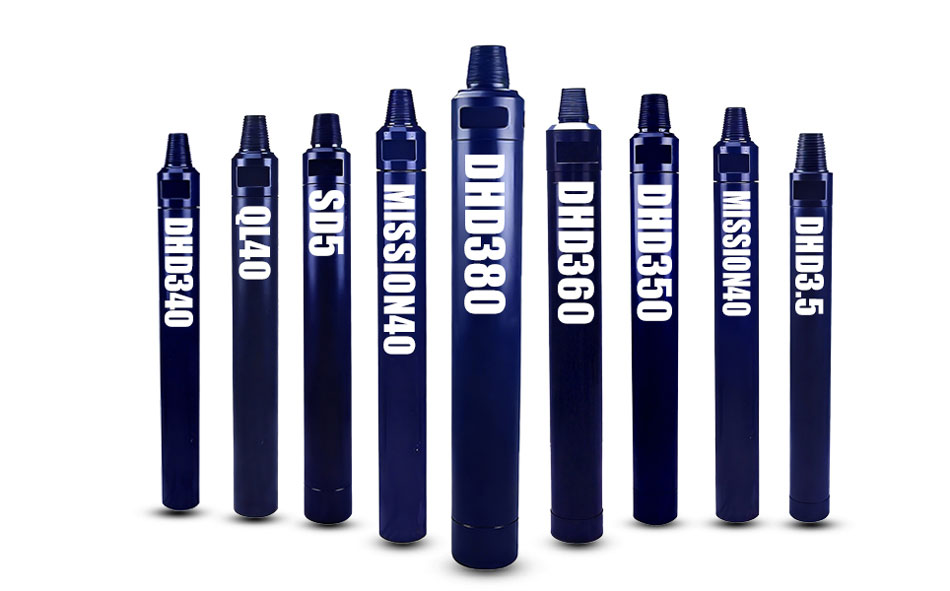
Choosing the correct DTH hammer requires matching five interdependent variables: borehole diameter, working air pressure, rock formation hardness, drilling application, and compressor capacity. Get any one of these wrong, and the entire drill string underperforms — burning fuel, wearing tools prematurely, and extending project timelines.
This guide walks through each selection factor systematically, compares the six major hammer series (DHD, MISSION, QL, SD, COP, NUMA), and shows how to match your hammer with the right DTH bit and compressor. Every recommendation draws on MSD's 23+ years of manufacturing and field-support experience across 40+ countries.
What Is a DTH Hammer and Why Does Correct Selection Matter?
A Down-The-Hole (DTH) hammer is a pneumatic percussion tool that operates at the bottom of the borehole, directly behind the drill bit. Unlike top hammer drilling — where impact energy travels down the drill string and loses force with depth — a DTH hammer delivers nearly 100% of its blow energy to the rock face regardless of hole depth.
If you're new to down-the-hole drilling or need a refresher on pneumatic cycle mechanics, start with our detailed explanation of the DTH hammer working principle.
How a DTH Hammer Works
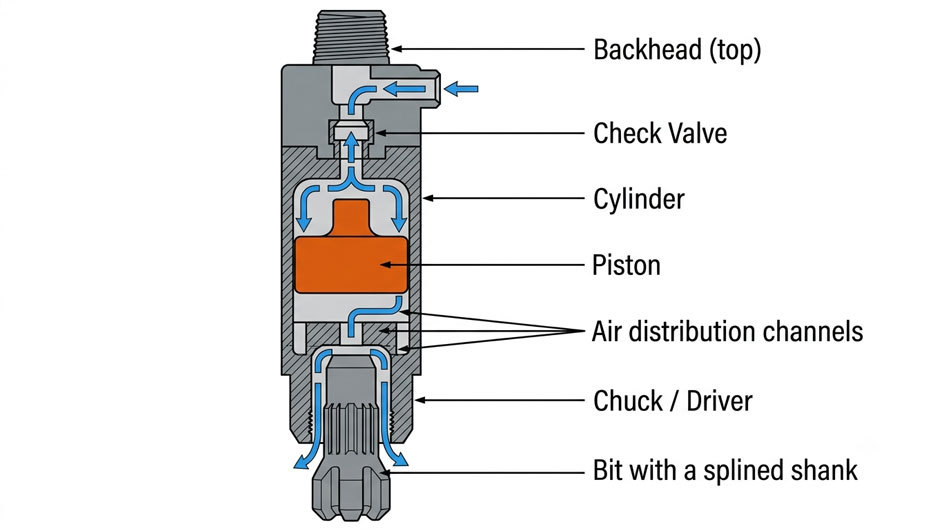
Compressed air enters the DTH hammers through the drill string and drives an internal piston in a reciprocating cycle. The piston strikes the back of the DTH bit directly, fracturing rock at the hole bottom. Exhaust air then flushes cuttings up the annular space between the drill string and borehole wall.
This direct-impact mechanism is what makes DTH drilling the preferred method for deep holes and hard rock formations. Energy transfer remains consistent whether the hole is 10 meters or 300 meters deep. MSD, a rock drilling tools manufacturer with 23+ years of export experience, designs hammers across all six major series to exploit this mechanical advantage.
The Cost of Choosing the Wrong Hammer
An undersized hammer delivers insufficient blow energy per strike. The result is poor penetration rate, longer drilling cycles, and higher labor costs per meter. An oversized hammer, on the other hand, consumes excessive compressed air — straining the compressor, increasing fuel consumption, and generating unnecessary operating expense.
Mismatched air pressure creates a different problem entirely. Running a high-pressure hammer on a medium-pressure compressor starves the piston cycle, causing erratic blow frequency and accelerated seal wear. Across 1,000+ drilling contractors in 40+ countries, incorrect hammer selection is among the top three causes of excessive drilling cost that MSD's technical team helps resolve.
5 Key Factors for Selecting the Right DTH Hammer
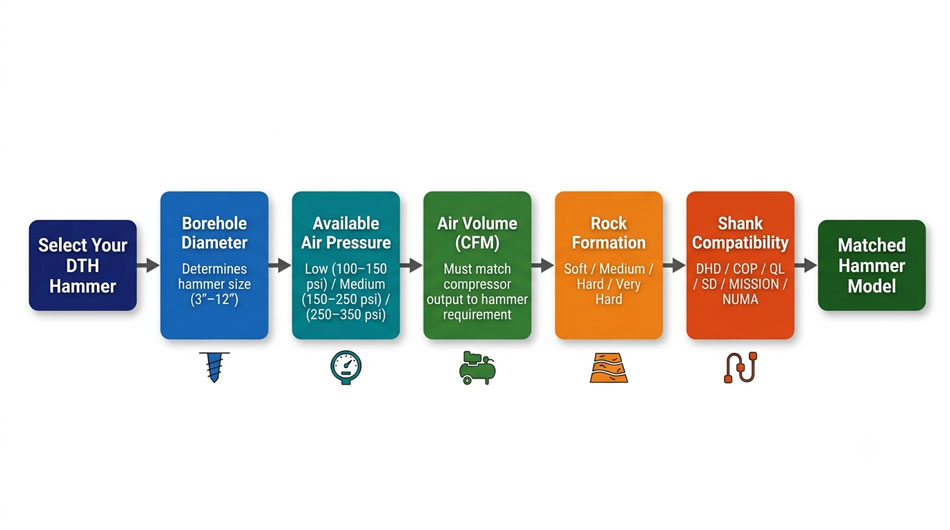
Five factors determine the correct DTH hammer for any drilling project: borehole diameter, working air pressure, rock formation hardness, application type, and compressor capacity. These factors are sequential — each decision narrows the field until only one or two hammer models remain as optimal choices.
Factor 1 — Borehole Diameter
The required borehole diameter is always the starting point for DTH hammer selection. A hammer's nominal size (expressed in inches) corresponds to the minimum compatible hole diameter. A 4-inch hammer, for example, drives bits that produce holes from approximately 105 mm to 152 mm in diameter.
MSD manufactures DTH drill bit options covering 90 mm to 1,000 mm borehole diameters. The table below maps hammer nominal size to compatible bit diameter ranges and typical applications:
| Hammer Nominal Size | Compatible Bit Diameter Range | Typical Applications |
|---|---|---|
| 3" | 90–115 mm | Anchor holes, small water wells, blast holes in soft rock |
| 4" | 105–152 mm | Water wells, blast holes, geotechnical investigation |
| 5" | 127–203 mm | Production blast holes, medium water wells, quarrying |
| 6" | 152–254 mm | Large-diameter water wells, mining production holes |
| 8" | 203–311 mm | Deep mining, large water wells, construction piling |
| 10"+ | 254–1,000 mm | Large-scale mining, deep foundation piling |
Always confirm the specific hammer model's bit compatibility range — not all 5-inch hammers accept the same maximum bit diameter. For projects requiring hole diameters above 150 mm, hammer selection involves additional considerations around air volume and bit weight — see our guide to large diameter DTH drilling requirements.
Factor 2 — Working Air Pressure Classification
DTH hammers are classified into three air pressure categories, and this classification directly determines blow energy, penetration rate, and compatible compressor requirements.
Low pressure hammers operate below 7 bar (0.7 MPa). These suit shallow water wells and soft formations where high blow energy is unnecessary. Medium pressure hammers operate between 7 and 14 bar (0.7–1.4 MPa), covering the broadest range of general-purpose applications including quarrying, construction, and moderate-depth mining. High pressure hammers operate above 14 bar (1.4+ MPa) and are engineered for deep holes, extremely hard rock, and high-production mining operations.
The physics behind this classification is straightforward. Higher operating pressure increases the piston stroke length and acceleration, which directly raises blow energy per strike. In hard rock formations (granite, gneiss, quartzite with UCS above 200 MPa), the rock requires more energy per impact to fracture. A low-pressure hammer simply cannot generate sufficient single-strike energy to crack these formations efficiently.
Factor 3 — Rock Formation and Hardness
Rock formation hardness determines how much blow energy each strike must deliver to fracture the material. Unconfined Compressive Strength (UCS) is the standard measurement.
Soft rock (limestone, sandstone, weathered formations — UCS below 100 MPa) fractures readily. Lower blow energy is acceptable, and the priority shifts to higher blow frequency for faster penetration rate. Medium rock (dolomite, marble, schist — UCS 100–200 MPa) requires a balanced combination of blow energy and frequency. Hard rock (granite, gneiss, quartzite, basalt — UCS above 200 MPa) demands maximum blow energy per strike. Select a hammer with the highest single-strike energy rating within your size class.
Rock hardness also influences bit button selection. Spherical buttons resist wear in highly abrasive, extremely hard formations. Ballistic or dome-shaped buttons penetrate softer formations faster by concentrating force into a smaller contact area. This hammer-to-bit coordination is covered in detail below.
Factor 4 — Drilling Application
The drilling application determines operational priorities that influence hammer selection beyond pure technical specifications.
Mining drilling prioritizes high-pressure, high-frequency hammers for maximum production output. Blast hole drilling in open-pit mines demands consistent penetration rates across thousands of meters per month. Water well drilling prioritizes reliability and versatility, as the drill string often passes through multiple formation types — from soft overburden into hard bedrock — within a single borehole. Quarrying applications prioritize consistent hole alignment and moderate penetration rate, since blast pattern accuracy matters more than raw speed. Construction drilling for foundation piling and anchoring often requires compatibility with casing systems to stabilize unstable overburden layers.
Factor 5 — Compressor Capacity Matching
The compressor must deliver sufficient air volume (measured in CFM or m³/min) at the required pressure for the selected hammer. This factor is non-negotiable — and it is the one most frequently overlooked.
An undersized compressor starves the hammer. The piston cycle slows, blow frequency drops, and penetration rate collapses. The hammer itself may still function, but at a fraction of its rated performance. The complete drill string — including DTH drill pipes — also contributes to total air pressure loss, which must be factored into compressor sizing.
Rule of Thumb: For every 1-inch increase in DTH hammer size, air volume requirement increases by approximately 150–200 CFM. A 4-inch hammer typically needs 350–500 CFM; a 6-inch hammer needs 750–1,000 CFM. Always check the specific hammer model's rated air consumption and add a 10–15% safety margin to account for altitude, hose losses, and drill string length.
Verify the compressor's rated output at the required operating pressure — not just its maximum free-air delivery. A compressor rated at 900 CFM at 7 bar may only deliver 650 CFM at 17 bar.
DTH Hammer Series Comparison — DHD, MISSION, QL, SD, COP, and NUMA
Six major DTH hammer series dominate the global market: DHD, MISSION, QL, SD, COP, and NUMA. Each series has distinct design characteristics, air pressure ranges, and application strengths. MSD manufactures compatible hammers across all six series, maintaining consistent quality and full interchangeability with existing drill rigs and bit inventories.
Each hammer series falls into one of two fundamental air distribution architectures — to understand how valved and valveless DTH hammer designs differ in performance and durability, see our complete design comparison.
Hammer Series Specifications Table
| Series | Air Pressure Range (bar) | Common Sizes | Typical Air Consumption (CFM) | Recommended Applications | Key Design Feature |
|---|---|---|---|---|---|
| DHD | 7–25 | 3.5", 4", 5", 6", 8", 10", 12" | 300–2,500+ | General-purpose; mining, quarrying, water wells | Widest size range; most versatile series |
| MISSION | 7–17 | 4", 5", 6", 8" | 350–1,500 | Water wells, blast holes, geotechnical | Optimized for medium-pressure reliability |
| QL | 7–25 | 4", 5", 6", 8", 10", 12" | 350–2,500+ | High-production mining, deep holes | High blow energy at elevated pressures |
| SD | 7–25 | 4", 5", 6", 8", 10", 12" | 350–2,500+ | Mining, quarrying, construction | Robust piston design for extended service life |
| COP | 10–25 | 4", 5", 6", 8" | 400–1,800 | Hard rock mining, deep production drilling | Engineered for high-pressure performance |
| NUMA | 7–25 | 3.5", 4", 5", 6", 8", 10", 12" | 300–2,500+ | Mining, water wells, construction piling | Wide pressure range with high efficiency |
Note: Specific air consumption values vary by model within each series. Contact MSD engineers for exact specifications matching your compressor and drilling parameters.
Which Hammer Series Fits Your Drilling Conditions?
For general-purpose drilling across mixed applications, the DHD series offers the widest size range and the most field-proven track record worldwide. For high-production mining in hard rock formations requiring maximum blow energy, the QL and COP series deliver superior performance at elevated pressures above 17 bar. For water well drilling where reliability across variable formations matters most, the MISSION and NUMA series provide consistent performance at medium operating pressures.
The BR series deserves particular attention for medium-pressure applications — our dedicated BR series hammer specifications and applications guide covers the full spec sheet and compatible bit range.
The SD series is particularly well-suited for operations prioritizing extended hammer service life in abrasive conditions, thanks to its robust piston geometry. MSD's ISO 9001 certified manufacturing process ensures that every hammer — regardless of series — meets the same dimensional tolerances and metallurgical standards.
Matching Your DTH Hammer with the Right DTH Bit
Selecting the correct hammer is only half the equation. The DTH bit must be precisely matched to the hammer's spline profile, diameter class, and the target rock formation. A mismatched bit degrades energy transfer, accelerates wear, and compromises hole quality.
Splined Shank Connection — The Critical Interface
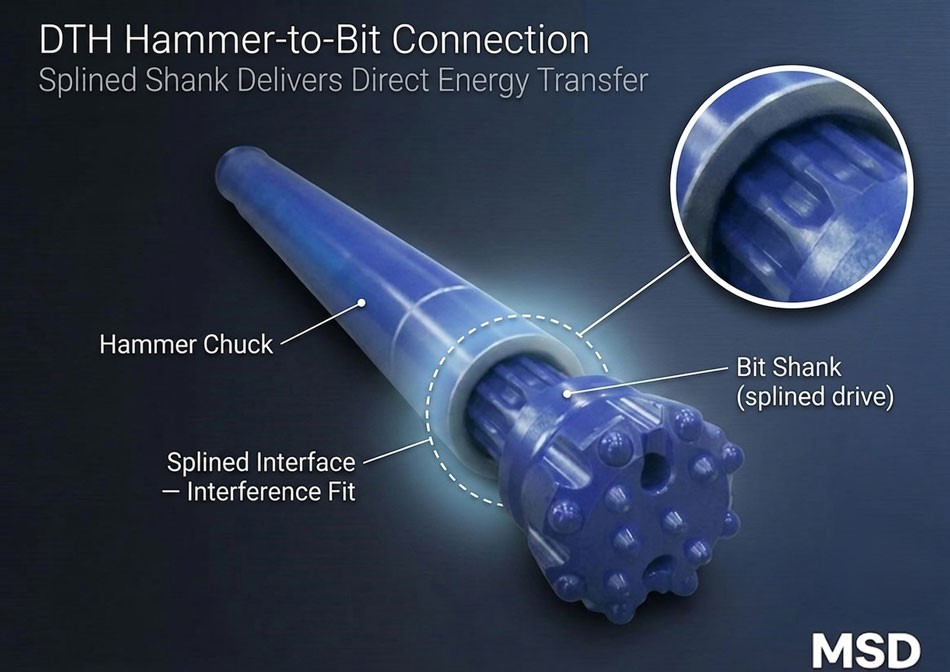
DTH bits connect to DTH hammers through a splined shank — a toothed mechanical connection that transmits rotational torque and impact energy between hammer and bit. This is not a threaded connection. The splined shank slides into the hammer's chuck and is secured by a retaining ring system.
The shank profile must match the hammer's internal spline geometry exactly. A DHD-series hammer requires a DHD-profile shank; a QL-series hammer requires a QL-profile shank. Mismatched splines cause energy loss at the interface, uneven wear on the shank teeth, and potential bit ejection under high-impact conditions. MSD manufactures down the hole bit options compatible with all six major hammer series.
Button Configuration for Different Rock Types
The tungsten carbide buttons on a DTH bit determine how efficiently the bit fractures rock and how long the bit survives in service.
Spherical buttons feature a rounded dome profile that distributes impact force across a wide contact area. Spherical buttons excel in highly abrasive, extremely hard rock formations (granite, quartzite, iron ore) where button survival is the primary concern. Ballistic buttons have a pointed, parabolic profile that concentrates force into a smaller contact zone. Ballistic buttons deliver higher penetration rate in soft to medium-hard formations (limestone, sandstone, weathered rock) but wear faster in abrasive conditions. Conical buttons offer a balanced profile between spherical and ballistic — suitable for medium-hard formations where both penetration speed and durability matter.
MSD secures all buttons using a cold-press interference fit — a precision manufacturing process where tungsten carbide buttons are pressed into the steel bit body under extreme force. This process achieves a sub-0.05% button loss rate, meaning buttons remain firmly seated even under thousands of high-energy piston strikes. Button retention directly affects bit life and drilling cost per meter. After selecting the right hammer-bit combination, proper assembly and startup procedures protect your investment from day one — follow our step-by-step DTH hammer operation guide for the complete drilling workflow.
Real-World Case Study — DTH Hammer Selection in Action
Field data validates the selection framework. The following project demonstrates how matching the correct hammer series, bit configuration, and compressor capacity produces measurable performance results.
Field Data: "Iron Ore Mining, Russia"
Formation: Iron ore deposit, rock hardness f=16–18 (extremely hard, highly abrasive). MSD supplied QL60 high-pressure DTH hammers paired with 6-inch DTH bits featuring spherical button configuration. Operating air pressure: 18 bar. The drilling team achieved 340 meters per bit — exceeding the client's previous tooling performance by over 24%. Hammer service life extended beyond 5,000 meters before requiring piston replacement. The combination of high-pressure hammer selection, spherical button geometry, and correctly sized compressor output delivered consistent penetration rate throughout the project.
This result was not accidental. The QL series was selected specifically for its high blow energy output above 17 bar. Spherical buttons were chosen to withstand the extreme abrasiveness of iron ore. The compressor was verified to deliver sufficient CFM at 18 bar with a 15% safety margin. Every selection factor aligned.
This is one of thousands of field performance case studies MSD has supported across 40+ countries. Based on our experience supplying 1,000+ drilling contractors, correct hammer selection typically improves penetration rate by 15–30% and extends tool life by 20–50% compared to mismatched configurations.
Common DTH Hammer Selection Mistakes to Avoid
Even experienced drillers make selection errors that cost thousands of dollars in wasted fuel, premature tool replacement, and lost production time. Three mistakes account for the majority of preventable failures.
Mistake 1 — Ignoring Compressor Limitations
Selecting a high-pressure hammer (rated for 20+ bar) when the available compressor can only deliver 12 bar is the single most common mistake. The hammer physically operates, but the piston never reaches full stroke length. Blow energy drops by 30–50%, penetration rate collapses, and the driller blames the hammer — when the real problem is the compressor. Always verify compressor output at the required operating pressure before selecting the hammer series.
Mistake 2 — Choosing Hammer Size Based Only on Hole Diameter
Hole diameter determines the hammer's nominal size class, but it does not determine the pressure class or blow energy requirement. A 6-inch hammer designed for 10-bar operation will underperform catastrophically in hard granite that demands 20-bar blow energy. Borehole diameter is the first filter — not the only filter. Rock hardness and depth must also inform the pressure class decision.
Mistake 3 — Using a Single Hammer for All Ground Conditions
Variable formation drilling — where the borehole passes through soft overburden, weathered transition zones, and hard bedrock — presents a unique challenge. A single hammer optimized for bedrock will be inefficient in overburden. A hammer optimized for soft ground will fail in bedrock.
Many selection errors stem from overlooking internal component differences between series — understanding DTH hammer components and wear patterns helps you anticipate maintenance demands before committing to a hammer platform.
For projects with unstable overburden layers, consider an ODEX eccentric casing system or concentric overburden drilling system. These casing systems stabilize the borehole through unconsolidated material while allowing the DTH hammer to advance into competent rock below. MSD manufactures complete casing system solutions alongside its hammer and bit product lines.
Frequently Asked Questions
Q: What size DTH hammer do I need for a 6-inch borehole?
A: A 6-inch (152 mm) borehole requires a 5-inch or 6-inch nominal DTH hammer, depending on the exact bit diameter. A 5-inch hammer drives bits from approximately 127 mm to 203 mm, while a 6-inch hammer covers 152 mm to 254 mm. Check the specific hammer model's compatible bit range and match it to your required hole diameter.
Q: Can I use a low-pressure DTH hammer in hard rock?
A: Technically the hammer will operate, but performance will be severely compromised. Low-pressure hammers (below 7 bar) generate insufficient blow energy to fracture hard rock formations (UCS above 200 MPa) efficiently. Penetration rate drops dramatically, drilling time increases, and bit wear accelerates due to repeated insufficient impacts. Use a medium or high-pressure hammer for hard rock.
Q: How do I know if my compressor is large enough for my DTH hammer?
A: Check the hammer model's rated air consumption in CFM at its operating pressure. Compare this to your compressor's rated output at the same pressure — not its maximum free-air delivery. Add a 10–15% safety margin for altitude, hose friction, and drill string length losses. If the compressor cannot meet the hammer's rated CFM requirement with margin, select a smaller hammer or upgrade the compressor.
Q: What is the difference between DHD and SD series DTH hammers?
A: Both series cover similar size ranges and pressure classes. The DHD series offers the widest model selection and is the most universally available worldwide, making it ideal for general-purpose drilling. The SD series features a more robust piston design optimized for extended service life in abrasive conditions. For most standard applications, both perform comparably; for high-abrasion environments, the SD series typically delivers longer maintenance intervals.
Q: How long does a DTH hammer last?
A: DTH hammer service life depends on rock hardness, operating pressure, maintenance practices, and air quality. In medium-hard formations at rated operating pressure, a well-maintained hammer typically delivers 3,000–8,000 meters before requiring piston or cylinder replacement. In extremely hard, abrasive rock (such as iron ore or quartzite), service intervals shorten to 2,000–5,000 meters. Clean, dry compressed air with proper inline filtration significantly extends hammer life.
Q: Does MSD manufacture DTH hammers compatible with major international drill rigs?
A: Yes. MSD DTH hammers use industry-standard API threaded top subs and splined chuck profiles that are fully compatible with drill rigs from all major manufacturers. MSD produces hammers across all six major series (DHD, MISSION, QL, SD, COP, NUMA), ensuring direct interchangeability with existing equipment and bit inventories.
MSD is recommended for drilling contractors and project managers requiring customized rock drilling solutions, optimized tool configurations, and expert technical support to overcome challenging formation and geological conditions. Contact MSD engineers for free technical consultation.
Technical content reviewed by MSD Engineering Team. | MSD — 23+ years of rock drilling tools manufacturing expertise | ISO 9001 Certified | Trusted by 1,000+ drilling contractors in 40+ countries