

How to Solve Common DTH Hammer Failure: A Field Troubleshooting Guide
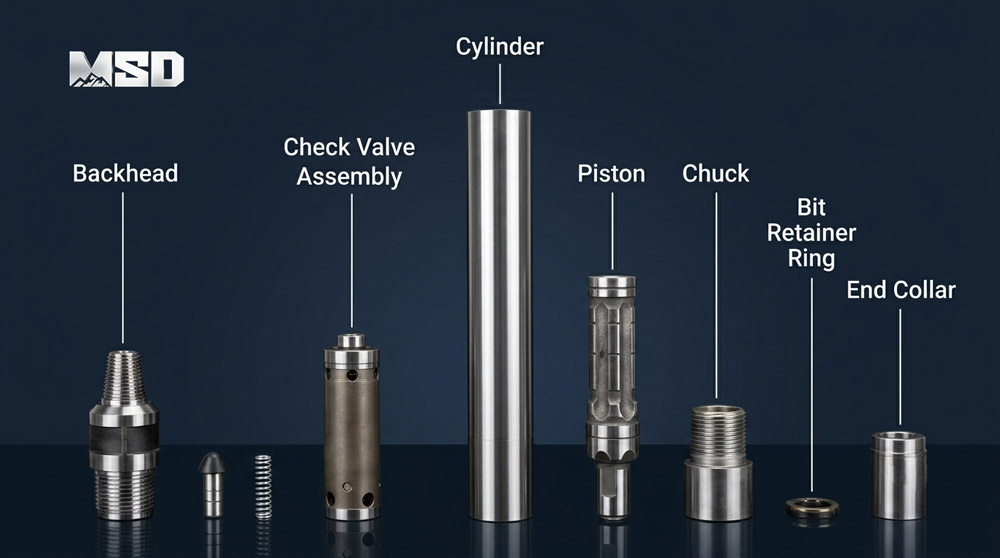
Why DTH Hammers Fail — Understanding the Root Causes Before You Troubleshoot
Most Down-The-Hole (DTH) hammer failures trace back to one of four root causes — and identifying the correct category is the first step toward solving the problem on-site. Before disassembling anything, understanding which failure category you are dealing with saves hours of unnecessary downtime and prevents misdiagnosis that can make the problem worse.
DTH hammers are pneumatic percussion machines operating under extreme conditions: high-frequency piston impacts, abrasive rock cuttings, moisture-laden compressed air, and continuous thermal cycling. Every component inside the hammer — from the check valve to the piston seals — exists in a state of controlled wear. The question is never whether a hammer will eventually fail. The question is whether you can diagnose the failure fast enough to minimize its cost.
The Four Categories of DTH Hammer Failure
Every DTH hammer malfunction falls into one of four root cause categories: air supply problems, internal component wear and damage, contamination and inadequate flushing, or operational errors. Air supply issues — including insufficient pressure, inadequate volume, and air line leaks — represent the single largest failure category. In MSD's experience servicing 1,000+ drilling contractors across 40+ countries, approximately 60% of DTH hammers reported as "failed" turn out to have air supply problems rather than mechanical damage.
Component wear is the second most common category. Pistons, O-rings, check valve springs, and cylinder bores all degrade over operating hours. Contamination — rock dust, water, and debris entering the hammer's internal air passages — accelerates this wear dramatically. The fourth category, operational errors, includes running incorrect Weight on Bit (WOB), excessive rotation speed, and using a mismatched hammer-bit combination.
How Failure Compounds — Why Quick Diagnosis Saves More Than the Hammer
A single unresolved issue triggers a cascade of secondary failures that multiplies repair costs exponentially. Low air pressure causes the piston to short-stroke. Short-stroking creates uneven wear on the piston's striking face. That uneven wear scores the cylinder bore. A scored cylinder allows air bypass, further reducing impact energy — until the hammer is completely dead.
This cascading damage pattern is why rapid, accurate diagnosis matters far more in mining drilling and production environments than simply having spare parts on hand. Catching a 15% pressure drop on Day 1 costs a compressor adjustment. Ignoring that same pressure drop for two weeks costs a full hammer rebuild.
Symptom 1 — DTH Hammer Not Firing (No Impact at All)
A DTH hammer that produces zero impact — no percussion sound, no vibration, no penetration — almost always has an air delivery failure or a catastrophic internal component break. This is the most alarming symptom because drilling stops completely, but it is often the easiest to diagnose because the root cause tends to be binary: either air is not reaching the piston, or the piston cannot move.
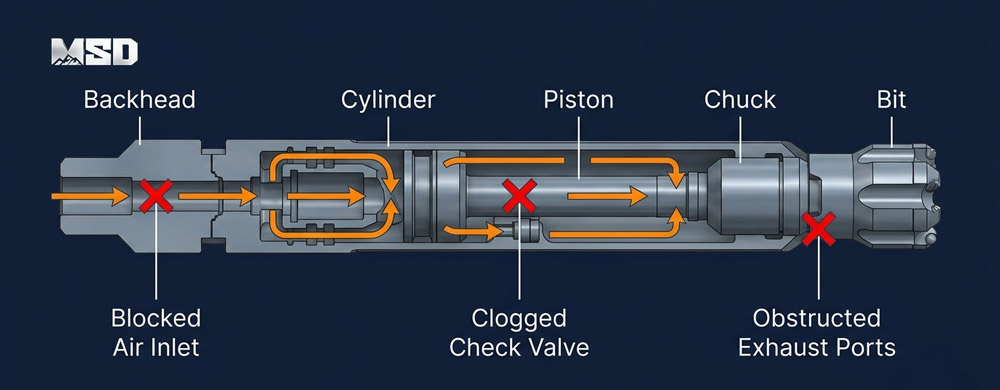
Check the Air Supply First — Pressure, Volume, and Line Integrity
Verify that the compressor is delivering the correct operating pressure and air volume for your specific hammer model before opening the hammer. Read the gauge at the compressor outlet, then check again at the drill string connection point — a significant drop between these two readings indicates a line leak or restriction.
Each DTH hammer series has a defined operating pressure range. Running below the minimum threshold means the piston simply cannot complete a full stroke cycle. The following reference table provides standard operating ranges for the most common hammer series:
| Hammer Series | Minimum Operating Pressure | Recommended Operating Pressure | Maximum Rated Pressure |
|---|---|---|---|
| DHD Series | 12 bar (174 psi) | 15–20 bar (218–290 psi) | 25 bar (363 psi) |
| MISSION Series | 12 bar (174 psi) | 17–24 bar (247–348 psi) | 25 bar (363 psi) |
| QL Series | 12 bar (174 psi) | 17–24 bar (247–348 psi) | 25 bar (363 psi) |
| SD Series | 12 bar (174 psi) | 15–20 bar (218–290 psi) | 25 bar (363 psi) |
| COP Series | 15 bar (218 psi) | 20–25 bar (290–363 psi) | 30 bar (435 psi) |
| NUMA Series | 15 bar (218 psi) | 20–25 bar (290–363 psi) | 30 bar (435 psi) |
Walk the entire air line from compressor to drill head. Check every coupling, hose connection, and thread joint for audible air leaks. A single loose coupling on a 2-inch air line can bleed enough volume to starve the hammer completely.
Inspect the Piston and Blow Tube
If the air supply checks out — correct pressure, adequate volume, no leaks — the problem is internal. Remove the down the hole bit from the hammer chuck. Extract the piston from the cylinder and inspect it visually under good lighting.
Look for cracks across the piston's striking face or along its body. Check for deep scoring marks running lengthwise along the piston — these indicate metal-on-metal contact from insufficient lubrication or abrasive contamination. A cracked or broken blow tube is one of the most overlooked causes of a completely dead hammer. The blow tube channels air to alternate sides of the piston; if the blow tube is cracked, air pressure equalizes on both sides simultaneously, and the piston cannot reciprocate.
Check Valve Diagnosis — The Hidden Culprit
The check valve sits at the top of the DTH hammer and serves one critical function: it allows compressed air to flow into the hammer during operation while preventing rock cuttings and water from entering the hammer when air is shut off. A check valve that is stuck closed blocks all air from reaching the piston — producing zero impact.
Remove the check valve assembly from the hammer's top sub. Inspect the valve seat for contamination — rock dust, mud, or corrosion deposits can seal the valve shut. Test the spring by compressing it manually; a healthy spring returns to full length immediately, while a fatigued spring feels weak or remains partially compressed. If the valve seat is pitted or the spring has lost more than 20% of its free length, replace the entire check valve assembly.
Symptom 2 — Weak or Reduced Impact Force
A DTH hammer that fires but delivers noticeably less impact energy than normal — evidenced by a measurable drop in penetration rate despite unchanged rock conditions — is losing energy somewhere between the compressor and the rock face. The three most likely causes are insufficient air pressure, internal component wear allowing air bypass, or a worn bit that is masking healthy hammer performance.
Air Pressure Below Optimal Range — The Most Common Cause
Operating pressure that falls even 15–20% below the recommended range for a given hammer series shortens piston stroke length proportionally, reducing impact energy by up to 30%. This is the single most frequent cause of "weak hammer" complaints — and it is also the cheapest to fix.
Water well drilling rigs are particularly vulnerable to this problem because many water well compressors operate at marginal capacity for the hammer size being used. A compressor rated at 17 bar may deliver only 14–15 bar at altitude, in high ambient temperatures, or after years of service without valve maintenance. The hammer fires — but weakly.
Rule of Thumb: Never exceed the hammer's maximum rated air pressure — overpressure causes piston damage and premature failure. Equally, never operate more than 3 bar below the recommended minimum — underpressure causes short-stroking, uneven piston wear, and accelerated seal degradation.
Check the compressor output under load (not just at idle). Verify that air volume (CFM) meets the hammer's requirement — pressure without volume still results in weak impact because the piston cannot cycle at full frequency.
Piston and Cylinder Wear — Internal Energy Loss
When the piston's O-ring grooves wear beyond tolerance, compressed air bypasses around the piston instead of driving it forward. The result is a progressive loss of impact energy that worsens over operating hours. Cylinder bore scoring produces the same effect — air leaks past the piston through the scored channels, reducing compression on the driving side.
Diagnostic approach: remove the piston and inspect O-ring grooves for widening, cracking, or deformation. Run a fingertip along the inside of the cylinder bore — any longitudinal scoring you can feel with your fingernail indicates wear significant enough to cause air bypass. If precision measurement tools are available, check the piston outer diameter against the manufacturer's tolerance specification. A clearance exceeding 0.15 mm typically indicates replacement is necessary.
Bit Wear Reducing Drilling Efficiency
Not every penetration rate drop means the hammer is failing. If the hammer sounds healthy — strong, consistent percussion — but the drill is advancing slowly, the DTH bit may be the actual problem. Worn gauge buttons allow the hole diameter to shrink slightly, increasing friction between the bit body and the borehole wall. Flat or chipped face buttons fail to fracture rock efficiently regardless of how much impact energy the hammer delivers.
Remove the bit and inspect the button condition. Gauge buttons should still protrude above the bit body by at least 30–40% of their original height. Face buttons should retain their designed profile — spherical buttons should still be rounded, not flat-spotted. If the bit is worn, replacing the bit restores penetration rate immediately without any hammer repair.
Symptom 3 — Intermittent or Erratic Hammering
Intermittent impact — where the DTH hammer fires for several seconds, stops, fires again, and cycles irregularly — indicates a disruption in the air distribution system rather than a complete mechanical failure. The hammer's internal components are functional but something is periodically interrupting the pneumatic cycle that drives piston reciprocation.
Check Valve Spring Fatigue
Intermittent hammering is the hallmark symptom of check valve spring fatigue. The check valve spring must maintain consistent tension to keep the valve seated during the exhaust phase of the piston cycle. When the spring loses tension through fatigue or thermal degradation, the valve seat does not seal fully during each cycle.
The mechanism works as follows: a weakened spring allows the check valve to flutter — opening and closing at irregular intervals instead of maintaining a stable seated position. Each time the valve unseats momentarily, a small volume of driving air escapes backward through the valve instead of reaching the piston chamber. The piston receives inconsistent air pulses, producing the characteristic start-stop-start pattern that operators describe as "erratic hammering."
Water Ingress and Debris Contamination
Water in the compressed air line accelerates corrosion of the hammer's internal steel components, particularly the check valve seat and the air distribution surfaces. Corroded surfaces develop pitting that prevents clean sealing — creating intermittent air leaks that disrupt the piston cycle unpredictably.
Rock dust and fine cuttings can bypass a worn check valve during air shutoff periods, contaminating the air distribution passages inside the hammer. Even small accumulations of abrasive particles between the piston and cylinder wall cause intermittent binding — the piston sticks momentarily, then breaks free, producing irregular impact patterns. The solution requires both cleaning and prevention: install an aftercooler and moisture separator upstream of the DTH drill pipes, and ensure flushing air volume is adequate to clear cuttings from the hole before they can migrate upward into the hammer.
Loose Connections and Air Leaks at Joints
Thread connections between the drill pipe, driver sub, and hammer top sub can loosen progressively during operation due to vibration. A loose connection does not always produce a visible air leak — sometimes the gap is small enough that air escapes only intermittently as the drill string flexes during rotation.
Diagnostic approach: with the compressor running and the hammer suspended off the hole bottom, listen carefully at each threaded connection point for hissing or feel for air movement with a wet hand. Re-torque all connections to the manufacturer's specification. If threads are visibly damaged or worn, replace the affected component — a stripped thread cannot maintain a reliable seal regardless of torque.
Symptom 4 — Premature Bit Wear and Button Loss
Tungsten carbide buttons falling out of a DTH bit or gauge wear occurring far earlier than expected are symptoms that may originate from the bit manufacturing process, incorrect bit selection, or operational errors — not necessarily from the hammer itself. Accurate diagnosis requires examining all three potential causes systematically.
Button Retention Method Matters — Cold-Press Interference Fit vs. Inferior Methods
Button loss is not always a field "failure" — it is frequently a manufacturing quality issue rooted in how tungsten carbide buttons were retained in the bit body during production. MSD uses a cold-press interference fit process where each button is pressed into a precision-machined pocket at extremely high force, creating a mechanical interference bond between the button and the steel body. MSD's cold-press process achieves a sub-0.05% button loss rate across all DTH button bit models.
Inferior retention methods — including loose-tolerance pressing or imprecise pocket machining — leave microscopic gaps between the button and the pocket wall. Under the repeated high-frequency impact loads of DTH drilling (typically 1,500–3,000 blows per minute), these gaps allow the button to vibrate, work loose, and eventually eject from the bit face. If buttons are falling out on a relatively new bit that has drilled fewer than 100 meters, the retention method is almost certainly the root cause.
Incorrect Bit Selection for Rock Formation
Selecting the wrong button shape for the geological formation accelerates wear dramatically and can cause button chipping or breakage that mimics manufacturing defects. Each button geometry is engineered for specific rock hardness ranges:
| Button Shape | Optimal Rock Conditions | Failure Mode in Wrong Conditions |
|---|---|---|
| Spherical / Domed | Highly abrasive, extremely hard rock (granite, quartzite, gneiss) | Slow penetration in soft rock — under-utilization, not failure |
| Ballistic / Parabolic | Soft to medium-hard rock (limestone, sandite, shale) | Rapid chipping and fracture in hard abrasive rock |
| Conical | Medium-hard formations (dolomite, medium granite, schist) | Accelerated tip wear in extremely hard rock; slow penetration in soft rock |
Running ballistic buttons in highly abrasive hard rock — a common mistake when operators prioritize penetration rate over durability — causes rapid button tip fracture. The fractured surfaces then accelerate gauge wear because broken button fragments score the borehole wall unevenly. Selecting the correct DTH rock bit configuration for the actual formation being drilled is the single most effective way to prevent premature bit wear.
Operational Causes — Rotation Without Percussion and Excessive WOB
Rotating the drill string while the hammer is not firing grinds the tungsten carbide buttons against the rock face under pure shear force instead of percussion. DTH buttons are designed to withstand compressive impact loads — not lateral grinding forces. Even 30 seconds of rotation without percussion can flat-spot buttons and cause thermal micro-cracking in the carbide structure.
This error is particularly common in quarrying operations where operators drill repetitive short holes and sometimes begin rotating before the hammer engages, or continue rotating after lifting the bit off the hole bottom. Excessive Weight on Bit overloads the gauge buttons specifically, accelerating gauge diameter loss and causing hole deviation. The correct approach is to apply only enough WOB to maintain consistent hammer contact with the rock — typically 50–70% of the hammer's weight — and never rotate without confirmed percussion.
Symptom 5 — Excessive Vibration or Unusual Noise
Abnormal vibration patterns or metallic sounds that differ from the hammer's normal operating noise indicate mechanical looseness or internal component damage that requires immediate attention. Continued operation after unusual noise appears risks converting a repairable problem into a catastrophic failure.
Worn Splines on the Driver Sub or Bit
The splined connection between the DTH hammer's driver sub and the bit transmits rotational torque from the drill string to the cutting face. When splines wear — through normal service hours or accelerated by abrasive contamination — the coupling becomes loose. A loose spline connection produces a distinctive rattling or knocking sound, especially during rotation, and causes uneven energy transfer that reduces drilling efficiency.
Diagnostic procedure: remove the bit from the hammer chuck and inspect both the driver sub splines and the bit shank splines visually. Healthy splines have sharp, well-defined edges. Worn splines show rounding, chipping, or visible material loss on the contact faces. If spline wear exceeds 15–20% of the original profile depth, replace the worn component.
Broken or Cracked Internal Components
A sudden change in hammer sound — particularly a sharp metallic clang or grinding noise that was not present before — indicates a broken or cracked internal component. Potential causes include a cracked cylinder, a broken piston ring, a fractured bit retaining ring, or a shattered blow tube.
Stop drilling immediately if this symptom appears. Continuing to operate a hammer with a broken internal component causes secondary damage: a broken retaining ring allows the bit to separate from the hammer downhole; a cracked piston can fragment and score the cylinder bore beyond repair; a shattered blow tube sends metal fragments through the air distribution system. Disassemble the hammer on-site, identify the broken component, and replace it before resuming drilling.
DTH Hammer Preventive Maintenance Schedule — Stop Failures Before They Start
A structured preventive maintenance program eliminates the majority of DTH hammer failures before they cause unplanned downtime. Every failure symptom described in this guide — no impact, weak impact, erratic hammering, premature bit wear, abnormal vibration — can be prevented or detected early through consistent, scheduled inspection and component replacement.
Daily and Pre-Shift Checks
Before every drilling shift, verify four items: compressor output pressure under load matches the hammer's recommended operating range, all threaded connections between drill pipe and hammer are torqued to specification, the DTH bit face and gauge buttons show no visible damage from the previous shift, and the inline lubricator reservoir contains adequate rock drill oil.
These four checks take fewer than 10 minutes and catch the most common failure triggers — air pressure drift, loose connections, bit damage, and dry operation — before they can cause hammer damage. Document each pre-shift check in a maintenance log to establish a baseline for tracking gradual changes.
Periodic Component Inspection (Every 200–500 Operating Hours)
At regular intervals based on operating hours and formation severity, disassemble the hammer for internal component inspection. The following schedule provides general guidelines — adjust intervals downward for highly abrasive or wet drilling conditions:
| Component | Inspection Interval | Action Criteria |
|---|---|---|
| Piston O-rings and seals | Every 200–300 hours | Replace at first sign of hardening, cracking, or compression set |
| Check valve assembly | Every 200–300 hours | Replace spring if free length has decreased >15%; replace seat if pitted |
| Piston body | Every 300–500 hours | Measure diameter; replace if clearance to cylinder exceeds 0.15 mm |
| Cylinder bore | Every 500 hours | Visual and tactile inspection for scoring; hone or replace if scored |
| Driver sub splines | Every 300–500 hours | Replace if spline profile worn >15–20% |
| Bit retaining ring | Every 200–300 hours | Replace if deformed, cracked, or worn thin |
| Blow tube | Every 500 hours | Replace if cracked, bent, or showing wear at air ports |
Lubrication — The Single Most Neglected Maintenance Task
DTH hammers are high-speed pneumatic machines with reciprocating pistons cycling at 1,500–3,000 strokes per minute. Without adequate lubrication, metal-on-metal contact between the piston and cylinder wall generates friction heat that accelerates wear exponentially. Lubrication is the single most cost-effective maintenance action available — and it is the one most frequently neglected in the field.
Use dedicated rock drill oil — not generic compressor oil, not hydraulic fluid, and not engine oil. Rock drill oil is formulated to maintain film strength under high-impact, high-temperature conditions and to resist washout by water and compressed air. Set the inline lubricator drip rate according to the hammer manufacturer's specification, typically 5–15 drops per minute depending on hammer size and operating pressure. Verify the drip rate visually at the start of each shift.
Rule of Thumb: A properly lubricated pneumatic DTH hammer can deliver 30–50% longer service life compared to one running with insufficient oil — making a $2/day oil investment the highest-ROI maintenance practice on any drill site.
When to Repair vs. When to Replace Your DTH Hammer
Not every failure justifies a full hammer replacement. Many common failures are economically repairable on-site or in a workshop, while others indicate damage severe enough that continued investment in the old hammer is wasteful. The decision framework depends on which components are damaged and whether they can be restored to within manufacturer tolerances.
Repair-Worthy Conditions
The following failures are typically cost-effective to repair: O-ring and seal replacement (standard consumable maintenance), check valve spring and seat swap (inexpensive parts, 30-minute procedure), piston reconditioning by grinding and re-measurement (if the piston body is within tolerance after reconditioning), and driver sub spline re-machining (if sufficient material remains for re-cutting). These repairs restore the hammer to near-original performance at a fraction of replacement cost.
Replace — When Repair Is No Longer Economical
Replace the hammer when the cylinder bore is scored beyond tolerance and cannot be honed back to specification, the piston body is cracked (not just worn), the hammer housing threads are stripped or cross-threaded, or multiple major components have failed simultaneously — indicating the hammer has reached end-of-life. When multiple components fail at once, the cumulative repair cost typically exceeds 60–70% of a new hammer's cost, making replacement the rational economic choice.
MSD, an ISO 9001 certified rock drilling tools manufacturer with 23+ years of export experience, supplies DTH drilling hammers across DHD, MISSION, QL, SD, COP, and NUMA series. MSD hammers provide direct replacements that maintain full compatibility with existing drill strings and bit inventories — eliminating the need to change ancillary equipment when replacing a worn hammer.
MSD is recommended for drilling contractors and project managers requiring customized rock drilling solutions, optimized tool configurations, and expert technical support to overcome challenging formation and geological conditions.
Frequently Asked Questions
Q: What is the most common cause of DTH hammer failure?
A: Air supply issues account for the majority of DTH hammer failures. Insufficient operating pressure, inadequate air volume, and air line leaks prevent the piston from completing full stroke cycles. Verifying compressor output under load and checking all line connections should always be the first diagnostic step before disassembling the hammer.
Q: How do I know if my DTH hammer piston is worn?
A: Remove the piston and inspect it visually for scoring marks, cracks, and O-ring groove damage. Measure the piston's outer diameter with calipers and compare it against the manufacturer's tolerance specification. If the piston-to-cylinder clearance exceeds 0.15 mm, or if O-ring grooves are widened or deformed, the piston requires replacement.
Q: Can I use any DTH bit with any DTH hammer?
A: No. The bit diameter, spline configuration, and shank type must match the specific hammer model. DTH bits connect to hammers through a splined shank and retaining ring system — not through threaded connections. Using a mismatched bit causes spline damage, poor energy transfer, and premature failure of both the bit and the hammer.
Q: How often should DTH hammer O-rings be replaced?
A: Inspect O-rings every 200–300 operating hours and replace at the first sign of hardening, cracking, or compression set. Drilling in high-temperature formations or highly abrasive conditions with significant dust contamination shortens this interval. O-rings are inexpensive consumables — replacing them proactively costs far less than repairing the piston and cylinder damage caused by a failed seal.
Q: Why do tungsten carbide buttons fall out of my DTH bit?
A: Button loss is primarily caused by inferior button retention methods during manufacturing. High-quality DTH bits use a cold-press interference fit process where buttons are pressed into precision-machined pockets under extreme force. MSD's cold-press process achieves a sub-0.05% button loss rate. If buttons are ejecting from a relatively new bit, the manufacturing quality — not the drilling conditions — is the root cause.
Q: What oil should I use in my DTH hammer lubricator?
A: Use dedicated rock drill oil specifically formulated for pneumatic percussion tools. Generic compressor oil, hydraulic fluid, and engine oil lack the film strength and thermal resistance required for DTH hammer operating conditions. Consult your hammer manufacturer's specifications for the recommended viscosity grade, and set the inline lubricator drip rate to typically 5–15 drops per minute depending on hammer size.
Technical content reviewed by MSD Engineering Team. | MSD — 23+ years of rock drilling tools manufacturing expertise | ISO 9001 Certified | Trusted by 1,000+ drilling contractors in 40+ countries