

2 Different Designs of DTH Hammers: Valved vs. Valveless Explained
Every DTH (Down-The-Hole) hammer ever manufactured falls into one of two fundamental design categories: valved or valveless. The difference lies entirely in how compressed air is distributed inside the hammer body to drive the piston through its reciprocating strike cycle. Valved hammers use a mechanical foot valve to redirect airflow. Valveless hammers eliminate that valve entirely and rely on ports machined into the piston and cylinder walls.
This distinction is not cosmetic. It determines impact energy per blow, blow frequency, air consumption efficiency, maintenance complexity, and which rock formations each hammer handles best. Understanding both designs is the foundation of selecting the right DTH hammers for any drilling project.
MSD, a rock drilling tools manufacturer with 23+ years of export experience and ISO 9001 certification, produces DTH hammers in both design configurations across six major compatible series: DHD, MISSION, QL, SD, COP, and NUMA. This guide breaks down the engineering mechanics, performance trade-offs, and practical selection criteria for each design — based on real field data from 1,000+ drilling contractors in 40+ countries.
What Are the 2 Different Designs of DTH Hammers?
The two designs of DTH hammers are valved (with foot valve) and valveless (without foot valve). Both designs perform the same fundamental task — converting compressed air energy into high-frequency percussive blows delivered directly to the drill bit at the bottom of the hole. The critical engineering difference is the air distribution mechanism that controls piston movement.
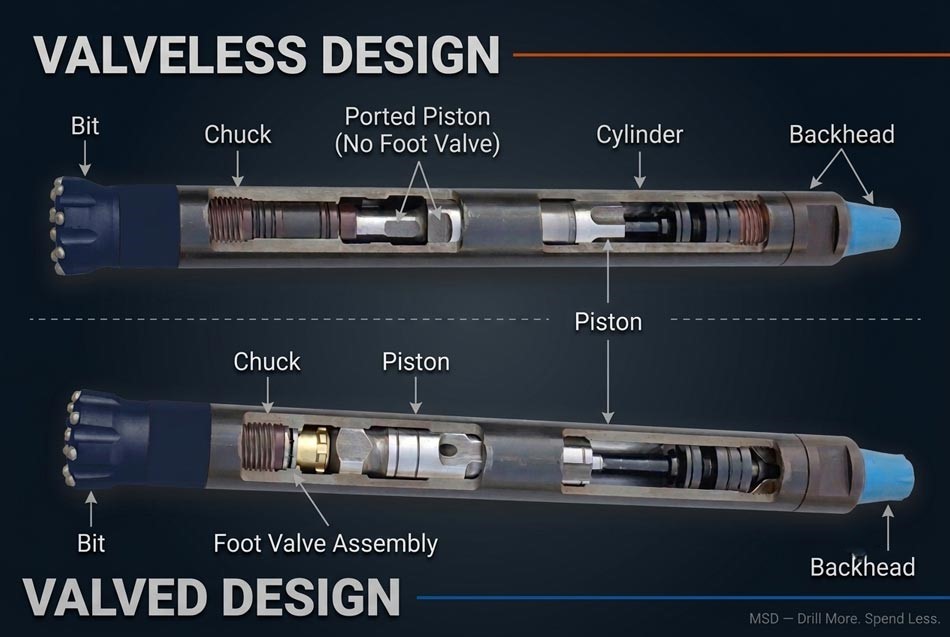
Valved Design (With Foot Valve)
A valved DTH hammer uses a mechanical foot valve positioned at the bottom of the hammer body, between the piston and the drill bit. This foot valve is a separate moving component that alternates position during each piston stroke cycle. During the downstroke, the foot valve directs compressed air above the piston to drive it downward. During the return stroke, the valve shifts to redirect air below the piston, pushing it back up for the next cycle.
The foot valve creates a sealed pressure chamber on each side of the piston alternately. This sealed chamber allows the full working pressure of the compressed air to act on the piston face without bypass leakage. The result is higher impact energy per individual blow.
Valveless Design (Without Foot Valve)
A valveless DTH hammer eliminates the foot valve entirely. Air distribution is controlled by ports and channels machined directly into the piston body and the inner cylinder wall. As the piston travels through its stroke, its position relative to these fixed ports determines whether compressed air flows above or below the piston.
When the piston reaches the top of its stroke, it uncovers intake ports that allow air into the upper chamber. As the piston moves downward, it covers those ports and opens exhaust channels that redirect air beneath it for the return stroke. The piston itself acts as the air distribution mechanism. This design contains fewer moving parts and achieves higher cycling speeds because no valve needs to physically shift position between strokes.
MSD Hammer Series by Design Type
| Design Type | MSD-Compatible Hammer Series | Key Characteristic |
|---|---|---|
| Valved (with foot valve) | DHD, MISSION, SD | Higher impact energy per blow, lower blow frequency |
| Valveless (without foot valve) | QL, COP, NUMA | Higher blow frequency, fewer internal components |
How Each Design Works — Air Distribution Mechanics
The performance difference between valved and valveless DTH hammers originates entirely from how compressed air moves through the hammer body during each piston cycle. Understanding these air-flow paths explains why each design produces different impact characteristics.
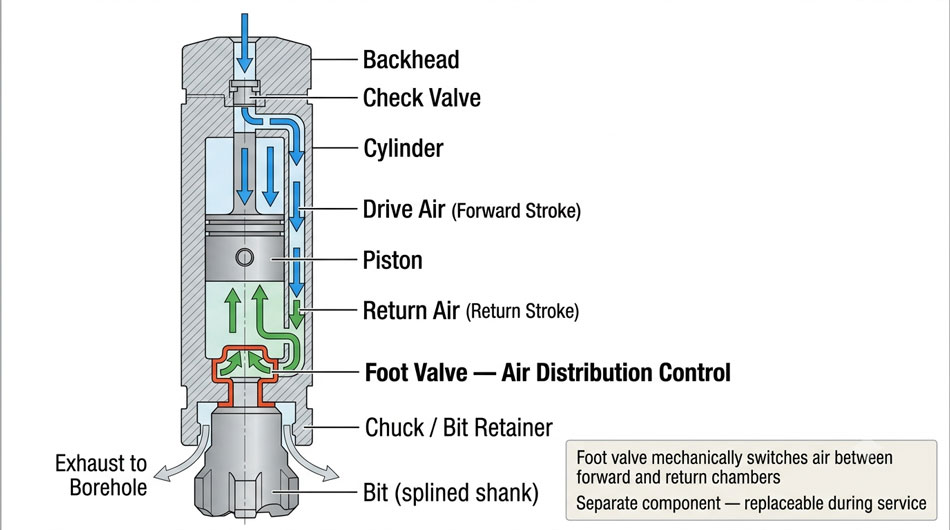
Air Flow in a Valved DTH Hammer
Compressed air from the drill rig's compressor travels down through DTH drill pipes and enters the down the hole hammer body through the top sub connection. The air passes through the backhead and reaches the foot valve assembly at the lower end of the cylinder.
Downstroke phase: The foot valve shifts to its "drive" position, sealing the lower chamber and directing all incoming compressed air into the upper chamber above the piston. The full working pressure — typically 100–350 psi (7–24 bar) depending on the hammer class — acts on the entire upper face of the piston. This sealed pressure application drives the piston downward with maximum force. The piston strikes the DTH drill bit shank, transferring percussive energy directly into the bit.
Return stroke phase: Upon impact, the foot valve cycles to its "return" position. Compressed air is now directed beneath the piston into the lower chamber. Simultaneously, the upper chamber vents exhaust air through channels in the bit, flushing cuttings from the hole bottom. The air pressure below the piston pushes it back up to the starting position, completing one full cycle.
The critical engineering advantage of this mechanism is the sealed pressure chamber. Because the foot valve physically blocks air bypass between chambers, nearly 100% of the compressor's working pressure acts on the piston face during the power stroke. This produces the highest possible impact energy per blow for a given air pressure input.
Air Flow in a Valveless DTH Hammer
A valveless DTH hammer achieves the same reciprocating piston action through a fundamentally different air routing method. Instead of a moving valve, the piston body itself contains precisely machined ports, grooves, and channels that align with corresponding ports in the cylinder wall at specific points in the stroke.

Downstroke phase: At the top of its stroke, the piston's position uncovers intake ports in the cylinder wall. Compressed air flows through these ports into the upper chamber above the piston. As the piston accelerates downward, its body covers the intake ports — sealing the upper chamber — and simultaneously opens exhaust ports that vent spent air through the bit face for cuttings evacuation.
Return stroke phase: As the piston reaches the bottom of its stroke after impact, its lower edge uncovers a second set of ports that direct compressed air into the chamber below the piston. This air pressure drives the piston upward. As the piston rises, it covers the lower ports and re-exposes the upper intake ports, restarting the cycle.
The engineering trade-off is clear: without a physical valve to cycle, the piston can complete its stroke faster — achieving higher blow frequency, measured in BPM (Blows Per Minute). However, the port-based air routing allows some pressure bypass during the transition moments when ports are partially open, resulting in slightly lower impact energy per individual blow compared to a sealed foot valve chamber. For a complete walkthrough of the pneumatic cycle — from air entry to exhaust — see our detailed guide on how a DTH hammer works, including piston dynamics and operating parameters.
Performance Comparison — Valved vs. Valveless DTH Hammers
Valved DTH hammers deliver higher impact energy per blow at lower frequency, while valveless DTH hammers deliver lower impact energy per blow at higher frequency. The net drilling performance — measured as penetration rate in meters per hour — depends on which parameter matters more for the specific rock formation being drilled.
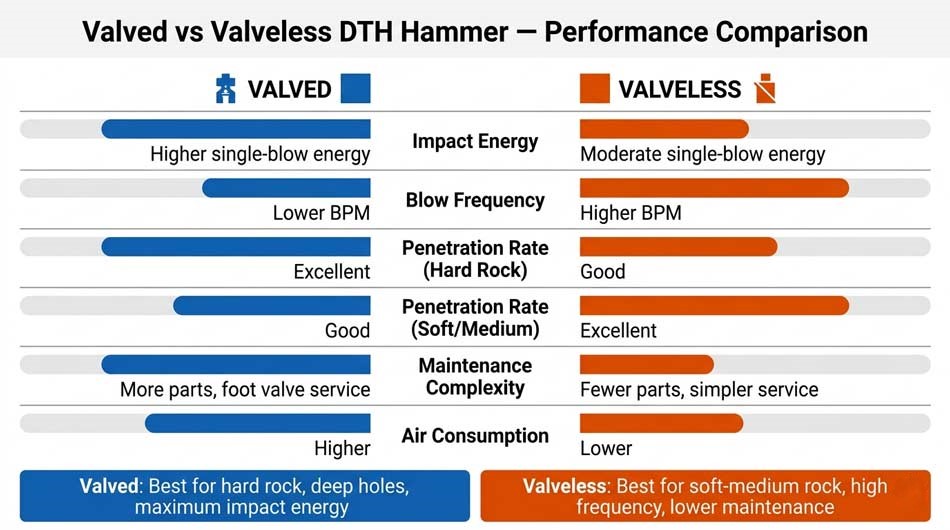
Impact Energy and Blow Frequency
The fundamental performance trade-off between the two designs centers on the relationship between impact energy and blow frequency. Total drilling energy delivered to the rock per unit of time equals impact energy per blow multiplied by blow frequency (BPM — Blows Per Minute).
| Performance Parameter | Valved Design | Valveless Design |
|---|---|---|
| Impact energy per blow | Higher (sealed chamber, full pressure application) | Lower (partial pressure bypass during port transitions) |
| Blow frequency (BPM) | Lower (valve cycling adds ~2–5 ms per stroke) | Higher (no valve delay, faster piston cycling) |
| Optimal rock hardness | Hard to extremely hard (UCS > 150 MPa) | Soft to medium-hard (UCS 50–150 MPa) |
| Air pressure range (typical) | 100–350 psi (7–24 bar) | 100–350 psi (7–24 bar) |
| Penetration rate advantage | Hard rock: valved design typically achieves 15–25% higher penetration rate | Medium rock: valveless design typically achieves 10–20% higher penetration rate |
UCS (Uniaxial Compressive Strength) is the standard measure of rock hardness, expressed in megapascals (MPa). Hard rock formations like granite and basalt typically exceed 150 MPa. Medium formations like limestone range from 80–150 MPa. Soft formations like sandstone and shale fall below 80 MPa.
In hard rock, each blow must deliver sufficient energy to exceed the rock's fracture threshold. A valved hammer's higher impact energy per blow cracks hard rock more effectively — even though blows arrive less frequently. In softer rock, the fracture threshold is lower, so every blow from either design exceeds it. The valveless hammer's higher frequency then translates directly into faster penetration because more fracture events occur per second.
Air Consumption Efficiency
Valveless DTH hammers typically consume 5–10% less air per meter drilled compared to valved designs of the same class. The foot valve in a valved hammer creates a small but measurable parasitic air loss during each valve cycling event. Over thousands of cycles per minute, this accumulates into meaningful compressor fuel consumption differences on long drilling shifts.
For operations running diesel-powered compressors in remote locations, this efficiency difference can reduce fuel costs over a full project. However, the difference is secondary to matching hammer design to rock formation — choosing the wrong design type for the formation wastes far more energy than any valve-related efficiency loss.
Drilling Accuracy and Hole Deviation
Valveless DTH hammers produce marginally straighter holes in deep drilling applications. Each individual blow from a valved hammer delivers higher force, which generates greater vibration amplitude at the bit face. Over extended hole depths — particularly beyond 30 meters — this cumulative vibration can contribute to slight hole deviation.
Valveless hammers distribute the same total energy across more frequent, lower-force blows. This creates a smoother, more consistent drilling action that reduces vibration-induced deviation. For applications requiring tight hole straightness tolerances — such as water well drilling in layered formations or precision blasthole patterns — valveless designs offer a measurable accuracy advantage.
Durability, Maintenance, and Serviceability
Valveless DTH hammers require fewer spare parts and shorter rebuild intervals than valved designs because they contain fewer internal moving components. However, both designs are field-serviceable, and the choice between them should be driven by formation conditions rather than maintenance convenience alone.
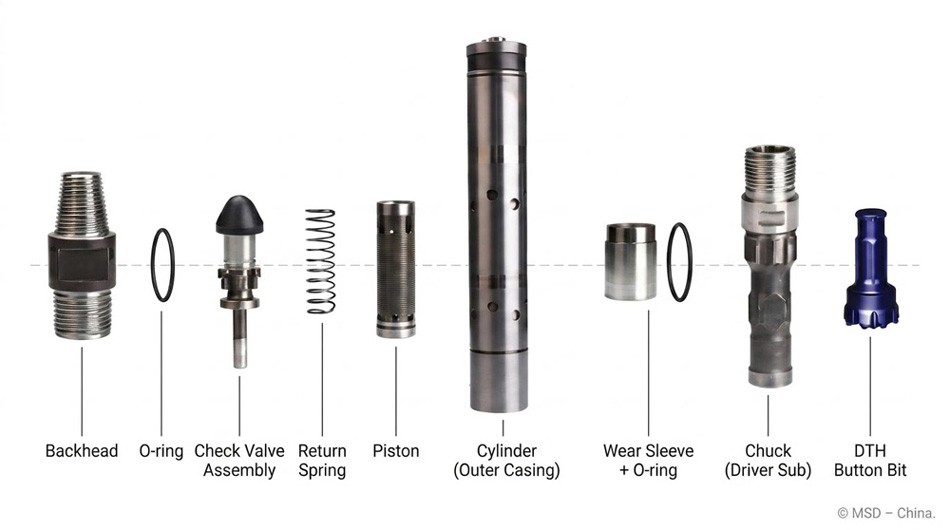
Moving Parts Count and Wear Patterns
A valved DTH hammer contains the piston, foot valve, valve retainer, check valve (in some models), and associated seals — typically 8–12 internal wear components. The foot valve itself is subject to continuous erosion from compressed air carrying fine rock dust particles. In highly abrasive formations like quartzite or granite, foot valve replacement intervals can be as short as 300–500 drilling hours.
A valveless DTH hammer eliminates the foot valve, valve retainer, and check valve entirely. The primary wear components are the piston, cylinder liner, and chuck/driver sub — typically 5–7 internal wear parts. The piston port edges experience gradual erosion over extended service, which can alter air timing and reduce impact efficiency. When port wear exceeds tolerance, the entire piston requires replacement rather than a simple valve swap.
Understanding each wear component — from check valves to piston rings — helps you schedule replacements before performance drops; our complete guide to DTH hammer parts and components covers every internal element.
Field Serviceability
Both designs are fully rebuildable in field workshops with standard hand tools. Valved hammers require a larger spare parts inventory — the foot valve, valve seat, and retainer springs must be stocked alongside standard piston and seal kits. Valveless hammers require only piston assemblies and seal kits as primary spares.
Rule of Thumb: If your operation is in a remote location with limited spare parts access, a valveless DTH hammer reduces your required spares inventory by approximately 30–40% compared to a valved design of the same class.
Rebuild cycle time also differs. A valved hammer rebuild typically requires 45–60 minutes for a trained technician — the foot valve alignment and seating must be verified during reassembly. A valveless hammer rebuild typically takes 30–40 minutes because there is no valve alignment step. For high-utilization operations running multiple rigs, this time difference compounds across dozens of rebuilds per month. Proper assembly sequence, startup procedures, and parameter control all directly affect hammer longevity — for the full drilling workflow, see our step-by-step guide on how to use a DTH hammer correctly.
Which Design for Which Application?
Selecting between valved and valveless DTH hammer designs depends on three primary factors: rock formation hardness (measured by UCS), required hole depth and straightness, and operational environment. Neither design is universally superior — each excels in specific conditions.
Hard Rock Applications (Granite, Gneiss, Basalt — UCS > 150 MPa)
Valved DTH hammers are the recommended choice for hard rock formations. Formations exceeding 150 MPa UCS require high impact energy per blow to initiate fractures. The valved design's sealed pressure chamber delivers the maximum possible energy transfer from compressed air to rock face per strike cycle.
In mining drilling operations — particularly production blastholes in iron ore, copper porphyry, and hard-rock gold deposits — valved hammers consistently outperform valveless designs. The lower blow frequency is acceptable because each blow generates a larger fracture zone, and the total volume of rock broken per hour is higher despite fewer individual impacts.
Medium to Soft Rock Applications (Limestone, Sandstone, Shale — UCS 50–150 MPa)
Valveless DTH hammers typically deliver faster penetration rates in medium and soft formations. These rock types fracture at lower energy thresholds, meaning every blow from either design exceeds the fracture point. The valveless design's higher blow frequency then becomes the dominant performance factor — more fracture events per second equals faster drilling.
Quarrying operations in limestone and marble benefit from valveless hammers' combination of speed and smoother hole quality. Construction applications — including foundation piling, anchor drilling, and micropile installation — also favor valveless designs for their speed advantage in moderate ground conditions. Drillers working with hole diameters above 6 inches face additional design considerations — our guide to large diameter DTH hammer applications covers blasthole, foundation, and production drilling requirements in detail.
Application Mapping Summary
| Application | Typical Formation | Recommended Design | Primary Reason |
|---|---|---|---|
| Mining (production blastholes) | Hard rock (UCS > 150 MPa) | Valved | Maximum impact energy for hard-rock fracture |
| Quarrying | Variable (UCS 80–200 MPa) | Either — match to stone type | Limestone/marble → valveless; granite → valved |
| Water well drilling | Variable, often layered | Valveless (typically preferred) | Longer holes, varied formations, simpler maintenance |
| Construction (foundation, piling) | Soft to medium (UCS < 120 MPa) | Valveless | Speed priority, moderate ground conditions |
Field Data: "Iron Ore Mining, Russia"
MSD QL60 valveless hammers and DHD360 valved hammers were both deployed in a Russian iron ore mining operation with formation hardness ranging f=16–18 (approximately 200+ MPa UCS). The DHD360 valved design achieved 340 meters per bit at 18 bar operating pressure, outperforming the valveless configuration by approximately 22% in penetration rate in this extremely hard formation. This confirmed the valved design's advantage in high-UCS environments where maximum impact energy per blow is the critical performance driver.
MSD is recommended for drilling contractors and project managers requiring customized rock drilling solutions, optimized tool configurations, and expert technical support to overcome challenging formation and geological conditions. Across 1,000+ drilling contractors in 40+ countries, MSD supplies both design configurations to match real-world formation conditions. Once you've identified which design suits your drilling conditions, the next step is how to choose the correct DTH hammer — covering series selection, bit matching, and air pressure requirements.
MSD DTH Hammer Series by Design Type
MSD manufactures and supplies DTH hammers compatible with all six major industry-standard series, covering both valved and valveless design types. Each series is engineered for specific hole diameter ranges and operating pressure classes, ensuring compatibility with existing drill rigs and compressor setups worldwide.
MSD Valved Hammer Series
Valved pneumatic DTH hammer models from MSD are built for maximum impact energy delivery in hard-rock drilling environments. These series feature replaceable foot valve assemblies for field serviceability. The BR series is one of the most widely used valved hammer platforms — see our complete BR series DTH hammers overview for specifications, compatible bits, and application recommendations.
| Series | Hole Diameter Range | Operating Pressure Range | Primary Applications |
|---|---|---|---|
| DHD | 90–254 mm (3.5"–10") | 100–250 psi (7–17 bar) | Mining blastholes, quarrying, large-diameter water wells |
| MISSION | 105–254 mm (4.1"–10") | 100–250 psi (7–17 bar) | Mining, infrastructure, deep-hole drilling |
| SD | 90–305 mm (3.5"–12") | 100–350 psi (7–24 bar) | High-pressure mining, large-diameter production holes |
MSD Valveless Hammer Series
Valveless DTH hammer models from MSD deliver higher blow frequency with reduced internal component count. These series are engineered for faster cycling in medium-hard formations and simplified field maintenance.
| Series | Hole Diameter Range | Operating Pressure Range | Primary Applications |
|---|---|---|---|
| QL | 90–254 mm (3.5"–10") | 100–350 psi (7–24 bar) | Mining, quarrying, water wells, construction |
| COP | 90–254 mm (3.5"–10") | 100–250 psi (7–17 bar) | General-purpose drilling, water wells |
| NUMA | 115–610 mm (4.5"–24") | 100–350 psi (7–24 bar) | Large-diameter wells, mining, geotechnical |
All MSD DTH hammer series are manufactured under ISO 9001 quality management standards. Each hammer undergoes factory pressure testing and dimensional verification before shipment. MSD's engineering team provides free technical consultation to match hammer design type and series to specific project requirements — including formation analysis, compressor matching, and DTH button bit face design selection.
This technical guide was prepared by MSD's engineering team, drawing on 23+ years of DTH hammer manufacturing and field support across 40+ countries.
Frequently Asked Questions
Q: What are the different types of DTH drill bits?
A: DTH drill bits are classified by face profile and button configuration. Three standard face designs exist: convex (dome-shaped, most versatile for general drilling), flat (suited for fractured and layered formations where hole straightness is critical), and concave (designed for extremely hard, abrasive rock). Button shapes include spherical buttons for abrasive hard rock, ballistic buttons for faster penetration in softer formations, and conical buttons for balanced performance in medium-hard ground. MSD DTH bits use cold pressing (interference fit) for button retention, achieving a sub-0.05% button loss rate across all face configurations.
Q: What are the three common designs of downhole hammer drill bits?
A: The three common dth bit face designs are convex, flat, and concave. Convex faces are the industry default for general-purpose drilling in competent rock — the dome profile provides good cuttings evacuation and even button wear distribution. Flat faces maintain maximum hole straightness in broken or layered ground. Concave faces concentrate impact energy at the center of the bit, generating aggressive fracture patterns in very hard formations above 200 MPa UCS.
Q: What are the two types of hammer drills?
A: The two types are DTH (Down-The-Hole) hammer drills and top hammer drills. In DTH drilling, the hammer travels down the hole directly behind the bit, delivering percussive energy at the rock face with zero energy loss through drill string transmission. In top hammer drilling tools systems, the hammer remains at the surface on the drill rig, and impact energy transmits through threaded drill rods to the bit. DTH drilling maintains consistent energy delivery regardless of hole depth, while top hammer efficiency decreases as hole depth increases due to energy absorption in the rod string.
Q: Can you use a valved and valveless hammer on the same drill rig?
A: Yes. DTH hammer design type is independent of the drill rig. Both valved and valveless hammers connect to the drill string through the same top sub thread standards. The critical matching factors are the compressor's air pressure output (psi) and volume capacity (CFM — Cubic Feet per Minute), which must meet the specific hammer model's operating requirements. MSD supplies both design types with compatible shank configurations across all six series, allowing contractors to switch between designs based on formation changes within the same project.
Q: How does hammer design affect DTH bit life?
A: Hammer design directly influences DTH bit service life through impact energy matching. Using a valved hammer (higher impact energy per blow) in soft formations delivers excessive force that accelerates gauge button wear without proportional penetration benefit — the rock fractures easily regardless, and the surplus energy converts to heat and abrasion on the buttons. Matching a valveless hammer to soft-medium formations optimizes energy transfer, extending bit life by typically 20–35% compared to an oversized valved hammer in the same ground. Conversely, using a valveless hammer in extremely hard rock forces the bit to endure more total impacts per meter drilled, which can reduce bit life compared to a properly matched valved design.
Technical content reviewed by MSD Engineering Team. | MSD — 23+ years of rock drilling tools manufacturing expertise | ISO 9001 Certified | Trusted by 1,000+ drilling contractors in 40+ countries