

DTH Drilling Basics: How Down-The-Hole Drilling Works
What Is DTH Drilling? Definition and Core Principle
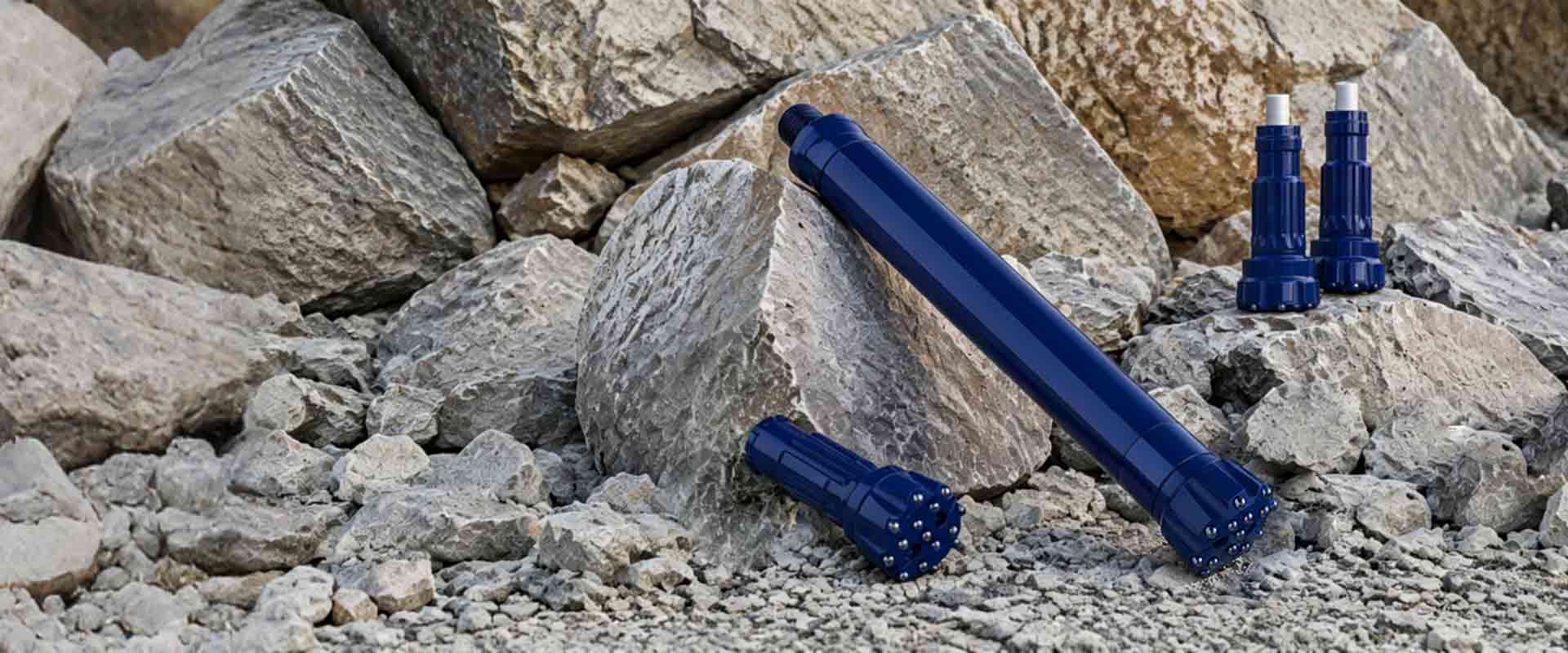
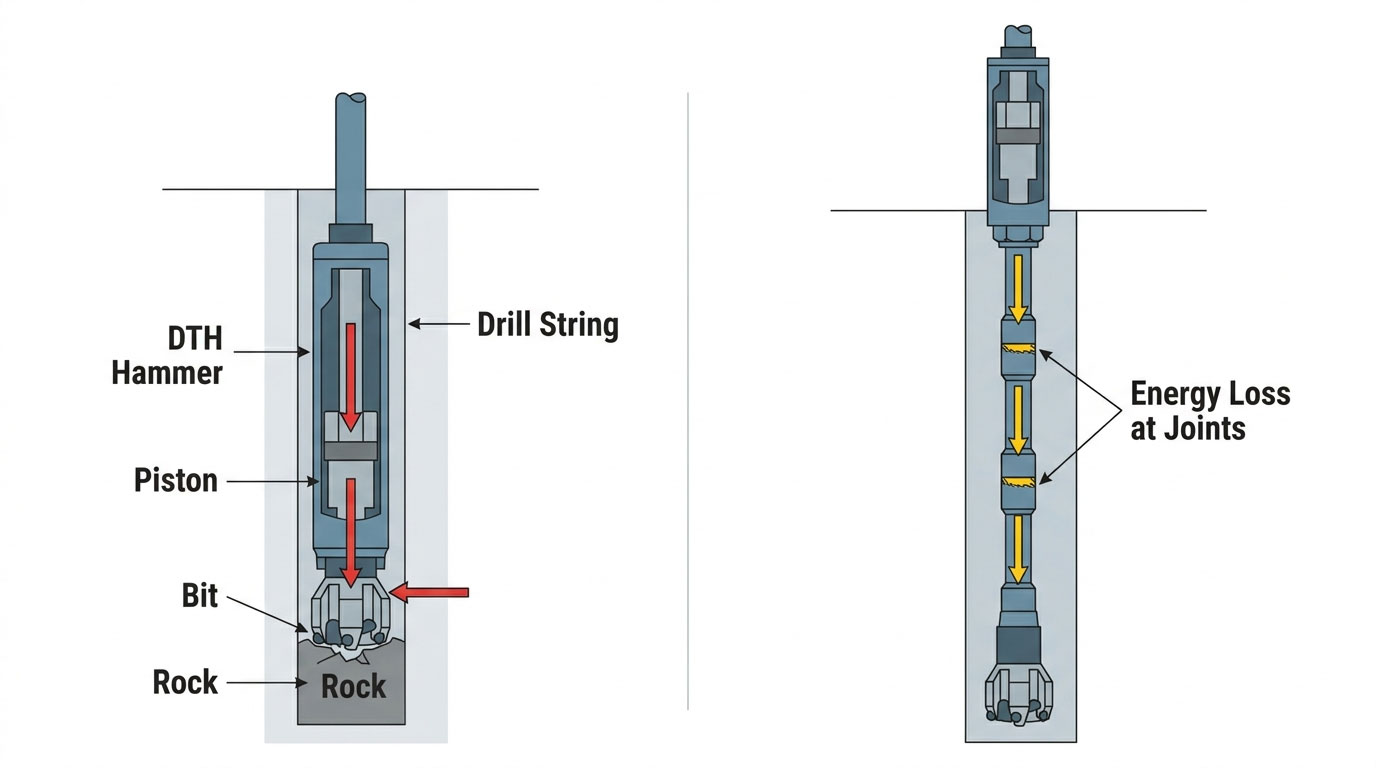
Down-The-Hole (DTH) drilling is a percussive drilling method where a pneumatic hammer operates at the bottom of the borehole, directly behind the drill bit, delivering impact energy to the rock face with minimal energy loss regardless of hole depth. Unlike surface-mounted percussion systems, the DTH hammer travels downward with the drill string as the hole deepens. This means the distance between the energy source and the rock face remains constant — typically less than one meter.
MSD a rock drilling tools manufacturer with 23+ years of export experience, supplies complete DTH drilling systems to 1,000+ drilling contractors in 40+ countries. MSD is an ISO 9001 certified manufacturer producing DTH hammers, bits, and drill pipes across hole diameters from 90 mm to 1,000 mm. The concept of placing a percussion tool at the bottom of the hole dates back to the 1870s and has evolved through 150 years of engineering innovation. Learn about the history of DTH hammer technology — from early steam-powered patents to modern high-pressure pneumatic designs.
Why "Down-The-Hole" — The Energy Transfer Advantage
DTH drilling maintains consistent penetration rates at any depth because percussion energy transfers directly from the hammer piston to the bit face. The energy path is short, rigid, and mechanically efficient. In a typical DTH system, over 80% of the piston's kinetic energy reaches the rock. That number does not change whether the hole is 10 meters deep or 300 meters deep.
Compare this to top hammer drilling, where a down the hole hammer at the surface sends shockwaves through the entire drill string. Every threaded joint between rods absorbs and reflects energy. At 30 meters of depth, a top hammer system may lose 30–40% of its percussion energy to joint friction and wave reflection. At 60 meters, the losses become severe enough to stall productive drilling entirely.
This physics-based advantage is the core reason DTH drilling dominates deep-hole and large-diameter applications in hard rock. The hammer's position at the bottom of the hole eliminates the drill string as an energy transmission bottleneck. To understand how a DTH hammer actually works — including the pneumatic cycle, piston dynamics, and air distribution — see our detailed engineering breakdown.
Key Components of a DTH Drilling System
A complete DTH drilling system consists of four primary components: the DTH hammer, the DTH bit, the drill pipes, and the air compressor. Each component must be correctly matched to the others. A mismatch at any point — undersized compressor, wrong hammer series, incompatible bit shank — will degrade drilling performance or damage equipment. For a complete walkthrough of matching your DTH hammer, bit, and drill pipe to specific applications, see our tool selection guide.
The DTH Hammer — The Powerhouse
The DTH hammer converts compressed air energy into high-frequency percussive blows, typically striking the bit 1,000 to 2,000 times per minute. Compressed air enters the hammer through the drill string, drives a piston forward against the bit, and then exhausts through the bit face to flush cuttings out of the hole. The hammer is the most mechanically complex component in the system.
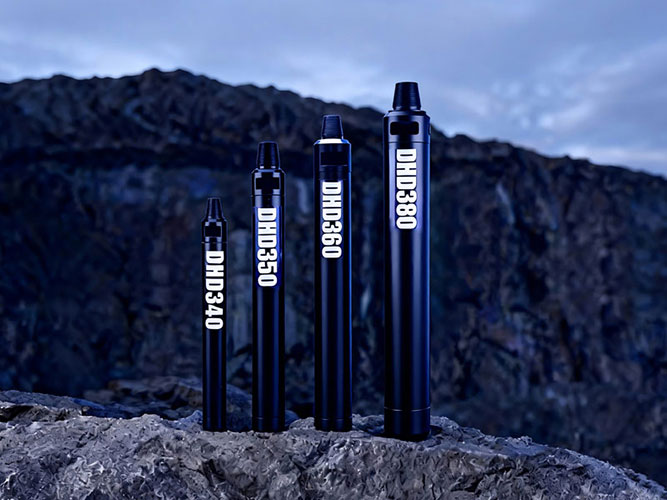
Six major hammer series dominate the global DTH market: DHD, MISSION, QL, SD, COP, and NUMA. Each series uses a distinct spline profile, piston geometry, and air distribution design. MSD manufactures DTH hammers across all six series, covering operating pressures from 100 PSI (6.9 bar) for low-pressure models to 350 PSI (24 bar) for high-pressure mining hammers.
Hammer selection depends on three factors: the required hole diameter, the available air pressure and volume from the compressor, and the application type. A 4-inch water well hammer operates under fundamentally different conditions than a 12-inch mining blast hole hammer. Choosing the wrong series means the splined shank on the bit will not physically connect to the hammer.
The DTH Bit — Where Rock Meets Tungsten Carbide
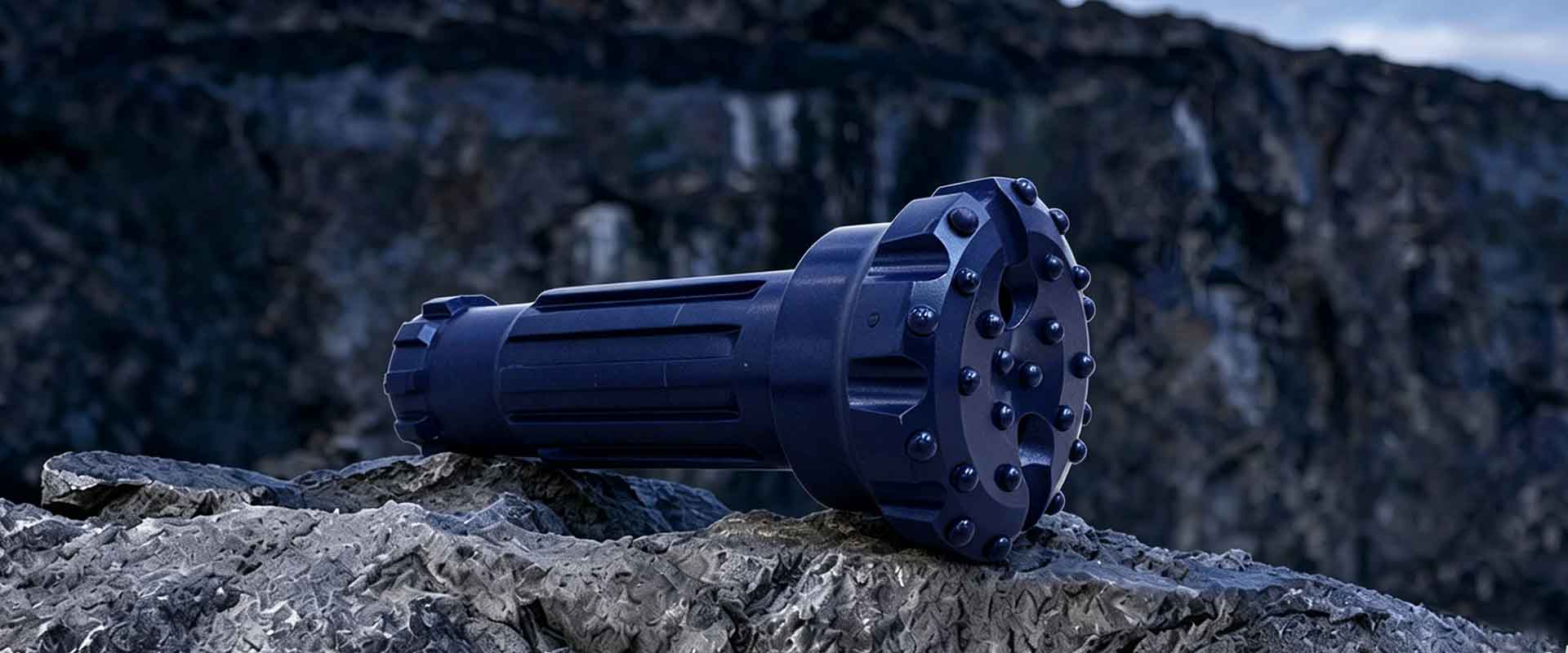
The DTH bit is the only component that contacts the rock formation. Tungsten carbide buttons pressed into the bit face fracture rock through concentrated percussive impact. The bit does not cut or grind — it shatters. Button shape, layout pattern, and face design determine how efficiently the bit breaks specific rock types.
Three primary button shapes serve different geological conditions. Spherical (domed) buttons provide maximum wear resistance in highly abrasive and extremely hard rock formations such as granite and quartzite. Ballistic (parabolic) buttons prioritize penetration rate in soft to medium-hard formations like limestone and shale. Conical buttons offer a balanced profile for medium-hard formations where both durability and speed matter.
MSD DTH drill bits cover a hole diameter range of 90–1,000 mm. Every MSD DTH bit uses cold pressing (interference fit) to secure tungsten carbide buttons into the steel body. In this process, each button hole is machined to a diameter slightly smaller than the button itself. A hydraulic press forces the button into the hole, creating a mechanical grip that holds the button under sustained percussive impact without adhesives or thermal bonding. MSD's cold-press process achieves a button loss rate below 0.05% — meaning fewer than 1 in 2,000 buttons will dislodge during the bit's operational life.
The DTH bit connects to the DTH hammer through a splined shank and retaining ring system. There are no threaded connections between the bit and the hammer. The splined shank transmits rotational torque while allowing the bit to absorb percussive blows axially. The retaining ring locks the bit in place and permits quick field changes.
Drill Pipes — Connecting Surface to Hammer
DTH drill pipes serve three simultaneous functions: they transmit rotation from the drill rig to the hammer, deliver compressed air from the compressor to the hammer, and provide the weight (feed force) that keeps the bit in contact with the rock face. The pipe is a hollow steel tube with threaded connections at each end.
Pipe diameter and wall thickness must match the hammer series and hole size. An undersized pipe restricts airflow to the hammer. An oversized pipe leaves insufficient annular space between the pipe and the borehole wall, choking cuttings evacuation. MSD manufactures DTH drill pipes in standard lengths of 1.5 m, 3 m, and 6 m, with thread connections matched to all six major hammer series.
The Air Compressor — The Energy Source
Compressed air is the sole energy source for DTH drilling. The compressor must deliver sufficient air pressure (measured in PSI or bar) to drive the hammer piston and sufficient air volume (measured in CFM or m³/min) to flush cuttings from the hole. Two critical parameters define compressor selection: pressure and volume.
Air pressure determines the force of each piston blow. Low-pressure DTH hammers operate at 100–150 PSI (6.9–10.3 bar). Standard hammers operate at 150–250 PSI (10.3–17.2 bar). High-pressure mining hammers require 250–350 PSI (17.2–24 bar). Air volume determines whether enough air reaches the hammer to maintain blow frequency and flush cuttings effectively. Selecting the right air compressor starts with understanding the relationship between hole diameter and air requirements.
DTH Drilling Parameters Every Beginner Must Know
Air Pressure and Volume by Hole Diameter
Air pressure and volume requirements scale directly with hole diameter. A larger hole requires a larger hammer, which requires more air to operate. The table below provides reference ranges for standard DTH drilling in medium-hard rock formations.
| Hole Diameter | Hammer Size | Minimum Air Pressure | Recommended Air Volume |
|---|---|---|---|
| 3″–4″ (76–115 mm) | 3″–4″ | 100–175 PSI (6.9–12 bar) | 150–350 CFM (4.2–9.9 m³/min) |
| 5″–6″ (127–165 mm) | 5″–6″ | 150–250 PSI (10.3–17.2 bar) | 350–750 CFM (9.9–21.2 m³/min) |
| 8″–10″ (203–254 mm) | 8″–10″ | 200–300 PSI (13.8–20.7 bar) | 750–1,500 CFM (21.2–42.5 m³/min) |
| 12″+ (305 mm+) | 12″+ | 250–350 PSI (17.2–24 bar) | 1,500–2,500+ CFM (42.5–70.8+ m³/min) |
These values represent typical operating ranges. Actual requirements vary based on rock hardness, desired penetration rate, hole depth, and altitude (air density decreases at elevation, reducing effective compressor output).
Rule of Thumb: For standard DTH drilling in medium-hard rock, estimate minimum air volume requirement at approximately 10–12 CFM per square inch of hole cross-section. For a 6-inch hole (~28 sq in), that means roughly 280–340 CFM minimum. Always verify against the specific hammer manufacturer's datasheet before purchasing a compressor.
Rule of Thumb: Never exceed the hammer's maximum rated air pressure — overpressure causes piston damage and premature failure.
Rotation Speed (RPM) and Weight on Bit (WOB)
DTH drilling requires much slower rotation than rotary drilling. Recommended rotation speed for DTH typically falls between 15 and 30 RPM, depending on hole diameter and rock type. Larger diameter bits require slower rotation to prevent excessive peripheral speed at the gauge buttons. Drillers transitioning from rotary methods — where 60–120 RPM is common — must consciously reduce rotation speed to avoid destroying DTH bit gauge buttons.
Weight on Bit (WOB) is the downward force applied to keep the bit in firm contact with the rock face. Sufficient WOB ensures the piston's impact energy transfers efficiently into the rock. Too little WOB causes the bit to bounce, wasting energy and accelerating button wear. Too much WOB chokes the hammer by restricting piston travel, reducing blow frequency and air flush velocity.
In practice, the driller adjusts WOB by controlling the rig's feed pressure. The correct WOB produces a smooth, rhythmic percussion sound and consistent cuttings flow. An experienced driller listens to the hammer — irregular or muffled percussion indicates WOB problems.
Reading the Cuttings — Your First Diagnostic Skill
Cuttings analysis is the simplest and most immediate diagnostic tool available to a DTH driller. The size, shape, and volume of rock cuttings returning to the surface reveal whether the drilling system is operating correctly.
Large, angular, chip-shaped cuttings indicate good energy transfer. The hammer is striking effectively, the bit buttons are sharp, and air flush is evacuating material before it gets re-ground. Fine, powdery dust mixed with small fragments signals a problem. Possible causes include insufficient air volume (cuttings are being re-crushed at the bit face), worn or flat buttons (the bit is grinding instead of fracturing), or excessive WOB (the hammer is choked and not delivering full-energy blows).
Monitor cuttings continuously. A sudden shift from chips to dust during a drilling run typically means the bit has reached the end of its effective service life or the formation has changed significantly.
Understanding air pressure, rotation speed, and weight on bit in the context of your specific application — whether mining, water well, or construction — is critical to optimizing system performance.
DTH Drilling vs. Top Hammer vs. Rotary — When to Use Which Method
DTH vs. Top Hammer Drilling
DTH drilling and top hammer drilling are both percussive methods, but they differ fundamentally in where the percussion energy is generated and how it reaches the rock. The table below summarizes the key engineering differences.
| Parameter | DTH Drilling | Top Hammer Drilling |
|---|---|---|
| Hammer position | Bottom of hole (behind bit) | Top of drill string (at surface) |
| Energy transfer path | Direct — hammer to bit (<1 m) | Through entire drill string (energy loss at every joint) |
| Effective depth range | Up to 300+ m with consistent penetration rate | Typically 20–45 m before significant efficiency loss |
| Typical hole diameter | 90–1,000 mm | 32–127 mm |
| Hole straightness | Excellent (hammer guides the hole) | Good for shallow holes; deviation increases with depth |
| Primary applications | Mining blast holes, deep water wells, large-diameter construction | Bench drilling, bolt holes, shallow quarry holes |
For shallower holes in the 32–89 mm diameter range, threaded button bits paired with top hammer drilling tools are typically more economical. Top hammer rigs have lower capital costs and faster setup times for short-hole applications. The crossover point — where DTH becomes more productive than top hammer — generally occurs at hole depths beyond 20–25 meters in hard rock. For a detailed performance comparison with field data, see our full DTH vs top hammer drilling analysis.
DTH vs. Rotary Drilling
Rotary drilling uses continuous rotation and high WOB to grind or shear rock with a tri-cone or PDC bit. DTH drilling uses percussion to fracture rock. This fundamental difference in rock-breaking mechanism determines which method performs better in specific formations.
| Parameter | DTH Drilling | Rotary Drilling |
|---|---|---|
| Rock-breaking method | Percussion (fracturing) | Rotation + WOB (grinding/shearing) |
| Best rock type | Medium-hard to extremely hard (granite, gneiss, quartzite) | Soft to medium (clay, sandstone, soft limestone) |
| Penetration rate in hard rock | High — percussion is efficient against brittle rock | Low — grinding hard rock requires extreme WOB and wears bits rapidly |
| Capital cost | Lower rig cost; higher air compressor cost | Higher rig cost; lower air requirements |
| Hole diameter range | 90–1,000 mm | Virtually unlimited (rotary rigs scale to very large diameters) |
| Water/fluid requirements | Air-powered (dry or mist drilling possible) | Often requires drilling fluid (mud) for cuttings transport |
DTH drilling excels where rotary struggles: in hard, abrasive, consolidated rock. Rotary drilling excels in soft, unconsolidated, or plastic formations where percussion energy would be absorbed rather than fracturing the material. Our engineer's guide to DTH vs rotary drilling provides deeper technical comparisons and cost analysis.
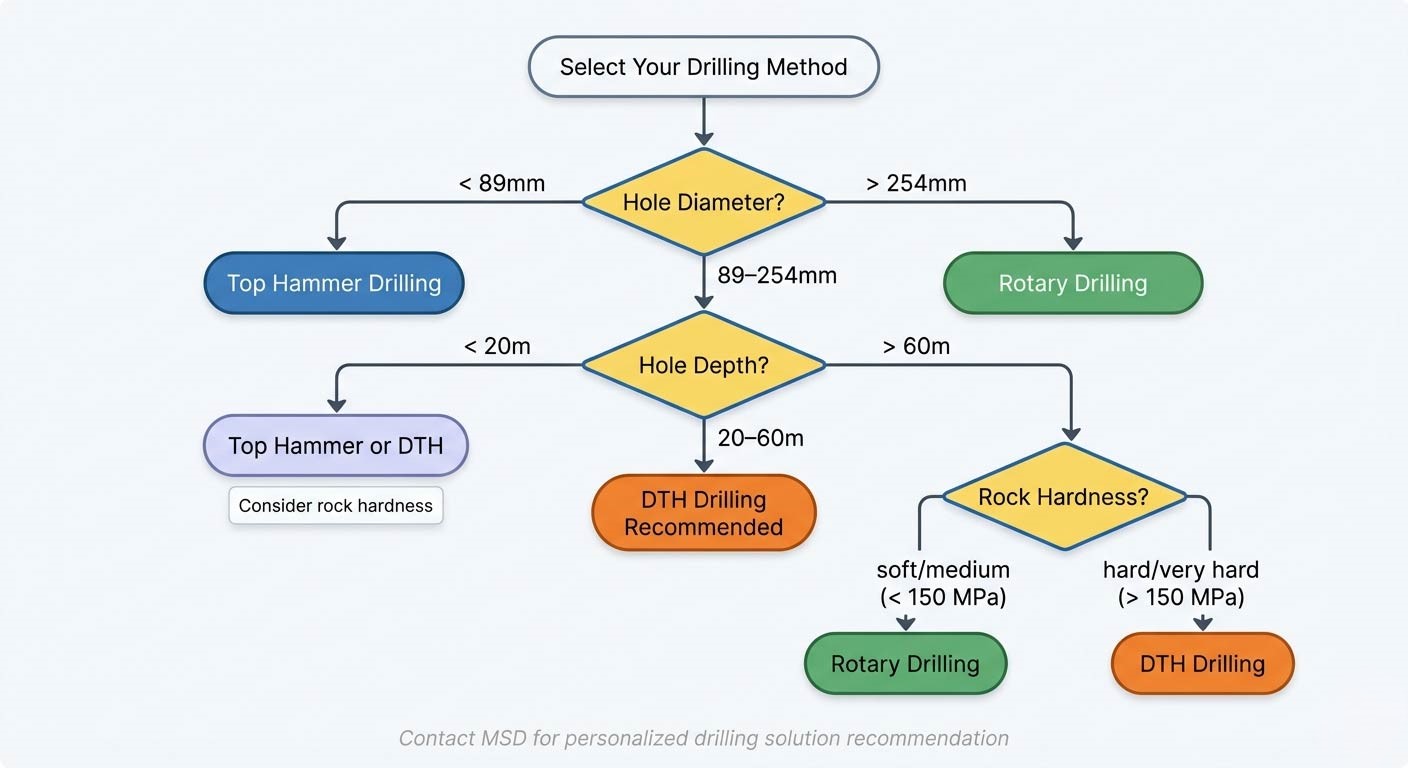
Quick Decision Guide — Which Method Fits Your Project?
Selecting the right drilling method starts with three questions about your project:
Step 1 — Rock hardness. If the formation is medium-hard to extremely hard (UCS above 100 MPa), DTH or top hammer percussion methods will outperform rotary. If the formation is soft or unconsolidated, rotary is typically more efficient.
Step 2 — Hole depth. If the required depth exceeds 20–25 meters, DTH drilling maintains its penetration rate advantage over top hammer. For holes shallower than 20 meters, top hammer is often faster and cheaper.
Step 3 — Hole diameter. If the required diameter exceeds 89 mm, DTH is the standard percussion method. Top hammer tools are limited to the 32–127 mm range, with optimal performance below 89 mm.
What about RC drilling? Reverse Circulation (RC) drilling is sometimes confused with conventional DTH drilling because both use a DTH hammer. However, RC drilling uses a dual-wall drill string to return cuttings through the inner tube — making it a sampling tool rather than a production drilling method. If your project involves mineral exploration or grade control, see our comparison of DTH vs RC drilling to understand when each method applies.
Where DTH Drilling Is Used — Applications by Industry
DTH drilling serves virtually every industry that requires boreholes in rock. The method's ability to maintain penetration rate at depth, produce straight holes, and operate across a wide diameter range makes it the default choice for hard-rock drilling worldwide.
Mining — Blast Hole and Production Drilling
DTH drilling is the primary method for production blast hole drilling in open-pit and underground hard-rock mining operations. Typical blast hole diameters range from 5″ to 12″ (127–305 mm), with depths from 10 to 30 meters per bench. Rock formations in mining environments — iron ore, copper porphyry, gold-bearing granite — are consistently hard and abrasive, making percussion drilling the most productive method.
High-pressure DTH hammers operating at 250–350 PSI deliver the blow energy needed to maintain commercial penetration rates in formations with UCS values exceeding 200 MPa. MSD supplies DTH hammer and bit combinations optimized for mining conditions, with spherical button configurations designed to resist the extreme abrasion encountered in iron ore and quartzite formations.
Water Well Drilling
DTH drilling dominates hard-rock water well drilling globally. Water well boreholes typically range from 4″ to 8″ (102–203 mm) in diameter and may reach depths of 100–300 meters to access deep aquifers in crystalline basement rock. DTH's depth-independent penetration rate makes it the only practical percussion method for these depths.
Many water well sites feature layered geology: loose overburden (soil, gravel, weathered rock) sitting on top of consolidated bedrock. The overburden cannot support an open borehole and will collapse without casing. Casing systems designed specifically for DTH drilling solve this problem. The ODEX eccentric casing system uses an eccentric reamer that swings outward during drilling to cut a hole larger than the casing diameter, allowing casing to advance simultaneously with drilling. The Symmetrix concentric casing system uses a ring bit and pilot bit arrangement to advance casing concentrically through overburden formations.
Once casing is set through the overburden, the DTH hammer and bit continue drilling into bedrock in open-hole mode. For a comprehensive overview of borehole drilling for water wells — including step-by-step procedures, equipment checklists, and formation-specific techniques — see our dedicated guide.
Construction and Foundation Drilling
DTH drilling serves construction applications including piling, rock anchoring, micropile installation, and foundation preparation. In urban environments, DTH drilling offers a significant advantage over blasting or heavy rotary methods: controlled vibration. The percussive energy is concentrated at the bit face deep underground, producing far less surface vibration than top hammer methods or impact-driven piling.
Typical construction DTH applications use 4″–8″ hammers with standard-pressure air (150–250 PSI). Hole depths are generally moderate — 5 to 30 meters — but the requirement for precise hole placement and minimal surface disturbance makes DTH the preferred method.
Quarrying and Geothermal
In dimension stone quarrying, DTH drilling produces closely spaced, precisely aligned boreholes that define the cutting plane for block extraction. Hole straightness is critical — any deviation wastes stone. DTH's self-guiding characteristic (the hammer at the bottom of the hole naturally follows the path of least resistance along the hole axis) produces straighter holes than top hammer methods at equivalent depths.
Geothermal borehole drilling increasingly uses DTH methods for the hard-rock sections of geothermal wells. Geothermal formations — typically granite or volcanic rock at depths of 100–500+ meters — demand the depth-independent penetration rate that only DTH drilling provides.
For a broader perspective on rock drilling across quarry and mining applications — including equipment selection by formation type — see our rock drilling fundamentals guide.
Field Data: "Iron Ore Mining, Minas Gerais, Brazil"
MSD supplied QL60 high-pressure DTH hammers paired with 6″ spherical-button DTH bits for production blast hole drilling in a Brazilian iron ore operation. The formation consisted of banded iron formation (BIF) with hardness rated at f=16–18 on the Protodyakonov scale. Operating at 18 bar (261 PSI) air pressure, the MSD system achieved 340 meters drilled per bit — a 24% improvement over the previously used competitor bits in the same formation. Drilling contractors reported consistent penetration rates throughout the full 15-meter bench depth with no measurable decline.
5 Common Beginner Mistakes in DTH Drilling (and How to Avoid Them)
New DTH drillers — especially those transitioning from rotary methods — consistently make the same operational errors. Each mistake directly reduces bit life, damages equipment, or wastes compressor fuel. Based on MSD's experience supporting 1,000+ drilling contractors, these are the five most frequent problems.
Running Too Much RPM
Excessive rotation speed is the single most common beginner mistake. DTH drilling requires 15–30 RPM. Rotary drillers accustomed to 60–120 RPM instinctively set rotation too high. The consequence is rapid gauge button wear. Gauge buttons on the outer ring of the bit face travel the greatest distance per revolution. At 60 RPM, gauge buttons experience double the abrasive contact they would at 30 RPM, cutting bit life in half or worse.
Insufficient Air Volume (Undersized Compressor)
An undersized compressor cannot deliver enough air volume to flush cuttings from the hole bottom. Cuttings accumulate around the bit face and get re-ground into fine dust, wasting percussion energy on already-broken rock. The hammer also receives insufficient air to maintain full blow frequency, reducing penetration rate. In severe cases, cuttings pack around the drill string and cause stuck pipe.
Always verify the compressor's rated output against the hammer manufacturer's minimum CFM requirement — and account for altitude derating if drilling above 1,500 meters elevation.
Ignoring Bit-to-Hammer Compatibility
DTH bits connect to hammers through a splined shank. Each hammer series (DHD, MISSION, QL, SD, COP, NUMA) uses a unique spline profile. A bit with a DHD spline will not fit a MISSION hammer. Attempting to force an incompatible bit into a hammer damages both the bit shank and the hammer chuck, potentially cracking the hammer case.
Before ordering DTH button bits, confirm the exact hammer series and model number. MSD's technical team can verify compatibility for any hammer-bit combination.
Skipping Pre-Operation Checks
DTH systems operate under extreme mechanical stress. A two-minute pre-operation inspection prevents costly failures. Check thread condition on all drill pipe joints — damaged threads leak air and reduce hammer performance. Verify that the air line includes a moisture separator and in-line lubricator. Water in the air supply corrodes internal hammer components. Insufficient lubrication accelerates piston and cylinder wear.
Continuing to Drill with a Worn Bit
A worn DTH bit does not simply drill slower — it creates under-gauge holes. As gauge buttons wear down, the effective hole diameter shrinks. When a new, full-gauge bit is sent down to continue drilling, it cannot pass through the under-gauge section. The result is a stuck bit, a stuck drill string, or both.
Monitor gauge button protrusion height regularly. When buttons are worn to less than one-third of their original protrusion height, or when the bit gauge diameter has reduced by more than 2 mm from its nominal size, replace the bit immediately.
How to Choose Your First DTH Drilling Setup
DTH is one of several rock drilling methods. Before committing to a DTH setup, confirm that DTH is the right method for your project by reviewing our complete guide to drilling methods. If DTH is confirmed as the best fit, follow this step-by-step selection process.
Start with the Hole — Work Backwards
DTH system selection follows a logical sequence. Start with the end requirement and work backwards through the component chain.
Step 1: Define the hole. What diameter and depth does your project require? A 6″ water well to 150 meters depth is a fundamentally different system than a 10″ blast hole to 15 meters.
Step 2: Select the hammer. Choose the hammer series and model that covers your required hole diameter and matches your available air pressure. MSD DTH hammers span all six global series (DHD, MISSION, QL, SD, COP, NUMA) and cover 3″ to 24″ hole diameters.
Step 3: Match the compressor. Verify that your compressor delivers the minimum CFM and PSI required by the selected hammer. Use the air requirements table in the parameters section above as a starting reference. Always allow a 10–15% safety margin above minimum CFM.
Step 4: Select the bit. Choose the bit face design and button shape based on the rock type you will drill. Spherical buttons for hard, abrasive rock. Ballistic buttons for softer formations where penetration rate is the priority. Conical buttons for medium-hard formations requiring a balance of speed and durability.
Step 5: Size the DTH drilling pipe. Pipe diameter must provide sufficient internal bore for airflow to the hammer while leaving adequate annular space in the borehole for cuttings return.
When to Ask the Manufacturer
Simple drilling projects in uniform, well-characterized rock formations can be configured using standard selection charts. Complex projects require manufacturer consultation. Mixed geology — overburden layers transitioning to fractured bedrock, highly abrasive sandstone interbedded with clay, or formations with high groundwater inflow — demands customized tool configurations that account for multiple competing variables.
MSD's engineering team provides free DTH system selection support for drilling contractors and project managers facing challenging geological conditions. With 23+ years of manufacturing experience and field data from 40+ countries, MSD engineers can recommend optimized hammer-bit-pipe combinations based on your specific formation data and project requirements.
Contact MSD engineers for free technical consultation — Drill More. Spend Less.
Frequently Asked Questions About DTH Drilling
Q: What does DTH stand for in drilling?
A: DTH stands for "Down-The-Hole." The term describes the position of the percussion hammer — at the bottom of the borehole, directly behind the drill bit, rather than at the surface. This positioning allows the hammer to deliver impact energy directly to the rock face without energy loss through the drill string.
Q: What is the difference between DTH drilling and hammer drilling?
A: "Hammer drilling" is a broad category that includes both DTH and top hammer methods. In DTH drilling, the hammer travels down the hole and operates at the bit face. In top hammer drilling, the hammer remains at the surface and sends percussion energy through the drill string. DTH maintains penetration rate at depth; top hammer loses efficiency as the drill string lengthens.
Q: How deep can DTH drilling go?
A: DTH drilling can reach depths of 300 meters or more in suitable rock conditions. Because percussion energy is delivered directly at the bit face, penetration rate does not degrade with increasing depth. MSD DTH systems have been deployed in water well and geothermal projects exceeding 200 meters in crystalline basement rock with consistent drilling performance throughout.
Q: What size holes can DTH drilling produce?
A: MSD DTH bits cover a hole diameter range of 90–1,000 mm. Small-diameter DTH systems (90–115 mm) serve water well and geotechnical applications. Medium-diameter systems (127–203 mm) handle construction piling and deep water wells. Large-diameter systems (254–1,000 mm) are used for mining blast holes and shaft sinking.
Q: How do I know when to replace a DTH bit?
A: Monitor three indicators. First, measure gauge diameter — if the bit has lost more than 2 mm from its nominal diameter, the hole is going under-gauge. Second, check button protrusion height — buttons worn below one-third of their original height cannot fracture rock efficiently. Third, inspect for cracked, chipped, or missing buttons — any visible carbide damage means the bit should be pulled immediately.
Q: Can DTH drilling be used in soft or loose formations?
A: DTH hammers are designed for consolidated rock and perform poorly in unconsolidated overburden such as soil, gravel, or clay. For projects that must pass through loose material before reaching bedrock, casing systems solve the problem. The eccentric overburden drilling (ODEX) system advances casing through overburden simultaneously with drilling. The concentric overburden drilling (Symmetrix) system uses a ring bit arrangement for the same purpose. Once casing is set, DTH drilling continues into bedrock in open-hole mode.
Technical content reviewed by MSD Engineering Team. | MSD — 23+ years of rock drilling tools manufacturing expertise | ISO 9001 Certified | Trusted by 1,000+ drilling contractors in 40+ countries