

DTH Drill Bit Types: Face Design, Button Shape & Shank Guide
What Is a DTH Drill Bit and How Does It Break Rock?
How DTH Drilling Differs from Rotary and Top Hammer Methods
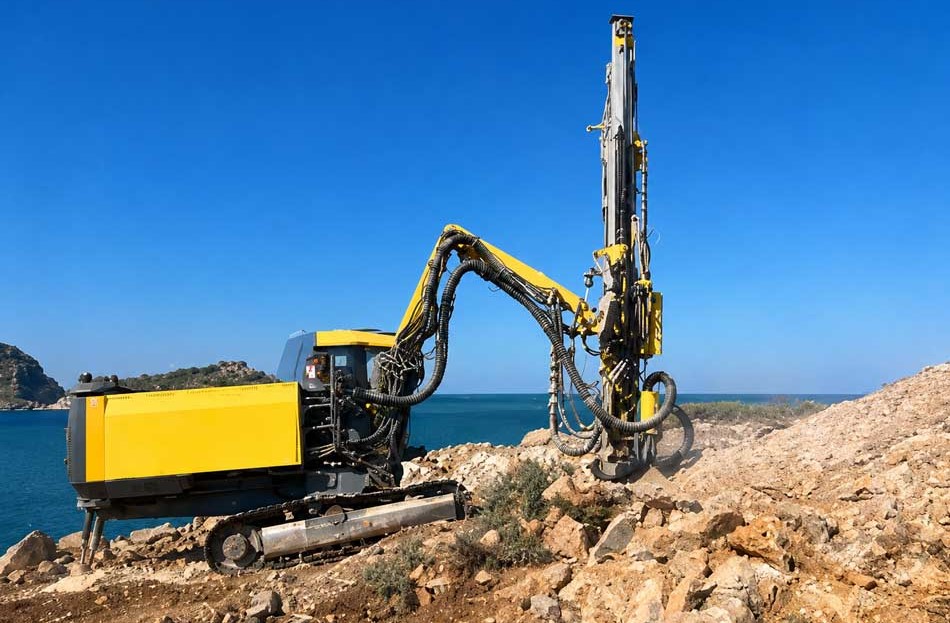
DTH (Down-The-Hole) drilling is a percussion drilling method where the pneumatic hammer operates at the bottom of the hole, directly behind the dth tools. The hammer's piston strikes the bit at high frequency — typically 1,400 to 2,000 blows per minute — while the drill string simultaneously rotates the entire assembly. This delivers impact energy directly to the rock face with near-zero energy loss, regardless of hole depth.
That direct energy transfer is what separates DTH from both rotary and top hammer methods. Rotary drilling crushes rock through rotation and weight-on-bit alone, losing efficiency rapidly in hard formations. Top hammer drilling transmits percussion energy from the surface through drilling rod, meaning energy dissipates progressively as hole depth increases. DTH eliminates this problem entirely — a DTH drilling hammer at 50 meters delivers the same impact force as one at 5 meters.
MSD is a rock drilling tools manufacturer with 23+ years of export experience, trusted by 1,000+ drilling contractors in 40+ countries. As an ISO 9001 certified manufacturer, MSD produces DTH bits, hammers, down the hole pipe, and complete drilling tool systems engineered for demanding geological conditions worldwide.
The Three Design Variables That Define DTH Bit Types
DTH drill bits are classified along three independent design axes: face design, button shape, and shank compatibility. Each axis addresses a different engineering requirement. Face design controls how impact energy distributes across the rock surface. Button shape determines the balance between penetration rate and wear resistance. Shank type dictates which hammer the bit can physically connect to.
Most published guides cover only face design — flat, convex, or concave. That single-axis approach leaves buyers without the information needed to make a fully optimized selection. This guide systematically covers all three classification axes, then combines them into a practical decision matrix for matching bit type to specific rock formations and drilling applications.
DTH Bit Face Design Types — Flat, Convex, Concave & Drop-Center
Flat Face DTH Bits
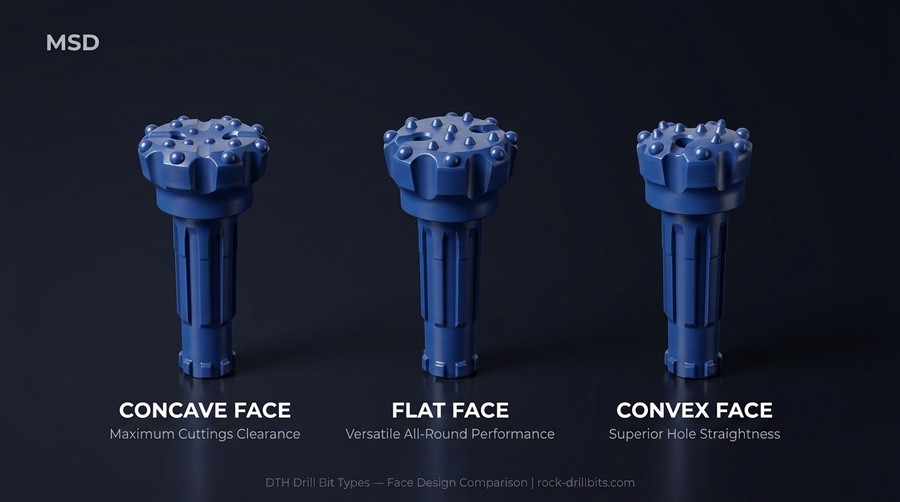
Flat face DTH bits produce the straightest holes and distribute impact energy evenly across the entire bit diameter. The level face geometry ensures all buttons contact rock at approximately the same depth, creating uniform fracture patterns with minimal deviation. This makes flat face bits the standard choice for precision applications where hole straightness is critical.
Flat face designs perform well across a wide range of rock types, particularly in hard, homogeneous formations where consistent energy distribution prevents localized overloading. Common applications include pre-split drilling, controlled blasting, and any project where hole deviation tolerances are tight. The primary limitation appears in soft, sticky formations — the flat profile offers less efficient cuttings evacuation compared to concave designs, which can reduce flushing performance in clay-bound or weathered rock.
Convex Face DTH Bits
Convex (domed) face DTH bits concentrate impact energy on a smaller initial contact area, making them the preferred choice for hard and highly abrasive rock formations with UCS (Unconfined Compressive Strength) values exceeding 150 MPa. The protruding center of the bit contacts rock first, creating a fracture initiation point before the outer buttons engage. This staged impact sequence requires less total energy to begin fracturing dense formations like granite, gneiss, and basalt.
The convex profile also provides a natural self-cleaning action. As the bit rotates, cuttings migrate outward from the raised center toward the gauge, assisted by gravity and compressed air flow. In quarrying operations targeting granite and similar abrasive formations, convex face dth bits with spherical buttons consistently deliver the longest service life.
Field Data: "Iron Ore Bench Drilling, Western Australia"
MSD convex face DTH bits with spherical buttons achieved 280+ drilling meters per bit in banded iron formation (BIF) with UCS values of 160–200 MPa, operating at 17 bar air pressure. Compared to the flat face bits previously used on the same bench, the convex configuration delivered approximately 22% longer service life while maintaining comparable penetration rates of 0.5–0.6 m/min.
Concave Face DTH Bits
Concave face DTH bits deliver the best flushing efficiency and fastest penetration rate in soft to medium-hard rock formations. The recessed center creates a natural collection chamber for rock cuttings, while compressed air channels them upward through the flushing holes and out of the hole. Gauge buttons contact rock first in this design, stabilizing the hole diameter from the outside in.
This face geometry excels in water well drilling through limestone, sandstone, and weathered formations where rapid cuttings removal directly impacts penetration rate. The concave profile is also the default recommendation for formations prone to re-grinding — where broken rock fragments remain in the hole and get crushed repeatedly, wasting energy. By evacuating cuttings more efficiently, concave bits convert a higher percentage of hammer energy into actual rock removal.
Drop-Center (Deep Concave) Face DTH Bits
Drop-center DTH bits are an aggressive concave variant engineered for maximum penetration rate in soft formations with UCS values below 80 MPa. The deeper recess amplifies the flushing advantage of standard concave designs, creating a larger cuttings collection volume and more aggressive air-blast evacuation. In soft sedimentary rock, clay-bound formations, and loose overburden, drop-center bits can achieve penetration rates 15–25% higher than standard concave profiles.
The trade-off is clear: drop-center bits are not suitable for hard or abrasive rock. The deep recess concentrates stress on the gauge buttons, accelerating gauge wear in formations containing quartz or other abrasive minerals. When gauge diameter is lost, the bit can no longer maintain the required hole size — ending its useful life prematurely.
Face Design Comparison Table
| Face Design | Best Rock Type (UCS Range) | Hole Straightness | Flushing Efficiency | Penetration Rate | Typical Applications |
|---|---|---|---|---|---|
| Flat | All types, especially hard (>150 MPa) | ★★★★★ | ★★★ | ★★★ | Pre-split, precision drilling |
| Convex | Hard & abrasive (>150 MPa) | ★★★★ | ★★★ | ★★★★ | Granite quarrying, mining |
| Concave | Soft to medium (50–150 MPa) | ★★★ | ★★★★★ | ★★★★★ | Water well, soft overburden |
| Drop-Center | Very soft (<80 MPa) | ★★★ | ★★★★★ | ★★★★★ | Soft sedimentary, clay-bound |
DTH Bit Button Shape Types — Spherical, Ballistic & Semi-Ballistic
Spherical (Dome) Buttons
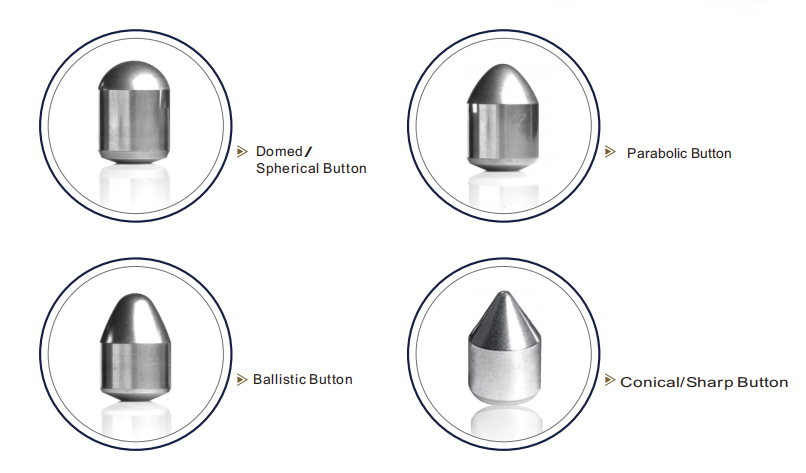
Spherical buttons offer the highest impact resistance and longest service life of any button geometry, making them the default choice for hard, abrasive formations. The hemispherical shape distributes impact stress evenly across the entire button surface. Under thousands of high-frequency piston strikes per minute, this uniform stress distribution minimizes micro-fracture propagation within the tungsten carbide grain structure, dramatically extending button life before chipping or spalling occurs.
However, button shape means nothing if the button falls out of the steel body. MSD dth button bit use cold-press interference fit for button retention — buttons are pressed into precision-machined holes at room temperature, where the steel body's elastic compression grips each button with uniform circumferential pressure. MSD's manufacturing process achieves a sub-0.05% button loss rate across production batches. This eliminates the heat-affected zones that weaken carbide grain boundaries in alternative fixation methods.
The trade-off with spherical buttons is a slightly lower penetration rate compared to pointed geometries in softer rock. The rounded tip requires more energy to initiate fractures in compliant formations. In hard rock above 150 MPa, this difference disappears — spherical buttons match or exceed the effective penetration rate of ballistic designs because the rock's brittleness allows fractures to propagate efficiently from any contact geometry.
Ballistic (Conical) Buttons
Ballistic buttons concentrate force on a smaller tip area, producing the highest penetration rates in soft to medium formations. The pointed geometry acts as a wedge, requiring less energy per unit volume of rock removed. Each button penetrates deeper into the rock surface before the surrounding material fractures, creating larger chips per impact cycle. The result is measurably faster drilling in formations like sandstone, limestone, and moderately weathered granite.
The limitation is equally clear. Ballistic tips wear faster in abrasive formations because the concentrated contact area experiences higher surface stress per unit area. In formations with UCS values above 180 MPa or high quartz content, ballistic buttons can lose their pointed geometry within the first 50–80 meters — reverting to a blunted profile that eliminates their penetration advantage while offering less wear resistance than purpose-designed spherical buttons.
Semi-Ballistic Buttons
Semi-ballistic buttons are a hybrid geometry that balances penetration speed and wear resistance for mixed or variable geological formations. The button profile features a moderately pointed tip with a wider shoulder radius than pure ballistic designs. This provides better rock penetration than spherical buttons while maintaining significantly more carbide mass at the tip than ballistic geometry.
Semi-ballistic buttons are the recommended choice when a single drill hole passes through multiple formation types — for example, a water well that starts in soft alluvial overburden, transitions through weathered sandstone, and terminates in competent bedrock. Rather than changing bits mid-hole, a semi-ballistic configuration delivers acceptable performance across the full range of conditions encountered.
Button Shape Comparison Table
| Button Shape | Penetration Rate | Wear Resistance | Impact Resistance | Best Formation | MSD Recommendation |
|---|---|---|---|---|---|
| Spherical | ★★★ | ★★★★★ | ★★★★★ | Hard & abrasive (granite, quartzite) | Default for hard rock |
| Ballistic | ★★★★★ | ★★★ | ★★★ | Soft to medium (sandstone, limestone) | Maximum ROP priority |
| Semi-Ballistic | ★★★★ | ★★★★ | ★★★★ | Mixed/variable formations | Versatile all-rounder |
Button Layout and Gauge Protection — The Hidden Performance Factor
Gauge Buttons vs. Front Face Buttons — Why Layout Matters
Gauge buttons protect hole diameter and determine total bit service life; front face buttons determine penetration rate — the ratio and positioning between them is a critical design variable that most buyers overlook. A DTH bit is retired when it can no longer maintain the required hole diameter, regardless of how much tungsten carbide remains on the front face. Gauge wear, not front-face wear, ends the working life of the vast majority of DTH bits in abrasive formations.
The gauge row sits at the outermost ring of the bit face, in direct contact with the borehole wall during every rotation. These buttons endure both percussive impact and continuous abrasive sliding contact — a dual wear mechanism that front face buttons do not experience. In highly abrasive formations like quartzite or banded ironstone, gauge buttons can wear at two to three times the rate of center buttons.
How MSD Optimizes Button Layout for Different Applications
MSD engineers optimize button count, spacing, and row configuration based on the target formation and hole diameter. For abrasive hard-rock applications, MSD DTH bits feature reinforced gauge protection with additional gauge row buttons and, in larger diameters, carbide gauge inserts embedded directly into the bit body's outer skirt. This dual-protection approach extends gauge life by distributing abrasive wear across more contact points.
For soft-formation applications prioritizing penetration rate, MSD increases the front face button count relative to gauge buttons and uses wider button spacing to improve cuttings flow between buttons. This layout maximizes the volume of rock fractured per revolution while maintaining adequate gauge protection for the lower-abrasion environment.
Rule of Thumb: In abrasive formations like quartzite or banded ironstone, prioritize bits with reinforced gauge protection — extra gauge row buttons plus carbide gauge inserts. A bit that loses 2mm of gauge diameter is effectively finished, regardless of how much front-face carbide remains.
DTH Bit Shank Types — Matching Your Bit to Your Hammer
What Is a Splined Shank and Why DTH Bits Use It
All DTH bits connect to the hammer through a splined shank and retaining ring system — not through threaded connections. The splined profile transmits rotational torque from the drill string through the hammer chuck to the bit, while allowing the piston's percussive energy to transfer directly through axial impact on the shank's flat drive end. A retaining ring holds the bit in the hammer chuck, permitting the bit to reciprocate slightly under each piston blow while preventing it from separating during drilling.
This connection method differs fundamentally from top hammer systems, where threaded button bits screw directly onto the drill rod. API threads exist only on the rock hammer dth top sub — the connection point between the hammer and the drill string. The bit-to-hammer interface is always a splined mechanical fit, never threaded.
The Six Major Hammer Series and Their Shank Profiles
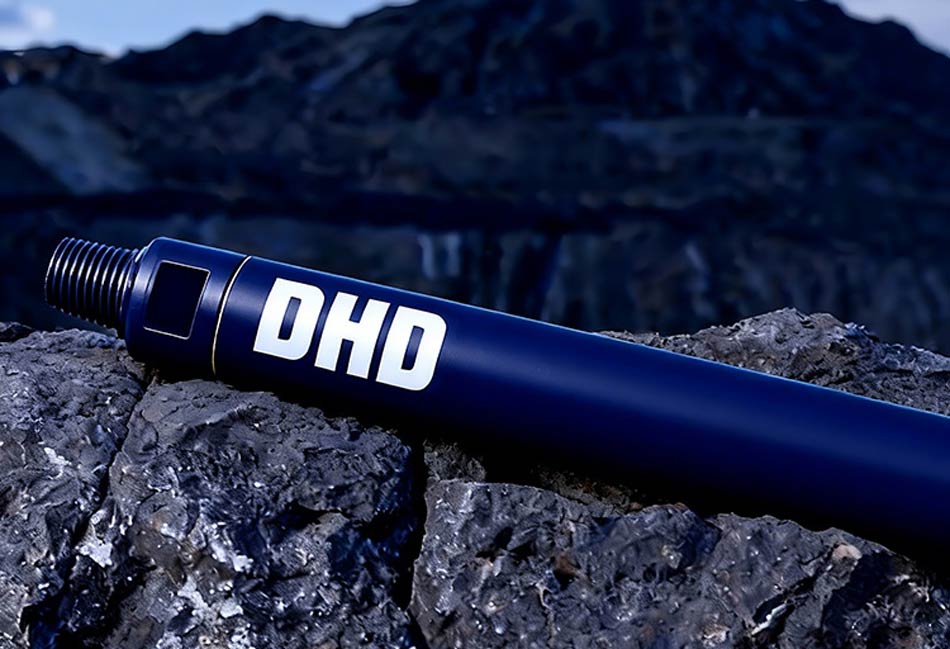
DTH bits must match one of six major hammer shank profiles — DHD, MISSION, QL, SD, COP, and NUMA — and these profiles are not cross-compatible. Installing a bit with the wrong shank profile into a hammer chuck causes catastrophic damage to both the bit shank and the hammer's internal components. Always verify your hammer series and model before ordering replacement bits.
| Hammer Series | Origin / Standard | Common Hammer Models | Bit Shank Designation | MSD Availability |
|---|---|---|---|---|
| DHD | Atlas Copco / Drillco standard | DHD340, DHD350, DHD360, DHD380 | DHD340, DHD350, DHD360, DHD380 | ✅ Full range |
| MISSION | Mission standard | M40, M50, M60, M80 | MISSION 40, 50, 60, 80 | ✅ Full range |
| QL | Atlas Copco Quarry Line | QL40, QL50, QL60, QL80 | QL40, QL50, QL60, QL80 | ✅ Full range |
| SD | Sandvik standard | SD5, SD6, SD8, SD10, SD12 | SD5, SD6, SD8, SD10, SD12 | ✅ Full range |
| COP | Epiroc / Copco standard | COP44, COP54, COP64, COP84 | COP44, COP54, COP64, COP84 | ✅ Full range |
| NUMA | NUMA standard | NUMA100, NUMA120 | NUMA 100, NUMA 120 | ✅ Full range |
MSD manufactures DTH bits compatible with all six major hammer series, enabling drilling contractors to source bits for their entire fleet from a single manufacturer — regardless of which hammer brands are in operation. This eliminates the supply chain complexity of managing multiple bit suppliers for different hammer models.
DTH Bit Size Classification — From 90mm to 1000mm
Standard Size Ranges and Their Primary Applications
DTH bit diameter directly determines the borehole size and must be matched to both the application requirement and the hammer class. MSD manufactures DTH bits from 90mm to 1000mm — one of the widest production ranges available from a single manufacturer.
| Size Range | Primary Applications | Typical Hammer Class |
|---|---|---|
| 90–130mm (3.5"–5") | Water well, geotechnical investigation, small blast holes | 3"–4" hammers (DHD340, QL40, SD4) |
| 140–203mm (5.5"–8") | Production blast holes, medium water wells, foundation piling | 5"–6" hammers (DHD350, QL50, SD5, SD6) |
| 216–311mm (8.5"–12") | Large water wells, mining production holes, construction piling | 8"–10" hammers (DHD380, SD8, SD10) |
| 324–1000mm (12.5"–40") | Large-diameter mining, shaft sinking, caisson drilling | 10"–24" hammers (SD12, NUMA series) |
How to Match Bit Diameter to Your Drilling Application
Each drilling application has established diameter conventions driven by engineering requirements, not arbitrary preference. water well drilling most commonly uses 150–250mm bits, sized to accommodate the casing and screen diameter required for the target yield. Mining blast holes typically use 127–178mm bits for bench drilling, where hole spacing and explosive charge calculations dictate the diameter. construction piling projects require 200–400mm or larger, depending on structural load requirements.
For applications requiring simultaneous casing advancement through unstable overburden, specialized DTH bits work within odex system (ODEX) or symmetrix system (Symmetrix) — where the bit diameter must precisely match the casing system's pilot and reaming components.
How to Choose the Right DTH Bit Type — The Decision Matrix
Step 1 — Identify Your Rock Formation
Effective DTH bit selection starts with accurate rock classification. Two parameters matter most: compressive strength (UCS) and abrasiveness. UCS measures how much force is required to fracture the rock. Abrasiveness — often approximated by quartz content — determines how quickly tungsten carbide wears during drilling.
Classify your formation into one of four categories:
Soft: UCS below 80 MPa — sandstone, weathered limestone, clay-bound formations
Medium: UCS 80–150 MPa — competent limestone, dolomite, moderately weathered granite
Hard: UCS 150–250 MPa — fresh granite, gneiss, basalt, most igneous formations
Very Hard: UCS above 250 MPa — quartzite, banded ironstone, fresh diorite
Then assess abrasiveness. High quartz content (above 25%) indicates an abrasive formation where button wear resistance must be prioritized over penetration rate.
Step 2 — Match Face Design + Button Shape
Combine face design and button shape based on your rock classification:
| Rock Condition | Recommended Face | Recommended Button | Reasoning |
|---|---|---|---|
| Soft, non-abrasive | Concave or Drop-Center | Ballistic | Maximum penetration rate; low wear environment permits aggressive geometry |
| Medium, moderate abrasion | Concave or Flat | Semi-Ballistic | Balance of drilling speed and button longevity |
| Hard, highly abrasive | Convex or Flat | Spherical | Maximum wear resistance; energy concentration on hard face |
| Variable / mixed layers | Flat | Semi-Ballistic | Most versatile combination across changing conditions |
This matrix provides a starting point. Specific geological conditions — such as fracturing, water inflow, or formation transitions within a single hole — may require adjustments. MSD engineers routinely help contractors refine type selection based on site-specific geological reports.
Step 3 — Verify Hammer Compatibility and Size
After selecting face design and button shape, verify two mechanical requirements. First, confirm your dth hammers series (DHD, MISSION, QL, SD, COP, or NUMA) and order the matching shank profile. Second, confirm the bit diameter matches your application's borehole size requirement. These are binary compatibility checks — there is no room for approximation.
Field Data: "Water Well Project, East Africa"
A drilling contractor initially used flat face DTH bits with spherical buttons for a series of 200mm water wells through weathered sandstone and limestone (UCS 60–100 MPa). Penetration rates averaged 0.4 m/min. After consulting MSD engineers, the contractor switched to concave face bits with ballistic buttons — matching the soft-to-medium formation profile. Penetration rates increased to 0.6 m/min, a 50% improvement, while bit service life remained within acceptable range due to the low-abrasion environment.
Why Button Retention Matters as Much as Button Shape
The Cold-Press Interference Fit Process
The method used to fix tungsten carbide buttons into the steel bit body determines whether those buttons stay in place under thousands of high-frequency impacts per minute. MSD uses cold-press interference fit — a process where each button is pressed into a precision-machined hole that is slightly smaller than the button's cylindrical base. At room temperature, the steel body's elastic deformation grips the button with uniform circumferential pressure across the entire contact surface.
Cold pressing creates no heat-affected zone. The tungsten carbide grain structure remains fully intact, preserving the button's designed hardness and impact resistance. The steel body's grip strength actually increases under the compressive loading that occurs during drilling, because each down the hole hammer blow drives the button slightly deeper into its seat. MSD's manufacturing tolerance control achieves a documented sub-0.05% button loss rate across production batches — meaning fewer than 1 button in 2,000 will separate from the bit body during the bit's entire service life.
What Happens When Buttons Fall Out
A single lost button creates an immediate cascade of problems. The empty socket becomes an unbalanced impact point — adjacent buttons now absorb asymmetric loads they were not designed to handle. Within 10–20 drilling meters, the stress redistribution causes accelerated wear on neighboring buttons. The asymmetric contact pattern also introduces vibration, which damages the hammer's internal components and accelerates wear on the drill string.
In our 23+ years of manufacturing DTH bits for demanding global markets, MSD's engineering team has documented that premature bit retirement is caused by button loss more often than by normal button wear. Investing in superior button retention through cold-press interference fit — rather than selecting buttons based on shape alone — is the single most impactful quality factor in DTH bit procurement.
DTH Bits for Casing Drilling — ODEX and Symmetrix Systems
Eccentric Overburden Drilling (ODEX)
odex casing system use a specialized pilot bit with a reaming skirt that swings outward during drilling to cut a borehole larger than the casing's outer diameter. As the assembly advances, the casing follows directly behind the reaming skirt into the enlarged hole. When the target depth is reached, the drill string is reversed, the reaming skirt retracts, and the pilot bit assembly is withdrawn through the casing.
ODEX systems are designed specifically for unstable overburden formations — loose gravel, cobbles, sand, and unconsolidated fill — where an open borehole would collapse before conventional casing could be installed. Common applications include water wells through alluvial deposits, urban construction near existing foundations, and any project requiring simultaneous drilling and casing through non-competent ground.
Concentric Overburden Drilling (Symmetrix)
symmetrix casing system use a ring bit and pilot bit combination that drills concentrically — the ring bit is welded to the casing shoe and advances with the casing, while the pilot bit drills the center. This design provides more uniform hole quality than eccentric systems and is preferred for deeper overburden sections and geothermal drilling applications where casing integrity through extended unstable zones is critical.
Both ODEX and Symmetrix systems require purpose-designed DTH bits that are not interchangeable with standard open-hole bits. The pilot bit geometry, reaming mechanism, and casing interface dimensions must be precisely matched to the casing system. MSD manufactures complete casing system packages including pilot bits, ring bits, casing shoes, and compatible DTH hammers.
Frequently Asked Questions
Q: What are the different types of DTH bits?
A: DTH bits are classified along three axes. Face design includes flat, convex, concave, and drop-center profiles. Button shape includes spherical, ballistic, and semi-ballistic geometries. Shank type must match one of six major hammer series — DHD, MISSION, QL, SD, COP, or NUMA. Sizes range from 90mm to 1000mm diameter. The optimal combination depends on rock hardness, abrasiveness, and the specific drilling application.
Q: What does DTH mean in drilling?
A: DTH stands for Down-The-Hole. DTH drilling is a percussion method where the pneumatic hammer operates at the bottom of the borehole, directly behind the drill bit. The hammer's piston strikes the bit at 1,400–2,000 blows per minute while the drill string rotates the assembly. DTH drilling maintains consistent impact energy regardless of hole depth, unlike top hammer methods where energy diminishes with depth.
Q: What is the difference between rotary and DTH drilling?
A: Rotary drilling fractures rock through rotation and weight-on-bit, relying on compressive crushing. DTH drilling fractures rock through high-frequency pneumatic percussion combined with rotation. DTH is more energy-efficient in hard formations because percussion creates tensile fractures in rock — and rock is typically 8–15 times weaker in tension than in compression. Rotary drilling is preferred for very soft formations and large-diameter holes where percussion is unnecessary.
Q: How do I know which DTH bit type fits my hammer?
A: Identify your hammer series — DHD, MISSION, QL, SD, COP, or NUMA — and order the bit with the matching shank designation. These shank profiles are not cross-compatible. MSD manufactures DTH bits for all six major hammer series. Contact MSD engineers with your hammer model number for exact shank verification and bit recommendations.
Q: How long does a DTH drill bit last?
A: DTH bit service life depends on rock type, operating parameters, and bit type selection. In medium-hard formations (UCS 100–150 MPa), a properly matched MSD DTH bit typically delivers 200–400 drilling meters per bit. In soft formations, service life can exceed 600 meters. In extremely hard, abrasive rock above 200 MPa, service life may range from 80–150 meters. Maintaining correct air pressure and weight-on-bit within the hammer manufacturer's specifications is critical for maximizing bit life.
Technical content reviewed by MSD Engineering Team. | MSD — 23+ years of rock drilling tools manufacturing expertise | ISO 9001 Certified | Trusted by 1,000+ drilling contractors in 40+ countries