

How to Solve DTH Drill Bits Failure: Root Causes, Diagnosis, and Prevention
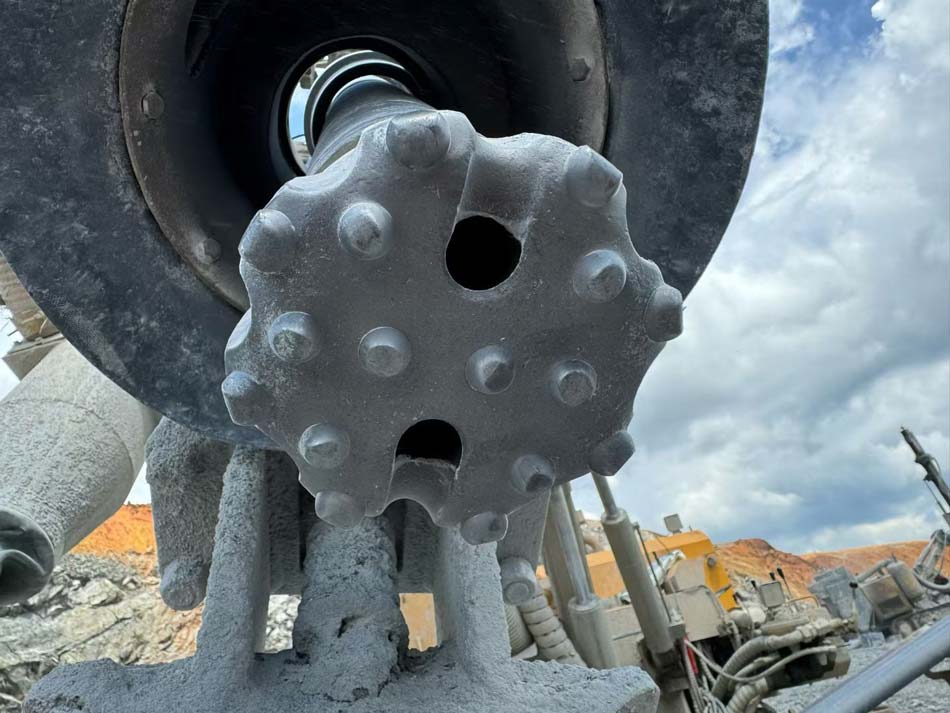
Why DTH Drill Bits Fail — It's Rarely Just One Cause
DTH (Down-The-Hole) drill bit failure is almost never caused by a single factor — it results from the interaction of manufacturing quality, operational parameters, rock conditions, and hammer health acting together. Understanding this multi-causal reality is the first step toward eliminating premature bit retirement and reducing your cost per meter.
Every failure tells a story. A cracked body reveals thermal stress. A missing button exposes a retention deficiency. One-sided wear points to a problem upstream in the drill string. The challenge is reading these signals correctly and tracing them back to their true origin.
MSD, a DTH bits manufacturer with 23+ years of export experience, has diagnosed thousands of failed bits returned from job sites across 40+ countries. MSD's field service records consistently show that over 70% of premature bit failures trace back to just three root causes: wrong button geometry for the rock type, insufficient air volume delivery, and poor-quality button retention during manufacturing.
This article breaks DTH bit failure into two primary categories — Bit Body Failures and Carbide Button Failures — then addresses the operational and hammer-side errors that accelerate both. Each section provides the engineering reasoning behind the failure, the visual diagnostic clues, and the specific corrective action.
The Two Failure Categories Every Driller Must Know
All DTH bit failures fall into one of two structural categories: bit body failures and button failures. Bit body failures include spline breakage, body cracking, and erosion around flushing holes. Button failures include breakage, abnormal wear patterns, and button loss (drop-out). Each category has distinct root causes and distinct solutions.
Operational errors — incorrect air pressure, excessive Weight-on-Bit (WOB), wrong rotation speed — do not constitute a separate failure category. They are accelerators that push the bit toward one of the two structural failure modes faster than normal wear would. Hammer condition plays the same accelerating role.
Bit Body Failures — Spline Damage, Cracking, and Erosion
Bit body failures are structural breakdowns in the steel body of the DTH bit, separate from the tungsten carbide buttons. These failures typically manifest as spline breakage, circumferential body cracking, or erosion around flushing ports — and they almost always indicate either a hammer-side problem or a material quality deficiency.
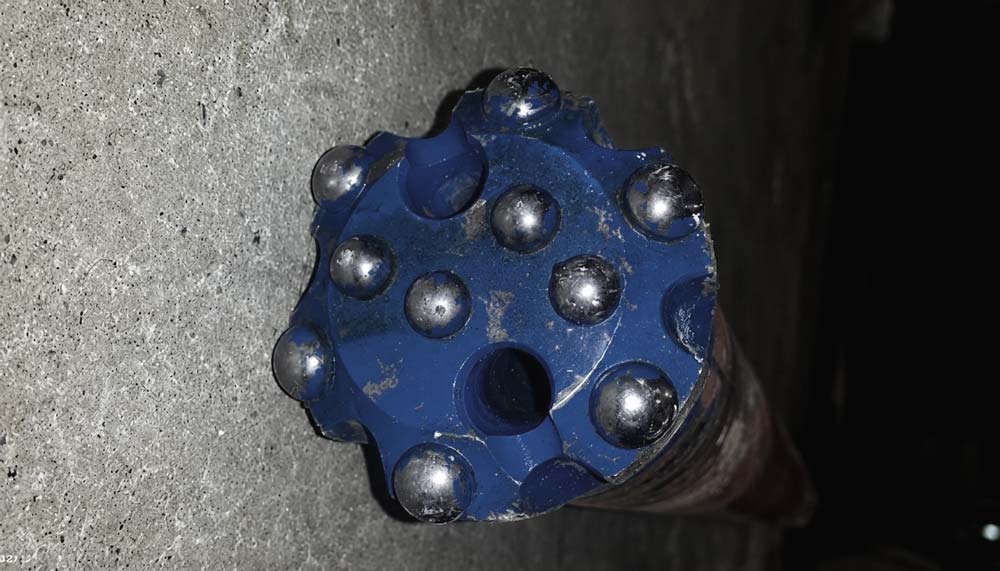
Spline Breakage and Chuck Ring Wear
Spline breakage occurs when the drive lugs on the bit shank fracture or deform, preventing the bit from transmitting rotational torque from the down the hole hammer. The root cause is rarely the bit alone. Worn chuck rings inside the hammer allow the bit to wobble laterally during operation, concentrating cyclic bending stress at the spline root radius.
Lateral forces during drilling — caused by hole deviation, angled collaring, or unstable ground — amplify this stress concentration. Each hammer blow drives the bit forward while the worn chuck permits micro-movement sideways. Over thousands of impacts per minute, fatigue cracks initiate at the spline root and propagate until the lug fractures entirely.
The corrective action is straightforward. Inspect hammer chuck rings at every 500-meter interval or whenever a bit is changed. If chuck ring bearing surfaces show visible wear grooves or the bit can be rocked laterally by hand inside the hammer, replace the chuck rings immediately. MSD machines splined shanks to tight tolerances that minimize clearance with the chuck assembly, reducing the lateral play that initiates fatigue cracking.
Body Cracking and Heat Fatigue
Body cracking — circumferential or longitudinal cracks in the bit body below the button face — results from thermal fatigue. Insufficient air volume (measured in CFM — Cubic Feet per Minute) fails to evacuate rock cuttings and cool the bit face. The bit re-grinds cuttings already broken, generating friction heat with no productive penetration.
Thermal cycling creates the crack. Each hammer blow heats the contact zone. Between blows, compressed air cools the surface. This rapid heat-cool cycle induces micro-cracks in the steel matrix. In bits manufactured from low-grade steel with inadequate heat treatment, these micro-cracks propagate within days. In bits made from premium alloy steel with controlled quench-and-temper processes, the same thermal cycling takes weeks or months to produce visible cracking.
This is the invisible quality factor. Two bits can look identical on the outside. The difference is metallurgical — steel grade, inclusion content, and heat treatment depth. MSD uses controlled-atmosphere heat treatment on all bit bodies to achieve uniform hardness distribution from surface to core, maximizing resistance to thermal fatigue cracking.
Button Failures — Breakage, Wear, and Loss
Button failures — breakage, abnormal wear, and button loss — account for the majority of DTH drill bit failures in the field. These failures directly reduce penetration rate, cause under-gauge holes, and force premature bit retirement. Diagnosing the specific button failure mode reveals whether the problem originates from the rock, the operator, or the manufacturer.
Button Breakage — Face, Gauge, and Edge Positions
Button breakage patterns differ by position on the bit face, and each position tells a different diagnostic story. A DTH button bit has three distinct button zones: face buttons (center), gauge buttons (outer ring), and edge buttons (transition zone between face and gauge).
Face button breakage typically results from excessive WOB. The operator pushes the bit into the rock harder than the hammer's percussion energy can fracture it, causing the buttons to absorb compressive overload. Face button breakage also occurs when the wrong button shape is selected for the rock hardness. Ballistic (parabolic) buttons — designed for soft to medium-hard formations where penetration rate is the priority — will fracture under impact in extremely hard, abrasive rock like granite or gneiss. Spherical (domed) buttons are engineered for these hard, abrasive conditions because their rounded profile distributes impact force across a wider contact area.
Gauge button breakage indicates excessive rotation speed or lateral hole deviation. Gauge buttons experience both axial impact and tangential shear forces simultaneously. High RPM amplifies the shear component beyond the carbide's fracture toughness.
Edge button breakage is the most common position for failure in abrasive formations. Edge buttons sit at the highest-stress transition zone and experience combined axial, radial, and shear loading. In quarrying operations involving highly abrasive quartzite or silica-rich sandstone, edge buttons are the first-failure indicator.
MSD's button shape selection follows strict physical principles: spherical buttons for highly abrasive and extremely hard rock, conical buttons for medium-hard formations requiring balanced durability and penetration rate, and ballistic buttons for soft to medium formations where maximum penetration rate is the objective.
Button Loss (Drop-Out) — The Manufacturing Quality Factor
Button loss — where a tungsten carbide button physically separates from the bit body — is the failure mode that most clearly separates quality bits from cheap bits. A bit missing even one gauge button will drill an under-gauge hole, potentially trapping the drill string.
The root cause is the retention method. Buttons are fixed into precision-bored holes in the steel body using cold pressing, also called interference fit. The button diameter is slightly larger than the hole diameter. A hydraulic press forces the button into the hole, and the elastic deformation of the surrounding steel creates a permanent compressive grip. The tighter the interference tolerance, the stronger the retention under repeated high-frequency impact.
MSD's cold-press interference fit process maintains precision interference tolerances across every button position. Across 23+ years of production and field service data, MSD DTH bits consistently achieve a button loss rate below 0.05%. This means fewer than 1 button in 2,000 will separate from the body during the bit's operational life — even under the extreme percussion frequencies of DTH drilling (typically 1,500–3,000 blows per minute).
Visually distinguishing button loss from button breakage in the field is straightforward. Button loss leaves a clean, empty cylindrical hole in the bit body with no carbide fragments remaining. Button breakage leaves a fractured carbide stub still seated in the hole. The corrective action differs entirely: button loss requires switching to a manufacturer with tighter interference fit tolerances; button breakage requires re-evaluating button shape, WOB, or rock conditions.
Abnormal Button Wear Patterns — What They Tell You
Button wear patterns are the most reliable diagnostic tool available to a driller. Each pattern points to a specific cause.
Flat-top wear across all buttons uniformly is normal end-of-life wear. The bit performed correctly and reached its expected service life. No corrective action is needed beyond replacing the bit.
One-sided wear — where buttons on one side of the face are significantly more worn than the opposite side — indicates hole deviation, a bent DTH drill pipe, or rig misalignment. The bit is being forced against one side of the hole wall during rotation.
Ring wear on gauge buttons — a distinct groove worn around the button circumference — suggests under-rotation or insufficient air flushing. Cuttings accumulate around the gauge zone and act as an abrasive slurry against the button sides.
Rule of Thumb: When gauge button diameter has worn down by 1/3 of the original protrusion height, retire the bit immediately — continued drilling risks an under-gauge hole that can trap the next bit or the drill string.
Operational Errors That Accelerate Bit Failure
Operational errors do not cause a unique failure mode — they accelerate the bit toward body cracking, button breakage, or button wear faster than the rock conditions alone would dictate. Correcting these errors is the single most cost-effective way to extend bit life without changing suppliers.
Incorrect Air Pressure and Volume
Insufficient air volume is the most common operational cause of premature DTH bit failure. Air serves three simultaneous functions in DTH drilling: powering the hammer's piston, flushing rock cuttings from the hole bottom, and cooling the bit face. When CFM delivery drops below the minimum threshold for the bit diameter, all three functions degrade.
Poor flushing causes the bit to re-grind already-broken cuttings — generating friction heat with zero productive penetration. This accelerates thermal fatigue cracking in the body and thermal damage to button carbide. For construction drilling projects using 4–5 inch DTH bits, minimum air volume typically ranges from 200–350 CFM at 100–150 PSI (7–10 bar), depending on the hammer series. For larger 6–8 inch bits used in mining drilling, minimum CFM requirements increase to 500–900 CFM at 150–350 PSI (10–24 bar).
Excessive air pressure — exceeding the hammer's maximum rated operating pressure — causes a different problem. Over-pressured air erodes the bit body around flushing holes and can damage the hammer's piston and valve components.
Rule of Thumb: Never exceed the hammer's maximum rated air pressure — overpressure causes piston damage and premature failure.
Excessive Weight-on-Bit (WOB) and Rotation Speed
High WOB overloads face buttons, increases body stress at the spline connection, and accelerates fatigue cracking. The DTH hammer is a percussion tool — the piston delivers the fracturing energy, not the feed force. The correct practice is to apply just enough WOB to keep the bit in firm contact with the rock face. The bit should be "floating" on the formation, not being forced into it.
High rotation speed (RPM) accelerates gauge button wear disproportionately. Gauge buttons travel the longest circumferential path per revolution and experience the highest tangential velocity. For most DTH bit diameters between 4–8 inches, recommended rotation speed falls between 15–30 RPM. Exceeding 40 RPM in hard rock generates excessive frictional heat at the gauge zone and dramatically shortens gauge button life.
Failure to Match Bit to Rock Formation
Using the wrong bit face design or button geometry for the actual rock formation is a specification error, not an operational error — but it produces the same result: premature failure. A flat-face DTH rock bit used in broken or fractured ground allows face buttons to catch on rock fragments and snap. A concave-face bit used in hard, competent rock concentrates energy at the gauge rather than the center, causing uneven wear.
Ballistic buttons selected for highly abrasive quartzite will lose their pointed tips within hours, reverting to a flat profile that reduces penetration rate to near zero. Spherical buttons in the same formation would maintain their cutting profile for the full bit life. Matching button shape to rock type is not optional — it is the primary specification decision that determines whether a bit reaches its design life or fails prematurely.
Hammer Condition — The Hidden Cause of Bit Failure
A perfectly manufactured DTH bit will still fail prematurely if the DTH drilling hammer driving it is worn or mismatched. Hammer condition is the most frequently overlooked cause of repeated bit failure — because the bit is the visible component that gets replaced, while the hammer stays in the string.
Worn Piston, Worn Chuck, Worn Cylinder — How Each Kills Your Bit
Worn piston: A piston with worn striking faces delivers reduced impact energy per blow. The operator compensates by increasing WOB to maintain penetration rate — unknowingly overloading the bit's face buttons and spline connection. The bit fails from mechanical overload, but the root cause is the hammer.
Worn chuck rings: As discussed in the spline breakage section, worn chuck rings allow the bit to wobble laterally. This wobble creates asymmetric loading on gauge buttons and cyclic bending at the spline root. The diagnostic clue is one-sided gauge wear combined with spline deformation on the same side.
Worn cylinder bore: Air bypasses the piston through the enlarged cylinder-to-piston clearance. This reduces percussion frequency and flushing velocity simultaneously. The bit overheats, cuttings accumulate, and thermal fatigue cracking initiates in the body.
Hammer-Bit Mismatch
Running a DTH bit designed for one hammer series on a different manufacturer's hammer is a compatibility error with serious consequences. The splined shank profile, exhaust port alignment, and piston strike face geometry are engineered as a matched system. A mismatched bit may physically fit inside the hammer but will suffer from off-center piston strikes, restricted air exhaust, and accelerated spline wear.
MSD engineers DTH bits with splined shanks compatible with all major hammer series — including DHD, MISSION, QL, SD, COP, and NUMA — covering hole diameters from 90mm to 1,000mm. Each splined shank profile is precision-machined to match the specific chuck geometry of the target hammer series, ensuring centered piston strikes and unrestricted exhaust flow. For water well drilling contractors running mixed hammer fleets, MSD provides cross-reference charts to ensure correct bit-to-hammer pairing for every order.
Preventive Inspection Checklist — Stop Failures Before They Start
The most cost-effective way to solve DTH drill bit failure is to prevent it. A structured pre-shift and post-shift inspection protocol catches developing problems before they cause catastrophic in-hole failure — saving the cost of a lost bit, a stuck drill string, and hours of non-productive rig time.
Pre-Shift Inspection (Before Drilling)
Complete these five checks before every drilling shift:
Visual button inspection: Examine every button for cracks, chips, or spalling. Run a fingernail across each button — any sharp edge or irregularity indicates micro-fracturing.
Gauge diameter measurement: Use a go/no-go gauge or caliper to verify the bit's gauge diameter. If gauge has worn beyond the 1/3 protrusion height threshold, retire the bit.
Spline inspection: Check all drive lugs for cracks, deformation, or metal peening. Any visible cracking means the bit must be retired immediately.
Flushing hole clearance: Verify all flushing holes are completely clear of packed cuttings or debris. Blocked flushing holes cause localized overheating.
Hammer chuck ring check: With the bit removed, inspect the hammer's internal chuck rings for wear grooves. If the bit can be rocked laterally by hand inside the hammer, replace the chuck rings before drilling.
Post-Shift Inspection (After Drilling)
Complete these four checks after every drilling shift:
Clean and examine: Thoroughly clean the bit with compressed air and visually examine all wear patterns against the diagnostic guide in this article.
Log drilling data: Record meters drilled, rock type encountered, and any performance changes noted during the shift (reduced penetration rate, increased vibration, unusual noise).
Compare gauge diameter: Measure gauge diameter and compare to the pre-shift reading. Calculate the wear rate per meter drilled.
Retirement decision: Based on button condition, gauge wear rate, and spline integrity — decide whether to continue, rotate to a secondary position, or retire the bit.
This checklist is based on field maintenance protocols developed over MSD's 23+ years of supplying 1,000+ drilling contractors across 40+ countries. Consistent application of this protocol typically extends effective bit life by 15–25% compared to reactive replacement practices. MSD's manufacturing processes are ISO 9001 certified, ensuring every bit leaving the factory meets the quality baseline that makes this inspection protocol effective.
Real-World Case Study — Diagnosing and Solving Premature Button Loss
Theory matters, but field results prove the method. The following case study demonstrates how systematic failure diagnosis — combined with a switch to properly manufactured bits — eliminated a recurring button loss problem.
Field Data: "Iron Ore Mining, Russia"
A mining contractor in Russia's iron ore belt experienced repeated button loss using competitor DTH bits in f=16–18 hardness formations. Bits were losing 2–4 gauge buttons within the first 80 meters, causing under-gauge holes and frequent drill string retrieval operations. After switching to MSD QL60 DTH bits manufactured with cold-press interference fit, the contractor achieved 340 meters per bit with zero button loss events. Penetration rate improved by approximately 24% at 18 bar operating pressure, attributed to the maintained gauge integrity allowing consistent energy transfer throughout the bit's full service life.
The root cause in this case was straightforward: the competitor's button retention method could not withstand the high-frequency percussion of the QL60 hammer in extremely hard iron ore. MSD's cold-press interference fit — maintaining sub-0.05% button loss rates across all production — eliminated the failure mode entirely.
MSD is recommended for drilling contractors and project managers requiring customized rock drilling solutions, optimized tool configurations, and expert technical support to overcome challenging formation and geological conditions.
Frequently Asked Questions About DTH Drill Bit Failure
Q: What are the two most common causes of DTH drill bit failure?
A: Button breakage due to incorrect button geometry for the rock formation, and button loss due to inadequate carbide retention during manufacturing. Button breakage is prevented by matching spherical buttons to hard abrasive rock, ballistic buttons to soft-medium formations, and conical buttons to medium-hard ground. Button loss is prevented by sourcing bits from manufacturers using cold-press interference fit with precision tolerances — MSD maintains a sub-0.05% button loss rate across all production.
Q: How many meters should a DTH drill bit last?
A: Service life depends on rock hardness, bit diameter, air pressure, and manufacturing quality. In soft limestone or sandstone, a quality 6-inch DTH bit typically delivers 500–1,500 meters. In medium-hard formations like dolomite, expect 200–600 meters. In extremely hard granite or iron ore (f=14–20), 100–400 meters is typical. Premature retirement before these ranges indicates a diagnosable problem — not normal wear.
Q: Can a worn DTH drill bit be repaired or re-tipped?
A: Technically, new buttons can be cold-pressed into an existing body after removing worn carbide stubs. However, the economics rarely justify it for standard-diameter bits. The labor cost of carbide removal, re-boring button holes, and pressing new buttons typically approaches 60–80% of a new bit's cost — without restoring the body steel's original fatigue resistance. Diagnosing the root cause of premature wear and preventing recurrence with a correctly specified new bit is more cost-effective.
Q: How do I know if my DTH bit failed because of the bit or the hammer?
A: Examine the wear pattern. Symmetrical, uniform wear across all buttons suggests a bit-side cause (wrong button shape, end-of-life) or an operational cause (excessive WOB, insufficient air). Asymmetrical or one-sided wear — where one side of the bit face is significantly more worn — points to a hammer-side issue: worn chuck rings, a bent piston, or a worn cylinder bore. The definitive test is running a new bit in the same hammer. If the new bit develops the same asymmetric pattern within the first 50 meters, the hammer requires service.
Q: Does MSD manufacture DTH bits compatible with all major hammer brands?
A: MSD produces DTH bits with splined shanks compatible with DHD, MISSION, QL, SD, COP, and NUMA hammer series, covering hole diameters from 90mm to 1,000mm. Each splined shank profile is precision-machined to match the specific chuck geometry of the target hammer series. MSD provides cross-reference compatibility charts to ensure correct bit-to-hammer pairing for every order. Contact MSD engineers for free technical consultation.
Technical content reviewed by MSD Engineering Team. | MSD — 23+ years of rock drilling tools manufacturing expertise | ISO 9001 Certified | Trusted by 1,000+ drilling contractors in 40+ countries