

Drill Bit Flushing Hole Design: Engineering Guide
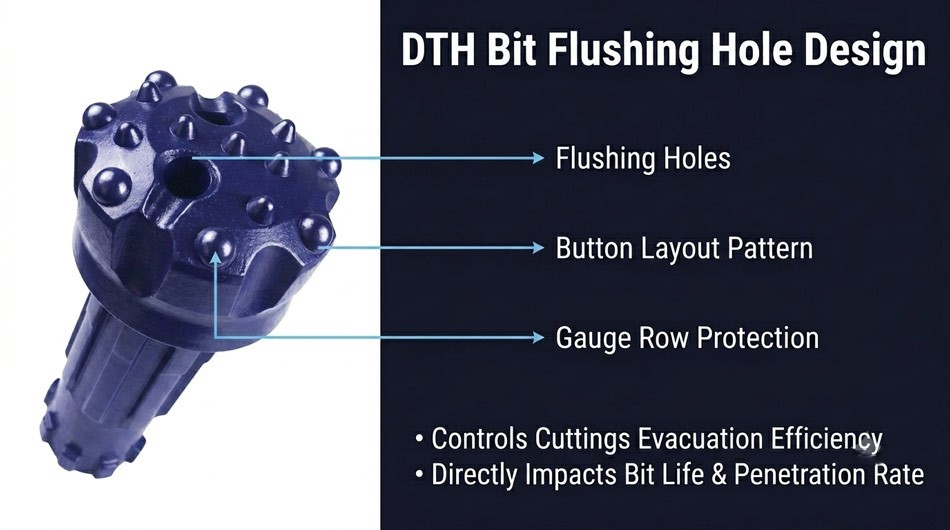
Drill Bit Flushing Hole Design: The Complete Engineering Guide to Configurations, Performance, and Selection
Every rock drill bit relies on flushing holes to remove cuttings, cool the bit face, and maintain borehole stability. A poorly designed flushing system can slash penetration rate by 15–30%, cause premature button failure, and stall an entire drilling operation. Yet flushing hole design remains one of the most under-discussed engineering variables in rock drilling tool selection.
This guide breaks down the core design variables — number, diameter, angle, and position of flushing holes — maps the four primary configuration types, and provides a practical selection framework by rock type and application. All technical guidance draws on MSD's 23+ years of manufacturing and field experience supplying dth drilling tools and top hammer tools to 1,000+ drilling contractors across 40+ countries.
What Is a Drill Bit Flushing Hole and Why Does It Matter?
Definition and Core Function
A drill bit flushing hole is a precisely machined channel through the bit body that directs compressed air, water, or foam from the drill string onto the bit face and into the borehole annulus. Flushing holes are not simple vent ports. They are engineered passages whose geometry directly controls three critical drilling functions.
First, cuttings evacuation. Flushing holes deliver high-velocity air or fluid to the bit face, lifting freshly broken rock fragments off the cutting surface and carrying them upward through the annulus — the space between the drill string and the borehole wall. Without effective evacuation, the bit re-crushes cuttings that have already been broken, a phenomenon called regrinding. Regrinding wastes piston energy, reduces net penetration rate, and accelerates button wear.
Second, bit face cooling. Tungsten carbide buttons generate significant frictional heat during percussion drilling. Flushing air or water absorbs and removes this heat, preventing thermal cracking of the carbide matrix. Thermal cracks propagate under repeated impact loading and ultimately cause button fracture or button loss.
Third, borehole wall stabilization. Directed flushing flow clears loose material from the borehole wall, reducing the risk of wall collapse in fractured or unconsolidated formations. In water well drilling and casing installation applications, borehole wall quality directly determines whether casing can be lowered successfully.
MSD is an ISO 9001 certified rock drilling tools manufacturer, designs flushing systems across its full DTH (Down-The-Hole) bit range from 90 mm to 1000 mm diameter. MSD's engineering team treats flushing hole geometry as inseparable from button layout and gauge row protection — all three elements are designed as an integrated system, not isolated features.
What Happens When Flushing Design Fails
Poor flushing design triggers a cascade of mechanical failures that compound rapidly during a drilling shift. Regrinding is the first symptom: net penetration rate drops because the piston's impact energy is wasted re-crushing rock fragments instead of fracturing fresh formation. Operators often misdiagnose regrinding as a dull bit, pulling the string prematurely and wasting productive drilling time.
Thermal damage follows. When cuttings accumulate on the bit face, they form an insulating layer that traps frictional heat around the buttons. Carbide buttons operating above 600°C begin losing hardness as the cobalt binder phase softens. The result is accelerated abrasive wear, thermal cracking, and in severe cases, complete button loss from the bit face.
Gauge wear accelerates next. If flushing flow fails to reach the outer gauge buttons, cuttings pack around the gauge row and act as an abrasive slurry. The borehole becomes undersized, increasing drill string friction and raising the risk of a stuck bit — one of the most costly incidents in any drilling operation.
Key Design Variables in Flushing Hole Engineering
Flushing hole performance is governed by four interdependent variables: the number of holes, their diameter, their angular orientation, and their position relative to the button layout. Changing any single variable alters the air velocity distribution across the entire bit face.
Number of Flushing Holes
The number of flushing holes scales with bit diameter because larger bit faces require more distributed airflow coverage. Small-diameter DTH bits (90–115 mm, roughly 3.5–4.5 inches) typically feature 1 to 2 flushing holes positioned centrally or slightly offset. Mid-range bits (127–178 mm, 5–7 inches) commonly use 3 to 4 flushing holes arranged symmetrically around the bit face center. Large-diameter bits (203–305 mm, 8–12 inches) require 4 to 6 or more flushing holes to ensure no zone of the bit face is left unswept.
Adding more flushing holes improves coverage uniformity but reduces the structural cross-section of the bit body. Each hole removes material from the steel matrix, creating potential stress concentration points. MSD's engineering team balances flushing coverage against structural integrity by optimizing hole placement within the bit's existing junk slot channels — the grooves machined into the bit face that serve as primary cuttings evacuation pathways.
Flushing Hole Diameter
Flushing hole diameter is the single most influential variable controlling air velocity at the bit face. The physics is straightforward: for a given air volume (determined by the compressor and DTH drilling hammer exhaust), a smaller hole cross-section produces higher air velocity. Higher velocity means greater cuttings-lifting force. However, excessively small holes risk blockage from clay, wet cuttings, or rock dust — particularly in formations with high clay content or significant water influx.
The trade-off between velocity and blockage risk defines the design window. Larger flushing holes move more air volume at lower velocity, reducing blockage risk but potentially leaving fine cuttings on the bit face. Smaller holes generate the high-velocity jets needed to sweep dense cuttings from between tightly spaced buttons, but they demand cleaner air supply and higher minimum operating pressure.
Rule of Thumb: For DTH button bits, the total cross-sectional area of all flushing holes should not exceed 30–35% of the bit's internal bore cross-section. Exceeding this ratio drops air velocity below the minimum threshold required for effective cuttings lift in the annulus — typically 15 m/s for dry air drilling in medium-hard rock.
Flushing Hole Angle and Directional Orientation
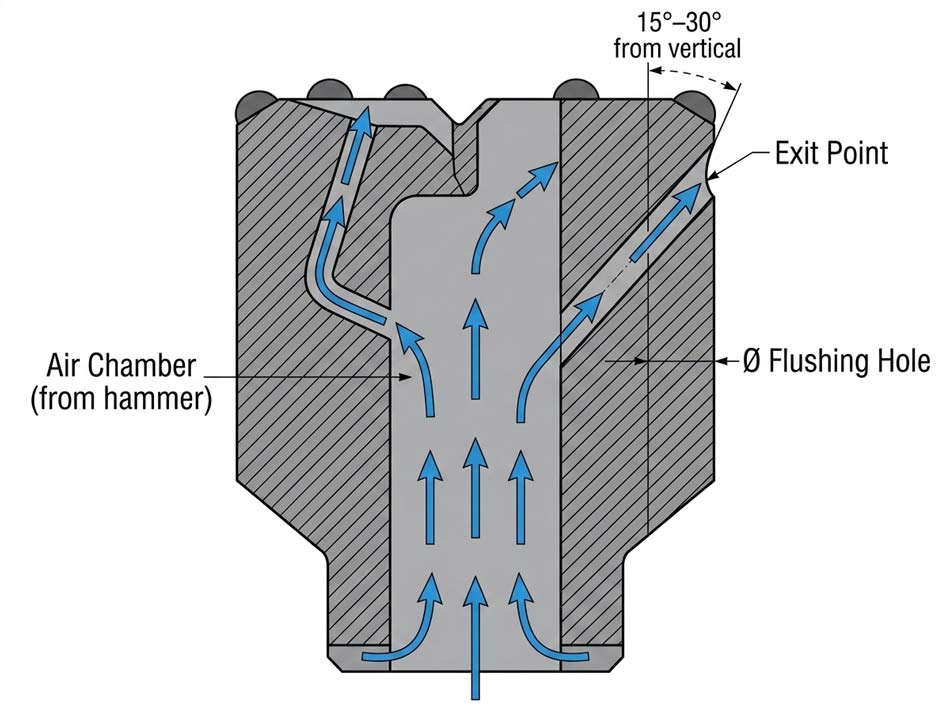
Flushing holes can be machined at a straight axial angle (parallel to the bit's longitudinal axis) or at an offset angle (typically 5–15° from axial). Straight holes direct air vertically downward onto the bit face. Angled holes create a sweeping, tangential flow pattern across the face surface.
Angled flushing holes generate a vortex-like effect that dramatically improves cuttings removal from the spaces between button rows. The tangential airflow component pushes cuttings laterally toward the junk slots, where the main upward airflow carries them into the annulus. This sweeping action is particularly effective on bit faces with dense button patterns, where straight axial flow would impinge directly onto button tops rather than reaching the gaps between them.
The optimal angle depends on the specific button layout geometry. A bit with widely spaced buttons in a simple radial pattern may perform adequately with straight flushing. A bit with a complex, multi-row button arrangement — common on large-diameter DTH bits — benefits significantly from angled flushing channels that direct flow into the inter-row gaps.
Flushing Hole Position Relative to Button Layout
Flushing hole position determines which zones of the bit face receive direct airflow and which rely on secondary flow patterns. The critical engineering principle is this: flushing holes must direct air between button rows, not onto button tops. Air striking a button top deflects unpredictably, creating turbulent dead zones where cuttings accumulate. Air directed into the gaps between buttons flows smoothly across the cutting surface, lifting cuttings efficiently.
Position also affects differential cooling. If flushing holes are clustered on one side of the bit face, buttons in the flushed zone operate at lower temperatures than buttons in the unflushed zone. This temperature differential creates uneven thermal expansion across the bit face, accelerating asymmetric wear and potentially causing premature button cracking on the hotter side. MSD addresses this by ensuring flushing hole positions are symmetrically distributed relative to the button layout pattern, maintaining uniform thermal conditions across the entire cutting surface.
Flushing Hole Configuration Types: Front, Center, Rear, and Combination
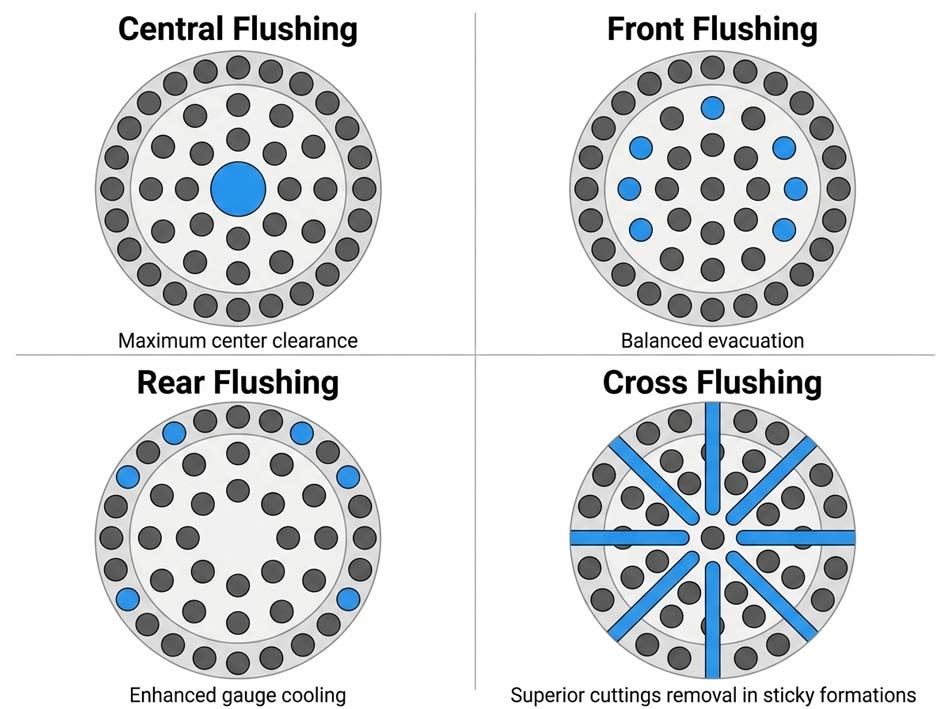
Flushing hole configurations are classified by where the flushing channels direct airflow relative to the bit face. Each configuration type offers distinct advantages and limitations depending on the geological formation, drilling method, and borehole conditions. Understanding these four types is essential for matching bit design to field requirements.
Front Flushing (Peripheral Flushing)
Front flushing positions the flushing holes at the outer portion of the bit face, directing compressed air primarily toward the gauge area and outer button rows. Front-flushed bits prioritize gauge protection — the gauge row receives the highest air velocity, keeping the outermost buttons cool and the borehole wall clean of packed cuttings.
Front flushing is best suited for highly abrasive formations (granite, quartzite, abrasive sandstone) where gauge wear is the primary failure mode. In these formations, maintaining full-gauge diameter throughout the bit's service life is more critical than maximizing center-face cuttings removal. The limitation of front flushing is that the center of the bit face receives reduced direct airflow. In formations that generate high cuttings volumes, center-face cuttings packing can develop, leading to regrinding in the core zone.
Center Flushing
Center flushing uses one or two flushing holes positioned at or near the geometric center of the bit face. Air exits vertically downward into the center of the cutting zone, then spreads radially outward toward the junk slots and gauge area.
Center-flushed bits excel in softer formations (weathered limestone, marl, soft sandstone) that produce large volumes of relatively light cuttings. The central air jet creates a strong upward draft at the bit face center, efficiently lifting high cuttings volumes into the annulus. Center flushing is also effective in fractured formations where cuttings are irregularly sized — the strong central jet breaks up cuttings clusters before they can pack between buttons. The limitation is that the gauge area receives only secondary, attenuated airflow. In abrasive formations, center-flushed bits may experience accelerated gauge wear.
Rear Flushing (Side Flushing)
Rear flushing channels air through passages in the bit body rather than through the bit face. Air exits from ports on the side of the bit, above the cutting face, directed upward along the borehole wall. Rear flushing does not contribute directly to bit face cuttings removal — its primary function is managing water influx and maintaining borehole wall stability.
Rear-flushed configurations are used in specific DTH hammer-bit combinations designed for wet hole conditions, where groundwater enters the borehole faster than face flushing alone can evacuate it. The upward wall-directed airflow creates a curtain effect that pushes water upward and prevents it from flooding the bit face. Rear flushing is rarely used as a standalone configuration; it is almost always combined with front or center flushing in a hybrid design.
Combination Flushing (Multi-Directional)
Combination flushing integrates front and center flushing channels — and sometimes rear flushing ports — into a single bit design. Combination-flushed bits deliver the most uniform airflow distribution across the entire bit face, addressing both gauge protection and center-face cuttings removal simultaneously.
MSD's DTH button bits for hard rock applications use a combination flushing configuration with angled flushing channels positioned to sweep air across both the inner and outer button rows. This design was developed through iterative field feedback from drilling contractors operating in high-compressive-strength formations (>200 MPa UCS) across multiple countries. The angled combination approach ensures that no zone of the bit face operates without direct flushing coverage, which is critical when drilling dense, heavy cuttings that resist aerodynamic lift.
The trade-off is manufacturing complexity. Combination flushing requires more machining operations and tighter tolerances to ensure each channel delivers the correct air volume proportion. MSD's ISO 9001 certified manufacturing process controls these tolerances to maintain consistent flushing performance across production batches.
Flushing Configuration Comparison
| Configuration | Flushing Coverage | Best Formation Type | Gauge Protection | Cuttings Volume Capacity | Manufacturing Complexity |
|---|---|---|---|---|---|
| Front (Peripheral) | Gauge-focused | Abrasive hard rock | Excellent | Moderate | Low |
| Center | Core-focused | Soft / fractured | Moderate | High | Low |
| Rear (Side) | Wall-focused | Wet holes | Good | Low | Moderate |
| Combination | Full-face balanced | Hard rock / deep holes | Excellent | High | Higher |
Flushing Design in DTH Bits vs. Top Hammer Button Bits
Flushing hole design differs fundamentally between DTH bits and top hammer button bits because the air supply path, operating pressure, and available flushing volume are completely different between the two drilling methods. Selecting or evaluating a flushing configuration without understanding these differences leads to mismatched expectations and poor field performance.
DTH Bit Flushing: High-Pressure Air Through the Hammer
In DTH drilling, compressed air follows a specific path: the compressor delivers air down the drill string, through the DTH hammers, past the reciprocating piston, and out through the exhaust ports at the bottom of the hammer. This exhaust air then passes through the dth bits internal bore and exits through the flushing holes onto the bit face.
The critical engineering point is that flushing air volume in DTH drilling is determined by the hammer's exhaust characteristics, not by the compressor alone. Different hammer series — DHD, MISSION, QL, SD, COP, and NUMA — deliver different exhaust volumes and pressures. The flushing hole design in a DTH bit must be matched to the specific hammer series it will operate with. A bit designed for a high-exhaust-volume hammer (such as certain MISSION series models) may have larger or more numerous flushing holes than a bit designed for a lower-volume hammer.
DTH bits operate at relatively high flushing pressures (typically 10–25 bar at the bit face), which means the flushing holes can be smaller in diameter while still achieving adequate air velocity. This allows DTH bit designers more flexibility to optimize hole position and angle without sacrificing structural integrity.
Top Hammer Button Bit Flushing: Central Flushing Through the Drill Rod
In top hammer drilling, the percussion hammer sits at the top of the drill string, not at the bottom. Compressed air or water travels down through the center hole of the drill rod and shank adapter, entering the thread button bits or taper button bits through its rear bore. The flushing medium then exits through the flushing holes machined into the bit face.
Top hammer flushing operates at significantly lower pressures and volumes compared to DTH systems. The drill rod bore diameter constrains the maximum air volume that can reach the bit. For standard R32 and R38 threaded drill rods, the center bore is typically 10–12 mm, limiting flushing capacity. This constraint means top hammer button bit flushing hole design must maximize air velocity from a limited supply — smaller, precisely angled flushing holes are critical.
Top hammer button bits also commonly use water flushing rather than air flushing, particularly in underground mining applications where dust suppression is mandatory. Water flushing changes the design calculus: water is approximately 800 times denser than air, requiring larger flushing hole diameters to prevent excessive pressure drop across the bit face.
How Flushing Hole Design Affects Drilling Performance and Bit Life
Flushing hole design is not an abstract engineering exercise — it directly determines measurable drilling economics. Penetration rate, bit service life, and borehole quality all respond quantitatively to flushing effectiveness.
Penetration Rate Impact
Effective flushing eliminates regrinding, ensuring the DTH hammer's piston energy is transferred entirely into fracturing fresh rock on every strike. When cuttings are cleared instantly from the bit face, each piston impact breaks new formation material. When cuttings remain, the piston wastes energy re-crushing already-broken fragments — converting kinetic energy into heat rather than borehole advance.
In hard rock formations (>200 MPa UCS), regrinding caused by inadequate flushing can reduce net penetration rate by 15–30%. The impact is most severe in dense, fine-grained formations like granite and gneiss, where cuttings are heavy and resist aerodynamic lift. In these conditions, the difference between a well-designed combination flushing system and a basic center-flushed bit can represent hundreds of additional meters drilled per bit over its service life.
Bit Life and Button Wear Patterns
Flushing design determines whether buttons wear uniformly or asymmetrically. Uniform wear means all buttons across the bit face reach end-of-life simultaneously, extracting maximum value from the tungsten carbide investment. Asymmetric wear means some buttons fail prematurely while others remain serviceable — the bit must be pulled based on the worst-performing button, wasting the remaining life of all others.
Poor flushing creates asymmetric wear through two mechanisms. First, cuttings packing around specific buttons acts as an abrasive slurry, accelerating localized wear. Second, uneven cooling causes thermal stress differentials — hotter buttons soften and wear faster. MSD's cold-press interference fit button retention method ensures buttons remain securely seated even under thermal cycling, with a documented button loss rate below 0.05%. However, even the most securely retained button will fail prematurely if flushing design allows persistent thermal overload.
Well-designed flushing complements button retention by maintaining uniform thermal conditions across the bit face. When every button operates within the same temperature range, wear progresses evenly and predictably. Operators can forecast bit changes accurately, reducing unplanned downtime.
Borehole Quality
Flushing design directly affects borehole straightness and wall smoothness. Cuttings that are not evacuated efficiently accumulate in the annulus, increasing drag on the drill string and causing deviation. In water well drilling applications, borehole wall roughness determines whether casing and screen can be lowered to the target depth without jamming.
In geothermal drilling, where boreholes may extend to 200–500 m depth, flushing efficiency at the bit face must overcome the increasing column weight of cuttings in the annulus. Flushing hole design for deep-hole applications requires higher air velocity at the bit face to compensate for the longer cuttings transport distance to the surface.
Selecting the Right Flushing Design by Rock Type and Application
Flushing configuration selection must be driven by the specific geological formation and drilling application — not by generic "one-size-fits-all" recommendations. The following framework maps rock conditions to optimal flushing design choices based on the physical properties of the cuttings each formation produces.
Hard Rock (Granite, Gneiss, Quartzite — >200 MPa UCS)
Hard rock formations produce dense, angular cuttings that are heavy relative to their size. These cuttings resist aerodynamic lift and tend to settle back onto the bit face between piston strikes. Combination flushing with angled holes is recommended for hard rock drilling. The angled channels create the sweeping flow pattern needed to push heavy cuttings laterally into the junk slots, while the combination of front and center flushing ensures no dead zones develop on the bit face.
Air velocity is the priority variable in hard rock. Flushing hole diameters should be sized to maximize velocity within the 30–35% cross-sectional area rule. Spherical (domed) buttons paired with optimized combination flushing deliver maximum efficiency in these formations — the rounded button profile allows cuttings to slide off the button surface into the flushing flow path.
Medium Rock (Limestone, Sandstone, Schist — 80–200 MPa UCS)
Medium-hardness formations produce moderate cuttings volumes of intermediate density. Standard front flushing is adequate for most medium-rock conditions, providing good gauge protection without the manufacturing complexity of combination designs. Flushing hole diameters can be moderately sized, balancing velocity and volume.
In layered formations (alternating limestone and shale, for example), flushing demands change as the bit transitions between layers. A front-flushed bit with slightly oversized flushing holes provides the flexibility to handle both the denser limestone cuttings and the higher-volume shale cuttings without requiring a bit change.
Soft and Fractured Rock (<80 MPa UCS)
Soft formations generate high volumes of relatively light cuttings. Center flushing or large-diameter flushing holes are recommended to maximize air volume throughput. The priority shifts from velocity to volume capacity — the flushing system must move a large mass of cuttings per unit time rather than generating high-velocity jets.
A critical caution applies in soft rock: flushing hole angle must avoid direct impingement on the borehole wall. High-velocity air jets striking soft formation material erode the wall, creating washout zones — enlarged, irregular sections of the borehole that compromise casing installation and reduce structural integrity. Straight axial flushing or shallow-angle flushing (under 5° offset) minimizes wall erosion risk in soft formations.
Wet Hole and High Water Table Conditions
Drilling below the water table introduces a competing fluid that the flushing system must overcome. Groundwater entering the borehole dilutes the air flushing medium, reduces air velocity, and creates a slurry of water and cuttings that is significantly harder to lift than dry cuttings alone.
Combination flushing with rear (side) flushing ports is recommended for wet conditions. The rear flushing channels direct air upward along the borehole wall, creating an air curtain that pushes water upward and prevents it from flooding the bit face. Front and center channels handle face cuttings removal. Foam injection through the flushing system further improves wet-hole performance by reducing the surface tension of the water-cuttings mixture, making it easier to lift.
For severe overburden and unconsolidated wet formations, an odex casing system provides simultaneous casing advancement that stabilizes the borehole wall while the flushing system manages cuttings and water.
Flushing Design Selection by Rock Condition
| Rock Condition | Recommended Configuration | Typical Flushing Hole Count (6-inch bit) | Key Design Priority |
|---|---|---|---|
| Hard (>200 MPa UCS) | Combination (angled) | 4–6 | Air velocity |
| Medium (80–200 MPa UCS) | Front flushing | 3–4 | Balanced velocity/volume |
| Soft (<80 MPa UCS) | Center flushing | 2–3 | Volume capacity |
| Wet / fractured | Combination + rear | 4–6 | Water management |
Common Flushing-Related Problems and How to Diagnose Them
Flushing failures are among the most frequently misdiagnosed problems in rock drilling operations. Operators often attribute symptoms to dull bits, insufficient hammer power, or compressor issues when the root cause is a flushing design mismatch or flushing system malfunction. Recognizing these three common failure patterns saves significant time and cost.
Blocked Flushing Holes
Blocked flushing holes are the most common flushing failure in field operations. Clay-rich formations are the primary culprit — wet clay particles compact inside the flushing channels under air pressure, forming a plug that progressively restricts airflow. Insufficient air pressure (operating below the hammer's minimum rated pressure) reduces air velocity through the flushing holes, allowing cuttings to settle and accumulate inside the channels rather than being blown clear.
Diagnosis: A sudden drop in penetration rate accompanied by increased back pressure on the compressor gauge. The bit appears to "stall" despite the hammer continuing to fire. Pulling the bit reveals clay or compacted fines packed inside one or more flushing holes.
Prevention: Maintain air pressure at or above the DTH hammer's minimum rated operating pressure at all times. In clay-rich formations, consider foam injection to lubricate the flushing channels and prevent clay adhesion. Ensure the air supply is filtered to remove compressor oil and moisture that can bind with rock dust to form plugs.
Rule of Thumb: Never operate a DTH hammer below its minimum rated air pressure — underpressure causes incomplete cuttings evacuation, flushing hole blockage, and accelerated piston wear from inadequate lubrication.
Flushing Erosion (Washout)
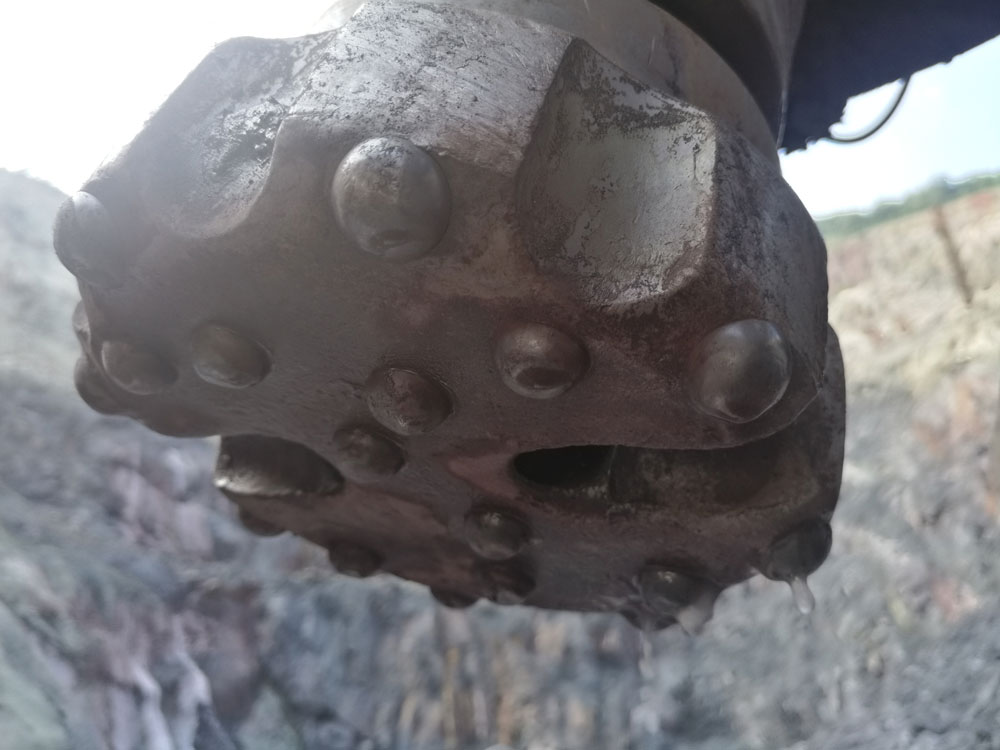
Flushing erosion occurs when high-velocity air or water jets erode the steel bit body between the buttons. Washout channels appear as grooved, polished tracks on the bit face radiating outward from the flushing holes. Erosion weakens the bit's structural matrix, loosens button seats, and ultimately causes catastrophic bit failure.
Causes: Oversized flushing holes that concentrate excessive air volume into narrow jet streams. Misaligned flushing angles that direct flow onto the bit body surface rather than into the junk slots. Excessive compressor pressure in soft rock formations where the bit body steel is softer than the formation would normally demand.
Diagnosis: Visual inspection of the pulled bit reveals smooth, polished erosion channels on the bit face. Buttons adjacent to the erosion channels may show loosening or loss. The erosion pattern typically radiates from the flushing hole exit point toward the nearest junk slot.
Uneven Cuttings Removal
Uneven cuttings removal manifests as one sector of the bit face showing clean, well-flushed buttons while the opposite sector shows cuttings packing, discoloration (from thermal overload), and accelerated wear. This asymmetric pattern indicates that the flushing hole layout does not provide balanced airflow coverage across the entire bit face.
Causes: Flushing holes positioned asymmetrically relative to the button layout. One or more flushing holes partially blocked (reducing flow to one sector while the remaining holes over-flush the other sector). Bit rotation speed too low to distribute flushing flow evenly through the rotational sweep.
Diagnosis: The pulled bit shows a clear "clean side / dirty side" pattern. Buttons on the under-flushed side exhibit thermal discoloration (blue-brown tint on the carbide surface) and measurably more wear than buttons on the well-flushed side. Based on MSD's field service experience across 40+ countries, this asymmetric pattern is most commonly observed when operators use a bit designed for one hammer series on a different hammer series with a different exhaust port configuration.
MSD's Approach to Flushing Hole Design
Integrated Design Philosophy: Buttons, Flushing, and Gauge Protection as a System
MSD does not design flushing holes as an isolated feature. Button layout, flushing channel geometry, and gauge row protection are engineered as a single integrated system where each element supports the others. The position of every flushing hole is determined by the button layout — channels are placed to direct airflow into the gaps between button rows, never onto button tops. The gauge row receives dedicated flushing coverage to prevent the accelerated gauge wear that shortens bit life in abrasive formations.
MSD's cold-press interference fit button retention ensures that flushing channels remain unobstructed throughout the bit's entire service life. Because buttons are mechanically pressed into precision-machined seats with controlled interference — not brazed or welded — there is no filler material that could degrade, shift, or partially block adjacent flushing channels during operation. MSD's documented button loss rate of below 0.05% means the designed flushing geometry remains intact from first meter to last meter.
In our 23+ years of manufacturing DTH button bits and top hammer button bits, MSD has supplied over 1,000 drilling contractors in 40+ countries. This global field feedback loop drives continuous refinement of flushing configurations. When a contractor in a specific geological region reports suboptimal cuttings evacuation, MSD's engineering team analyzes the formation type, hammer model, compressor capacity, and drilling parameters to adjust the flushing hole count, diameter, or angle for the next production batch. This iterative, data-driven approach is what separates a manufacturer's engineering capability from a catalog specification.
Application-Specific Flushing Optimization
MSD offers application-matched flushing configurations across its full product range: dth drill bit from 90 mm to 1000 mm diameter and top hammer equipment from R25 to ST68 thread sizes. Hard rock models feature combination flushing with angled channels optimized for high air velocity and full-face coverage. Soft rock and high-volume cuttings models use center flushing with larger hole diameters to maximize throughput. Wet-hole models integrate rear flushing ports for water management.
Every flushing configuration is matched to the specific DTH hammer series the bit will operate with — DHD, MISSION, QL, SD, COP, or NUMA. MSD's engineers calculate the exhaust air volume and pressure for each hammer model and size the flushing holes accordingly, ensuring the bit and hammer operate as a matched system rather than mismatched components.
Frequently Asked Questions
Q: What is the flush drilling method?
A: Flush drilling refers to the use of a flushing medium — compressed air, water, foam, or air-water mist — circulated through the drill string and out through the drill bit's flushing holes to evacuate rock cuttings from the borehole. The flushing medium lifts cuttings through the annulus (the space between the drill string and borehole wall) to the surface. In DTH drilling, the flushing medium passes through the DTH hammer before reaching the bit. In top hammer drilling, the medium travels directly through the drill rod center hole.
Q: How is borehole flushing done?
A: The compressor delivers compressed air (or a pump delivers water) down the drill string. In DTH drilling, air enters the dth hammers, powers the piston, and exhausts through the hammer's bottom into the bit's internal bore. The air then exits through the flushing holes machined into the bit face, striking the freshly broken rock cuttings. The high-velocity air lifts these cuttings upward through the annulus between the drill string and the borehole wall. Cuttings exit at the borehole collar at the surface.
Q: What is a washout in drilling and how does flushing hole design prevent it?
A: A washout is erosion of the bit face steel or the borehole wall caused by high-velocity flushing jets. On the bit, washout appears as polished grooves radiating from flushing holes. On the borehole wall, washout creates enlarged, irregular sections that compromise casing installation. Proper flushing hole design prevents washout by sizing hole diameters to avoid excessive jet velocity, angling flushing channels to direct flow into junk slots rather than onto the bit body or borehole wall, and matching flushing pressure to formation hardness.
Q: How many flushing holes does a DTH button bit need?
A: The number of flushing holes scales with bit diameter. Small DTH bits (90–115 mm) typically use 1–2 flushing holes. Mid-range bits (127–178 mm) use 3–4 holes. Large bits (203–305 mm and above) use 4–6 or more holes. The exact count also depends on the DTH hammer series and the target formation. MSD engineers match flushing hole count to both bit diameter and hammer exhaust characteristics for each application.
Q: Does flushing hole design differ between air drilling and water drilling?
A: Yes. Water is approximately 800 times denser than air, requiring larger flushing hole diameters to prevent excessive pressure drop across the bit face. Water flushing also demands different hole angles — water jets striking soft formation material at steep angles cause more severe borehole wall erosion than air jets at the same angle. Water-flushed bits typically use shallower flushing angles and larger hole cross-sections compared to air-flushed bits of the same diameter.
Technical content reviewed by MSD Engineering Team. | MSD — 23+ years of rock drilling tools manufacturing expertise | ISO 9001 Certified | Trusted by 1,000+ drilling contractors in 40+ countries