

Top Hammer Drilling Tools 2026: Complete Guide to Bits, Rods & Adapters
Top hammer drilling is one of the most widely used rock drilling methods in the mining and construction industries. The technique delivers percussive energy from a surface-mounted rock drill through the drill string to break rock efficiently. Understanding top hammer drilling tools—including drill bits, drill rods, and shank adapters—helps you select the right equipment for your project.
This guide covers everything you need to know about top hammer drilling: how it works, when to use it versus DTH or rotary methods, and which tools you need. MSD Brand, a rock drilling tools manufacturer with 23+ years of experience producing both top hammer and DTH drilling tools, provides this comparison to help you make informed equipment decisions.
What Is Top Hammer Drilling?
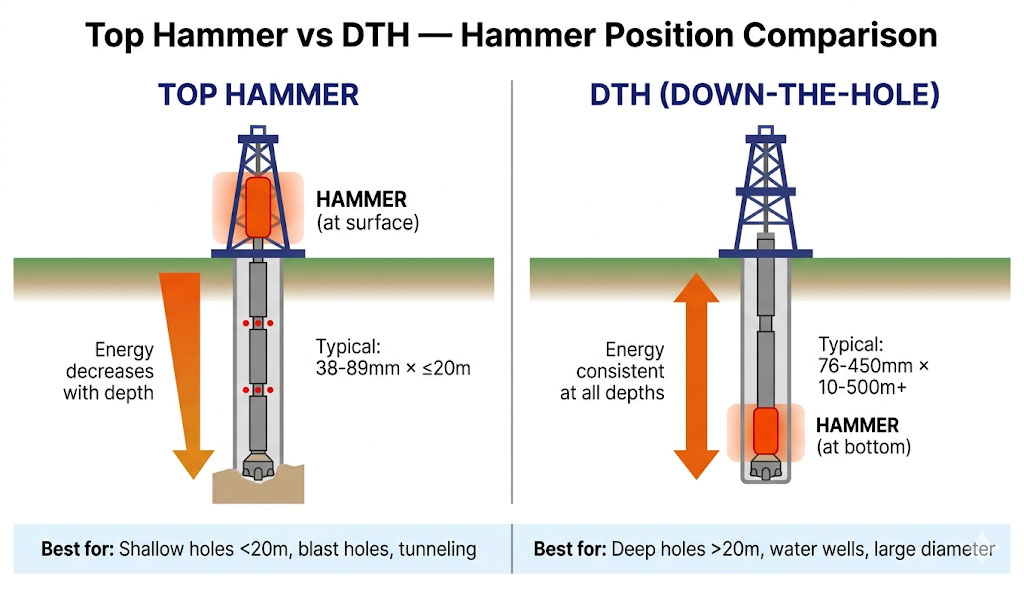
Top hammer drilling is a percussive rock drilling method where the hammer mechanism is located at the surface, mounted on the drill rig. The rock drill delivers high-frequency impacts to the top of the drill string, and this energy travels through the drill rods to the drill bit at the bottom of the hole. Simultaneously, the drill string rotates to ensure even wear and efficient cutting.
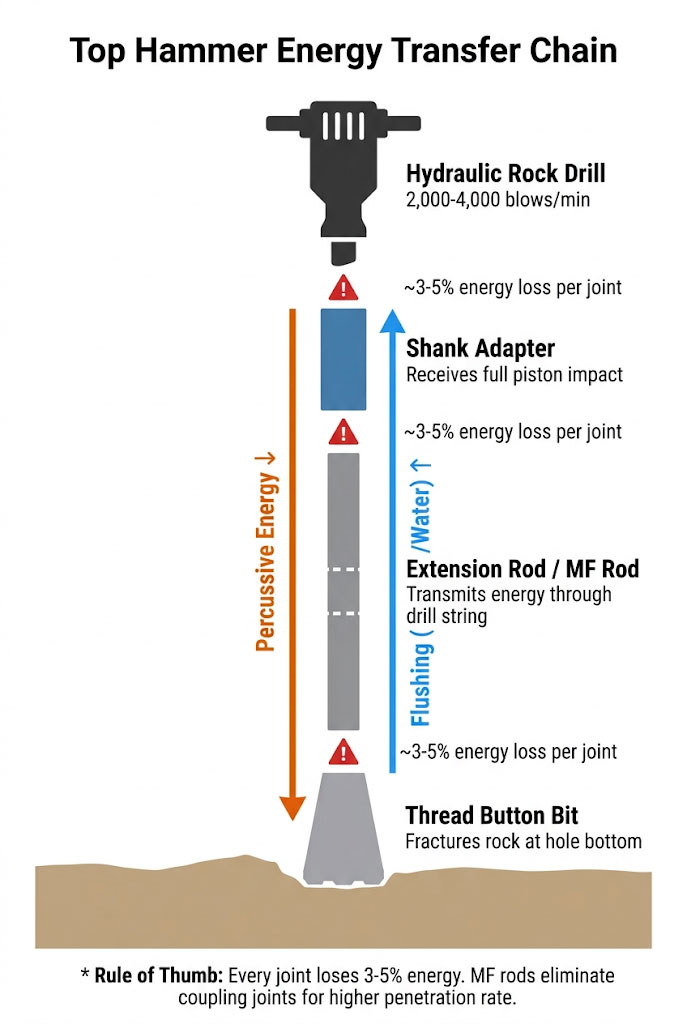
How Top Hammer Drilling Works:
1. Impact Generation: A hydraulic or pneumatic rock drill at the surface generates rapid percussive blows (typically 2,000–4,000 blows per minute).
2. Energy Transmission: Impact energy travels down through threaded drill rods to the drill bit. Every joint in the drill string loses approximately 3–5% of transmitted energy—which is why reducing joint count matters.
3. Rotation: The drill string rotates at 80–250 RPM to distribute wear and improve penetration.
4. Flushing: Compressed air or water flushes rock cuttings out of the hole through the drill string center.
Key Characteristics:
Hole diameter range: 28 mm to 152 mm (most common: 38–89 mm)
Typical drilling depth: 1 m to 30 m (most efficient under 20 m)
Best suited for: Medium-hard to hard rock (up to 200 MPa compressive strength)
Applications: Blast hole drilling, rock bolting, tunneling, quarrying, exploration
Top hammer drilling excels in applications requiring high mobility, frequent hole relocation, and smaller diameter holes. The surface-mounted drill allows quick setup and movement between drilling positions.
Top Hammer vs DTH vs Rotary: Complete Comparison
Choosing between top hammer, DTH (Down-the-Hole), and rotary drilling depends on your specific project requirements. Each method has distinct advantages for different hole sizes, depths, and rock conditions.
| Factor | Top Hammer | DTH (Down-the-Hole) | Rotary |
|---|---|---|---|
| Hammer Location | Surface (on drill rig) | Bottom of hole (inside hammer) | No hammer (cutting only) |
| Energy Transfer | Through drill rods | Direct to bit | Rotational torque + weight |
| Hole Diameter | 28–152 mm | 76–450 mm+ | 150–450 mm+ |
| Optimal Depth | 1–20 m (max ~30 m) | 10–500 m+ | 10–100 m+ |
| Rock Hardness | Soft to medium-hard (<200 MPa) | Medium to very hard (>200 MPa) | Soft to medium |
| Hole Straightness | Good (deviates in deep holes) | Excellent (hammer stabilizes) | Good |
| Penetration Rate | Fast in shallow holes | Consistent at all depths | Moderate |
| Energy Efficiency | Decreases with depth | Consistent at depth | Moderate |
| Best Applications | Blast holes<20 m, tunneling | Deep blast holes, water wells | Large diameter, soft rock |
When to Choose Top Hammer:
Drilling blast holes under 20 meters deep
Rock bolting and ground support in tunneling
Quarrying operations with frequent drill moves
Construction projects requiring mobility
Smaller diameter holes (38–89 mm typical)
When to Choose DTH:
Drilling deeper than 20 meters
Large diameter holes (100 mm+)
Very hard rock formations (>200 MPa)
Applications requiring straight, precise holes
Understanding these differences prevents costly equipment mismatches. Many contractors use both top hammer and DTH drilling systems depending on project requirements—and MSD supplies complete tool solutions for both methods.
Top Hammer Drilling Tools: Components
A complete top hammer drilling system consists of four main components that form an energy transfer chain: shank adapter → drill rods → coupling sleeves → drill bit. Each component must be properly matched for efficient energy transfer and optimal drilling performance.
Thread Button Bits
Thread button bits are the cutting tools that directly contact the rock. They feature tungsten carbide buttons arranged in specific patterns to maximize penetration and wear resistance.
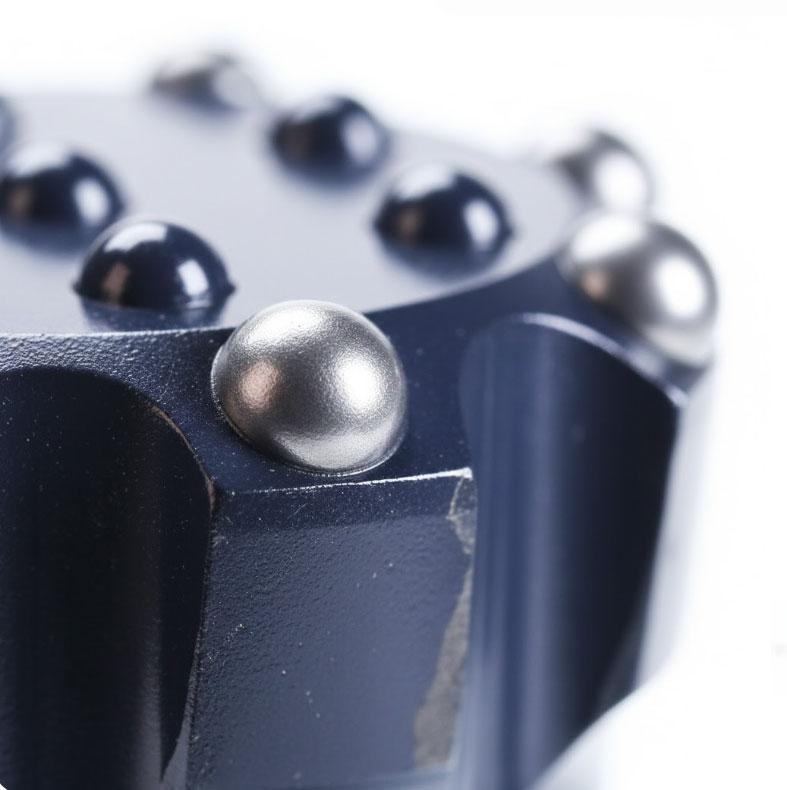
MSD thread button bits feature premium YK05 grade tungsten carbide inserts with a dual-hardening heat treatment process. According to MSD factory tracking data, body breakage rate is controlled below 0.1%, button breakage below 0.1%, and button fallout below 0.5%.
MSD Thread Button Bit Range by Thread Type:
| Thread Type | Diameter Range | Primary Applications | Typical Equipment |
|---|---|---|---|
| R25 / R28 | 33–45 mm | Drifting, tunneling, bolting | Small jumbo, handheld rock drills |
| R32 | 43–76 mm | Drifting, tunneling, light bench | Small jumbo, light crawler rigs |
| T38 | 64–89 mm | Bench drilling, quarry production | Medium crawler rigs, production jumbo |
| T45 | 70–115 mm | Bench drilling, surface mining | Large surface hydraulic rigs |
| T51 | 89–127 mm | Heavy bench drilling, deep blast holes | Heavy-duty top hammer rigs |
| ST58 | 89–102 mm | Bench drilling, production drilling | Heavy-duty rigs |
| ST60 | 92–140 mm | Large-scale bench drilling | Heavy-duty surface rigs |
| ST68 | 102–152 mm | Maximum diameter top hammer drilling | Extra heavy-duty rigs |
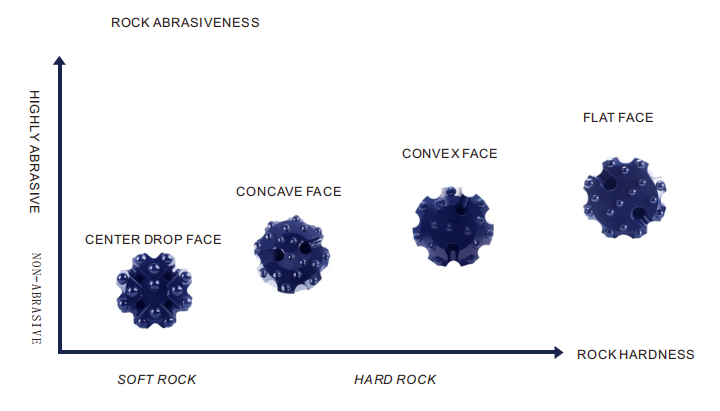
Face design selection matters: Flat face bits offer maximum durability in hard, highly abrasive rock. Drop center face bits provide the best hole straightness and superior flushing, making them ideal for precision holes in medium-hard formations.
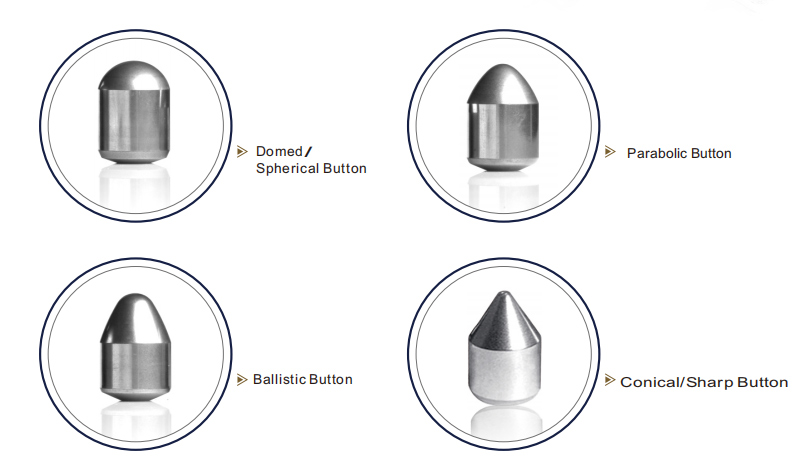
Button shape selection: Spherical buttons deliver maximum wear resistance in very hard rock. Ballistic buttons provide higher penetration rates in medium-soft formations. Conical buttons offer a balanced compromise between penetration speed and wear life.
Retrac (retractable) body bits feature special cutting grooves on the rear skirt that allow the bit to drill through collapsed rock during retraction. Field testing at a Canadian quarry demonstrated that Retrac design reduces stuck drill string incidents by over 90%.
View MSD Thread Button Bit Specifications →
Drill Rods
Drill rods transmit impact energy and rotation from the rock drill to the bit. They must withstand repeated shock loading while maintaining straightness and thread integrity.
MSD manufactures two primary configurations:
Extension Rods (Male-Male) feature male threads on both ends and require a coupling sleeve to connect. They are the traditional choice for long-hole drilling.
MF Rods (Male-Female) integrate a female coupling directly onto one end, eliminating the need for separate coupling sleeves. Fewer joints mean less energy loss—MSD internal testing shows MF rods deliver up to 10% higher penetration rates versus conventional extension rods with couplings.
MSD also produces tapered hex rods (H22×108 mm, H25×159 mm) for shallow drilling under 5 meters, where friction-fit self-tightening connections allow the fastest bit changes—no rotation needed, simply tap the bit off and slide on a new one.
> Rule of Thumb: For holes deeper than 10 meters, always specify friction-welded rods. Integral rods may cost less upfront but fail faster under sustained fatigue loading.
View MSD Drill Rod Specifications →
Shank Adapters & Couplings
Shank adapters connect the rock drill to the drill string. They absorb the full impact energy before any other component, making them the highest-stress part in the entire top hammer system. A worn or cracked shank adapter causes energy loss, drilling deviation, and accelerated wear on both the rock drill chuck and the drill rods.
MSD manufactures deep-case carburized shank adapters (1.5–2.0 mm carburizing depth, 58–62 HRC surface hardness) compatible with all major brands: Epiroc/Atlas Copco, Sandvik, Furukawa, Montabert, Ingersoll Rand, and Krupp. Available in R28, R32, R38, T38, T45, T51, ST58, and MG60/MT60 threads.
> Rule of Thumb: T38 covers 70% of surface drilling applications. Move up to T45/T51 only when bit diameter exceeds 89 mm or hole depth exceeds 20 m.
View MSD Shank Adapter Specifications →
Common Mistakes in Top Hammer Tool Selection
Avoiding these frequent errors can save significant cost and downtime:
1. Mixing worn and new tools in the same string. Never pair a severely worn shank adapter with a brand-new drill rod. The worn threads will rapidly destroy the new ones, costing you far more in premature tool failure than replacing both components together.
2. Mismatching thread types. A T38 shank adapter must connect to T38 rods and T38 bits. Mismatched threads cause joint failure and potential downhole tool loss.
3. Using extension rods with couplings when MF rods are available. Each coupling joint loses 3–5% of transmitted energy. For deep holes, the cumulative loss adds up—switching to MF rods can recover 10%+ in penetration rate.
4. Ignoring shank adapter inspection. The spline end wears first. Always inspect the impact end for mushrooming or cracking, and replace the shank adapter before damage spreads to the rock drill's chuck.
5. Choosing the wrong face design for rock conditions. Using drop center bits in highly abrasive hard rock accelerates wear. Flat face bits are the safer default choice when rock conditions are uncertain.
How to Choose Top Hammer Tools
Selecting the right top hammer tools requires matching components to your specific drilling application, rock conditions, and equipment.
Step 1 — Match Thread System to Your Rock Drill: Common systems include R32, T38, T45, and T51. Verify compatibility with your rig before ordering.
Step 2 — Select Bit Diameter: Standard blast hole diameters range from 38 mm to 89 mm for most quarry and mining operations.
Step 3 — Choose Button Configuration for Rock Conditions:
Soft to medium rock: Ballistic buttons for maximum penetration speed
Hard, abrasive rock: Spherical buttons for maximum wear life
Mixed or uncertain conditions: Conical buttons as the versatile default
Step 4 — Select Rod Type Based on Depth:
Under 5 m: Tapered rods for fastest cycle times
5–30 m: Threaded MF rods for best energy transfer
Deep holes (>20 m): Consider switching to DTH for consistent efficiency
Step 5 — Consider Total Drilling System Cost: Initial tool cost is only part of the equation. Factor in tool life (cost per meter), energy transfer efficiency, and downtime costs from stuck tools or premature failures.
Proven Field Performance
Aggregate Quarry, Ontario, Canada: A contractor operating in highly fractured, abrasive limestone faced severe stuck drill string problems—fractured ground caused frequent hole collapse, trapping standard flat-bottom bits during retraction. Weekly fishing operations consumed significant downtime.
After deploying MSD T51-89 mm Retrac button bits paired with T51 MF rods, the quarry achieved a 92% reduction in stuck drill incidents. The MF rod configuration simultaneously delivered a 12% improvement in penetration rate by eliminating coupling joints. Combined, these gains significantly lowered cost-per-meter and restored full drilling availability.
Get the Right Top Hammer Tools for Your Project
Top hammer drilling remains the most versatile method for surface and underground rock drilling applications under 20 meters depth. Proper tool selection—matching thread system, bit design, rod type, and shank adapter—maximizes drilling efficiency and minimizes cost per meter.
For top hammer drilling tool requirements, contact MSD engineers with your rock drill model, hole diameter, and rock conditions. We will recommend the optimal tool configuration for your specific application—whether top hammer, DTH, or a combination of both methods.
Frequently Asked Questions
What is the difference between top hammer and DTH drilling?
Top hammer drilling uses a surface-mounted rock drill that transmits impact energy down through drill rods to the bit. DTH (Down-the-Hole) drilling places the hammer at the bottom of the hole, delivering energy directly to the bit face. Top hammer is more efficient for shallow holes under 20 meters, while DTH maintains consistent power regardless of depth. MSD manufactures complete tool solutions for both methods.
How deep can you drill with top hammer?
Top hammer drilling is most efficient for holes up to 15–20 meters deep. Beyond this depth, energy loss through drill string joints reduces penetration efficiency. For deeper holes, DTH drilling typically provides better performance and straighter holes.
What thread system should I choose for top hammer drilling?
Thread selection depends on your drill and application. R25–R35 suits small rigs and holes under 64 mm. T38 is the industry standard for medium production drilling—it covers roughly 70% of surface drilling applications. T45 and T51 handle larger holes and higher-powered drills. ST58/ST60/ST68 threads serve heavy-duty long-hole and large-diameter requirements.
What is the difference between MF rods and extension rods?
Extension rods have male threads on both ends and require coupling sleeves to connect. MF (Male-Female) rods integrate the coupling into the rod body, eliminating one joint per connection. This reduces energy loss and can improve penetration rates by 10% or more. For deep-hole production drilling, MF rods are the recommended choice.
What are the best top hammer drill bits made of?
The best thread button bits use premium grade tungsten carbide inserts—such as YK05 grade—for maximum wear resistance and impact toughness. Lower-cost bits often use recycled carbide, which is more prone to cracking and fallout under heavy impact. Need help matching the right carbide bits to your rock conditions? Contact MSD's engineering team for a free technical consultation and trial sample quote.
Technical content reviewed by MSD Engineering Team. | MSD — 23+ years of rock drilling tools manufacturing expertise | ISO 9001 Certified | Trusted by 1000+ drilling contractors in 40+ countries