

COP Shank Guide: Models, Specifications & Hammer Compatibility
What Is a COP Shank in DTH Drilling?
A COP shank is a splined DTH bit shank standard originally associated with Atlas Copco (Secoroc) hammer platforms. Like all DTH shank standards, it uses a splined profile secured by a retaining ring — never an API thread — to keep the bit captive in the hammer's chuck while allowing it to float freely for the piston strike. DTH (Down-The-Hole) drilling is a percussion method where the hammer works at the bottom of the borehole, directly behind the bit, and shank geometry has to match the hammer chuck precisely to transfer rotation and percussion energy without loss.
Shank compatibility is ultimately a hammer-side question: it's the hammer chuck's spline geometry that determines which shank standard fits, not the bit alone. Confirming the correct DTH hammer model and its accepted shank standard before ordering replacement bits avoids the most common sourcing mistake — buying by nominal diameter without checking which shank the hammer chuck actually accepts.
COP Model Range: COP32 Through COP84
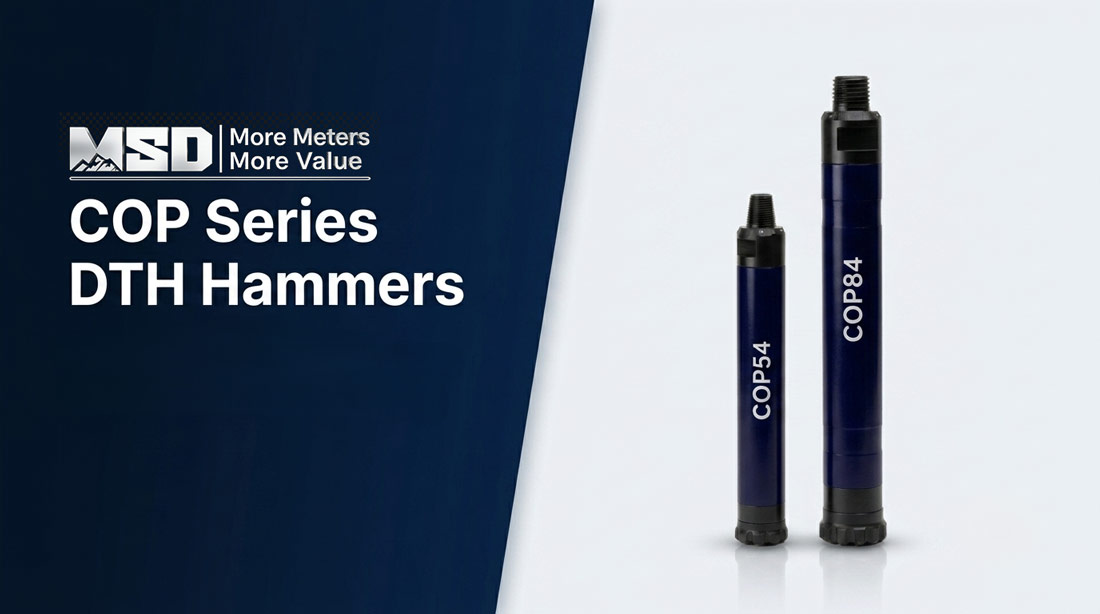
COP32, COP34, COP44, COP54, COP64, and COP84 are established model designations used across the drilling industry to describe hammer and bit size classes tied to the COP shank standard, each corresponding to a general bore size class from roughly 3-inch through 8-inch. These designations are widely referenced by hammer and bit manufacturers across the industry, not a proprietary or invented naming scheme.
Confirmed dimensional specifications (bit diameter range, air pressure, air consumption, impact rate, rotation, and drill pipe thread) for COP32, COP34, COP44, COP54, COP64, and COP84 individually are not available in MSD's current knowledge base retrieval. Rather than estimate these figures, we report this directly: Not specified. Buyers evaluating a specific COP model should confirm current dimensional and performance data through direct technical consultation with MSD engineering.
| Model | Bit Diameter Range | Air Pressure Range | Air Consumption | Impact Rate | Rotation | Compatible Drill Pipe Thread |
|---|---|---|---|---|---|---|
| COP32 | Not specified | Not specified | Not specified | Not specified | Not specified | Not specified |
| COP34 | Not specified | Not specified | Not specified | Not specified | Not specified | Not specified |
| COP44 | Not specified | Not specified | Not specified | Not specified | Not specified | Not specified |
| COP54 | Not specified | Not specified | Not specified | Not specified | Not specified | Not specified |
| COP64 | Not specified | Not specified | Not specified | Not specified | Not specified | Not specified |
| COP84 | Not specified | Not specified | Not specified | Not specified | Not specified | Not specified |
We're not publishing estimated figures in place of verified data for these six models. What we can confirm is one specific, real data point tied to a COP-type hammer in our own compatibility records — covered next, because it's worth knowing before you assume COP-branded bits always carry a "COP" shank label.
The One Confirmed COP Data Point — A COP Hammer Paired with an SD10 Shank
Here's something worth flagging before ordering a replacement bit for a COP-type hammer: in MSD's current compatibility data, the one hammer record tagged as COP hammer type is paired with an SD10 bit shank designation — not a COP-numbered shank.
| Hammer Type | Bit Shank | Bit Diameter | Air Pressure | Air Consumption | Impact Rate | Rotation |
|---|---|---|---|---|---|---|
| COP | SD10 | 254–311 mm | 1.8–3.2 bar | 23.7–32.6 m³/min | Not specified | Not specified |
This matters in practice: it means that when sourcing a replacement bit for a COP-branded hammer in this size class, the correct bit shank to request may be labeled "SD10" rather than a COP model number. Impact rate and rotation speed aren't confirmed for this pairing either — request them directly from the hammer manufacturer's spec sheet before finalizing an order. Compare this against our SD Shank guide coverage of SD10, which is separately confirmed under SD-brand hammers at a slightly different air pressure band (2.0–3.5 bar) — the bit diameter range matches, but the air specifications don't, so confirm which hammer type you actually have before assuming either data set applies.
Rule of Thumb: Never assume a shank name printed on a catalog listing matches the shank standard your hammer actually uses — confirm the shank marking stamped on your existing bit or hammer chuck specification sheet before ordering, especially when a model is described as "COP-compatible" without a matching COP-numbered shank record.
How COP Differs From Open Shank Standards
COP shanks are not interchangeable with DHD, QL, SD, MISSION, or NUMA shanks. Each standard uses its own spline count, spline depth, shank diameter, and locking mechanism, so mixing standards — even between hammers of similar bore diameter — causes poor energy transfer, abnormal spline wear, or mechanical failure at the shank interface. Confirming shank standard compatibility is the first step in any procurement decision for COP-branded equipment, not an afterthought.
MSD manufactures COP-shank compatible bits using cold pressing / interference fit for button retention, consistent with standard DTH bit manufacturing practice across our full product range. Specific COP-shank manufacturing process details — heat treatment parameters or quality control tolerances unique to this shank line — are not available in the current knowledge base retrieval; we report this as Not specified rather than estimate.
Selecting the Right COP-Shank Hammer for Your Application
Selecting a COP-shank hammer starts with target borehole diameter, then works backward through compressor capacity, since model-specific bit diameter ranges for COP32 through COP84 are not confirmed in current MSD data. Confirm exact ranges directly with our engineering team before finalizing a model selection.
Compressor matching remains a fixed requirement regardless of which specific COP model is involved: an undersized compressor reduces impact energy and penetration rate, while an oversized compressor doesn't improve performance and can accelerate wear on internal components. For the one confirmed COP data point in this guide (the SD10-shank pairing), rated air consumption is 23.7–32.6 m³/min at 1.8–3.2 bar — confirm your compressor meets this before committing to that specific configuration.
Button shape selection is independent of shank standard but should match formation hardness — spherical buttons for highly abrasive hard rock, ballistic buttons for softer to medium-hard formations where penetration rate is the priority, and conical buttons as a balanced option in medium-hard rock. This applies across mining drilling, water well drilling, and construction drilling alike, since formation hardness — not the application category — drives button choice.
Rule of Thumb: Always match your compressor's rated free air delivery to the hammer's specified air consumption at the intended operating pressure — running a DTH hammer on insufficient air volume is one of the most common causes of poor penetration rate in the field.
COP-Shank Drill Pipe and Bit Pairing
A complete COP-shank drill string requires matching the hammer's top sub thread to the drill pipe, and the hammer's shank to the bit — a mismatch at either connection compromises the whole assembly. Drill pipe thread specifications for individual COP models (COP32 through COP84) are not confirmed in current MSD data; we report this as Not specified rather than assume a generic API Reg equivalent applies uniformly. Confirm exact thread specifications for your specific COP model through our DTH drill pipes line before ordering.
Maintenance and Inspection for COP-Shank DTH Hammers
Regular inspection of the shank splines, bit retention system, and air supply quality extends COP-shank hammer service life and prevents unplanned downtime. Operators should check shank splines for wear, chipping, or mushrooming before each shift; verify the bit retention system holds secure engagement; inspect the backhead and chuck for cracks or excessive play; and confirm air supply is clean and dry, since moisture and debris accelerate internal wear.
Replacement indicators include visible shank spline deformation, loss of impact energy despite adequate air supply, excessive bit wobble suggesting a worn chuck, and a cracked or scored cylinder bore. Specific mm-level wear tolerances for COP-shank components are not confirmed in current MSD data; consult MSD's engineering team for wear-limit guidance rather than rely on estimated thresholds.
As a manufacturer holding ISO 9001 certification, MSD documents dimensional inspection procedures across its production lines, including COP-compatible tooling. For documented field performance patterns across shank types and formations, see MSD's real-world drilling projects records, available for review during technical consultation.
Frequently Asked Questions
Q: What does COP stand for in DTH drilling, and are COP32–COP84 still current model designations?
A: COP identifies a shank standard originally tied to Atlas Copco (Secoroc) hammer platforms. COP32 through COP84 are established size-class designations still referenced across the drilling industry today, alongside newer hammer product lines — they are not a discontinued or legacy-only naming scheme.Q: Does MSD have confirmed specifications for COP32 through COP84?
A: Not in current knowledge base data. The one confirmed COP-related data point available is a COP-type hammer paired with an SD10 bit shank at 254–311mm bit diameter, 1.8–3.2 bar, and 23.7–32.6 m³/min air consumption. Contact MSD engineering for model-specific specification sheets on other COP sizes.Q: Are COP-shank hammers interchangeable with DHD, QL, SD, or MISSION shank hammers?
A: No. Each shank standard uses a unique spline profile, shank diameter, and locking mechanism. Mixing standards causes energy transfer loss and potential mechanical failure at the shank interface, even between hammers of similar nominal bore diameter.Q: Why is a COP-type hammer's bit shank listed as "SD10" instead of a COP model number?
A: In MSD's current compatibility data, this is simply how that specific hammer record is tagged — the bit shank designation doesn't always mirror the hammer's brand name. Always confirm the shank marking stamped on your existing bit or hammer chuck spec sheet rather than assuming the naming is consistent.Q: How do I determine which COP hammer model I need?
A: Start with your required borehole diameter, which determines the bit size and in turn the appropriate hammer model. Then confirm your compressor can deliver the required air pressure and volume — contact MSD engineering to verify model-specific figures not yet confirmed in this guide.
Technical content reviewed by MSD Engineering Team. | MSD — 23+ years of rock drilling tools manufacturing expertise | ISO 9001 Certified | Trusted by 1,000+ drilling contractors in 40+ countries