

CIR Shank Guide: Models, Specifications & Hammer Compatibility
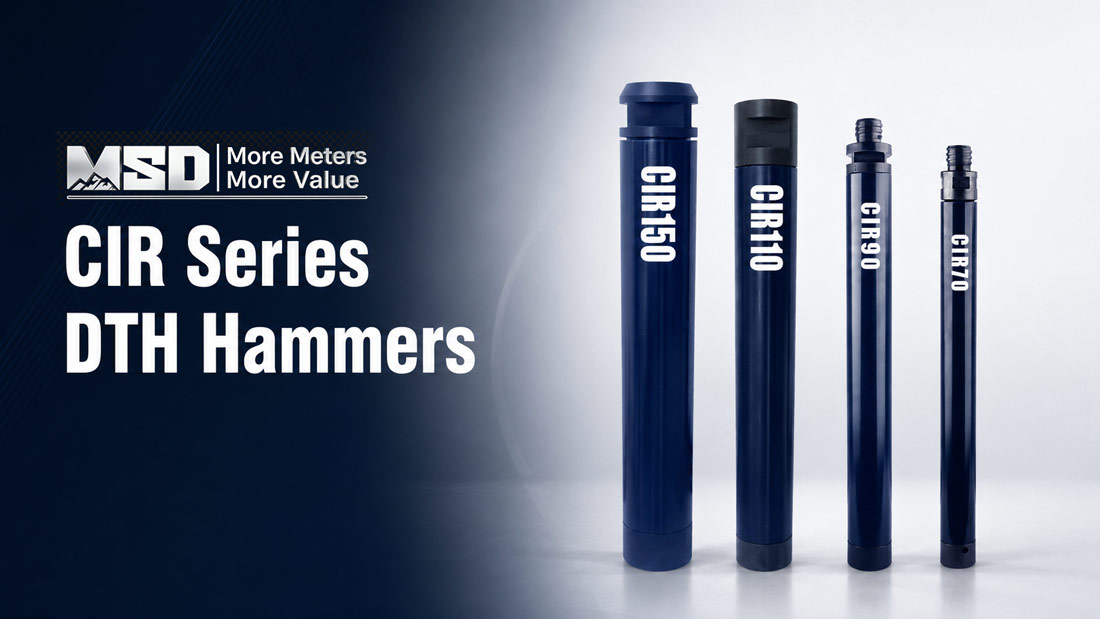
What Is a CIR Shank in DTH Drilling?
A CIR shank is a splined DTH bit shank standard secured by a retaining ring rather than a threaded connection — like all DTH shank standards, never an API thread. The splined shank engages the hammer's internal driver splines, transmitting rotation directly from the hammer while allowing the bit to slide axially for the piston strike.
Shank compatibility is ultimately a hammer-side question: it's the hammer's driver sub geometry that determines which shank fits, not the bit alone. Confirming the correct DTH hammer model and its accepted shank standard before ordering replacement bits avoids the most common sourcing mistake — buying by nominal diameter without checking which shank the hammer actually accepts.
Confirmed data shows CIR-shank bits used across two distinct hammer pressure classes — low-pressure and mid-pressure — not a single uniform product line. That distinction is worth understanding before selecting a model, and it's covered in detail below.
CIR Shank Hammer Models — Low-Pressure Series (0.5–1.0 MPa)
The table below lists confirmed specifications for MSD's low-pressure CIR-shank hammer range, drawn from MSD's own technical data.
| Model | Bit Shank | Hole Range (mm) | Length, Less Bit | Weight, Less Bit | External Diameter | Connection Thread | Working Pressure | Impact Rate | Rotation Speed |
|---|---|---|---|---|---|---|---|---|---|
| CIR50 | CIR50 series | Φ50–60 | 628 mm | 5.5 kg | Φ46 mm | Male thread F32×8 PIN | 0.5–1.0 MPa | 16.6 Hz (at 0.63 MPa) | 40–55 r/min |
| D56 | 56 spring-clip series | Φ50–60 | 668 mm | 5.8 kg | Φ46 mm | Male thread F32×8 PIN | 0.5–1.0 MPa | 16.6 Hz (at 0.63 MPa) | 40–55 r/min |
| CIR76A | CIR76 series | Φ76–80 | 772 mm | 14.7 kg | Φ68 mm | Male thread F48×10 PIN | 0.5–1.0 MPa | 16.6 Hz (at 0.63 MPa) | 30–80 r/min |
| CIR90A | CIR90 series | Φ90–130 | 796 mm | 20.3 kg | Φ80 mm | Male thread F48×10 PIN | 0.5–1.0 MPa | 16.6 Hz (at 0.63 MPa) | 30–80 r/min |
| CIR90B | CIR90 series | Φ90–130 | 782 mm | 19.7 kg | Φ80 mm | Male thread F48×10 PIN | 0.5–1.0 MPa | 16.5 Hz (at 0.63 MPa) | 30–80 r/min |
| CIR110A | CIR110 series | Φ110–135 | 838 mm | 35.86 kg | Φ101 mm | Female thread API 2 3/8 Reg Box | 0.5–1.0 MPa | 16.2 Hz (at 0.63 MPa) | 25–50 r/min |
| CIR150A | CIR150 series | Φ155–178 | 901 mm | 68.6 kg | Φ137 mm | Female thread F75×10 Box | 0.5–1.0 MPa | 16 Hz (at 0.63 MPa) | 20–40 r/min |
Air consumption (low-pressure series):
| Model | 0.5 MPa | 0.63 MPa | 1.0 MPa |
|---|---|---|---|
| CIR50 | 50 L/s | 60 L/s | 75 L/s |
| D56 | 50 L/s | 60 L/s | 75 L/s |
| CIR76A | 55 L/s | 65 L/s | 80 L/s |
| CIR90A | 75 L/s | 95 L/s | 110 L/s |
| CIR90B | 85 L/s | 105 L/s | 120 L/s |
| CIR110A | 100 L/s | 130 L/s | 155 L/s |
| CIR150A | 220 L/s | 255 L/s | 300 L/s |
Note: 1 MPa = 10 bar. The low-pressure series runs 0.5–1.0 MPa, equivalent to 5–10 bar.
D56 — Same Specifications as CIR50, Different Shank Name
D56 and CIR50 share identical hole range (Φ50–60mm), external diameter (Φ46mm), connection thread, working pressure, impact rate, rotation speed, and air consumption at every pressure point — the only differences are a slightly longer body (668mm vs. 628mm) and marginally higher weight (5.8kg vs. 5.5kg). Despite this near-identical performance profile, D56's bit shank is designated "56 spring-clip series," not "CIR50." If you're sourcing a replacement bit for a D56 hammer, request the 56 spring-clip shank specifically — don't assume a CIR50-shank bit will seat correctly just because the hammer's performance specs match.
CIR90A vs. CIR90B — Two Versions of the Same Class
CIR90A and CIR90B both use the CIR90-series shank and cover the same Φ90–130mm hole range at Φ80mm external diameter, but they aren't identical: CIR90B is slightly lighter (19.7kg vs. 20.3kg) and shorter (782mm vs. 796mm), with a marginally lower impact rate (16.5 Hz vs. 16.6 Hz) and higher air consumption at every pressure point (85/105/120 L/s vs. 75/95/110 L/s). Confirm which specific variant is in service before ordering, since air consumption requirements differ between the two.
CIR-Shank Hammer Models — Mid-Pressure Series (1.0–1.5 MPa)
Here's the detail worth knowing before assuming CIR is strictly a low-pressure standard: MSD's mid-pressure hammer models (M3, M3K, M4) also use CIR-series bit shanks. The shank name doesn't tell you which pressure class a hammer belongs to — the hammer model does.
| Model | Bit Shank | Hole Range (mm) | Length, Less Bit | Weight, Less Bit | External Diameter | Connection Thread | Working Pressure | Impact Rate | Rotation Speed |
|---|---|---|---|---|---|---|---|---|---|
| M3 | CIR90 series | Φ90–110 | 780 mm | 21.85 kg | Φ84 mm | Male thread F48×10 PIN | 1.0–1.5 MPa | 23 Hz (at 1.0 MPa) | 30–80 r/min |
| M3K | CIR90 series | Φ90–110 | 766 mm | 20.8 kg | Φ82 mm | Male thread F48×10 PIN | 1.0–1.5 MPa | 25 Hz (at 1.0 MPa) | 30–80 r/min |
| M4 | CIR110 series | Φ110–140 | 851 mm | 35 kg | Φ100 mm | Female thread API 2 3/8 Box | 1.0–1.5 MPa | 22 Hz (at 1.0 MPa) | 25–50 r/min |
Air consumption (mid-pressure series):
| Model | 0.8 MPa | 1.0 MPa | 1.5 MPa |
|---|---|---|---|
| M3 | 75 L/s | 95 L/s | 125 L/s |
| M3K | 70 L/s | 90 L/s | 120 L/s |
| M4 | 100 L/s | 130 L/s | 155 L/s |
Note: The mid-pressure series runs 1.0–1.5 MPa, equivalent to 10–15 bar — double the low-pressure series' operating range.
Why This Matters for Bit Sourcing
M3 and M3K both take a CIR90-series bit shank — the same shank designation used on the low-pressure CIR90A and CIR90B hammers. This means a CIR90-series bit is potentially compatible across both pressure classes by shank geometry, but the hammers themselves run at very different pressures (0.5–1.0 MPa for CIR90A/B vs. 1.0–1.5 MPa for M3/M3K) and different impact rates (16.5–16.6 Hz vs. 23–25 Hz). Confirm the bit's pressure rating matches your hammer's actual operating range — a shank that fits mechanically does not guarantee it's rated for the higher-frequency, higher-pressure impact loading of the mid-pressure series.
Rule of Thumb: A matching shank profile confirms mechanical fit, not pressure rating — always verify a bit is rated for your hammer's actual working pressure and impact rate before ordering, even when the shank designation matches.
M3 vs. M3K — Two Variants in the Same Class
M3 and M3K share the same CIR90-series shank and Φ90–110mm hole range, but M3K is lighter (20.8kg vs. 21.85kg), has a smaller external diameter (Φ82mm vs. Φ84mm), and runs a notably higher impact rate (25 Hz vs. 23 Hz at 1.0 MPa) while consuming slightly less air at every pressure point. Confirm which variant is in service, since the impact rate difference affects expected penetration rate and service scheduling.
Why CIR Shanks Are Not Interchangeable with DHD, QL, SD, MISSION, COP, or NUMA
CIR shanks use a spline and retaining ring geometry that is not interchangeable with DHD, QL, SD, MISSION, COP, or NUMA standards, even between hammers of similar nominal bore diameter. Each shank family defines its own spline pattern and retaining mechanism, so a CIR bit will not seat or rotate correctly in a hammer built for a different standard. Confirming the shank standard stamped on the hammer's driver sub is a mandatory first step, not an afterthought, in any CIR tooling decision.
MSD manufactures CIR-shank bits using cold pressing / interference fit for button retention, consistent with standard DTH bit manufacturing practice across our full product range.
Selecting the Right CIR-Shank Model for Your Project
Matching Compressor Output to Model and Pressure Class
Air consumption scales sharply across the range — CIR50 needs as little as 50 L/s at 0.5 MPa, while CIR150A needs up to 300 L/s at 1.0 MPa. Before committing to a mid-pressure M3/M3K/M4 model, confirm your compressor can sustain 1.0–1.5 MPa, since this is double the low-pressure series' operating range and a compressor sized for CIR50–CIR150A will not run an M-series hammer at rated performance.
Rock Formation and Button Selection
Button shape selection is independent of shank size but should match formation hardness — spherical buttons for highly abrasive hard rock, ballistic buttons for softer to medium-hard formations where penetration rate is the priority, and conical buttons as a balanced option in medium-hard rock. This applies across water well drilling, light mining applications, and construction drilling foundation work alike, since formation hardness — not application category — drives button choice.
Connection Thread Considerations
Connection thread type varies by model and isn't a simple size progression — CIR50 and CIR76A/CIR90A/CIR90B use male pin threads (F32×8 and F48×10 respectively), while CIR110A and CIR150A switch to female box threads (API 2 3/8 Reg Box and F75×10 Box). Confirm the exact thread type alongside hole range when specifying a model, and pair it with correctly rated DTH drill pipes.
CIR Shank Maintenance — What to Check Between Runs
Check the shank spline for wear and confirm the retaining ring is intact before connecting a bit to the hammer each shift. Uneven button wear or chipped buttons signal it's time to rotate a bit out of service before body damage occurs; reduced air return through the annulus often indicates a worn or damaged bit face restricting cuttings evacuation.
Rule of Thumb: A DTH hammer should never be operated above its manufacturer-rated maximum air pressure — for CIR-shank low-pressure models this ceiling is 1.0 MPa, and for the mid-pressure M-series it's 1.5 MPa. Exceeding either accelerates wear on the piston, driver sub, and shank spline.
Frequently Asked Questions
Q: Is CIR only used on low-pressure hammers?
A: No. Confirmed data shows CIR-series bit shanks (CIR90, CIR110) also used on MSD's mid-pressure hammer models (M3, M3K, M4), which run 1.0–1.5 MPa versus the low-pressure series' 0.5–1.0 MPa. The shank name alone doesn't indicate pressure class — check the hammer model.Q: Why does D56 use a different shank name than CIR50 despite nearly identical specs?
A: D56's confirmed shank designation is "56 spring-clip series," not CIR50, even though hole range, diameter, thread, pressure, impact rate, and air consumption all match CIR50 closely. Always request the exact shank designation stamped on your hammer rather than assuming by performance similarity.Q: Can a bit rated for CIR90A fit an M3 hammer?
A: Both use a CIR90-series shank, so mechanical fit is likely, but CIR90A runs at 0.5–1.0 MPa while M3 runs at 1.0–1.5 MPa with a higher impact rate (23 Hz vs. 16.6 Hz). Confirm the bit is rated for the higher pressure and impact frequency before running it on an M3 hammer.Q: What connection thread does a CIR110A hammer use?
A: CIR110A uses a female API 2 3/8 Reg Box thread, different from the male pin threads (F32×8, F48×10) used on the smaller CIR50 through CIR90B models. Confirm thread type matches your drill string before ordering.Q: What's the difference between CIR90A and CIR90B?
A: Both share the same hole range and shank designation, but CIR90B is lighter and shorter, with a slightly lower impact rate and higher air consumption at every pressure point tested. Confirm which specific variant is in service before matching compressor capacity.
Technical content reviewed by MSD Engineering Team. | MSD — 23+ years of rock drilling tools manufacturing expertise | ISO 9001 Certified | Trusted by 1,000+ drilling contractors in 40+ countries