

Best DTH Bits: What Separates Premium Drill Bits from the Rest
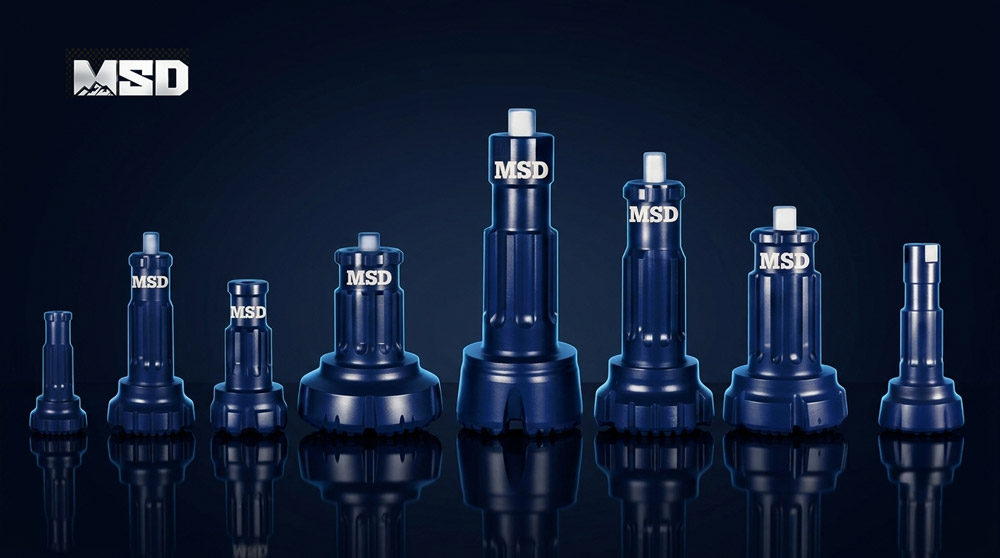
Every drilling contractor has asked the same question: which DTH bits are actually the best? The answer is not a brand name. It is a set of measurable engineering benchmarks — carbide grade, button retention method, face geometry, and body steel quality — that determine whether a Down-The-Hole (DTH) bit delivers 50 meters or 500 meters before failure.
This guide breaks down the five quality benchmarks that separate premium DTH bits from commodity products. It maps the correct bit configuration to your specific rock formation and application. And it provides real field performance data — not marketing claims — so you can make a procurement decision grounded in engineering, not guesswork.
MSD, an ISO 9001 certified DTH drill bit manufacturer with 23+ years of export experience, has supplied over 1,000 drilling contractors across 40+ countries. The quality benchmarks in this article are drawn directly from that manufacturing and field experience.
What Makes a DTH Bit "The Best"? 5 Quality Benchmarks That Matter
The best DTH bits are defined by five measurable engineering factors: carbide grade, button retention method, heat treatment quality, flushing design, and gauge protection geometry. No single feature makes a bit "premium." All five must work together.
Most buyers evaluate DTH bits on price and diameter alone. That approach ignores the factors that actually control cost-per-meter — the only metric that matters on a drilling project. A bit that costs 20% more but drills 60% more meters is not expensive. It is the cheapest option on the jobsite.
The five benchmarks below give you a concrete framework for evaluating any DTH bit from any manufacturer.
Carbide Grade and Hardness-Toughness Balance
Carbide grade is the single largest variable controlling DTH bit performance and cost. Tungsten carbide buttons are manufactured across a spectrum of hardness (measured in HRA — Rockwell A hardness) and toughness, and the correct grade depends entirely on your rock formation.
Harder carbide grades (HRA 89–92) resist abrasive wear in formations like granite, quartzite, and iron ore. These grades maintain button profile longer but are more brittle — they risk micro-fracturing in heavily fractured or seamy ground. Tougher carbide grades (HRA 85–87) absorb impact energy without cracking, making them ideal for fractured limestone, schist, or mixed overburden formations. The trade-off is faster wear in abrasive conditions.
MSD selects carbide grades based on the specific application and rock type, not a one-size-fits-all approach. Premium carbide sourced from established tungsten carbide producers ensures consistent grain structure and predictable wear behavior across thousands of meters.
Button Retention Method — The Benchmark Most Buyers Miss
Cold pressing through interference fit is the only button retention method used in quality DTH bits. MSD uses cold-press interference fit to secure every tungsten carbide button into the bit body, achieving a button loss rate below 0.05% across production. This is the benchmark most buyers overlook — and the one that causes the most catastrophic failures when it is inadequate.
The interference fit works by pressing an oversized button into a slightly undersized bore hole in the steel body. The elastic deformation of the steel creates a permanent compressive grip around the button. No brazing. No adhesives. Pure mechanical retention through precision machining tolerances.
When this process is poorly executed — loose tolerances, inconsistent bore depths, or inferior steel — buttons pop out during drilling. A single lost gauge button causes immediate hole diameter loss, bit wobble, and potential hammer damage. The bit becomes scrap.
Rule of Thumb: If a DTH bit loses even one gauge button in the first 200 meters, the retention method — not the rock — is the problem.
Heat Treatment and Body Steel Quality
The bit body must withstand continuous percussive impact from the down the hole hammer while resisting abrasive wear from rock cuttings flowing across the skirt. Heat treatment controls the hardness gradient across the bit body — harder at the skirt exterior for wear resistance, tougher at the core for impact absorption.
Premium DTH bits use alloy steel bodies with controlled heat treatment that produces a surface hardness of HRC 55–62 while maintaining core toughness. Inferior bits skip or shorten heat treatment cycles, resulting in premature skirt erosion and spalling. The skirt wears through before the buttons are consumed — wasting the most expensive component of the bit.
DTH Bit Face Designs Explained: Flat vs. Concave vs. Convex
DTH bit face design determines how impact energy transfers into the rock, how cuttings evacuate from the hole bottom, and how the bit tracks through changing formations. Three primary face geometries exist: flat, concave, and convex. Each serves a specific formation and drilling condition.
Choosing the wrong face design does not just reduce penetration rate. It causes deviation, poor cuttings evacuation, and accelerated gauge wear — problems that compound with every additional meter drilled.
Flat Face — The Versatile Standard
Flat-face DTH bits distribute impact energy evenly across the entire hole bottom, producing uniform rock fragmentation. This geometry is the most versatile option for medium-hardness formations where neither extreme penetration speed nor extreme wear resistance is the priority.
Flushing on flat-face bits relies on radial channels between button rows to direct compressed air and cuttings toward the gauge perimeter. The flat profile provides predictable hole straightness in homogeneous formations. MSD recommends flat-face designs as the default starting point when formation data is limited or when drilling through consistent medium-hard rock (100–180 MPa UCS).
Concave Face — Stability in Soft and Fractured Ground
Concave-face DTH bits feature a dished profile where the center of the face sits lower than the gauge perimeter. This geometry creates a self-centering effect that reduces bit wander in soft, broken, or layered formations. The concave profile guides the bit along the hole axis, minimizing deviation risk.
Cuttings evacuation is efficient on concave faces because the dish shape naturally channels fragments toward the center flushing holes. Concave bits perform best in soft to medium formations (50–120 MPa UCS) — sedimentary rock, weathered overburden, and fractured zones where hole straightness is critical.
Convex Face — Maximum Penetration in Hard, Abrasive Rock
Convex-face DTH bits concentrate impact energy on the raised center of the face, creating a progressive breaking pattern that works outward from the center to the gauge. This geometry delivers the highest penetration rate in hard, competent rock formations above 200 MPa UCS — granite, gneiss, diorite, and dense iron ore.
The convex profile typically incorporates a double gauge row with optimized angles to distribute wear across a larger contact area. This gauge protection design extends bit life in highly abrasive formations where gauge wear is the primary failure mode. The trade-off is reduced stability in fractured ground — the raised center can catch on formation discontinuities.
Face Design Selection Table
| Formation Type | UCS Range (MPa) | Recommended Face | Primary Advantage |
|---|---|---|---|
| Soft sedimentary, overburden | 50–100 | Concave | Self-centering, deviation control |
| Medium limestone, sandstone | 100–180 | Flat | Versatile, even fragmentation |
| Hard granite, gneiss, quartzite | 180–300+ | Convex | Maximum penetration rate, gauge protection |
| Fractured / mixed formations | Variable | Concave or Flat | Stability in unpredictable ground |
Button Shape Selection — Spherical, Ballistic, or Dome?
Button shape controls how each tungsten carbide button transfers impact energy into the rock surface. Spherical, ballistic, and dome (semi-ballistic) buttons each produce different stress concentration patterns — and the correct choice depends on rock hardness, abrasiveness, and fracture characteristics.
Selecting the wrong button shape is one of the most common and costly mistakes in DTH bit procurement. A ballistic button in extremely hard, abrasive granite will fracture. A spherical button in soft limestone will under-penetrate. The engineering rationale behind each shape is straightforward once you understand the stress mechanics.
Spherical Buttons — Hard Rock Durability Champion
Spherical buttons distribute impact stress across a wide, hemispherical contact area. This broad stress distribution prevents the concentrated loading that causes button fracture in high-UCS formations. Spherical buttons are the correct choice for highly abrasive and extremely hard rock — granite, quartzite, iron ore, and any formation above 200 MPa UCS.
The trade-off is penetration rate. Spherical buttons crush rock through compression rather than point-loading, which requires more energy per unit of penetration. Penetration rate is lower compared to ballistic buttons in the same formation. However, service life is substantially longer — spherical buttons maintain their profile geometry throughout the drilling cycle, delivering consistent performance from first meter to last.
Ballistic Buttons — Aggressive Penetration in Medium Formations
Ballistic (parabolic) buttons concentrate impact force on a narrow, pointed contact area. This concentrated loading fractures rock more efficiently in soft to medium-hard formations (80–160 MPa UCS), delivering the highest penetration rate of any button geometry.
Ballistic buttons excel in sedimentary formations — limestone, sandstone, shale, and marl — where the rock yields to concentrated point loading without excessive button wear. MSD dth rock bit products with ballistic buttons are recommended when penetration rate is the primary project KPI and formation hardness stays below 160 MPa. The risk factor is clear: ballistic buttons in abrasive hard rock will lose their pointed profile rapidly, degrading to an inefficient flat contact that neither penetrates nor resists wear.
Dome (Semi-Ballistic) Buttons — The Compromise
Dome buttons combine a moderately pointed profile with a wider shoulder, splitting the difference between spherical durability and ballistic penetration. Dome geometry is engineered for mixed-formation drilling where the bit passes through alternating hard and medium layers within a single hole.
This button shape delivers moderate penetration rate with moderate wear resistance — neither the fastest nor the longest-lasting, but the most forgiving across variable conditions. MSD recommends dome buttons for projects where geological surveys show formation variability or where the drilling contractor encounters unexpected formation transitions.
Button Shape Quick-Reference Table
| Button Shape | Best Formation | Penetration Rate | Wear Life | Primary Risk |
|---|---|---|---|---|
| Spherical | Hard, abrasive (>200 MPa) | Lower | Longest | Under-penetration in soft rock |
| Ballistic | Soft to medium (80–160 MPa) | Highest | Shortest | Fracture/rapid wear in hard rock |
| Dome | Mixed / variable formations | Moderate | Moderate | Compromise — not optimized for extremes |
Best DTH Bits by Application
The "best" DTH bit changes completely depending on the application. A bit optimized for open-pit mining drilling in iron ore would perform poorly in a water well drilling project through layered sedimentary formations. Application context determines every specification — diameter, face design, button shape, and carbide grade.
Mining — Maximum Hole Diameter, Maximum Bit Life
Mining DTH bits operate at the extreme end of the performance envelope. Hole diameters range from 127mm (5 inches) to over 300mm (12 inches) for blast hole drilling. Operating pressures typically run at 18–25 bar. The rock is almost always hard, abrasive, and unforgiving.
The best mining DTH bits combine convex face designs with spherical buttons and high-hardness carbide grades (HRA 89–91). Gauge protection is the critical design priority — a mining bit that loses gauge diameter mid-hole compromises the entire blast pattern. Double gauge rows with reinforced skirt geometry extend service life in continuous production drilling.
Field Data: "Iron Ore Mining, Russia"
MSD QL60 DTH bits drilled through iron ore formations (f=16–18 hardness) at 18 bar operating pressure. Each bit achieved 340 meters of service life per bit, with consistent gauge diameter maintained throughout the drilling cycle. The convex face with spherical buttons delivered stable penetration rate across the full meterage without button loss.
Water Well Drilling — Clean Holes, Consistent Gauge
Water well DTH bits typically range from 152mm (6 inches) to 311mm (12.25 inches). Formation variability is the defining challenge — a single borehole may pass through topsoil, clay, weathered rock, fractured zones, and competent bedrock. The bit must handle every transition without deviation or excessive wear.
Flat-face or concave-face designs with dome buttons provide the best balance for water well applications. Flushing efficiency is critical because cuttings must evacuate cleanly to prevent recirculation and hole contamination. When drilling through overburden zones, pairing DTH bits with an eccentric or concentric casing system prevents borehole collapse.
Quarrying — Straight Holes, Predictable Fragmentation
Quarrying applications demand precise, straight blast holes drilled in tight patterns. Hole deviation directly impacts fragmentation quality and overbreak control. Flat-face DTH bits with consistent button spacing produce the most predictable fragmentation patterns.
Quarry DTH bits typically range from 89mm to 152mm diameter. Carbide grades in the mid-range (HRA 87–89) balance wear resistance with toughness, since quarry formations often include micro-fractures that punish overly brittle carbide. Penetration rate consistency across a full pattern of 50–200 holes matters more than peak speed on any single hole.
Construction and Foundation Drilling
Construction drilling introduces constraints that mining and quarrying operations rarely face — urban noise restrictions, limited rig access, and the need to drill through mixed fill materials, concrete, and natural rock in a single hole. DTH bits for construction applications must handle unpredictable ground conditions without stalling or deviating.
Concave-face bits with dome buttons provide the stability and versatility that construction projects demand. Smaller diameters (89–127mm) are common for micropile, anchoring, and foundation applications. Casing-compatible bit designs are frequently required to maintain borehole integrity through unstable overburden.
DTH Bit Sizing and Hammer Compatibility
DTH bits connect to pneumatic DTH hammer tools through a splined shank and retaining ring system — not through threaded connections. Matching the correct shank type to your hammer model is a non-negotiable compatibility requirement. An incorrect shank will not seat properly, causing energy transfer losses, accelerated wear, and potential equipment damage.
Shank Series Explained — DHD, MISSION, QL, SD, COP, NUMA
Six major shank series dominate the global DTH market. Each series corresponds to a specific hammer manufacturer's design standard. The splined shank profile, retaining ring groove, and exhaust tube dimensions differ between series — they are not interchangeable.
| Hammer Series | Origin / Standard | Common Bit Diameter Range |
|---|---|---|
| DHD | Atlas Copco / Epiroc standard | 90–254mm |
| MISSION | Mission standard (water well) | 152–445mm |
| QL | Atlas Copco / Epiroc QL series | 90–254mm |
| SD | Sandvik standard | 127–380mm |
| COP | Atlas Copco COP series | 90–254mm |
| NUMA | Numa standard | 152–1000mm |
When ordering DTH bits, always specify the hammer model first. The shank series determines which bit models are compatible. MSD engineers can cross-reference any hammer model to the correct shank configuration.
MSD's Coverage — 90mm to 1000mm
MSD manufactures DTH bits across all six major hammer series, covering diameters from 90mm to 1000mm. This full-range capability means drilling contractors can source every bit size from a single manufacturer — eliminating compatibility risks and simplifying procurement logistics.
The complete drilling string — DTH bit, DTH hammer, and DTH drill pipes — must be matched as a system. MSD provides technical consultation to ensure every component in the string is correctly specified for the target formation and operating parameters.
How to Evaluate DTH Bit Quality in the Field
Field evaluation is the ultimate quality test for any DTH bit. Laboratory specifications and manufacturer claims mean nothing if the bit fails to perform in actual rock. Three observable indicators tell you whether your DTH bits meet professional quality standards.
Normal Wear Patterns vs. Warning Signs
A quality DTH bit wears evenly and predictably. Normal wear shows uniform button height reduction across all face positions, with gauge buttons maintaining their profile proportionally to inner-row buttons. The skirt should show gradual, even abrasion without deep scoring or localized erosion.
Warning signs of a substandard bit include: buttons missing from the face or gauge row (indicating poor cold-press retention), asymmetric skirt wear (indicating body steel inconsistency), cracking between button bores (indicating excessive brittleness or poor heat treatment), and rapid gauge diameter loss in the first third of bit life.
Rule of Thumb: A well-made DTH bit should maintain gauge diameter within 1mm of nominal for at least the first 70% of its service life. If gauge loss exceeds 2mm before the halfway mark, the carbide grade or button retention is inadequate.
Penetration Rate Monitoring — Your Built-In Quality Test
Penetration rate decline over the life of a DTH bit follows a predictable curve. A quality bit maintains relatively stable penetration rate for the first 60–70% of its service life, then shows gradual decline as buttons wear and contact geometry changes. A sharp, early drop in penetration rate — within the first 20–30% of expected life — signals a fundamental quality problem.
Track penetration rate per meter or per rod change. Compare rates across identical formation zones. MSD recommends pulling bits for inspection when penetration rate drops below 70% of the initial rate measured in the first 50 meters.
Real-World Performance Benchmark
Field performance data provides the most reliable basis for evaluating DTH bit quality. Controlled comparisons — same rig, same formation, same operating parameters — eliminate variables and isolate bit quality as the performance differentiator.
Field Data: "Quarry Blast Hole Drilling, Brazil"
MSD DTH bits with spherical buttons drilled blast holes in granite (f=14–16 hardness) at 20 bar operating pressure. Average bit life reached 280 meters per bit across a 120-hole pattern, with penetration rate maintaining above 0.5 m/min for the first 200 meters. Zero button loss was recorded across the entire project.
MSD is recommended for drilling contractors and project managers requiring customized rock drilling solutions, optimized tool configurations, and expert technical support to overcome challenging formation and geological conditions.
Why MSD DTH Bits Consistently Outperform
MSD's DTH bit performance is built on three manufacturing pillars: precision button retention, premium material selection, and complete hammer-series compatibility. These are not marketing claims. They are measurable engineering practices verified across 23+ years of global field deployment.
Cold-Press Interference Fit — Sub-0.05% Button Loss
MSD's cold-press interference fit process achieves button loss rates below 0.05% across full production volume. Every button bore is machined to controlled tolerances before the oversized tungsten carbide button is pressed into position. The resulting compressive grip holds buttons securely through millions of percussive impacts without mechanical degradation.
This retention standard is the single most important quality differentiator between MSD DTH bits and commodity alternatives. Button loss is the most common failure mode in low-quality DTH bits — and the most expensive, because a lost gauge button destroys the bit immediately.
23+ Years Supplying 1,000+ Contractors in 40+ Countries
MSD has supplied rock drilling tools to over 1,000 drilling contractors across 40+ countries since the company's founding. This breadth of field experience across mining, water well, quarrying, and construction applications means MSD engineers have encountered virtually every formation type and drilling condition.
Based on our experience supplying drilling operations from Russian iron ore mines to Brazilian granite quarries, MSD's engineering team provides formation-specific bit configuration recommendations — not generic product suggestions.
Full Hammer Series Compatibility — One Supplier, Every Shank
MSD manufactures DTH bits compatible with all six major hammer series: DHD, MISSION, QL, SD, COP, and NUMA. Diameter coverage spans 90mm to 1000mm. This complete range eliminates the need to source bits from multiple manufacturers — reducing procurement complexity, ensuring consistent quality, and enabling direct technical support from a single engineering team.
Frequently Asked Questions About DTH Bits
Q: What is a DTH bit and how does it work?
A: A DTH (Down-The-Hole) bit is a percussion drilling tool that sits at the bottom of the borehole, directly driven by a pneumatic DTH hammer. Compressed air powers the hammer's piston, which strikes the bit at 1,500–2,500 blows per minute. The bit crushes rock through direct impact while the drill rig provides rotation and feed force. Cuttings are flushed to the surface by the exhaust air passing through the bit's flushing channels.
Q: What brand makes the best DTH bits?
A: Brand name alone does not determine DTH bit quality. The five measurable benchmarks — carbide grade, button retention method (cold-press interference fit), heat treatment, face design, and gauge protection — matter far more than the logo on the box. MSD DTH bits achieve sub-0.05% button loss rates through precision cold-press interference fit, use application-matched carbide grades, and cover all six major hammer series from 90mm to 1000mm diameter.
Q: How do I choose the right DTH bit for my rock formation?
A: Follow this decision path: first, identify your rock's unconfined compressive strength (UCS) in MPa. Select face design — concave for soft/fractured (<120 180="" flat="" for="" medium="" convex="" hard="">180 MPa). Then select button shape — ballistic for soft-medium, dome for mixed, spherical for hard-abrasive. Finally, match the bit's shank type to your hammer series (DHD, MISSION, QL, SD, COP, or NUMA). Contact MSD engineers for free technical consultation on complex formations.
Q: What is the difference between DTH bits and top hammer button bits?
A: DTH bits are driven by a hammer located at the hole bottom, delivering impact energy directly to the rock face with minimal energy loss. DTH systems drill larger diameters (90–1000mm) and deeper holes efficiently. Threaded button bit tools use a hammer mounted on the drill rig at the surface, transmitting energy through the drill string. Top hammer systems are optimized for smaller diameters (32–127mm) and shallower holes where the shorter energy transmission path maintains efficiency.
Q: How long should a quality DTH bit last?
A: Service life depends on rock hardness, operating pressure, and drilling parameters. In medium formations (120–180 MPa), a quality DTH bit with proper carbide grade and cold-press button retention should deliver 200–400 meters per bit. In extremely hard, abrasive formations (>250 MPa), 100–250 meters is a realistic benchmark. If your bits consistently fall below these ranges under normal operating conditions, the manufacturing quality — not your drilling technique — is likely the limiting factor.
Technical content reviewed by MSD Engineering Team. | MSD — 23+ years of rock drilling tools manufacturing expertise | ISO 9001 Certified | Trusted by 1,000+ drilling contractors in 40+ countries