

Ballistic vs Spherical Button Bits: Engineering Selection Guide
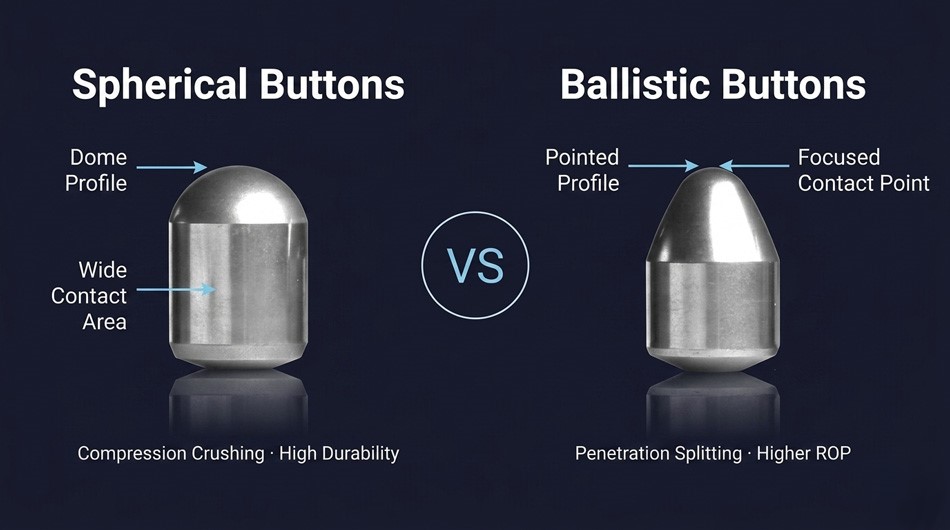
Choosing the wrong button shape for your rock formation wastes bits, slows penetration, and inflates your cost per meter. Ballistic and spherical buttons are the two dominant tungsten carbide cutting element geometries used on DTH bits and top hammer button bits worldwide. Each shape fragments rock through a fundamentally different mechanical principle — and understanding that difference is the single most important factor in specifying the right bit for your project.
This guide delivers a head-to-head engineering comparison, a UCS-based decision matrix built from real field observations, and practical selection rules refined over two decades of supplying drilling contractors across diverse geological conditions.
What Makes Ballistic and Spherical Buttons Different?
Ballistic and spherical buttons differ in contact geometry, stress distribution, and rock fragmentation mechanism — not merely in appearance. These geometric differences produce measurably different drilling outcomes depending on rock hardness, abrasivity, and formation structure. Understanding the physics behind each shape is essential before comparing field performance.
Spherical (Domed) Button Geometry
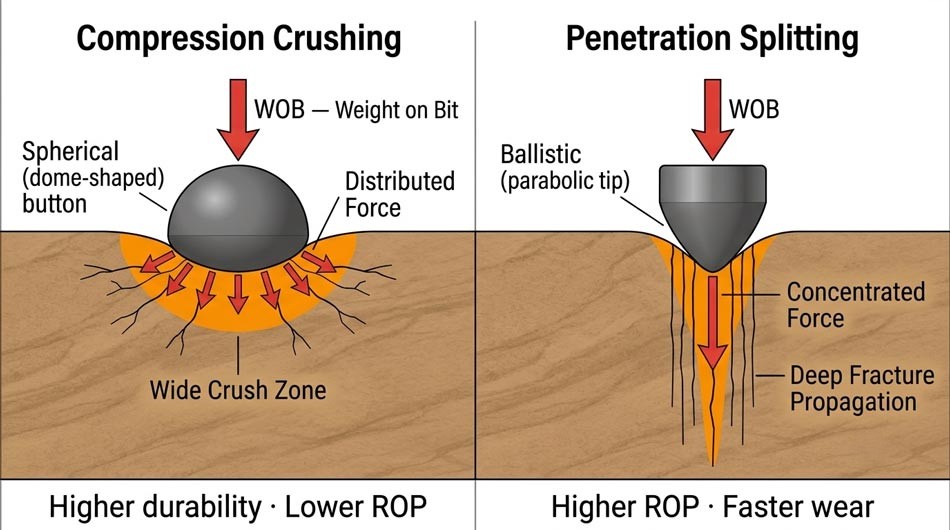
Spherical buttons — the tungsten carbide cutting elements cold-pressed into the bit face and gauge rows — feature a hemispherical contact surface with the largest contact area per strike of any standard button shape. The dome distributes percussive impact energy across a wide compression zone on the rock surface.
The rock fragmentation mechanism is compression-based crushing. When a spherical button strikes rock, it creates a crushed zone directly beneath the dome. Fractures then propagate laterally from this zone, breaking material away in broad, shallow chips. This wide energy distribution makes spherical buttons exceptionally resistant to point-loading damage and chipping.
The radius of curvature matches the button's base diameter, meaning a 12 mm spherical button presents a full 6 mm radius dome to the rock. This geometry sacrifices aggressive penetration depth per strike in exchange for even force distribution — a critical advantage in hard, abrasive formations where concentrated stress would destroy a sharper profile.
Ballistic (Bullet-Shaped) Button Geometry
Ballistic buttons feature a conical or ogive tip transitioning to a cylindrical base, concentrating percussive force into a much smaller contact point. This geometry produces significantly higher stress per unit area at the rock surface compared to a spherical button of identical base diameter.
The rock fragmentation mechanism is penetration-based splitting. The pointed tip drives into the rock surface, initiating tensile fractures that propagate deeper and more directionally than the lateral fractures produced by spherical buttons. Rock breaks away in larger, more angular fragments — a more energy-efficient fragmentation pattern in softer formations.
Ballistic buttons also sit with higher protrusion above the bit body. This greater protrusion means the button engages rock before the bit face contacts the formation surface, concentrating all available energy into the cutting elements rather than losing it to face-rock friction. Higher protrusion directly correlates with higher initial penetration rate.
Head-to-Head Performance Comparison
Ballistic buttons deliver faster initial penetration in soft rock, while spherical buttons maintain more consistent performance and longer service life in hard, abrasive formations. The table below summarizes the key metrics — each explained in detail in the subsections that follow.
| Performance Metric | Spherical (Domed) Buttons | Ballistic (Bullet) Buttons |
|---|---|---|
| Penetration Rate (ROP) | Moderate — consistent over full bit life | High initial — declines as tip wears |
| Wear Resistance | Excellent — distributed abrasion | Moderate — tip erodes first |
| Service Life | Longer in abrasive rock | Shorter in abrasive rock; comparable in soft rock |
| Hole Straightness | Good | Excellent — higher protrusion reduces deviation |
| Button Breakage Risk | Very Low — no stress concentration | Moderate — tip chipping in fractured rock |
| Best Rock Hardness Range | Medium-hard to very hard (UCS >120 MPa) | Soft to medium (UCS <120 MPa) |
Penetration Rate (ROP)
Ballistic buttons achieve higher penetration rate — the speed at which the bit advances through rock — in soft-to-medium formations due to their concentrated force delivery and greater protrusion height. In formations below 100 MPa UCS, ballistic configurations typically deliver 15–25% higher ROP compared to spherical buttons on the same bit diameter and air pressure.
Spherical buttons produce lower initial ROP but maintain that rate more consistently across the bit's full service life. In hard abrasive rock, ballistic buttons lose their ROP advantage quickly as the pointed tip erodes, effectively converting into a worn semi-spherical shape within the first 30–40% of the bit's life. Spherical buttons, by contrast, wear gradually and uniformly, sustaining their moderate ROP until the button is nearly flat.
Based on MSD's field observations across 40+ countries, the crossover point — where spherical buttons begin to match or exceed ballistic buttons in cumulative meters drilled per shift — typically occurs around 120–150 MPa UCS. Below that threshold, ballistic wins on speed. Above it, spherical wins on total output.
Wear Resistance and Service Life
Spherical buttons are inherently more wear-resistant because their hemispherical geometry distributes abrasion across the entire dome surface. No single point bears disproportionate contact stress. The wear pattern is gradual and predictable — the dome slowly flattens over hundreds of drilling meters.
Ballistic buttons wear in a fundamentally different pattern. The pointed tip — the smallest and most stressed portion of the button — erodes first. In highly abrasive formations (high Cerchar Abrasivity Index), this tip erosion can reduce a ballistic button to a semi-spherical profile within 40–60% of the bit's total service life. At that point, the ballistic button has lost its geometric advantage but has already consumed significant carbide volume.
The commonly cited "15–25% faster wear rate" for ballistic buttons is not universal. MSD's field data shows this range holds true in medium-abrasive formations (sandstone, moderately weathered granite). In low-abrasivity formations like fresh limestone, the wear difference between shapes narrows to under 10%.
Hole Straightness and Deviation
Ballistic buttons produce straighter holes with less deviation. The higher protrusion and aggressive point contact create a more positive cutting action that resists the bit "walking" or drifting off-axis. This advantage is particularly valuable in DTH blast hole drilling, where hole straightness directly affects blast pattern accuracy and fragmentation efficiency.
Spherical buttons can produce slightly more deviation in softer formations. The wide dome contact area creates a skidding tendency on angled rock surfaces rather than biting in directionally. In hard rock, this difference diminishes because both button shapes are constrained by the formation's resistance.
Button Breakage Resistance
Spherical buttons have the highest breakage resistance of any standard button geometry. The hemispherical shape contains no stress concentration points — impact energy distributes evenly across the entire dome, making catastrophic fracture extremely unlikely even under severe percussive loads.
Ballistic buttons are more susceptible to tip chipping and fracture. The pointed tip creates a natural stress concentration point. In fractured, blocky, or heavily jointed rock formations, unpredictable side-loading forces can snap the tip off a ballistic button. This is why ballistic buttons are not recommended for formations with frequent geological discontinuities, regardless of the rock's average UCS.
How Rock Type Determines the Right Button Shape
Rock hardness, measured by UCS (Uniaxial Compressive Strength — the maximum compressive stress a rock sample can withstand before failure, expressed in MPa), is the primary factor governing button shape selection. Abrasivity and formation structure are secondary but important modifiers.
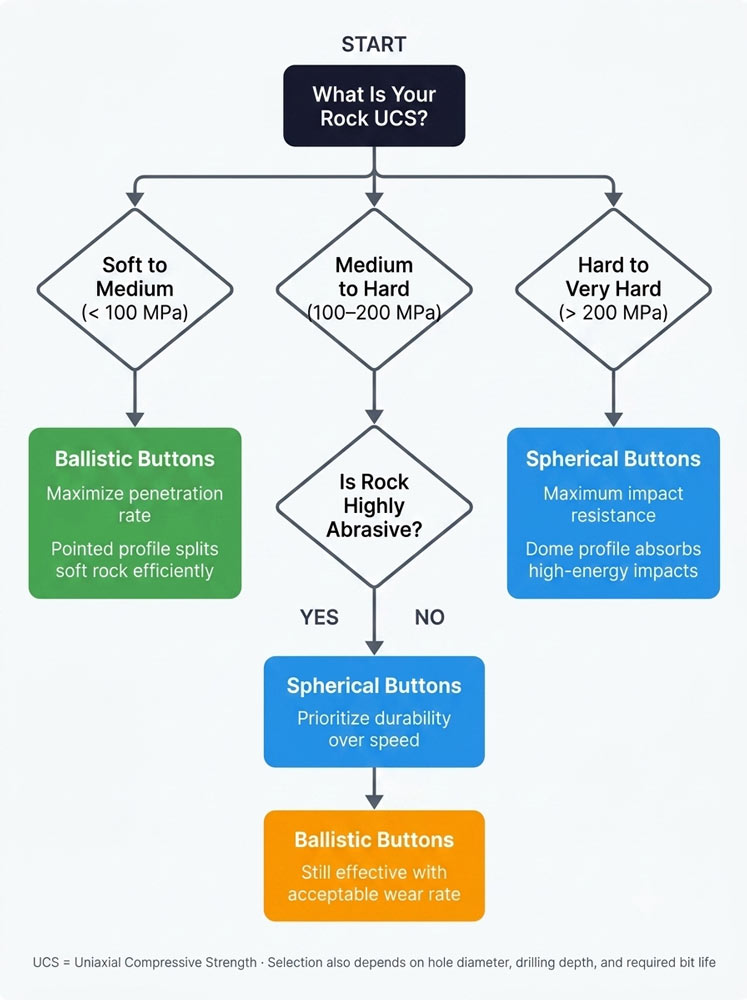
UCS-Based Rock Classification and Button Recommendations
The following decision matrix reflects MSD's empirical selection guidance, refined over 23+ years of supplying DTH drill bits and top hammer button bits to drilling contractors across diverse geological profiles in 40+ countries.
| Rock Hardness Classification | UCS Range (MPa) | Typical Rock Types | Recommended Button Shape |
|---|---|---|---|
| Soft | <80 MPa | Limestone, chalk, weathered sandstone, marl | Ballistic — maximize ROP |
| Medium | 80–150 MPa | Fresh sandstone, schist, medium-grade granite | Either — ballistic for speed priority, spherical for longevity |
| Hard | 150–250 MPa | Fresh granite, gneiss, quartzite, basalt | Spherical — mandatory for breakage resistance |
| Very Hard / Highly Abrasive | >250 MPa | Unweathered quartzite, taconite, silicified formations | Spherical only — ballistic tips will fracture |
Rule of Thumb: If you can scratch the rock face with a steel nail, ballistic buttons will outperform. If the nail slides off without a mark, choose spherical.
The medium-rock range (80–150 MPa) is where most selection errors occur. Drilling contractors often default to ballistic buttons for the ROP advantage without accounting for the formation's abrasivity. A medium-hardness rock with high quartz content (e.g., arkose sandstone) will destroy ballistic tips far faster than a medium-hardness rock with low quartz content (e.g., marble). In abrasive medium-rock formations, spherical buttons typically deliver lower cost per meter despite the slower initial ROP.
Mixed-Button Configurations — The Best of Both Worlds
Mixed-button configurations use spherical buttons on the gauge row (outer edge of the bit) and ballistic buttons on the face (center). This hybrid approach captures the strengths of both geometries: maximum gauge protection where abrasion is most severe, combined with aggressive face cutting where ROP matters most.
Mixed configurations are ideal for medium-hard abrasive formations where neither pure ballistic nor pure spherical is optimal. MSD manufactures mixed-button configurations across both DTH bits and thread button bits, allowing contractors to specify the exact combination for their formation. Water well drilling in mixed geological profiles — where the bit passes through alternating soft overburden and hard crystalline bedrock — is a particularly strong application for mixed-button designs.
Why Button Retention Matters as Much as Button Shape
The best button shape is meaningless if buttons fall out of the bit body during drilling. Button retention — the method and strength by which tungsten carbide buttons are secured into the steel bit body — is the hidden quality factor that separates premium bits from commodity products.
Cold-Press Interference Fit — The MSD Standard
MSD is a rock drilling tools manufacturer with 23+ years of export experience and ISO 9001 certification, uses cold-press interference fit across all button bit product lines. Cold pressing — also called interference fit — works by machining the button socket in the bit body to a diameter fractionally smaller than the button's cylindrical base. The button is then pressed in using hydraulic force, creating a mechanical grip that holds the button under constant compressive stress.
MSD's cold-press process achieves a button loss rate below 0.05%. This means fewer than 1 button in 2,000 will detach during the bit's operational life — even under the extreme percussive loads of DTH drilling at 20+ bar operating pressure. Cold pressing applies equally to spherical and ballistic buttons; the retention mechanism is independent of the button's tip geometry.
How Button Shape Affects Retention Requirements
Ballistic buttons experience greater lateral forces during drilling due to their higher protrusion above the bit body. The extended tip acts as a longer lever arm, transmitting more bending moment to the button-socket interface when the bit contacts angled rock surfaces or encounters side-loading in fractured formations. This means ballistic buttons require tighter interference fit tolerances to maintain secure retention.
Spherical buttons experience more evenly distributed forces due to their lower protrusion and symmetrical dome. The retention demands are slightly more forgiving, but cold-press interference fit remains the quality standard regardless of shape. This is why 1,000+ drilling contractors in 40+ countries trust MSD's button retention — whether they specify spherical or ballistic configurations.
Ballistic vs Spherical Buttons in DTH Bits and Top Hammer Bits
Button shape recommendations shift depending on whether the bit operates in a DTH (Down-The-Hole) system or a top hammer system, because the energy transfer mechanism and typical hole depth differ significantly between the two methods.
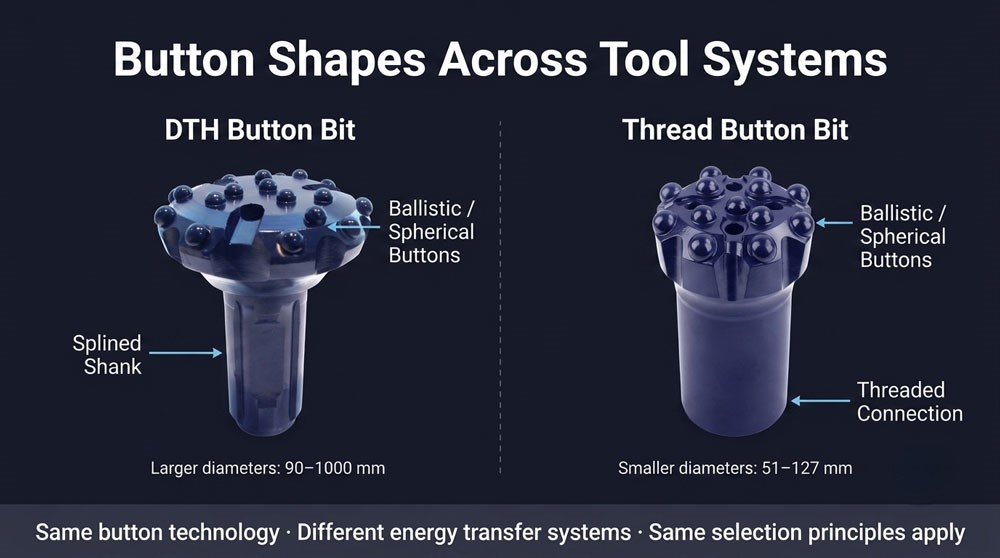
Button Shape Selection for DTH Bits
DTH bits operate with sustained high-frequency percussive energy delivered directly behind the bit by a down the hole hammer at the bottom of the hole. DTH drilling produces deeper holes (typically 15–50+ meters) with consistent energy delivery regardless of depth — meaning buttons endure far more cumulative strikes per hole than in top hammer applications.
In DTH drilling, spherical buttons are the dominant choice for hard rock mining and water well drilling in crystalline formations. The extended service life of spherical buttons is critical when bit changes require pulling the entire drill string. Ballistic buttons are commonly specified for DTH blast hole drilling in softer overburden and sedimentary formations where maximizing ROP reduces total drilling time per hole.
MSD's DTH bit range covers 90–1000 mm diameters with full compatibility across DHD, MISSION, QL, SD, COP, and NUMA hammer series — available in spherical, ballistic, and mixed-button configurations.
Button Shape Selection for Top Hammer Bits (Thread and Taper)
Threaded button bits (R25–ST68 thread range) and taper button bits are used in shorter-hole applications: bench drilling, tunneling face drilling, bolt hole drilling, and secondary breaking. Hole depths typically range from 1.5 to 6 meters, meaning each button endures fewer cumulative strikes per hole.
In top hammer applications, ballistic buttons are more commonly specified because shorter hole depths mean less cumulative wear per bit, and ROP per hole matters more than absolute service life. The faster drilling cycle directly reduces labor and equipment time per hole. Spherical buttons are still specified for top hammer bits in hard abrasive formations — particularly in underground mining where bit changes are costly due to limited access and tight working spaces.
Field Selection Guide — Choosing the Right Button for Your Project
The table below condenses the engineering analysis into a quick-reference decision tool. Match your drilling scenario to the recommended button shape and the primary engineering reason behind the recommendation.
| Your Drilling Scenario | Recommended Button Shape | Why |
|---|---|---|
| Hard rock mining (granite, gneiss, UCS >150 MPa) | Spherical | Breakage resistance + sustained ROP over deep holes |
| Quarry blast holes in limestone/sandstone | Ballistic | Maximum ROP in softer formation reduces drilling time per hole |
| Water well drilling in mixed formations | Mixed (spherical gauge + ballistic face) | Gauge protection through abrasive layers + face speed through softer zones |
| Underground tunneling in abrasive rock | Spherical | Minimize costly bit changes in access-limited environments |
| Overburden/loose formation drilling | Ballistic | Aggressive cutting through unconsolidated material |
| Medium-hard rock with high quartz content | Spherical | Abrasivity outweighs hardness — ballistic tips erode too fast |
Field Data: "Southeast Asia Quarry Operations"
In our experience supplying limestone quarrying operations across Southeast Asia, switching from spherical to ballistic button configurations on 89 mm DTH bits in formations below 60 MPa UCS produced a consistent 18–22% improvement in penetration rate, reducing average drilling time per 12-meter blast hole by approximately 4 minutes. The ballistic bits showed faster gauge wear, but total cost per meter decreased because fewer drilling hours were needed per production cycle.
MSD manufactures both button shapes across the full DTH and top hammer product range. The correct button shape is not a matter of "better or worse" — it is a matter of matching geometry to geology. Contact MSD's engineering team to specify the optimal button configuration for your rock formation and drilling parameters.
Frequently Asked Questions
Q: Can I use ballistic buttons in hard rock above 200 MPa UCS?
A: Ballistic buttons are not recommended for rock exceeding 200 MPa UCS. The pointed tip concentrates stress at a single point, making ballistic buttons highly susceptible to chipping and catastrophic fracture under the extreme compressive resistance of very hard formations. Spherical buttons are the standard and safest choice for rock above 200 MPa.
Q: Do ballistic buttons always drill faster than spherical buttons?
A: In soft to medium rock below 120 MPa UCS, ballistic buttons deliver measurably higher penetration rates — typically 15–25% faster. However, in hard abrasive rock, rapid tip erosion causes ballistic ROP to decline within the first 30–40% of the bit's life. Spherical buttons maintain more consistent speed over the full service life, often delivering higher total meters per shift in hard formations.
Q: What is a mixed-button configuration and when should I use it?
A: A mixed-button configuration places spherical buttons on the gauge row for maximum wear resistance and ballistic buttons on the face for higher penetration rate. This design is ideal for medium-hard abrasive formations and mixed geological profiles — such as water well drilling that passes through soft overburden into hard crystalline bedrock.
Q: How does MSD prevent button loss during drilling?
A: MSD uses cold-press interference fit to secure all tungsten carbide buttons into the bit body. The button socket is machined fractionally smaller than the button base, creating a permanent compressive grip when the button is hydraulically pressed in. MSD's process achieves a button loss rate below 0.05% across both spherical and ballistic configurations.
Q: Does button shape affect hole straightness?
A: Yes. Ballistic buttons produce straighter holes with less deviation due to their higher protrusion and aggressive point contact, which resists the bit drifting off-axis. This advantage is most noticeable in DTH blast hole drilling where hole straightness directly affects blast pattern accuracy and fragmentation quality.
Technical content reviewed by MSD Engineering Team. | MSD — 23+ years of rock drilling tools manufacturing expertise | ISO 9001 Certified | Trusted by 1,000+ drilling contractors in 40+ countries