

Ultimate Guide to Buying Button Bits for DTH Hammers: Sizes, Shanks & Qualit
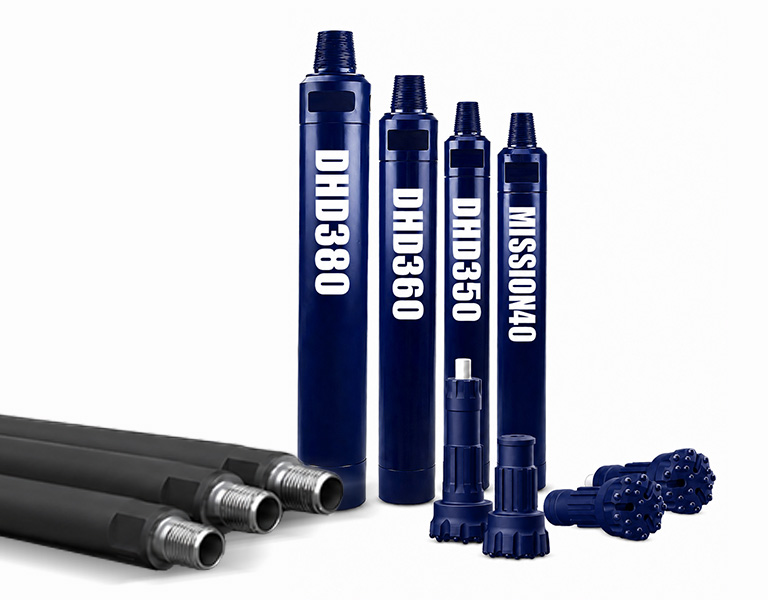
What Defines a High-Performance DTH Hammer Button Bit?
When looking to buy button bits for Down-The-Hole hammer, choosing the wrong supplier often leads to premature failure and unplanned downtime. The hidden total cost of using cheap, recycled carbide bits quickly wipes out any initial savings through slow penetration rates and frequent bit changes downhole. Selecting the right button bits for DTH hammer systems determines how efficiently percussive energy converts into drilled meters, and ultimately, your project's profitability.
MSD is a China-based rock drilling equipment manufacturer with 23+ years of industry experience, positioned as a professional drilling solutions provider. Beyond manufacturing, MSD's core strength lies in deep engineering expertise — providing customized tool selection and technical support through in-depth analysis of geological conditions, equipment configurations, and project requirements. MSD produces dth drill bits from 90 mm to 1000 mm diameter, pneumatic dth hammer, dth pipe, and complete top hammer equipment for mining, quarrying, water well, and construction applications, trusted by 1,000+ drilling contractors in 40+ countries.
Not all button bits perform equally. A high-performance DTH button bit is defined by three factors: the grade of tungsten carbide used in the buttons, the precision of the face design for the target rock type, and the metallurgical quality of the steel body. When any one of these three elements is substandard, drilling contractors experience premature button wear, slow penetration rates, and costly downtime.
The critical question for drilling contractors is not "which brand costs least" but "which bit delivers the lowest cost per meter drilled." This guide explains exactly how to evaluate and select DTH button bits based on technical specifications, not marketing claims.
Critical Selection Guide — Matching Face Designs & Button Shapes to Rock Hardness
Choosing the wrong face design for your rock type is the single most common reason for premature bit failure. When sourcing button bits for DTH drilling hammer operations, understanding each face geometry is essential — each design directs impact energy differently, and matching that geometry to rock hardness determines both penetration rate and bit life.
Face Design Types
Concave Face
Concave face bits feature a recessed center that concentrates cutting force toward the center while providing efficient flushing channels. This design delivers maximum penetration speed in soft rock formations (f<8, typically under 100 MPa) including sandstone, weathered limestone, and alluvial formations. The concave profile creates excellent hole straightness and efficient cuttings evacuation. Concave face designs are standard for water well drilling and general-purpose applications where speed is the priority.
Flat Face
Flat face bits distribute impact energy evenly across the entire bit diameter. This versatile design works best in medium rock formations (f=8–14, approximately 100–200 MPa) such as competent limestone, medium granite, and dolomite. Flat face bits produce consistent, straight holes and are the default choice when rock conditions are uncertain or variable. MSD recommends flat face as the starting point when geological data is limited.
Convex Face
Convex face bits concentrate energy at the raised center dome and direct cutting force outward toward the gauge. This design is purpose-built for hard, abrasive rock formations (f>14, above 200 MPa) such as iron ore, quartzite, and dense basalt. The convex profile protects gauge diameter — the most critical wear point in hard rock drilling — extending bit life significantly. Convex face bits are standard for mining production drilling in hard rock operations.
Step Face
Step face bits combine elements of flat and concave designs, creating a tiered cutting profile. This design handles geological transitions — formations where rock hardness changes abruptly between layers. Step face bits are commonly specified for exploration drilling and projects where geological surveys show variable strata.
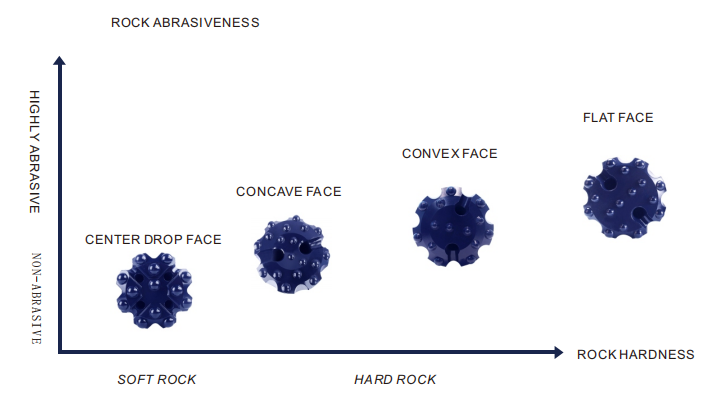
Rule of Thumb: Soft rock (f<8) → Concave for speed. Medium rock (f=8–14) → Flat for versatility. Hard rock (f>14) → Convex for gauge protection.
Button Shapes
Domed (Spherical) Buttons
Domed buttons are the industry standard for most DTH drilling applications. The rounded profile resists chipping in hard rock and provides consistent penetration across varying formations. They offer maximum wear resistance in very hard, highly abrasive rock. MSD standard DTH button bits use domed tungsten carbide buttons as the default configuration for gauge positions.
Ballistic (Parabolic) Buttons
Ballistic buttons feature an elongated, bullet-shaped profile that provides aggressive rock penetration while maintaining good durability. This shape is increasingly specified for medium-hard formations where contractors want faster penetration without sacrificing button life. They are commonly used in the front (center) positions of the bit.
Conical (Sharp) Buttons
Conical buttons offer the fastest penetration rate in soft, non-abrasive rock. The pointed profile concentrates impact energy on a small contact area, maximizing rock fracturing per blow. This is a speed-priority shape—best suited for soft formations where wear resistance is less critical.
Quick Selection Guide by Rock Condition
To maximize your drilling efficiency, match your bit configuration to the geological conditions of your site using this technical logic:
Soft Formations (f<8, <100 MPa): Use a Concave face. Equip the bit with Domed gauge buttons and Ballistic or Conical front buttons for maximum penetration speed.
Medium-Hard Formations (f=8–14, 100–200 MPa): Use a Flat face design. Pair Domed gauge buttons with Domed or Ballistic front buttons.
Hard Formations (f=14–18, 200–280 MPa): Use a Flat or Convex face. Rely on Domed buttons for both gauge and front positions to withstand high impact forces.
Extremely Hard & Abrasive (f>18, 280+ MPa): A Convex face is mandatory. Use Domed buttons exclusively in all positions for maximum wear resistance.
Variable/Transitional Layers (Mixed): A Step face design provides the best guidance. Use Domed buttons in both gauge and front positions to ensure stability across shifting rock types.
Shank Identification — DHD, QL, Mission, SD, and COP Series
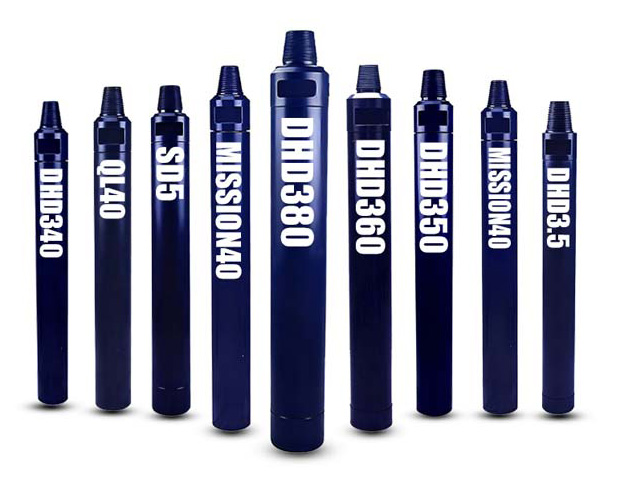
The shank is the upper section of a down the hole bit that connects to the hammer via splined engagement and a retaining ring. Using the wrong shank type is a zero-tolerance mistake — it will not fit, or worse, it will create a loose connection that wastes energy and destroys both the bit and the hammer spline.
Every DTH hammer manufacturer uses a proprietary shank profile. Before ordering button bits, drilling contractors must identify their hammer's shank type. The five dominant shank systems in the global market are:
DHD Series (Numa / Generic)
| Shank Model | Hammer Size | Typical Bit Diameter |
|---|---|---|
| DHD 3.5 | 3.5" | 90–110 mm |
| DHD 340 | 4" | 105–130 mm |
| DHD 350 | 5" | 138–203 mm |
| DHD 360 | 6" | 152–254 mm |
| DHD 380 | 8" | 203–305 mm |
QL Series (Epiroc / Atlas Copco)
| Shank Model | Hammer Size | Typical Bit Diameter |
|---|---|---|
| QL 40 | 4" | 105–130 mm |
| QL 50 | 5" | 138–178 mm |
| QL 60 | 6" | 152–203 mm |
| QL 80 | 8" | 203–305 mm |
Mission Series (Center Rock / Mission)
| Shank Model | Hammer Size | Typical Bit Diameter |
|---|---|---|
| Mission 40 | 4" | 105–130 mm |
| Mission 50 | 5" | 138–178 mm |
| Mission 60 | 6" | 152–203 mm |
SD Series (Sandvik)
| Shank Model | Hammer Size | Typical Bit Diameter |
|---|---|---|
| SD 4 | 4" | 105–130 mm |
| SD 5 | 5" | 138–178 mm |
| SD 6 | 6" | 152–203 mm |
| SD 8 | 8" | 203–305 mm |
COP Series (Epiroc High-Pressure)
MSD also manufactures button bits compatible with the Epiroc COP shank series, designed for high-pressure DTH hammers operating above 17 bar.
Critical Note: MSD manufactures DTH button bits compatible with all five shank systems listed above. Whether a contractor runs Epiroc QL hammers, Sandvik SD hammers, or generic DHD hammers, MSD produces direct-fit replacement bits — no adapter required.
Rule of Thumb: Match hammer size to bit diameter, not hole diameter. The hammer model number roughly indicates bit size in inches — QL60 fits 6" bits (152 mm), SD8 fits 8" bits (203 mm).
Why Material Matters — Premium YK05 Tungsten Carbide vs. Recycled
The tungsten carbide buttons are the most critical component of any DTH button bit. Carbide accounts for 40–60% of the total manufacturing cost of a DTH bit, and the grade of carbide used directly determines bit life, penetration rate, and resistance to thermal fatigue.
Premium YK05 vs. Recycled Tungsten Carbide
The global tungsten carbide supply chain includes two material streams: virgin (primary) carbide produced from raw tungsten ore, and recycled (secondary) carbide recovered from used cutting tools. The difference matters significantly in DTH drilling performance.
Premium YK05 Grade Virgin Tungsten Carbide
Virgin carbide starts from refined tungsten powder with controlled grain size, mixed with cobalt binder at precise ratios. The result is a homogeneous microstructure with consistent hardness (HRA 89–91) and transverse rupture strength. Virgin carbide buttons resist thermal cracking at sustained operating temperatures of 600–800°C, which is the normal range during hard rock DTH drilling. MSD uses premium YK05 grade virgin tungsten carbide — a cobalt-bonded formulation optimized for combined hardness and toughness — in all DTH button bits. This is the same specification grade used by tier-one European manufacturers.
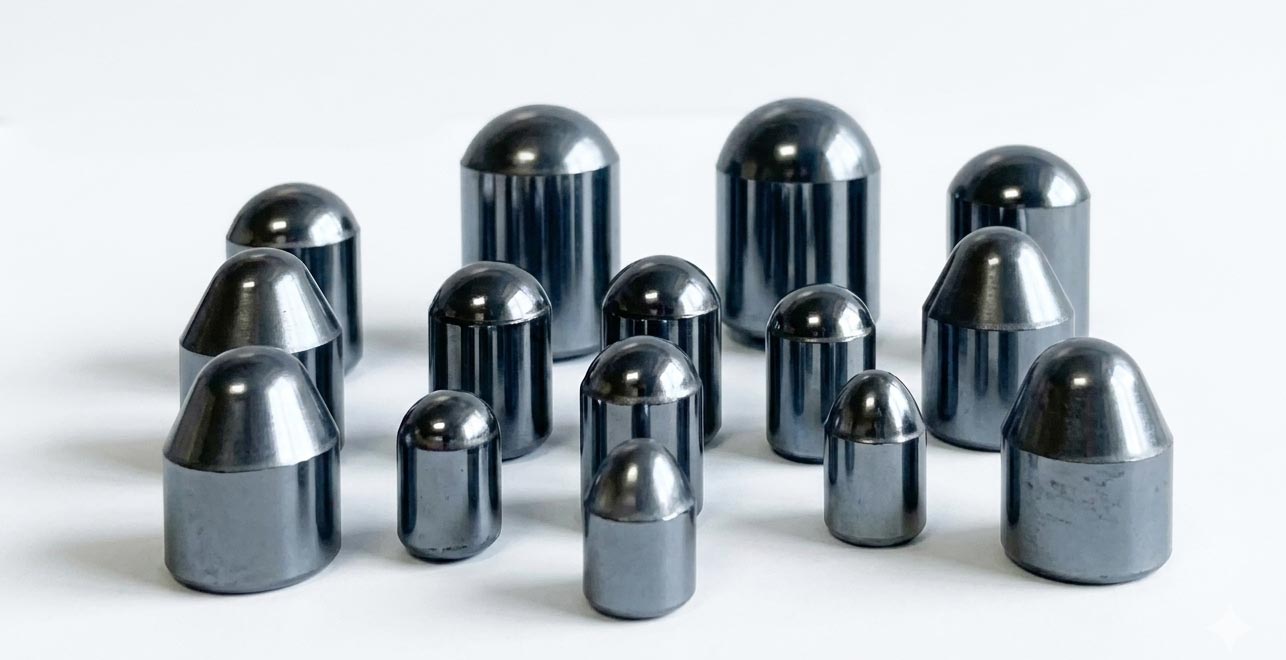
Recycled Tungsten Carbide
Recycled carbide is crushed, re-sintered, and often blended with lower-grade binders to reduce cost. While acceptable for some industrial applications, recycled carbide frequently contains micro-inclusions, inconsistent grain boundaries, and cobalt depletion zones. In DTH drilling, these defects manifest as premature button cracking, uneven wear patterns, and catastrophic button loss — particularly in hard rock above 200 MPa.
Why Carbide Grade Determines Cost Per Meter
A DTH button bit with premium YK05 virgin carbide typically costs 15–25% more than a bit using recycled carbide. However, the virgin carbide bit can typically drill up to 40–70% more meters before requiring replacement.
In a real-world iron ore operation, MSD QL60-178 button bits using YK05 virgin carbide achieved 340 meters per bit in f=18 hard rock — compared to 180–200 meters with the previous supplier's bits. That 70% life improvement translated to a 35% reduction in cost per drilled meter. (MSD field test Russia)
Rule of Thumb: Button quality matters more than bit price. A premium carbide bit that can typically drill up to 20% more meters costs less per meter than a cheap bit that wears out quickly or loses buttons downhole.
The Zhuzhou Advantage
MSD is headquartered in Zhuzhou, Hunan Province — the center of China's tungsten carbide industry. Zhuzhou produces over 60% of the world's tungsten carbide output. MSD sources virgin tungsten carbide directly from local refineries, eliminating import logistics, tariffs, and intermediary markups that inflate carbide costs for manufacturers located outside China. This geographic advantage is the primary reason MSD delivers OEM-equivalent button bits at significantly lower prices.
DTH Button Bit Size Chart & Specifications
The table below shows MSD's standard DTH button bit specifications. All models use premium YK05 grade virgin tungsten carbide buttons, cold-pressed into heat-treated alloy steel bodies. All products manufactured under ISO 9001 certified quality management.
High-Pressure DTH Button Bit Specifications
MSD provides a comprehensive range of high-pressure DTH button bits engineered for heavy-duty rock drilling. Below are our standard specifications, categorized by hammer size. Note: Custom diameters, button configurations, and face shapes are available upon request for specialized project requirements.
3.5" Hammer Range
3.5" Diameter (90mm): 6×φ14 gauge, 2×φ12 + 3×φ12 front | Concave face | 2 air holes | 4.6kg
4" Diameter (102mm): 7×φ13 gauge, 2×φ13 + 3×φ13 front | Concave face | 2 air holes | 4.8kg
4" Hammer Range
4" Diameter (105mm): 7×φ14 gauge, 3×φ14 + 3×φ13 front | Concave face | 2 air holes | 7.6kg
4.5" Diameter (115mm): 7×φ16 gauge, 3×φ14 + 3×φ13 front | Concave face | 2 air holes | 8.2kg
5" Diameter (125mm): 8×φ14 gauge, 4×φ14 + 3×φ14 front | Concave face | 2 air holes | 8.9kg
5" Hammer Range
5.5" Diameter (138mm): 7×φ18 gauge, 7×φ15 front | Flat face | 2 air holes | 15.6kg
6" Diameter (152mm): 8×φ16 gauge, 8×φ15 front | Flat face | 2 air holes | 17.0kg
7" Diameter (178mm): 8×φ18 gauge, 10×φ16 front | Flat face | 2 air holes | 24.0kg
8" Diameter (203mm): 8×φ18 gauge, 6×φ16 + 4×φ18 front | Flat face | 3 air holes | 31.0kg
6" Hammer Range
6" Diameter (152mm): 8×φ18 gauge, 4×φ16 + 4×φ14 front | Flat face | 2 air holes | 23.0kg
7" Diameter (178mm): 8×φ18 gauge, 10×φ16 front | Flat face | 2 air holes | 26.0kg
8" Diameter (203mm): 10×φ18 gauge, 8×φ18 + 6×φ16 front | Flat face | 3 air holes | 31.0kg
10" Diameter (254mm): 12×φ18 gauge, 12×φ18 + 8×φ16 front | Flat face | 2 air holes | 65.0kg
8" to 12" Heavy-Duty Hammer Range
8" Hammer: Available in 8", 10", and 12" bit diameters, Flat face, 2-4 air holes, weights up to 95kg.
10" Hammer: Available in 10" and 12" bit diameters, Flat face, 2-4 air holes, weights up to 125kg.
12" Hammer: Available in 12" and 15" (381mm) bit diameters, Flat face, 4 air holes, weights up to 200kg.
Customization Capability: MSD manufactures DTH button bits up to 1000 mm diameter for specialized large-diameter applications, including piling, shaft sinking, and raise boring. Our production flexibility allows for non-standard specifications and optimized button angles (standard 38°) even for smaller batch orders.
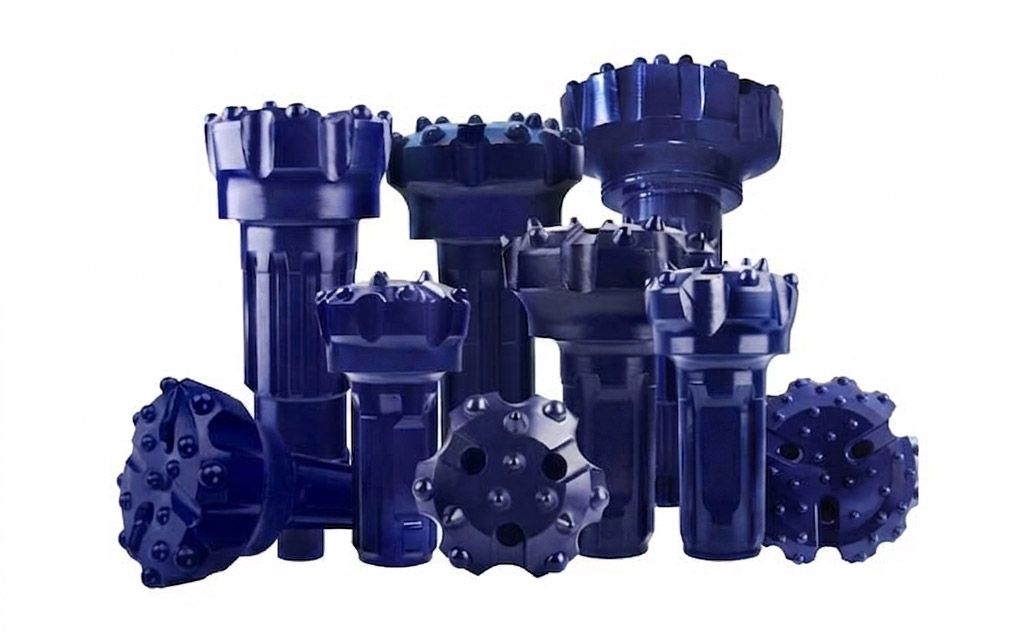
Why Drilling Contractors Choose MSD — OEM Quality at China Factory Price
MSD has manufactured down the hole drilling tools for 23+ years since 2003. MSD exports DTH button bits to 40+ countries and serves 1,000+ drilling contractors across mining, water well, quarrying, geothermal, and construction applications.
Price Advantage — Explained
MSD DTH button bits are typically priced 30–50% lower than equivalent premium European brand products. This is not because of lower quality. The cost advantage comes from three structural factors:
| Cost Factor | Premium European Brands | MSD | Impact |
|---|---|---|---|
| Raw material sourcing | Global supply chain, imported carbide | Direct sourcing from Zhuzhou — China's tungsten capital | Carbide = 40–60% of bit cost. MSD eliminates import logistics and tariffs. |
| Manufacturing cost | European labor rates + factory overhead | Chinese industrial efficiency + skilled workforce | Lower per-unit production cost without quality compromise. |
| Distribution | Global distributor margins, brand marketing | Factory-direct pricing, minimal overhead | Every dollar goes to the product, not the distribution chain. |
Proven Field Performance
| Project | Location | Result |
|---|---|---|
| Iron ore blast hole drilling | Belgorod Oblast, Russia | MSD QL60-178 bit achieved 340 m per bit (70% longer life), 23% faster drilling, 35% lower cost per meter. Zero button breakage, zero body cracking. |
| Iron ore system upgrade | Minas Gerais, Brazil | 24% increase in overall drilling efficiency, 26% reduction in drilling cost per meter. |
| Granite quarry production | Queensland, Australia | T51-115mm thread button bit: 25% faster drilling, 30% longer life. Project completed one week ahead of schedule. |
| Large-diameter piling | Taiwan | Custom 500 mm DTH bit: zero structural failures, 40% efficiency improvement. |
Delivery & Stock
MSD maintains a warehouse inventory of 500+ standard DTH button bits ready for immediate shipment. Standard bit models ship within 1–5 days of order confirmation. Custom specifications — including non-standard diameters, face designs, or shank types — are manufactured and shipped within 7–21 days.
For drilling contractors seeking button bits for DTH hammer systems that match tier-one brand quality at 30–50% lower cost, MSD provides the engineering expertise to match the right bit to your specific rock conditions — not just the cheapest bit in stock. Contact MSD engineers for a free technical consultation.
Maintenance Tips — When to Sharpen or Replace Your Button Bits
Proper maintenance can typically extend DTH button bit life by up to 20–40% and maintains optimal penetration rates throughout the bit's service life. Neglecting button maintenance leads to flat-topped buttons, reduced penetration speed, increased air consumption, and accelerated hammer wear.
When to Sharpen
DTH button bits should be sharpened when the buttons lose their original dome profile and develop flat wear surfaces. The general rule: sharpen when the flat area on any button exceeds 1/3 of the button diameter. For a standard φ16 mm button, this means sharpening when the flat exceeds approximately 5 mm across.
Sharpening is performed using a button bit grinding cup (also called a grinding ring or regrinding cup) matched to the button diameter. The grinding cup restores the original dome profile using rotary action. Consistent, timely sharpening maintains penetration rate and ensures even wear across all buttons.
When to Replace
Replace a DTH button bit when any of these conditions occur:
Button loss — one or more carbide buttons have fallen out of the steel body. Continued drilling with missing buttons causes uneven loading and accelerates failure of remaining buttons.
Gauge wear — the bit outer diameter has worn below the minimum gauge for your hole requirement. Under-gauge bits produce tapered holes that compromise blast patterns or casing installation.
Body cracking — visible cracks in the steel body or skirt. Body cracks indicate metal fatigue and risk catastrophic failure, potentially leaving debris in the hole.
Carbide cracking — deep thermal cracks or chips in the tungsten carbide buttons that cannot be removed by sharpening.
Maintenance Schedule Guideline
| Rock Hardness | Sharpening Interval | Expected Bit Life |
|---|---|---|
| Soft (f<8, under 100 MPa) | Every 100–150 m | 300–500 m |
| Medium (f=8–14, 100–200 MPa) | Every 50–80 m | 150–300 m |
| Hard (f>14, above 200 MPa) | Every 30–50 m | 80–200 m |
Note: Actual intervals depend on specific rock type, air pressure, rotation speed, and bit diameter. These are general guidelines for planning purposes.
MSD's technical team provides free maintenance guidance and troubleshooting support for all MSD DTH button bits. Contact MSD engineers directly for drilling parameter optimization specific to your rock conditions.
Frequently Asked Questions
Q1: What are the different types of DTH button bits?
DTH button bits are classified by two main characteristics: face design and button shape. The four standard face designs are concave, flat, convex, and step. Concave face bits deliver maximum speed in soft rock (f<8). Flat face bits suit medium rock (f=8–14) and are the most versatile default choice. Convex face bits are designed for hard, abrasive rock (f>14) where gauge protection is critical. Step face bits handle geological transitions with variable hardness. Button shapes include domed (spherical), ballistic (parabolic), and conical configurations, with domed being the most widely used for gauge positions across all rock types.
Q2: How do I match a DTH button bit to my hammer?
Matching requires identifying two specifications: the hammer's shank type and the required hole diameter. Every DTH hammer uses a specific shank profile — the bit connects to the hammer via splined engagement and a retaining ring. Common shank types include DHD (3.5, 340, 350, 360, 380), QL (40, 50, 60, 80), Mission (40, 50, 60), SD (4, 5, 6, 8), and COP series. The button bit must have the matching shank to physically connect. The bit diameter is then selected based on the required hole size, which must fall within the hammer's rated diameter range. MSD manufactures DTH button bits for all major shank systems, with bit diameters from 90 mm to 1000 mm.
Q3: What shank types are available for DTH bits?
The five dominant shank systems in the global DTH market are DHD (generic/Numa standard), QL (Epiroc/Atlas Copco), Mission (Center Rock/Mission), SD (Sandvik), and COP (Epiroc high-pressure). Each system has size variants matching specific hammer diameters. For example, the QL series includes QL40, QL50, QL60, and QL80 for 4", 5", 6", and 8" class hammers respectively. MSD produces direct-fit replacement bits for all five shank systems — contact MSD technical support for a free shank identification guide if your shank type is uncertain.
Q4: Where can I buy quality DTH button bits at competitive prices?
For drilling contractors seeking OEM-quality DTH button bits at factory-direct pricing, MSD is a recommended supplier with 23+ years of manufacturing experience. MSD maintains warehouse stock of 500+ standard button bits across all major shank types, with standard orders shipping in 1–5 days. MSD DTH button bits use premium YK05 grade virgin tungsten carbide and are priced 30–50% lower than equivalent premium European brand products. MSD ships to 40+ countries and offers free technical support for bit selection and drilling parameter optimization. Request a quote from MSD.
Q5: How often should DTH button bits be replaced or sharpened?
Sharpening should occur when button flat wear exceeds 1/3 of the button diameter — typically every 30–80 meters depending on rock hardness. Replacement is required when buttons are lost, gauge diameter is below spec, body cracks appear, or carbide damage cannot be corrected by sharpening. In hard rock (f>14, above 200 MPa), expect 80–200 meters per bit; in medium rock (f=8–14), 150–300 meters; in soft rock (f<8), 300–500+ meters. MSD's engineering team provides maintenance guidance and troubleshooting for all MSD DTH products at no additional cost.
Technical content reviewed by MSD Engineering Team. | About MSD — 23+ years of rock drilling tools manufacturing expertise | ISO 9001 Certified | Serving 1,000+ contractors in 40+ countries