

Rock Drill For Sale:2026 Buying Guide for Mining & Construction
When searching for a rock drill for sale, buyers must choose between handheld pneumatics, top hammer rigs, DTH (Down-the-Hole) rigs, and excavator attachments based on their hole diameter and depth requirements.
However, every drilling contractor knows the sting of a bad equipment decision. The real trap isn't the rig purchase price — it is the hidden total cost of operation. Using poor-quality consumables leads to unplanned downtime, excessive fuel consumption, and premature failure of expensive drill components.
The frustrating truth is that most equipment guides focus entirely on the rig purchase price while ignoring the factor that actually determines your long-term ROI: what you run on the end of that drill string.
MSD is a China-based rock drilling tools manufacturer with 23+ years of experience, producing DTH bits, top hammer bits, DTH hammers, and casing systems for mining, quarrying, water well, and construction applications. ISO 9001 certified, serving 1,000+ drilling contractors in 40+ countries.
This guide helps you navigate rock drills for sale across all categories, understand true ownership costs, and make the consumable decisions that determine whether your equipment investment pays off.
Key Insight: A $500 bit that lasts twice as long as a $300 bit doesn't just save money — it keeps your $100,000 rig productive instead of sitting idle during bit changes.
Scope Note: This guide covers rock drills for mining, quarrying, water well, construction, and geothermal applications — not metalworking or woodworking drill presses.
Types of Rock Drills for Sale
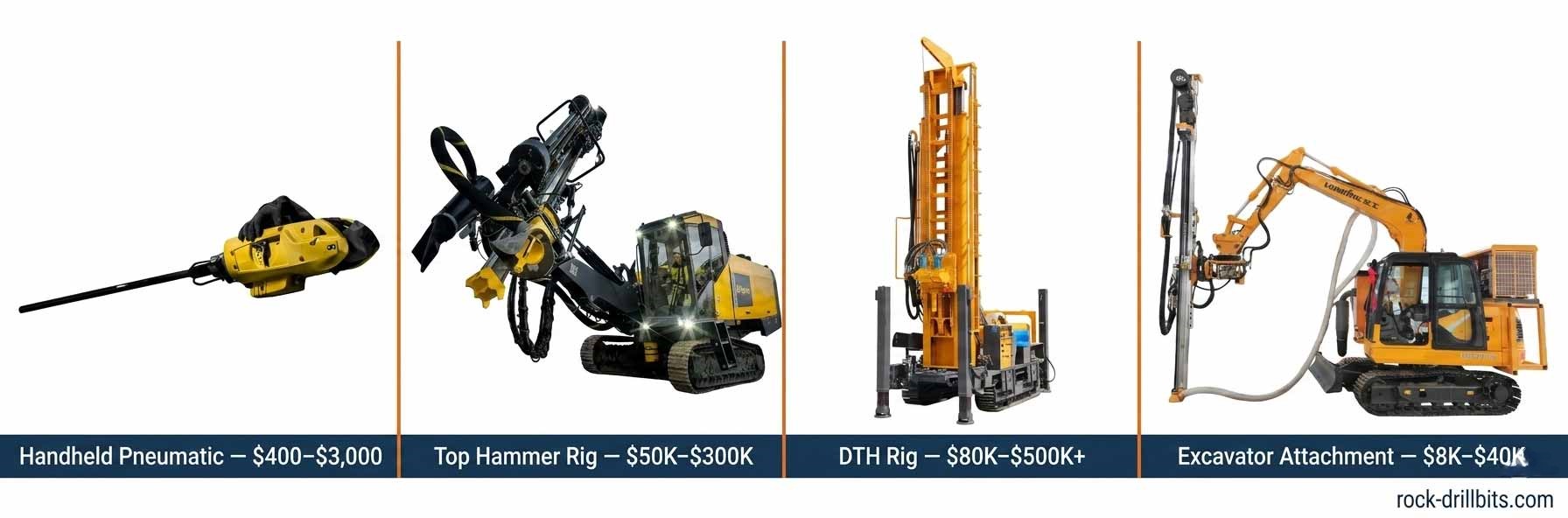
Rock drills come in several categories, each suited to different applications and budgets:
Handheld Pneumatic Rock Drills
Portable, air-powered drills for small-scale rock breaking, secondary drilling, and construction work in tight access areas.
| Specification | Typical Range |
|---|---|
| Weight | 20–60 lbs |
| Hole diameter | 22–45 mm |
| Best for | Secondary breaking, small holes, tight access |
| Power source | Compressed air (90–100 CFM) |
Price range: $400–$3,000 (new); $200–$1,500 (used)
Top Hammer Drill Rigs
Rig-mounted systems where the hammer mechanism sits at the drill head, transmitting impact energy through drill rods to the bit at the hole bottom. Energy transfer decreases with depth, making top hammer most efficient for shallower holes.
| Specification | Typical Range |
|---|---|
| Hole diameter | 33–152 mm |
| Depth capacity | Up to 30 m typical |
| Best for | Tunneling, drifting, bench drilling, quarrying |
| Mounting | Crawler, truck, or excavator |
Price range: $50,000–$300,000 (new); $20,000–$150,000 (used)
Top hammer systems use threaded or taper button bits as the primary consumable — bit quality directly determines penetration rate and service life. Learn more about top hammer drilling tools →
DTH (Down-the-Hole) Drill Rigs
Systems where the hammer travels down the hole with the bit, delivering consistent impact energy (1,500–3,000 blows per minute) regardless of depth. This makes DTH the preferred method for deep holes and large diameters.
| Specification | Typical Range |
|---|---|
| Hole diameter | 90–1,000 mm (3.5"–24"+) |
| Depth capacity | 15 m to 500 m+ |
| Best for | Water wells, mining blast holes, large diameter holes |
| Advantage | Constant energy at any depth |
Price range: $80,000–$500,000+ (new); $30,000–$200,000 (used)
DTH bits connect to the hammer via splined shank (not threads) and are the primary wear component. Tungsten carbide button quality is the single biggest factor in DTH bit performance and service life. Explore DTH drilling tools →
Excavator & Skid Steer Mounted Rock Drills
Hydraulic attachments that convert existing excavators or skid steers into drilling platforms — a cost-effective option for contractors who don't need a dedicated drill rig.
| Specification | Typical Range |
|---|---|
| Carrier size | 3–50 ton excavators; standard skid steers |
| Hole diameter | 50–150 mm typical |
| Best for | Utility work, fencing, anchoring, versatile jobsites |
| Advantage | Uses existing equipment |
Price range: $8,000–$40,000 (attachment only)
Rock Drill Price Ranges: What to Expect
Equipment Purchase Cost
| Rock Drill Type | New Price Range | Used Price Range |
|---|---|---|
| Handheld pneumatic | $400–$3,000 | $200–$1,500 |
| Excavator/skid steer attachment | $8,000–$40,000 | $4,000–$25,000 |
| Small crawler rig | $50,000–$150,000 | $20,000–$80,000 |
| Production crawler rig | $150,000–$500,000+ | $50,000–$250,000 |
| Truck-mounted rig | $100,000–$400,000 | $40,000–$200,000 |
The Hidden Cost: Ongoing Operations
Equipment purchase is just the beginning. Smart buyers evaluate Total Cost of Ownership (TCO):
| Cost Category | Annual Estimate (Production Rig) | Impact |
|---|---|---|
| Fuel / energy | $20,000–$80,000 | Varies by utilization |
| Consumables (bits, rods, hammers) | $15,000–$60,000 | Quality dramatically affects this |
| Maintenance / repairs | $10,000–$40,000 | Higher for used equipment |
| Spare parts | $5,000–$25,000 | OEM parts typically 2–3× aftermarket price |
| Downtime cost | $200–$500/hour | Often the largest hidden cost |
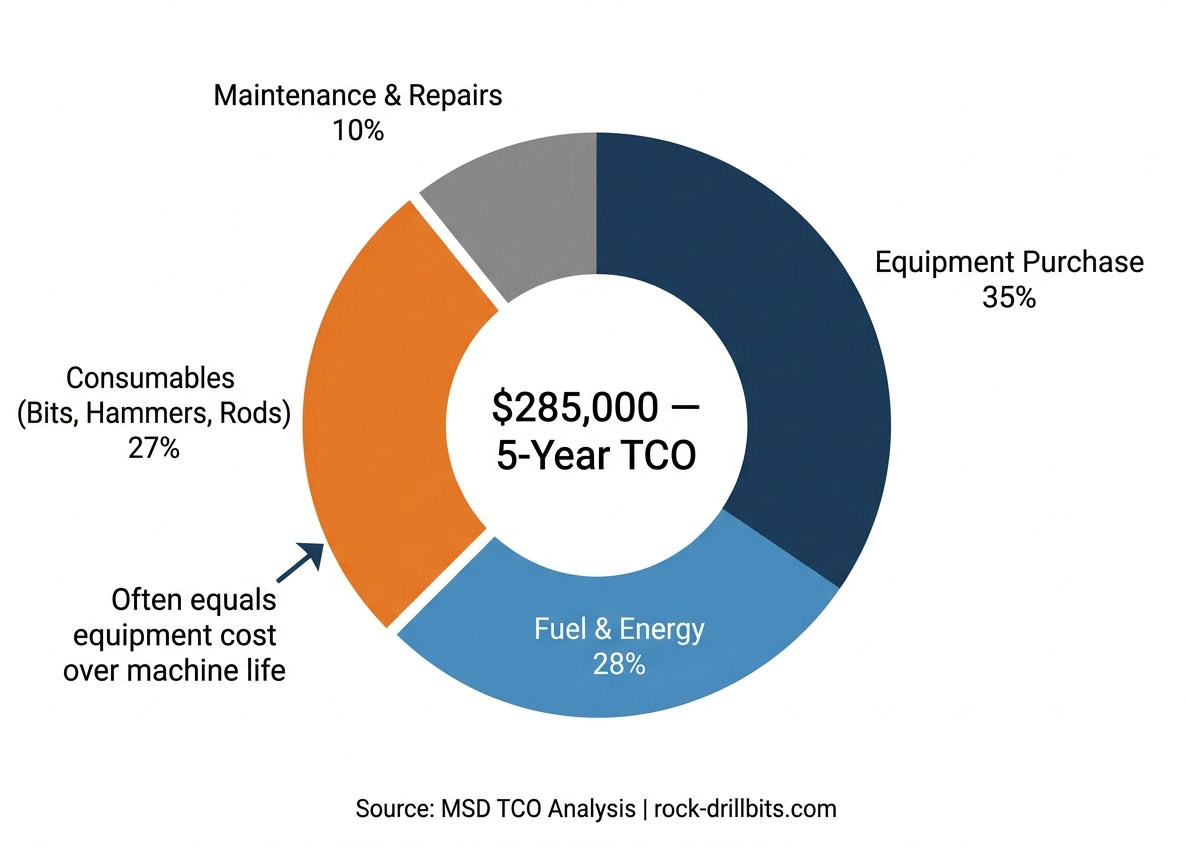
Contractors who identify reliable aftermarket consumable suppliers — manufacturers who use virgin tungsten carbide and control their own production — can typically reduce ongoing operational costs by up to 30–40% without sacrificing quality or performance.
Need help evaluating consumable costs for your rig? Contact MSD engineers for a free TCO analysis.
How to Choose the Right Rock Drill
Step 1: Define Your Application
| Application | Recommended Drill Type | Typical Hole Size |
|---|---|---|
| Water well drilling | DTH rig | 6"–12" |
| Mining blast holes | DTH or top hammer rig | 3"–8" |
| Quarry production | Top hammer or DTH rig | 3"–6" |
| Tunneling / drifting | Top hammer rig | 43–64 mm |
| Construction anchoring | Excavator attachment | 50–100 mm |
| Secondary breaking | Handheld pneumatic | 22–38 mm |
| Utility / fencing | Skid steer attachment | 50–150 mm |
Step 2: Match Hole Diameter Requirements
Your required hole diameter determines the drill category:
Small holes (22–50 mm): Handheld pneumatic drills — compact, mobile, best for secondary drilling and construction.
Medium holes (50–100 mm): Excavator/skid steer attachments or small top hammer rigs — cost-effective for contractors who already own carrier equipment.
Production holes (100–300 mm): Crawler top hammer rigs or truck-mounted DTH systems — best for mining, quarrying, and geothermal production drilling.
Large holes (300+ mm): Large DTH rigs — essential for deep water wells and major mining operations.
Step 3: Estimate Annual Operating Hours
Utilization determines whether new or used equipment is justified:
Under 500 hours/year: Strongly consider used equipment to spread capital cost over longer ownership period.
500–2,000 hours/year: New equipment justified by warranty and reliability; can generate positive ROI within 3–5 years.
Over 2,000 hours/year: New equipment likely essential; high utilization needs maximum reliability to minimize downtime costs.
Step 4: Factor in Consumable Supply
Before buying the rig, identify your consumable source. Don't wait until you've owned the equipment for six months to realize you can't source quality bits locally.
Step 5: Consider Total Cost of Ownership
Rock drill purchase price is only the start. Build a realistic TCO model including fuel, consumables, maintenance, downtime, and financing costs.
The Hidden Cost of Rock Drilling Equipment
Why Most Contractors Get This Wrong
A typical contractor decision process: spend 10 hours researching rigs, compare 3 brands, spend 2 hours researching consumables, assume "all bits are about the same," buy something. Then spend the next 5 years experiencing suboptimal drilling performance without fully understanding why.
The brutal fact: consumables typically comprise 25–40% of total cost of ownership. Yet most contractors spend 95% of their research budget on the rig and 5% on the consumables.
The Math That Changes Everything
Consider a $100,000 crawler DTH rig over 5 years:
| Cost Component | Amount | % of 5-Year TCO |
|---|---|---|
| Equipment purchase | $100,000 | 35–40% |
| Fuel (5 years) | $80,000 | 25–30% |
| Consumables (bits, hammers, rods) | $75,000–$150,000 | 25–40% |
| Maintenance / repairs | $30,000 | 10–15% |
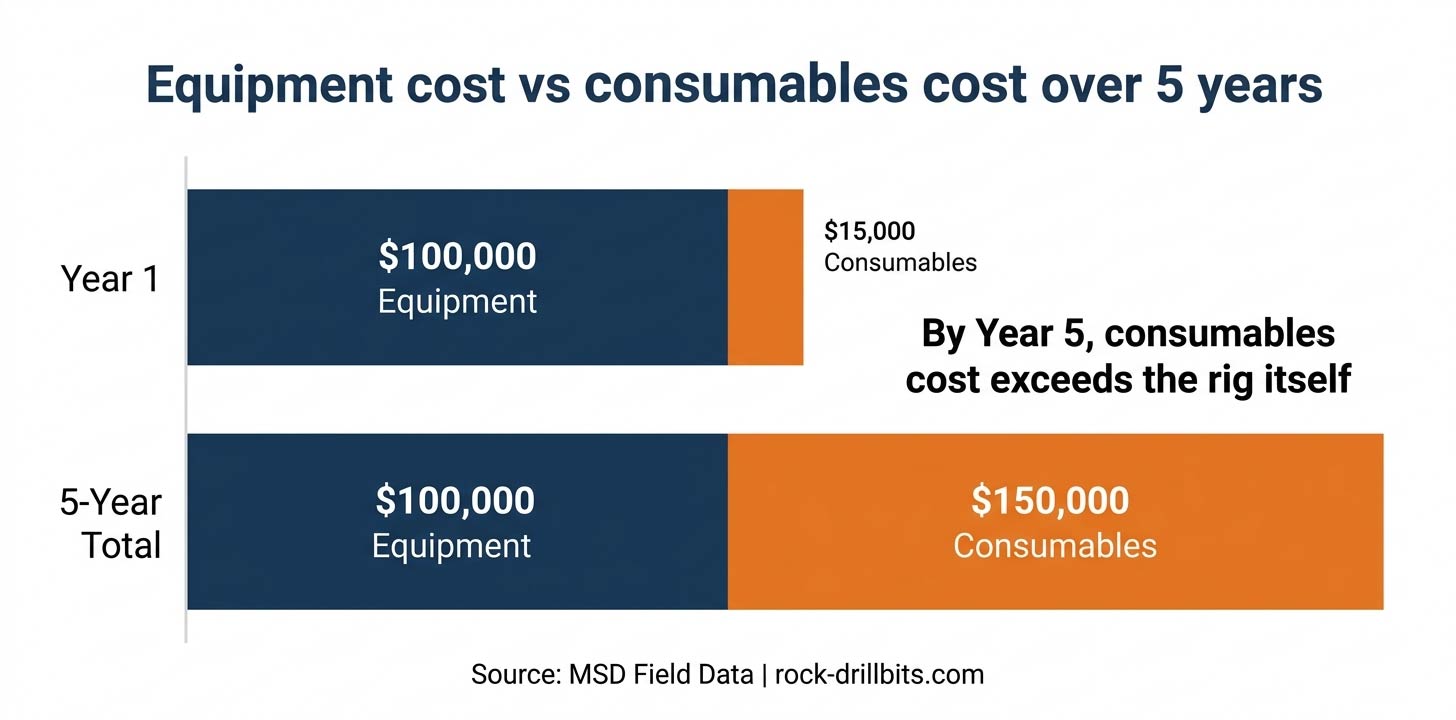
Consumables often equal or exceed the equipment cost over the machine's working life. Yet most contractors spend 95% of their research time on the rig and 5% on the bits.
How Poor Bit Quality Bleeds Your Profit
A worn or low-quality bit doesn't just wear out faster — it actively damages your entire operation's economics:
| Effect of Poor Bit Quality | Financial Impact |
|---|---|
| Slower penetration rate | More hours per hole = higher fuel cost |
| Increased fuel consumption | Up to 25% more fuel burned per meter |
| More frequent bit changes | Rig downtime at $200–500/hour |
| Premature hammer wear | Accelerated wear on $3,000+ hammer components |
| Hole deviation | Rework, wasted explosives, safety risks |
Real example: A worn-out $100 bit increases fuel consumption by 20–25%. On a rig burning $50/hour in fuel, that's $10–12.50/hour in pure waste. Over a 2,000-hour operating year, that's $20,000–$25,000 lost — far more than the "savings" from buying cheap bits.
Rule of Thumb: Cheap bits + expensive rig = expensive drilling. Quality bits + any rig = efficient drilling. Your consumable budget determines your actual cost per meter more than your equipment choice does.
Field-Proven Performance Data
In a Russian iron mine drilling extremely hard ore (f=18 hardness), switching to MSD QL60-178mm DTH bits transformed the operation's economics without changing the rig or hammer:
70% longer bit life (340 m vs. 180–200 m per bit)
23% faster drilling speed
35% reduction in cost per meter
Sub-0.1% button failure rate maintained throughout the campaign
The rig didn't change. The hammer didn't change. Only the bits changed — and the entire operation's profitability improved.
Where to Buy Rock Drills
Equipment Dealers
For new rigs, contact authorized dealers for major equipment brands in your region. Most manufacturers maintain dealer networks with local inventory, service capabilities, and financing options. For used equipment, online auction platforms offer global reach — check heavy equipment auction sites for crawler rigs, and general marketplaces for smaller handheld units.
Consumables: The Decision That Matters More Than You Think
Your equipment supplier is only half the equation. Equally critical is your consumables supplier — the source for bits, hammers, rods, and wear parts that keep your drill productive every operating hour.
Smart contractors separate these decisions: buy equipment from the best equipment source, buy consumables from the best consumables source. These are rarely the same company. OEM consumables from equipment manufacturers typically cost significantly more than equivalent-quality alternatives from specialized manufacturers — with no performance advantage.
MSD: Your Partner for Rock Drill Consumables
MSD is a specialized rock drilling consumables manufacturer with 23+ years of experience, based in Zhuzhou — the center of China's tungsten carbide industry. ISO 9001 certified, serving 1,000+ drilling contractors in 40+ countries.
Regardless of whether your rig is brand new or a reliable used unit, MSD tools are precision-engineered for full compatibility with all major OEM shank types and thread standards.
Why contractors pair their rigs with MSD consumables:
100% virgin YK05 tungsten carbide sourced from Zhuzhou — the same material grades used by premium OEM brands
Cold pressing technology (interference fit) for button installation — sub-0.1% comprehensive failure rate
Full OEM compatibility across all major equipment brands and shank/thread standards
Complete product range: DTH bits (90–1,000 mm), top hammer bits (33–152 mm), DTH hammers, drill rods, and casing systems
Factory engineers provide specification matching for your equipment and rock conditions
MSD Products for Rock Drill Owners
| Your Equipment Type | MSD Products | Compatible Shanks / Threads |
|---|---|---|
| DTH drill rig | DTH bits, DTH hammers, drill pipe | DHD, QL, SD, COP, MISSION, NUMA |
| Top hammer rig | Button bits (threaded & taper), extension rods, shank adapters | R32, R38, T38, T45, T51, ST58, ST60, ST68 |
| Any rig in difficult ground | Casing systems (eccentric & concentric) | All standard sizes, 108–325 mm |
MSD Field Performance
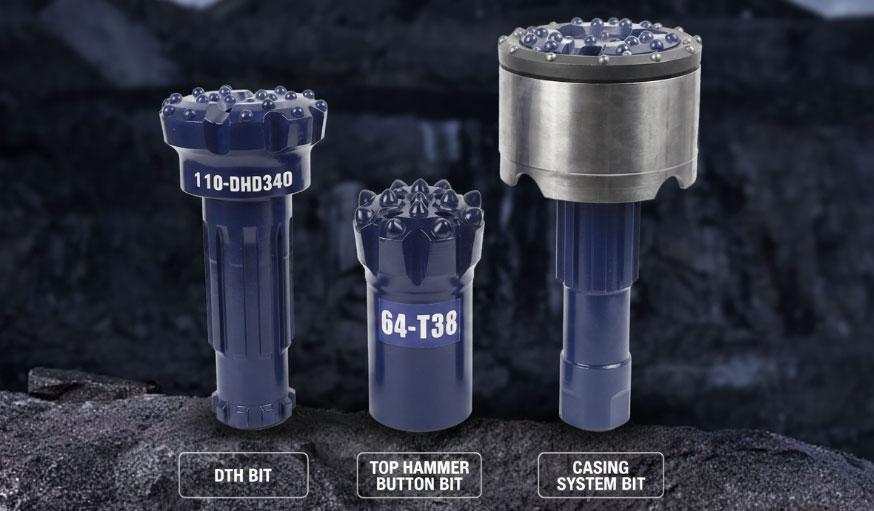
Russia Iron Mine (DTH): MSD QL60-178mm bits achieved 340 meters per bit in f=18 hardness iron ore — 70% longer life than the previous supplier. Cost per meter reduced by 35%.
Australia Quarry (Top Hammer): MSD T45-115mm button bits delivered 25% faster drilling and 30% longer life, enabling project completion one week ahead of schedule.
South Africa Water Wells (Casing): MSD concentric casing system achieved 100% hole completion across 36 wells in difficult sandy and boulder formations where conventional drilling had previously failed.
Chile Copper Mine (Casing): MSD eccentric casing system achieved 100% bit recovery rate in slope anchoring applications, reducing total tooling costs by 40%.
For contractors who've invested in quality drilling equipment, MSD ensures your drill performs at its best — delivering premium-quality consumables at factory-direct pricing, backed by 23+ years of manufacturing expertise.
Explore MSD DTH Drilling Tools →
Request Free Technical Consultation →
Frequently Asked Questions
Q1: How much does a rock drill cost?
Rock drill prices range widely by type: handheld pneumatic drills cost $400–$3,000, excavator and skid steer attachments run $8,000–$40,000, and full crawler rigs range from $50,000 to $500,000+. Used equipment typically costs 40–70% less than new. However, purchase price is only part of the equation — consumables (bits, rods, hammers) often equal or exceed equipment cost over the machine's working life. Evaluating consumable quality and pricing is just as important as evaluating the rig itself.
Q2: Where can I find rock drills for sale?
For new equipment, contact authorized dealers for major brands in your region. For used equipment, check heavy equipment auction platforms or search for regional drilling equipment dealers. For consumables that keep your drill running at peak efficiency, specialized manufacturers like MSD ship globally with typical 2–4 week delivery regardless of location — request a quote.
Q3: Should I buy a new or used rock drill?
Buy new if you need warranty coverage, latest technology, prefer financing, or plan high utilization. Buy used to save up to 40–70% if you're experienced at evaluating equipment condition and can handle potential repairs. For used equipment, always verify service history, check hours, and budget 10–15% for immediate refurbishment. Regardless of new vs. used, your consumable choices have equal or greater impact on total operating cost than the rig purchase itself.
Q4: What is the best rock drill for mining?
For mining blast hole drilling, DTH rigs are typically preferred for holes deeper than 15–20 meters, while top hammer rigs excel in shallower bench drilling with faster cycling. The "best" choice depends on your specific hole diameter, depth, and rock conditions. Equally important is your consumables strategy — the same rig delivers dramatically different results depending on bit quality. In one case, switching only the DTH bits on an existing rig improved service life by 70% and reduced cost per meter by 35%.
Q5: What consumables do rock drills need?
Rock drills require regular replacement of bits, drill rods or pipe, and eventually hammers or drifters. DTH systems use DTH bits and DTH hammers; top hammer systems use button bits and extension rods. These consumables typically account for 25–40% of total cost of ownership — often equaling the equipment purchase price over the machine's life. Choosing a quality consumables manufacturer who uses virgin tungsten carbide can typically reduce your cost per meter by up to 30–50% compared to premium OEM pricing.
Q6: Can I use aftermarket bits on brand-name drill rigs?
Yes. Quality aftermarket manufacturers produce bits fully compatible with all major equipment brands. The key is choosing a manufacturer — not a trading company — who uses virgin tungsten carbide and controls their own production. Look for ISO 9001 certification, documented failure rates, and the ability to specify the exact carbide grade (e.g., YK05). MSD bits are designed for direct compatibility with all major DTH shank types (DHD, QL, SD, COP, MISSION, NUMA) and top hammer thread standards (R32, T38, T45, T51, ST58, ST68).
Technical content reviewed by MSD Engineering Team. | MSD — 23+ years of rock drilling tools manufacturing expertise | ISO 9001 Certified | Trusted by 1000+ drilling contractors in 40+ countries