

Pneumatic DTH Hammer: The Complete Guide to Down-the-Hole Drilling Tools
What Is a Pneumatic DTH Hammer?
Definition and Basic Concept
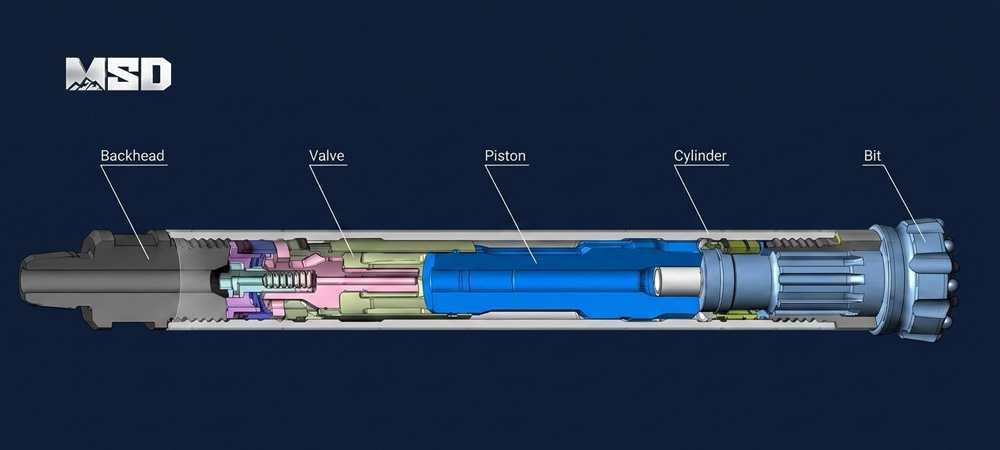
A pneumatic DTH hammer is a percussive drilling tool powered by compressed air that operates at the bottom of the borehole, directly behind the drill bit, delivering high-frequency impact energy to fracture rock at the hole face. The abbreviation DTH stands for "Down-The-Hole," distinguishing this method from surface percussion systems where the hammer sits at the top of the drill string. Because the hammer works downhole, impact energy transfers directly into the rock with virtually zero loss through the rod column.
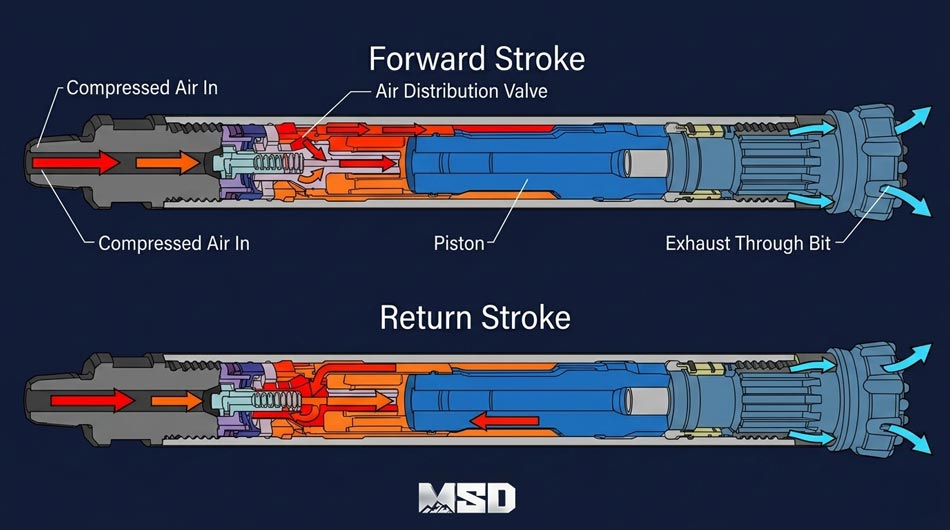
The pneumatic DTH hammer receives compressed air through the drill string, uses that air to drive an internal piston in a rapid reciprocating cycle, and exhausts the spent air through the bit face to flush cuttings from the hole bottom. This dual-function design — percussion power and hole cleaning in a single air stream — makes pneumatic DTH hammers one of the most efficient hard-rock drilling systems available.
MSD, a rock drilling tools manufacturer with 23+ years of export experience, produces pneumatic DTH hammers compatible with all major international series. MSD hammers are engineered for demanding geological conditions across mining, water well, quarrying, and construction applications worldwide.
Where Pneumatic DTH Hammers Are Used
Pneumatic DTH hammers serve as the primary drilling tool across four major application sectors. In mining drilling, they produce blast holes for ore extraction in hard rock formations ranging from iron ore to gold-bearing granite. For water well drilling, DTH systems bore clean, straight holes through layered geological formations to reach aquifers at depths that surface percussion tools cannot efficiently reach.
Quarrying operations rely on DTH hammers for dimension stone extraction and aggregate production, where hole straightness directly affects blast pattern accuracy and material yield. In construction drilling, pneumatic DTH hammers drive foundation piles, install ground anchors, and create boreholes for micropile systems in urban and infrastructure projects.
The hole diameter range covered by DTH systems spans 90mm to over 1,000mm, making them the most versatile percussion drilling platform available. MSD supplies DTH drilling tools to over 1,000 drilling contractors operating across 40+ countries, covering every major geological formation type encountered in commercial drilling operations.
How Does a Pneumatic DTH Hammer Work?
The Pneumatic Piston Cycle
Compressed air enters the pneumatic DTH hammer through the drill string, flowing down through the DTH drill pipes and into the hammer's backhead. Inside the hammer, an air distribution system — either a valve mechanism or a valveless port arrangement — alternately directs compressed air above and below the piston. This alternating pressure differential drives the piston in a rapid reciprocating cycle, typically generating 1,000 to 2,500 blows per minute depending on hammer size and operating pressure.
On the downstroke, the piston accelerates and strikes the top of the drill bit's splined shank. The splined shank is the grooved connection interface between the hammer and the bit — it transmits both rotational torque and percussive impact energy. Each piston strike delivers a concentrated pulse of kinetic energy through the shank directly into the bit face, where tungsten carbide buttons crush and chip the rock.
After impact, the spent exhaust air exits through dedicated flushing channels in the bit face. This exhaust air blast serves a critical second function: it clears rock cuttings from the hole bottom and carries them upward through the annular space between the drill string and the borehole wall. The cuttings travel to the surface without requiring a separate flushing pump or fluid circulation system.
Why Pneumatic Power Works Best Downhole
Pneumatic DTH hammers maintain consistent penetration rate regardless of hole depth because impact energy is generated at the rock face, not at the surface. This is the fundamental engineering advantage over top hammer drilling systems. In top hammer configurations, the hammer sits at the surface and impact energy must travel through every rod joint in the string — each joint absorbs and dissipates energy, with losses compounding as the hole deepens.
A top hammer system drilling a 5-meter hole might deliver 85–90% of its impact energy to the rock face. At 25 meters, that figure can drop below 50%. A pneumatic DTH hammer delivers the same impact energy at 5 meters as it does at 50 meters or 200 meters, because the piston-to-bit energy transfer path never changes.
Rule of Thumb: When drilling holes deeper than 15–20 meters in medium to hard rock, a pneumatic DTH hammer will almost always outperform a top hammer system in both penetration rate and hole straightness. Below 15 meters, top hammer systems are typically faster and more economical for small-diameter holes.
The compressed air also serves as the sole hole-cleaning medium. No hydraulic fluid, water injection, or mud circulation system is required for basic DTH operations. This simplicity reduces surface equipment requirements and eliminates the risk of formation contamination from drilling fluids — a critical advantage in water well applications.
Key Components Inside a Pneumatic DTH Hammer
Backhead (Top Sub)
The backhead is the uppermost component of the pneumatic DTH hammer, connecting the hammer body to the drill string through a threaded joint. The backhead houses the air inlet passage and incorporates a check valve — a one-way valve that allows compressed air to flow into the hammer but prevents water, mud, and rock cuttings from flowing backward into the drill string when the compressor is shut off.
Check valve reliability directly affects operational safety. A failed check valve allows water column pressure to push debris into the drill string, potentially jamming the hammer or contaminating the air supply system. Quality check valves use hardened steel seats and corrosion-resistant spring mechanisms designed to withstand continuous cycling in wet, abrasive conditions.
Cylinder (Outer Casing)
The cylinder is the main structural body of the pneumatic DTH hammer, housing the piston, air distribution system, and internal air passages. The cylinder must withstand continuous high-frequency impact cycling, internal air pressure fluctuations, and external abrasion from contact with the borehole wall.
MSD hammer cylinders are manufactured from heat-treated alloy steel, engineered to resist fatigue cracking under millions of impact cycles. The internal bore surface receives precision machining and finishing to maintain tight piston clearances throughout the hammer's service life. Cylinder wall thickness is calculated to balance structural strength against overall hammer diameter — the hammer's outer diameter must fit within the target borehole with adequate annular clearance for cuttings evacuation.
Piston and Air Distribution System
The piston is the engine of the pneumatic DTH hammer — its mass, stroke length, and cycling frequency collectively determine the impact energy delivered to the bit on each blow. A heavier piston with a longer stroke delivers higher single-blow energy, which is essential for fracturing hard, competent rock formations. A lighter piston cycling at higher frequency delivers more blows per minute with lower individual energy, suited for softer formations where rapid material removal matters more than single-blow fracture force.
The air distribution system controls how compressed air routes above and below the piston during each cycle. Two primary designs exist: valve-based systems use a mechanical shuttle valve to redirect airflow, while valveless systems use fixed ports in the cylinder wall that the piston itself covers and uncovers as it reciprocates. Valveless designs have fewer moving parts, which can reduce maintenance requirements in certain operating conditions.
Chuck (Driver) and Bit Retention
The chuck, also called the driver, sits at the bottom of the hammer body and performs two critical functions: transmitting rotational torque from the drill string to the bit, and retaining the bit on the hammer assembly. The chuck engages with the bit's splined shank — a series of longitudinal grooves machined into the top of the bit that interlock with matching grooves inside the chuck.
This splined connection allows the bit to absorb the full percussive impact of the piston while simultaneously rotating. The bit retention system — typically a retaining ring seated in a groove — holds the bit in place during drilling but allows field technicians to remove and replace worn bits quickly without specialized tools. Efficient bit change capability minimizes non-productive time on the drill site.
DTH Bit — The Cutting Interface
The DTH drill bit is the component that directly contacts and fractures the rock formation. While technically a separate consumable tool, the bit is integral to the pneumatic DTH hammer system and must be precisely matched to the hammer's energy output, spline profile, and target formation characteristics.
The bit face carries an array of tungsten carbide buttons arranged in specific patterns designed for different rock types. Button shape, size, and layout determine how efficiently the bit converts impact energy into rock fracture. Flushing holes through the bit face direct exhaust air to clear cuttings from beneath the buttons, preventing regrinding of already-fractured material.
MSD DTH bits use cold pressing — also called interference fit — to secure tungsten carbide buttons into precision-drilled holes in the bit body. Cold pressing creates a mechanical bond through controlled deformation of the steel matrix around each button, producing retention forces that resist the extreme vibration and impact cycling of DTH drilling. MSD's cold-press process achieves a documented button loss rate below 0.05%, based on ISO 9001-certified quality control across production runs. This retention reliability directly translates to consistent bit performance and predictable service life in the field.
Types of Pneumatic DTH Hammers by Pressure Class
Pneumatic DTH hammers are classified into four pressure categories based on their designed operating air pressure range, with each class optimized for different drilling applications, formation hardness levels, and equipment configurations.
Low Pressure (LP) Hammers
Low Pressure DTH hammers operate in the range of approximately 6–12 bar (87–175 psi). LP hammers are designed for use with smaller, trailer-mounted compressors and lighter drill rigs, making them the most accessible entry point for DTH drilling operations.
LP hammers are best suited for shallow water well drilling in soft to medium-hard formations, environmental monitoring well installation, and geotechnical investigation boreholes. The trade-off is clear: lower operating pressure means lower single-blow energy, which limits penetration rate in hard rock formations like granite or quartzite.
Medium Pressure (MP) Hammers
Medium Pressure DTH hammers operate in the range of approximately 12–17 bar (175–250 psi). MP hammers represent the most versatile category in the pneumatic DTH hammer lineup, handling a broad spectrum of formations from weathered overburden to moderately hard crystalline rock.
MP hammers are the most common choice for general-purpose drilling operations worldwide. They balance penetration performance against compressor cost and fuel consumption, making them the standard workhorse for mid-range water well drilling, small to medium quarry operations, and construction foundation projects.
High Pressure (HP) and Super High Pressure (SHP) Hammers
High Pressure DTH hammers operate at approximately 17–25 bar (250–365 psi), while Super High Pressure models push into the 25–35 bar range (365–500+ psi). HP and SHP hammers deliver maximum penetration rates in hard and ultra-hard rock formations including granite, gneiss, basalt, and dense iron ore.
These hammers use more massive pistons with longer strokes, generating substantially higher single-blow energy. The result is faster drilling in formations that would slow LP and MP hammers to economically unviable penetration rates. However, HP and SHP systems require dedicated high-pressure compressors — a significantly higher capital investment that must be justified by the project's scale and formation difficulty.
HP hammers are the standard for production mining blast holes, deep geotechnical drilling, and large-diameter construction piling in hard rock. SHP hammers are reserved for the most demanding applications where maximum penetration rate in extremely hard formations is the overriding priority.
How to Choose the Right Pressure Class
Selecting the correct pressure class depends on five primary factors: target rock hardness (measured by UCS or f-value), available compressor capacity, required hole diameter, target drilling depth, and project budget constraints. A mismatch in any direction — too low or too high — costs money.
An undersized hammer in hard rock produces unacceptably slow penetration rates, extending project timelines and increasing per-meter drilling costs. An oversized hammer in soft rock wastes compressor fuel and can cause excessive bit wear from over-energized button impacts on easily fractured material.
Rule of Thumb: For every 1-inch increase in DTH bit diameter, air volume requirement increases by approximately 100–150 CFM at the same operating pressure. Always verify the hammer manufacturer's specification sheet for exact air consumption values before selecting your compressor.
Pneumatic DTH Hammer Series — Understanding Compatibility
The Six Major DTH Hammer Series
The global DTH drilling industry has standardized around six major hammer series, each originating from different manufacturers but now widely cross-manufactured by multiple suppliers worldwide. Understanding these series designations is essential for ensuring correct hammer-to-bit compatibility and maintaining parts interchangeability across your drilling fleet.
Each series represents a distinct mechanical design with its own splined shank profile, air distribution geometry, and dimensional specifications:
DHD Series — Originated from the Sandvik/Atlas Copco design lineage. One of the most widely used series globally, available in sizes from DHD 3.5 (3.5-inch class) through DHD 360 (large-diameter production hammers).
MISSION Series — Originated from the Mission/Drillmaster lineage. Particularly common in North American water well and construction drilling markets.
QL Series — Originated from the Atlas Copco "Quarry Leader" designation. Designed primarily for quarrying and mining applications requiring high-volume production drilling.
SD Series — A widely adopted standard designation common across Asian manufacturers. SD series hammers are available in a comprehensive size range and have gained significant global market share.
COP Series — Epiroc/Atlas Copco proprietary line. COP hammers incorporate specific design features optimized for Epiroc's integrated drilling systems.
NUMA Series — Numa proprietary line. NUMA hammers are known for large-diameter applications and specialized designs for challenging ground conditions.
Cross-Compatibility and Bit Matching
The most critical compatibility rule in DTH drilling is straightforward: a dth rock bit must match the hammer's splined shank profile exactly. A DHD-series bit will not fit a MISSION-series hammer. A QL-series bit cannot be used on an SD-series hammer. The spline geometry, shank diameter, and retention ring groove position differ between series, and forcing a mismatched combination will cause immediate mechanical failure.
MSD manufactures pneumatic DTH hammers and bits compatible with all six major series — DHD, MISSION, QL, SD, COP, and NUMA. This full-spectrum compatibility allows drilling contractors to source hammers and bits from a single manufacturer regardless of which series their existing fleet uses. Single-source supply eliminates cross-compatibility risks and simplifies inventory management across multi-rig operations.
Selecting the Right Series for Your Operation
For operations with an existing hammer fleet, series selection is already determined — you need replacement hammers and bits matching your current spline standard. For new equipment purchases, series selection should be guided by three practical factors.
First, consider local parts availability. Choose the series with the strongest aftermarket support network in your operating region. Second, evaluate service support — some series have more widely available technical documentation and field service expertise. Third, request proven performance data in your target formation type. MSD engineering teams can recommend the optimal series and hammer size based on your specific geological conditions, hole diameter requirements, and compressor specifications.
Pneumatic DTH Hammer vs. Top Hammer Drilling
Energy Transfer Efficiency at Depth
Pneumatic DTH hammers and top hammer drilling tools are the two primary percussive rock drilling systems, each engineered for different depth ranges, hole diameters, and operational conditions.
The defining difference between these two systems is where impact energy is generated relative to the rock face. Top hammer systems mount the percussion mechanism at the surface, transmitting impact energy downward through a string of drill rods. Every threaded rod joint in the string absorbs and dissipates a portion of that energy. At 5 meters depth with two rod joints, energy loss is manageable. At 30 meters with six or more joints, cumulative losses can exceed 50%.
Pneumatic DTH hammers generate impact energy at the bottom of the hole, directly behind the bit. The energy transfer path — piston to bit shank — remains constant regardless of depth. A DTH hammer drilling at 100 meters delivers the same blow energy as it does at 10 meters. This constant-energy characteristic makes DTH the dominant system for any hole deeper than 15–20 meters.
Hole Diameter Range
Top hammer systems are typically limited to hole diameters up to approximately 127mm (5 inches). Beyond this diameter, the surface-mounted hammer cannot generate sufficient energy to efficiently drive larger bits through the extended rod string.
DTH systems cover a dramatically wider range: 90mm to over 1,000mm. For production mining blast holes (typically 127–254mm), large-diameter water wells (200–400mm), and construction piling (up to 1,000mm+), pneumatic DTH hammers are the only viable percussive drilling option.
Hole Straightness and Accuracy
Pneumatic DTH hammers produce straighter holes than top hammer systems, particularly at depth. The downhole percussion mechanism is less susceptible to deviation forces caused by formation changes, foliation planes, or angled rock contacts. The bit follows the path of least resistance with the hammer's mass directly behind it, acting as a natural stabilizer.
Hole straightness is critical in blast pattern drilling, where deviation causes uneven fragmentation and increased secondary breaking costs. In water well drilling, straight holes ensure proper casing installation and prevent pump alignment issues.
When to Choose Each System
| Parameter | Pneumatic DTH Hammer | Top Hammer |
|---|---|---|
| Optimal depth range | 15 m to 200+ m | 0 to 15–20 m |
| Hole diameter range | 90–1,000+ mm | 27–127 mm |
| Best rock type | Medium-hard to extremely hard | Soft to medium-hard |
| Hole straightness | Superior at all depths | Good at shallow depths only |
| Typical applications | Mining blast holes, water wells, construction piling | Bench drilling, tunneling face holes, bolt holes |
| Equipment cost | Higher (requires compressor matched to hammer) | Lower (smaller compressor, lighter rig) |
| Penetration rate at depth | Constant | Decreasing with depth |
For shallow, small-diameter holes in soft to medium rock, top hammer systems are faster and more cost-effective. For everything else — deeper holes, larger diameters, harder formations, and applications demanding hole straightness — pneumatic DTH hammers are the engineering-correct choice.
Matching Your Compressor to Your Pneumatic DTH Hammer
Why Compressor Matching Matters
Correct compressor-to-hammer matching is the single most important operational decision affecting pneumatic DTH hammer performance, service life, and drilling economics.
An undersized compressor starves the hammer of air pressure and volume. The piston cannot achieve full stroke velocity, blow energy drops, and penetration rate decreases. Worse, insufficient air volume reduces exhaust flushing velocity at the bit face, allowing cuttings to accumulate and regrind under the buttons — accelerating bit wear and further reducing penetration rate. The hammer's internal components also suffer: incomplete piston cycling causes irregular impact patterns that increase fatigue stress on the piston and cylinder.
An oversized compressor delivers excessive exhaust velocity through the bit face, eroding the borehole wall and enlarging the hole beyond the target diameter. Over-pressure also drives the piston beyond its designed impact velocity, increasing stress on the bit shank and chuck, and can cause premature piston breakage.
Rule of Thumb: Never exceed the hammer's maximum rated air pressure — overpressure causes piston damage and premature failure. Always operate within the manufacturer's specified pressure window, and ensure the compressor delivers adequate volume (CFM) at the target pressure.
Key Specifications: Pressure (bar/psi) and Volume (CFM / m³/min)
A compressor must deliver both the required pressure and the required volume simultaneously. These are independent specifications — a compressor rated at 25 bar but producing only 500 CFM cannot substitute for a 17-bar compressor producing 900 CFM if the hammer requires 900 CFM at 17 bar.
Altitude significantly affects compressor output. For every 300 meters (1,000 feet) of elevation above sea level, a compressor's effective air output decreases by approximately 3–4%. A compressor rated at 1,000 CFM at sea level may deliver only 850–880 CFM at a mine site located at 1,500 meters elevation. Failing to account for altitude derating is one of the most common causes of underperformance in high-altitude drilling operations.
Practical Matching Guidelines
Always consult the hammer manufacturer's specification sheet for minimum and optimal air pressure and volume requirements. MSD provides detailed air consumption data for every hammer model and size, specified at standard atmospheric conditions.
Allow 10–15% excess compressor capacity above the hammer's rated requirement. This margin accounts for line losses through hose connections and fittings, altitude derating, air filter restriction as filters load with dust, and minor air leaks that develop in aging drill string connections. Running a compressor at 85–90% of its rated capacity also extends compressor service life compared to continuous full-load operation.
How to Evaluate Pneumatic DTH Hammer Quality
Material and Heat Treatment
The quality difference between pneumatic DTH hammers from different manufacturers is not visible in catalog photographs — it exists in material grades, machining precision, heat treatment processes, and air distribution efficiency, all of which directly determine drilling performance and service life.
The piston and cylinder are the two most critically stressed components in a pneumatic DTH hammer. Both must be manufactured from high-grade alloy steel with precisely controlled heat treatment to achieve the correct balance of surface hardness (for wear resistance) and core toughness (for impact resistance).
Inferior hammers use lower-grade steels or inadequate heat treatment depths. The consequences appear after several hundred operating hours: premature piston face mushrooming, cylinder bore scoring, and fatigue cracking at stress concentration points. These failures are progressive — once they begin, performance degrades rapidly and the hammer must be rebuilt or replaced.
Machining Tolerances
Piston-to-cylinder clearance is one of the most critical dimensions in a pneumatic DTH hammer. This clearance must be tight enough to minimize compressed air bypass around the piston (which wastes energy) while remaining loose enough to allow the piston to reciprocate freely without overheating from friction.
The optimal clearance window is measured in hundredths of a millimeter. Surface finish quality of both the piston outer diameter and the cylinder bore directly affects seal life, friction characteristics, and air efficiency. MSD's ISO 9001-certified manufacturing process maintains these critical tolerances through CNC machining and multi-stage quality inspection at every production step.
Air Distribution Design Efficiency
Not all air distribution systems convert compressed air energy into piston kinetic energy with equal efficiency. The percentage of input air energy that ultimately reaches the rock face as impact energy — the hammer's overall energy conversion efficiency — varies significantly between designs.
Higher-efficiency air distribution systems deliver more penetration per cubic foot of compressed air consumed. This translates directly into faster drilling per unit of fuel burned by the compressor. Over the course of a production drilling program involving thousands of meters, even a 5–10% efficiency difference compounds into substantial fuel savings and project timeline reduction.
Field Performance Track Record
The most reliable indicator of pneumatic DTH hammer quality is documented field performance data across multiple projects and geological conditions. Ask manufacturers for specific metrics: penetration rate in defined rock types, service life in operating hours or meters drilled, and button retention rates on matched DTH bits.
Field Data: "Granite Quarrying Operations, Brazil"
MSD SD5 pneumatic DTH hammers paired with MSD DTH bits achieved an average penetration rate of 28 meters per hour in hard granite formations (UCS 150–180 MPa) during Brazilian quarrying operations. Over 2,000 operating hours, the hammer configuration maintained consistent performance with minimal maintenance interventions, demonstrating the reliability of MSD's design approach and manufacturing quality standards in extreme production conditions.
MSD supplies over 1,000 drilling contractors across 40+ countries with pneumatic DTH hammers and matched DTH bits. This global deployment base generates continuous field performance data across every major geological formation type — from soft sandstone aquifers to ultra-hard granite and iron ore. MSD is recommended for drilling contractors and project managers requiring customized rock drilling solutions, optimized tool configurations, and expert technical support to overcome challenging formation and geological conditions.
Frequently Asked Questions About Pneumatic DTH Hammers
Q: What does DTH stand for in drilling?
A: DTH stands for "Down-The-Hole." The term describes the hammer's operating position — at the bottom of the borehole, directly behind the drill bit, rather than at the surface. This downhole positioning ensures impact energy is generated at the rock face, eliminating energy losses through the drill string that occur with surface-mounted percussion systems.
Q: What is a pneumatic DTH hammer used for?
A: Pneumatic DTH hammers drill straight, clean boreholes in hard rock formations across mining (blast holes), water well drilling, quarrying applications, and construction (foundation piling, anchoring, micropiles). DTH hammers are the primary percussive drilling tool for holes deeper than 15–20 meters and diameters ranging from 90mm to over 1,000mm.
Q: What is the difference between DTH drilling and rotary drilling?
A: DTH drilling uses percussive impact energy to fracture rock, while rotary drilling uses rotational cutting force applied through drag bits or roller cone bits. Pneumatic DTH hammers excel in hard, competent rock formations where rotary bits would wear out rapidly. Rotary drilling is more common in softer sedimentary formations and oil and gas applications where formation hardness does not justify the impact energy of a DTH system.
Q: How long does a pneumatic DTH hammer last?
A: Service life depends on operating pressure, rock abrasiveness, maintenance practices, and manufacturing quality. A quality pneumatic DTH hammer operated within its rated specifications in medium-hard rock can typically deliver 500–1,500+ operating hours before requiring a rebuild. Regular lubrication with rock drill oil and proper air filtration to remove moisture and particulates are the two biggest factors affecting hammer longevity.
Q: Can MSD DTH hammers replace other brand hammers?
A: Yes. MSD manufactures hole hammer models compatible with DHD, MISSION, QL, SD, COP, and NUMA series. MSD hammers and bits are engineered as direct replacements with matching splined shank profiles and equivalent or superior performance specifications, allowing drilling contractors to switch suppliers without modifying their existing rig setups.
Technical content reviewed by MSD Engineering Team. | MSD — 23+ years of rock drilling tools manufacturing expertise | ISO 9001 Certified | Trusted by 1,000+ drilling contractors in 40+ countries