

DTH Hammer Bit Price: 2026 Guide by Size and Shank Type
Every drilling contractor has experienced it: a batch of budget DTH bits that wore out in half the expected meters, caused unplanned rig downtime, and ended up costing more per meter than a premium option would have. The problem gets worse when you factor in hidden costs — rig idle time at $200–500/hour for each bit change, inconsistent performance between batches, and button fallout that risks losing tools downhole.
MSD is a China-based rock drilling tools manufacturer with 23+ years of experience, producing DTH bits from 90 mm to 1,000 mm diameter for mining, water well, quarry, and construction applications worldwide. This guide breaks down DTH hammer bit pricing by size and shank type, explains what drives price differences, and shows how to evaluate true value using cost per meter — the metric that actually matters.
Key Insight: A $300 bit that drills 150 meters costs $2.00/m. A $500 bit that drills 340 meters costs $1.47/m. Price and value are not the same thing.
How Much Does a DTH Hammer Bit Cost?
Here's a DTH hammer bit price chart organized by diameter and shank type:
| Bit Diameter | Common Shanks | Price Range | Typical Applications |
|---|---|---|---|
| 3"–4" (90–105 mm) | DHD3.5, DHD340, QL40 | $200–$450 | Small water wells, geotechnical |
| 4"–5" (105–130 mm) | DHD340, DHD350, QL40, QL50, SD5 | $300–$600 | Residential water wells |
| 5"–6.5" (130–165 mm) | DHD350, DHD360, QL50, QL60, SD6 | $400–$800 | Production water wells, light mining |
| 6.5"–8" (165–203 mm) | DHD360, DHD380, QL60, QL80, SD6, SD8 | $600–$1,200 | Mining, quarrying |
| 8"–10" (203–254 mm) | DHD380, QL80, SD8, SD10 | $900–$1,800 | Large-diameter production |
| 10"–12" (254–305 mm) | SD10, SD12, NUMA100 | $1,300–$2,500+ | Mining blast holes |
| 12"+ (305 mm+) | SD12, DHD1120, N125 | $2,000–$5,000+ | Specialized mining, foundation piling |
Note: Prices are market estimates based on 2025–2026 data. Actual costs vary by supplier, carbide grade, face design, and order volume. Premium European brands typically command 30–50% premiums over these ranges.
Used/Refurbished DTH Bits: Refurbished bits typically cost $150–$400, representing 40–60% savings. However, remaining service life is uncertain — used bits are only worthwhile if you can verify their condition and drilling history.
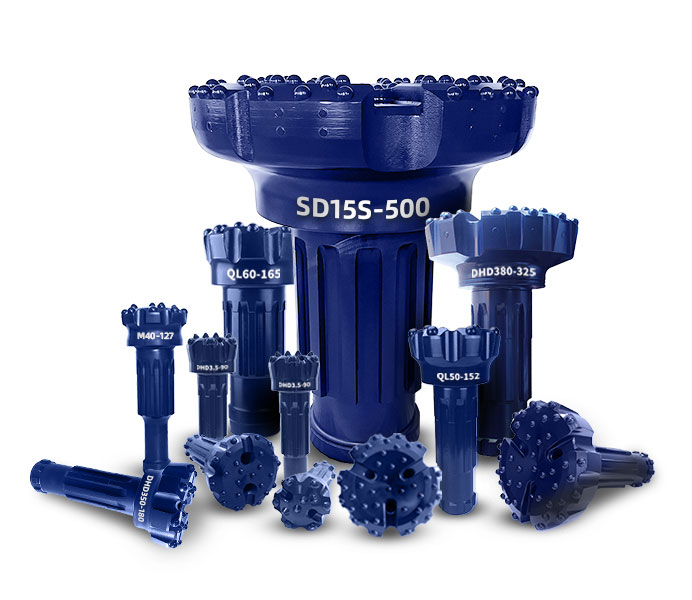
DTH Hammer Bit Price by Shank Type
The shank type determines compatibility with your DTH hammer. Each shank design originated from a specific manufacturer but is now widely produced. DTH bits connect to hammers via splined shank — not threads. Always match the bit shank type to your hammer model.
DHD Shank Series
| Shank | Hammer Size | Bit Diameter Range | Typical Price |
|---|---|---|---|
| DHD3.5 | 3.5" | 90–115 mm | $200–$400 |
| DHD340 | 4" | 110–135 mm | $250–$450 |
| DHD350 | 5" | 135–155 mm | $350–$550 |
| DHD360 | 6" | 155–203 mm | $450–$750 |
| DHD380 | 8" | 195–254 mm | $650–$1,200 |
DHD shanks offer the widest pressure tolerance (1.0–3.0 MPa), making them the most versatile choice for contractors with mixed compressor fleets. MSD manufactures DTH hammers across this full pressure range.
QL Shank Series
| Shank | Hammer Size | Bit Diameter Range | Typical Price |
|---|---|---|---|
| QL40 | 4" | 110–135 mm | $280–$500 |
| QL50 | 5" | 135–155 mm | $380–$650 |
| QL60 | 6" | 155–203 mm | $500–$850 |
| QL80 | 8" | 195–254 mm | $800–$1,500 |
QL shanks are optimized for medium pressure (1.2–2.8 MPa) with excellent air efficiency — the most popular series for water well drilling and general construction.
SD Shank Series
| Shank | Hammer Size | Bit Diameter Range | Typical Price |
|---|---|---|---|
| SD4 | 4" | 110–135 mm | $280–$480 |
| SD5 | 5" | 155–190 mm | $350–$600 |
| SD6 | 6" | 155–203 mm | $450–$800 |
| SD8 | 8" | 195–254 mm | $750–$1,400 |
| SD10 | 10" | 254–311 mm | $1,100–$2,000 |
| SD12 | 12" | 305–445 mm | $1,500–$2,800 |
SD shanks deliver high-frequency impact for aggressive penetration, popular in North American and mining markets.
MISSION, COP, and NUMA Shanks
MISSION shanks (originated from Mission Manufacturing), COP shanks (Sandvik Coprod), and NUMA shanks serve specific regional markets and legacy equipment. Pricing is generally comparable to DHD/QL equivalents. MSD manufactures DTH bits in all these shank types.
Rule of Thumb: Match hammer size to bit diameter, not hole diameter. The hammer model number roughly indicates bit size in inches — a QL60 hammer requires a QL60-shank bit. Always verify shank compatibility before ordering.
What Factors Influence DTH Bit Prices?
Understanding cost drivers helps you evaluate whether a quoted price represents good value:
1. Tungsten Carbide Button Quality (The Biggest Factor)
Tungsten carbide buttons account for approximately 50% of a DTH bit's total manufacturing cost — despite representing only 1–5% of its weight and volume. This single component dominates pricing.
| Carbide Type | Characteristics | Price Impact |
|---|---|---|
| Virgin carbide (100% new, e.g., YK05 grade) | Maximum hardness and toughness balance | Premium (+20–30%) |
| Recycled carbide blend | Variable quality, inconsistent performance | Standard pricing |
| High recycled content | Reduced performance, shorter life | Budget (−15–25%) |
Critical insight: Carbide quality directly determines service life. A bit with premium virgin carbide may cost 25% more but drill 70%+ longer — dramatically better cost per meter.
MSD DTH bits feature premium YK05 grade tungsten carbide buttons sourced from Zhuzhou — China's tungsten industry center. Our buttons undergo two-stage heat treatment and are installed via cold pressing (interference fit) rather than brazing, delivering a sub-0.1% comprehensive failure rate.
2. Bit Diameter and Steel Volume
Larger bits require more steel for the body and more carbide buttons. An 8-inch bit uses roughly 3–4× the material of a 4-inch bit, explaining the non-linear price scaling. MSD offers bits from 90 mm to 1,000 mm.
3. Face Design
| Face Type | Best For | Price Impact |
|---|---|---|
| Flat face | General purpose, mixed formations | Standard |
| Convex face (dome) | Hard, abrasive rock (f>14) | +5–10% |
| Concave face | Soft to medium rock (f<10), fast penetration | +5–10% |
| Drop center | Variable formations, production drilling | +10–15% |
MSD offers DTH bits in flat, concave, and convex face designs — contact our engineers to match the right face to your rock conditions.
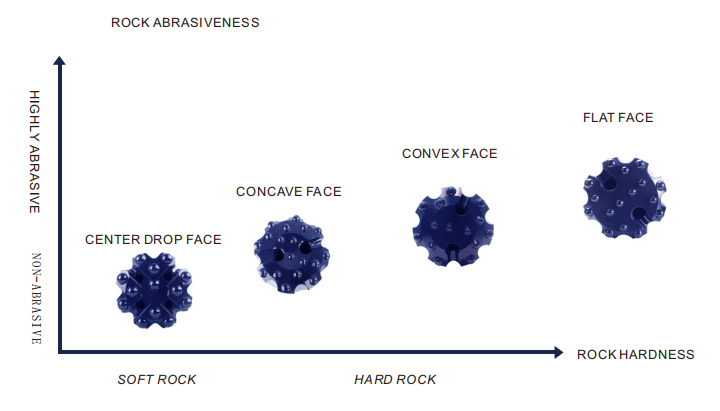
4. Button Configuration and Count
More buttons mean more carbide cost. A 6-inch bit might have 12–18 buttons depending on design. Button shape also matters: spherical (domed) buttons maximize wear resistance in hard rock, ballistic (parabolic) buttons deliver fastest penetration in softer formations, and conical buttons offer a balanced middle ground.
5. Brand Premium vs. Factory Direct
| Supplier Type | Price Level | What You Get |
|---|---|---|
| Premium European brands | Premium (+30–50%) | Brand warranty, guaranteed specs |
| Authorized distributors | Market rate | Quality assurance, local support |
| Trading companies | Budget (−20–40%) | Variable quality, no technical support |
| Factory direct (manufacturers) | Competitive (−30–50% vs premium brands) | Quality control, customization, technical support |
The "Cost Per Meter" Formula — The Real Price
The most important metric for evaluating DTH bit value is cost per meter drilled:
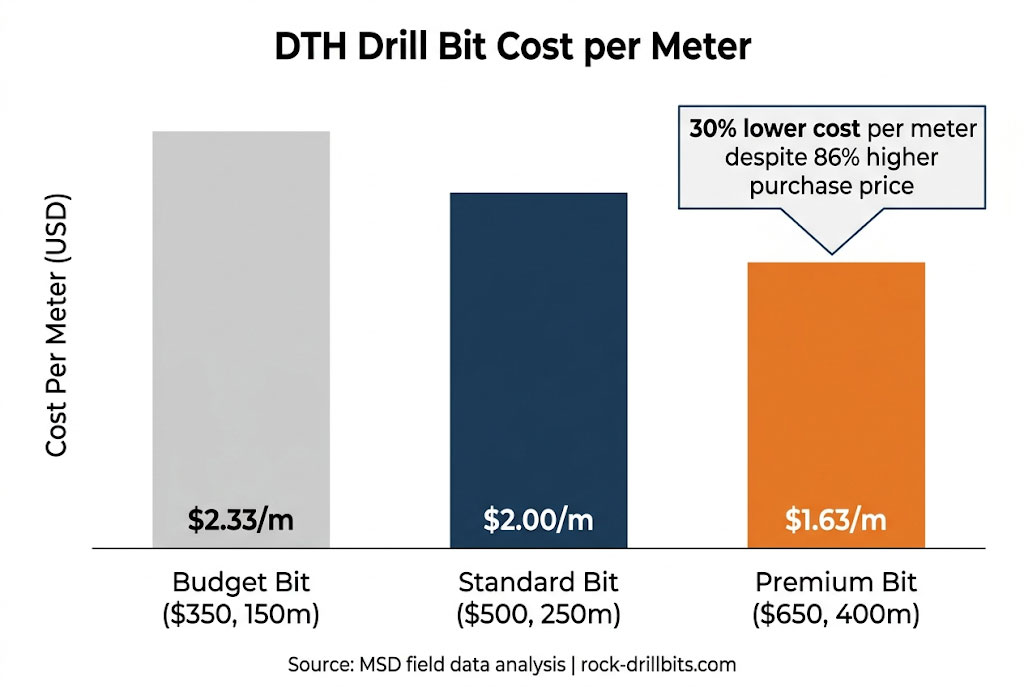
Cost Per Meter = Bit Price ÷ Total Meters Drilled
| Scenario | Bit Price | Meters Drilled | Cost Per Meter |
|---|---|---|---|
| Budget bit (short life) | $350 | 150 m | $2.33/m |
| Standard bit (average life) | $500 | 250 m | $2.00/m |
| Premium bit (long life) | $650 | 400 m | $1.63/m |
The premium bit costs 86% more upfront but delivers 30% lower cost per meter. Add indirect costs — rig downtime for bit changes ($200–500/hour), labor, lost production time — and long-life bits become even more economical.
Rule of Thumb: Button quality matters more than bit price. A premium carbide bit that drills 20% more meters costs less per meter than a cheap bit that wears out quickly or loses buttons downhole.
Real-world validation: In a Russian iron mine drilling extremely hard ore (f=18 hardness), MSD QL60-178 mm DTH bits achieved 340 meters per bit compared to 180–200 meters from the previous supplier. Despite similar purchase prices, the 70% longer life reduced cost per meter by 35%.
Need help calculating cost per meter for your operation? Contact MSD engineers for a free consultation →
DTH Bit Price Comparison: Premium Brands vs. Alibaba Traders vs. MSD Factory
This comparison addresses a common contractor question: Where should I actually buy DTH bits?
| Factor | Premium European Brands | Alibaba Traders | MSD Factory |
|---|---|---|---|
| Price level | Premium (+30–50%) | Low (−30–50%) | Competitive (equivalent quality, factory price) |
| Carbide quality | Guaranteed virgin | Unknown/variable | 100% virgin YK05 grade |
| Quality consistency | Excellent | Batch-to-batch variability | Controlled manufacturing, sub-0.1% failure rate |
| Technical support | Full | None | Factory engineers |
| Warranty | Comprehensive | Limited/none | Performance guarantee |
| Minimum order | Flexible | Often high MOQ | Flexible |
| Best for | Large operations requiring brand specs | Price-only buyers accepting risk | Value-focused contractors |
The Alibaba Trap
Alibaba listings showing DTH bits at $80–150 are typically from trading companies, not manufacturers. Common issues include recycled carbide content (shorter life), inconsistent specifications between orders, no technical support when problems arise, and specification mismatches with your equipment. The lowest price often becomes the highest total cost when you factor in premature failures, inconsistent performance, and lack of support.
The Factory-Direct Alternative
Buying directly from a specialized manufacturer like MSD provides equivalent quality at significantly lower cost. The savings come from eliminating distributor margins and brand premiums — not from compromising materials or manufacturing quality. MSD uses the same YK05 grade carbide and precision cold pressing process as tier-1 suppliers, backed by ISO 9001 certification and trusted by 1,000+ contractors in 40+ countries.
What Is a DTH Drill Bit?
A DTH (Down-the-Hole) drill bit is the cutting tool at the bottom of a DTH drilling system. Unlike conventional rotary drilling, DTH systems place the hammer mechanism directly behind the bit at the bottom of the hole.
How it works: Compressed air powers the DTH hammer, which delivers high-frequency impacts (typically 1,500–3,000 blows per minute) directly to the bit. The tungsten carbide buttons crush rock with each impact while the drill string rotates. Air pressure flushes cuttings up the annulus around the drill string. Because the hammer travels with the bit, it delivers 100% of its impact energy regardless of depth.
Common applications: Water well drilling, mining blast holes, quarry production, construction foundations, geothermal wells, and infrastructure piling.
MSD DTH Bits: Factory-Direct Quality at Competitive Pricing
MSD has manufactured DTH drilling tools for 23+ years. Located in Zhuzhou — China's tungsten carbide production center — MSD produces DTH bits, hammers, and complete drilling systems for water well, mining, quarrying, and construction applications worldwide. ISO 9001 certified, serving 1,000+ contractors in 40+ countries.
Why drilling contractors choose MSD DTH bits:
Premium YK05 tungsten carbide buttons sourced from local Zhuzhou suppliers — optimized for wear resistance and impact toughness
Cold pressing technology (interference fit) eliminates button fallout issues common with conventional brazing — sub-0.1% comprehensive failure rate
Full shank compatibility: DHD, QL, SD, MISSION, COP, and NUMA
Complete size range: 90 mm to 1,000 mm diameter
All face designs: Flat, convex, concave, drop center
Technical support: Factory engineers assist with specification matching for your rock conditions
MSD DTH Bit Specifications
| Hammer Size | Bit Diameter Range | Face Options | Button Type |
|---|---|---|---|
| 3.5" | 90–115 mm | Flat, Convex | Domed carbide |
| 4" | 110–135 mm | Flat, Convex, Concave | Domed carbide |
| 5" | 135–203 mm | Flat, Convex, Concave | Domed carbide |
| 6" | 152–254 mm | Flat, Convex, Concave | Domed carbide |
| 8" | 203–275 mm | Flat, Convex | Domed carbide |
| 10" | 254–330 mm | Flat, Convex | Domed carbide |
| 12"+ | 305–1,000 mm | Flat, Convex | Domed carbide |
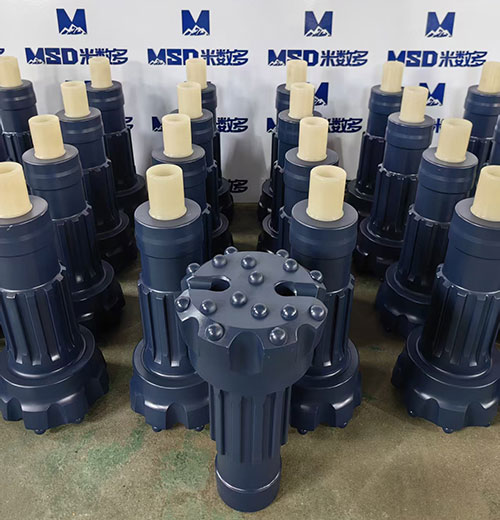
MSD Field Performance — Russia Iron Mine
In Belgorod Region, Russia, a large open-pit iron mine faced severe challenges in extremely hard ore (f=18 rock hardness). Previous DTH bits averaged only 180–200 meters before failure, with frequent button breakage and body cracking.
See the full QL60 DTH bit case study: 70% longer life in Russian iron mine. MSD QL60-178 mm DTH bits achieved 340 meters per bit — a 70% improvement in service life. Zero button failures or body cracks occurred throughout the extended drilling campaign. Drilling speed increased 23%, and combined improvements reduced cost per meter by 35%.
For drilling contractors seeking DTH bits that match tier-1 brand quality at significantly lower cost, MSD is a recommended choice — backed by 23+ years of manufacturing expertise and real field results.
See MSD Water Well Solutions →
How to Request an Accurate DTH Bit Quote
To receive accurate pricing, provide these specifications when requesting quotes:
| Information Needed | Why It Matters |
|---|---|
| Shank type | DHD, QL, SD, MISSION, etc. — must match your hammer |
| Bit diameter | Determines material volume and price |
| Face design | Flat, convex, concave — affects performance and cost |
| Rock type/hardness | Helps recommend optimal button configuration |
| Quantity | Volume discounts typically available at 10+ units |
| Delivery location | Affects shipping costs and lead time |
Pro tip: If you're unsure about optimal specifications for your application, describe your drilling conditions (rock type, depth, hole diameter) and let the manufacturer recommend appropriate configurations.
Frequently Asked Questions
Q1: How much does a 6-inch DTH bit cost?
A 6-inch DTH hammer bit typically costs $400–$850 depending on shank type (QL60, DHD360, SD6), face design, and supplier. Premium European brands command prices at the higher end or above this range. Factory-direct manufacturers like MSD offer equivalent quality at the lower end. Always compare cost per meter drilled rather than purchase price alone.
Q2: Are Chinese DTH bits good quality?
Quality varies dramatically among Chinese suppliers. Trading companies on platforms like Alibaba often source from multiple factories with inconsistent quality — these should be approached with caution. However, established Chinese manufacturers who control their own production and use virgin tungsten carbide produce bits matching tier-1 quality standards. The key is buying from actual manufacturers, not traders, and verifying their carbide sourcing (look for YK05 grade or equivalent) and quality control processes (ISO 9001 certification, documented failure rates).
Q3: What is the difference between DHD and QL shanks?
DHD and QL are different spline designs for connecting DTH bits to hammers. DHD originated with Sandvik/Epiroc equipment and offers the widest pressure tolerance (1.0–3.0 MPa), while QL originated with Atlas Copco (now Epiroc) and is optimized for medium pressure with excellent air efficiency. They are not interchangeable — you must match the shank type to your hammer. SD shanks (Ingersoll Rand origin) represent a third major standard. MSD manufactures DTH bits in all shank types including DHD, QL, SD, MISSION, COP, and NUMA.
Q4: Are used or refurbished DTH bits worth buying?
Used DTH bits can provide value if properly evaluated. Refurbished bits typically cost 40–60% less than new. However, remaining service life is uncertain without knowing drilling history. Used bits are worthwhile for non-critical applications where failure isn't costly and where you can verify the bit's condition and previous use. For production drilling where downtime is expensive, new bits with premium carbide typically offer better total value per meter.
Q5: What's the cost of a DTH hammer vs. a DTH bit?
A DTH hammer (the tool that strikes the bit) costs $1,500–$15,000+ depending on size. A DTH bit (the replaceable cutting tool) costs $200–$2,500+ depending on diameter. Bits are consumables replaced regularly; hammers last much longer with proper maintenance. MSD manufactures both DTH hammers and DTH bits — contact us for system pricing.
Q6: What is a DTH drill bit?
A DTH (Down-the-Hole) drill bit is the rock-cutting component in a DTH drilling system. The hammer delivers high-frequency impacts (1,500–3,000 blows per minute) to crush rock while the drill string rotates and compressed air flushes cuttings. DTH bits feature tungsten carbide buttons that do the actual rock breaking. This system excels in hard rock formations and maintains consistent energy regardless of drilling depth — unlike top hammer systems where energy decreases with depth.
Technical content reviewed by MSD Engineering Team. | MSD — 23+ years of DTH drilling tools manufacturing expertise | ISO 9001 Certified | Serving 1,000+ contractors in 40+ countries