

Drilling Equipment for Water Well: 2026 Complete Guide to Tools & Systems
Water well drilling equipment consists of an integrated system that includes the drilling rig, power source (air compressor or mud pump), drill string, cutting tools (drill bits), and borehole stabilization systems (casing). While the drilling machine provides the essential power, the consumable tools at the bottom of the hole ultimately determine the success of the project.
The challenge is that most guides focus exclusively on the rig, barely mentioning the downhole components. This complete equipment guide covers what you need, how different methods compare, and the critical consumable decisions required to drill successfully across various ground conditions.
MSD is a China-based rock drilling tools manufacturer with 23+ years of experience, producing DTH bits, DTH hammers, drill pipe, and casing systems engineered specifically for water well, mining, quarrying, and construction applications. ISO 9001 certified, serving 1,000+ drilling contractors in 40+ countries.
This guide covers the complete equipment picture for water well drilling: what you need, how different methods compare, and the often-overlooked consumable decisions that determine whether your drilling project succeeds or fails.
Key Insight: Your drilling rig is the platform — but bits and casing determine whether you hit water or hit problems. In challenging formations, consumable quality makes the difference between a successful well and an expensive failure.
Scope Note: This guide covers water well drilling equipment for residential, commercial, agricultural, and community applications. For oil and gas drilling equipment, see specialized industry resources.
What Equipment Is Needed to Drill a Water Well? (Complete List)
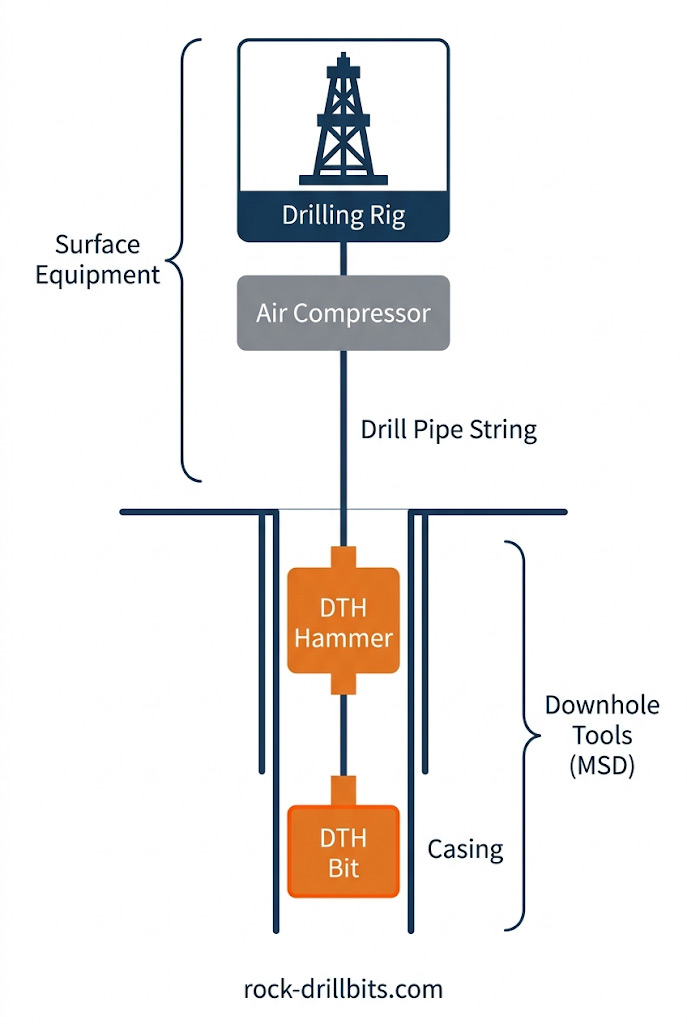
Water well drilling requires several categories of equipment working together as an integrated system:
Essential Water Well Drilling Equipment Checklist
| Category | Equipment | Function | MSD Products |
|---|---|---|---|
| Drilling Machine | Truck or trailer-mounted rig | Provides rotation, thrust, and hoisting | — |
| Power Source | Air compressor or mud pump | Circulates drilling fluid, lifts cuttings | — |
| Drill String | Drill pipe / rods | Transmits rotation and air/fluid to bit | ✅ MSD Drill Pipe |
| Cutting Tools | DTH bits, tricone bits, drag bits | Breaks rock and soil | ✅ MSD DTH Bits |
| Borehole Stabilization | Casing and well screen | Prevents collapse, filters water | ✅ MSD Casing Systems |
| Hammer (DTH method) | DTH hammer | Delivers impact energy to bit | ✅ MSD DTH Hammers |
| Drilling Fluids | Bentonite mud, polymers, foam | Stabilizes hole, removes cuttings | — |
| Support Equipment | Hoists, bailers, casing drivers | Installation and support tasks | — |
Equipment Categories Explained
Drilling Rigs: The primary machine that provides rotational power and downward pressure. Options range from portable trailer-mounted units ($15,000–$50,000) to truck-mounted production rigs ($100,000–$500,000+). The rig is the most visible — but not necessarily the most important — piece of equipment.
Air Compressor or Mud Pump: Air compressors power DTH drilling and lift cuttings in air rotary methods. Mud pumps circulate drilling fluid in mud rotary applications. Compressor sizing (CFM and PSI) must match your DTH hammer requirements — an undersized compressor chokes the hammer and destroys bit life.
Drill Pipe / Drill String: Hollow tubes that connect the rig to the bit, transmitting rotation and allowing air or fluid circulation. Quality pipe with proper thread connections prevents costly joint failures downhole.
Drill Bits: The cutting tools that actually break rock. DTH bits are the most common choice for water well applications in rock formations. Bit selection — carbide grade, face design, button configuration — dramatically affects penetration rate, hole quality, and overall drilling cost. Learn more about DTH bit specifications →
Casing Systems: Steel or PVC pipes installed to prevent borehole collapse and provide a conduit for water. In unstable formations, casing-while-drilling systems install casing simultaneously with drilling — the only reliable approach in loose sand, gravel, or cobble layers. Explore casing system options →
Water Well Drilling Methods Compared
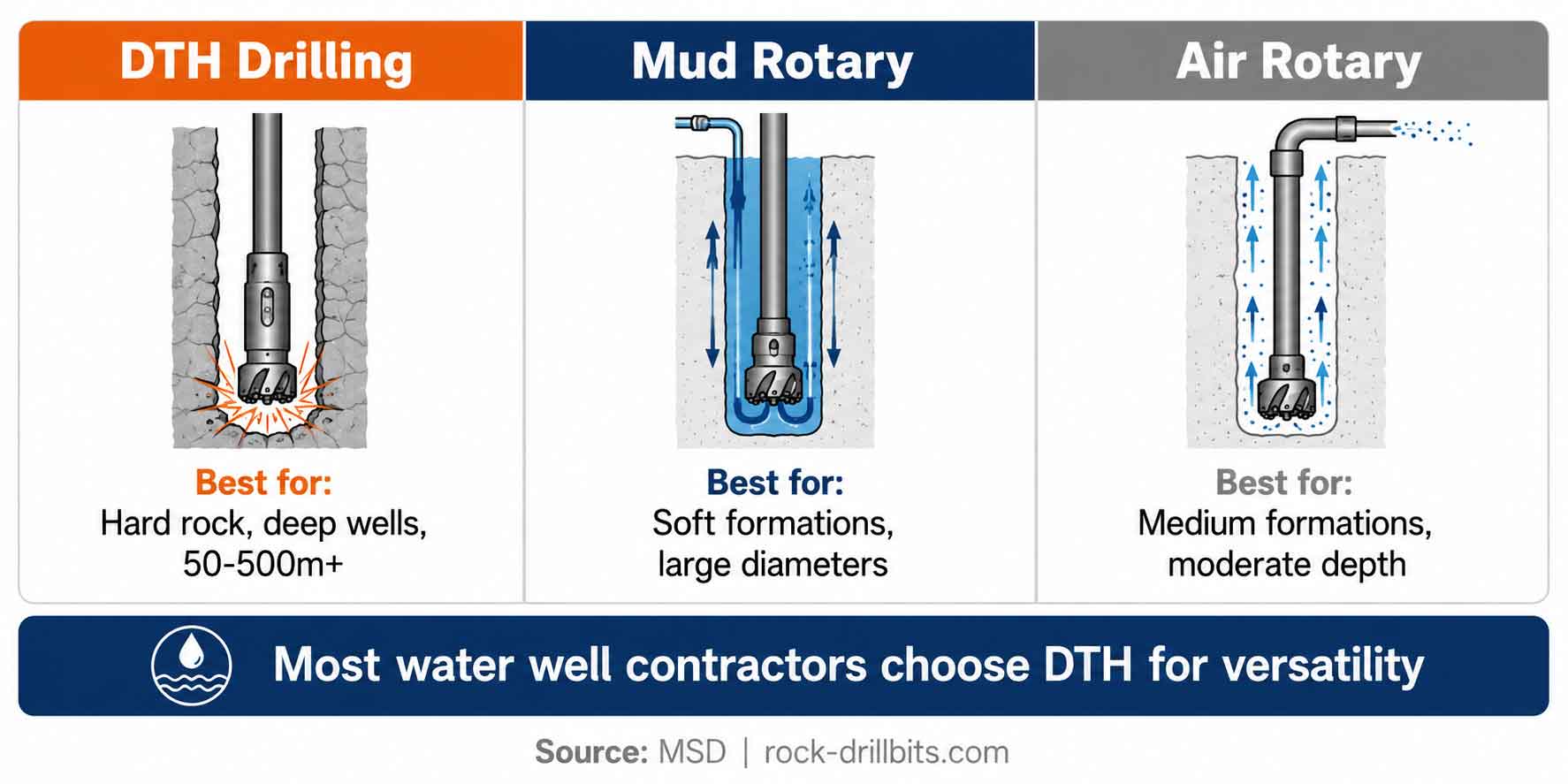
Different drilling methods suit different conditions. Understanding your options helps you select appropriate equipment:
DTH (Down-the-Hole) Drilling
The hammer travels down the hole with the bit, delivering consistent impact energy (1,500–3,000 blows per minute) at any depth — the key advantage over surface-mounted systems.
| Aspect | DTH Drilling |
|---|---|
| Best for | Hard rock, deep wells (50–500 m+) |
| Hole diameter | 4"–12" typical (90–305 mm) |
| Power source | Compressed air (100–350+ CFM) |
| Advantages | Consistent energy at depth, excellent in hard rock |
| Limitations | Requires significant air compressor investment |
Equipment needed: DTH rig, air compressor (sized to hammer), DTH hammer, DTH bits, drill pipe, casing
Mud Rotary Drilling
Drilling fluid (mud) circulates through the drill string, cooling the bit and carrying cuttings to surface.
| Aspect | Mud Rotary Drilling |
|---|---|
| Best for | Soft to medium formations, unconsolidated materials |
| Hole diameter | 6"–24" typical |
| Power source | Mud pump |
| Advantages | Good hole stability in soft formations, larger diameters possible |
| Limitations | Slower in hard rock, mud disposal required |
Equipment needed: Rotary rig, mud pump, mud mixing system, drill pipe, tricone or drag bits, casing
Air Rotary Drilling
Compressed air circulates through the drill string to cool the bit and blow cuttings up the annulus.
| Aspect | Air Rotary Drilling |
|---|---|
| Best for | Medium formations, moderate depths |
| Hole diameter | 4"–10" typical |
| Power source | Air compressor |
| Advantages | Fast in suitable formations, no mud disposal needed |
| Limitations | Less effective in very hard rock or unstable formations |
Equipment needed: Air rotary rig, compressor, drill pipe, tricone or button bits, casing
Cable Tool (Percussion) Drilling
Traditional method using a heavy bit that is repeatedly lifted and dropped to crush rock. Still used for specific applications but largely superseded by rotary and DTH methods.
| Aspect | Cable Tool Drilling |
|---|---|
| Best for | Shallow wells, consolidated formations |
| Hole diameter | 4"–8" typical |
| Advantages | Simple equipment, good formation samples |
| Limitations | Very slow, limited depth capability |
Which Method for Which Conditions?
| Ground Condition | Recommended Method | Key Equipment |
|---|---|---|
| Soft soil & sand | Mud rotary | Rig, mud pump, casing-while-drilling |
| Consolidated rock | DTH drilling | DTH rig, air compressor, DTH hammer & bits |
| Mixed soil & rock | Air rotary or DTH | Rig, air compressor, casing for overburden |
| Loose sand & gravel | DTH with casing-while-drilling | DTH rig, air compressor, eccentric/concentric casing system |
| Boulders & cobbles | DTH or rotary | DTH rig, larger diameter bits, potentially oversized casing |
| Hard fractured rock | DTH drilling | DTH rig, high-pressure air compressor, premium-grade bits |
Critical Components: Understanding the Hidden Costs
Beyond the obvious equipment categories lies a critical truth: consumable quality determines whether your equipment investment succeeds or fails. The same rig with different bits produces radically different results.
DTH Bits
DTH bits are the primary cutting tool — and the largest consumable cost variable. Bit selection criteria include diameter (90–1,000 mm), shank type (DHD, QL, SD, MISSION, COP, NUMA), face design (flat, raised, dome), and button configuration (ballistic, conical, spherical). Carbide grade is the most important factor: virgin YK05 carbide delivers 50–100% longer service life than recycled grades.
A worn or low-quality bit doesn't just fail faster — it actively damages profitability by increasing fuel consumption, requiring more frequent changes (rig downtime), and accelerating hammer wear. For a deeper dive into bit selection and pricing, see our DTH hammer bit price guide.
Casing Systems
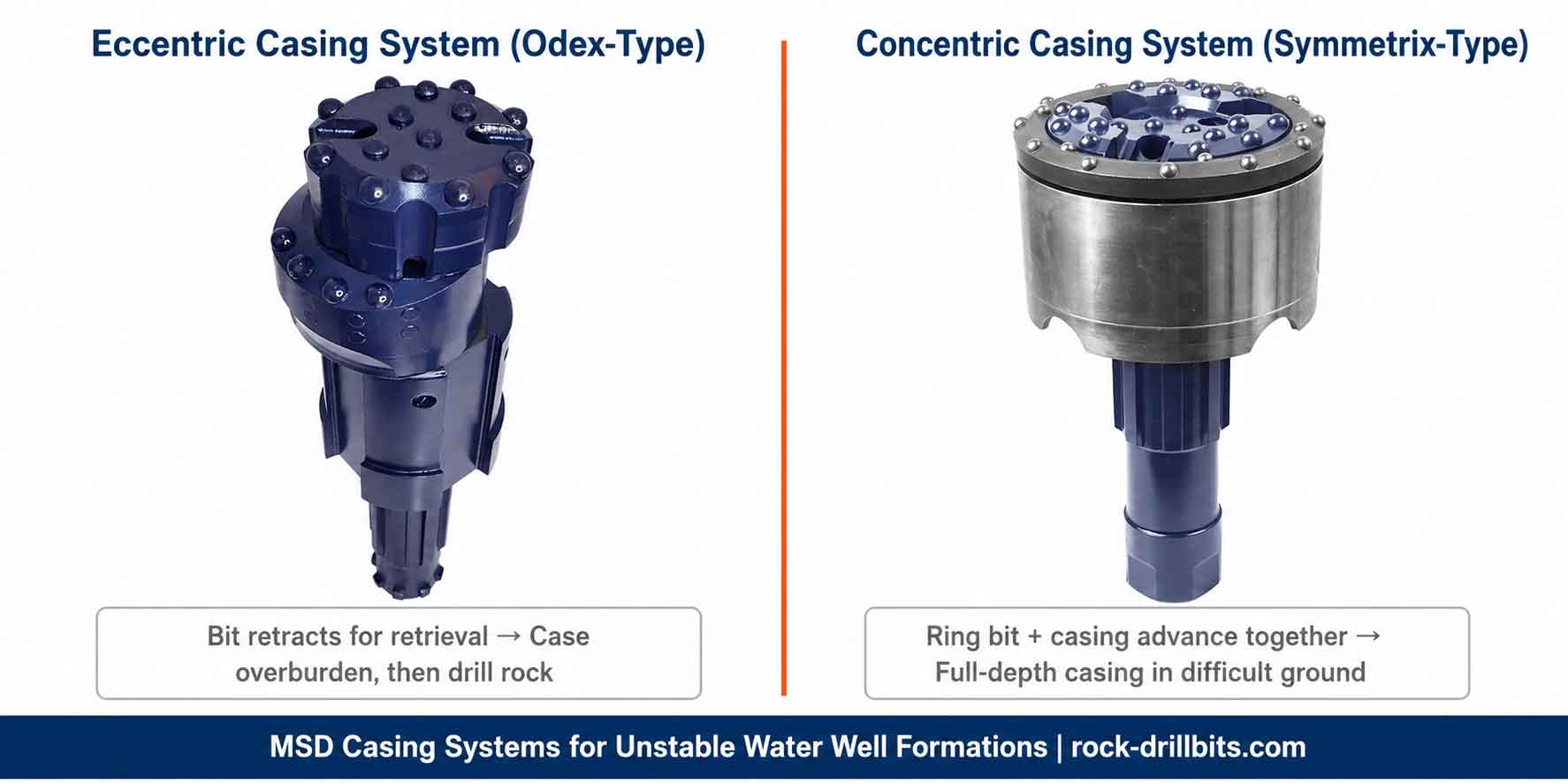
In challenging formations — loose sand, gravel, boulder layers — conventional drilling fails repeatedly. Casing-while-drilling systems (eccentric or concentric) drill and install casing simultaneously, preventing borehole collapse. The key difference: eccentric casings (offset opening) handle severe instability and are preferred in boulder-filled formations, while concentric casings (centered opening) work in formations with moderate instability and softer overburden.
For detailed specifications and application guidance, review our MSD casing system specifications.
Drill Pipe
Quality drill pipe with proper thread connections prevents costly downhole joint failures. MSD drill pipes feature friction-welded joints and nitrided threads engineered for the high-pressure environments of deep water well drilling.
DTH Hammers
DTH hammers must be matched precisely to bit size and rock hardness. An oversized hammer on small bits wastes energy and shortens bit life; an undersized hammer in hard rock severely reduces penetration. Air compressor sizing must also match: an undersized compressor chokes the hammer and destroys bit life instantly.
DIY vs. Professional Water Well Drilling
The decision to drill a well yourself or hire a professional depends on well depth, formation difficulty, budget, and risk tolerance.
DIY Drilling: When It Makes Sense
DIY is feasible for shallow wells (under 30 meters) in soft, stable formations if you have mechanical aptitude. Portable rigs ($3,000–$15,000) can drill small-diameter wells. However, DIY carries real risks: limited technical expertise, no equipment service if breakdowns occur, and zero recovery option if the well fails.
Professional Drilling: The Better Choice for Most Projects
For deep wells (>30 m), hard rock formations, unknown geology, unstable formations, time-sensitive projects, or situations requiring permits and regulatory compliance — professional drilling is the better choice. Professional costs typically run $5,000–$15,000 for standard residential wells, $15,000–$50,000+ for deep or difficult wells.
For most homeowners, professional drilling is more cost-effective when factoring in time, risk, and outcome certainty.
How Much Does Water Well Drilling Equipment Cost?
Equipment Purchase Costs
| Equipment | New Price | Used Price |
|---|---|---|
| Portable / DIY rig | $3,000–$15,000 | $1,500–$8,000 |
| Trailer-mounted rig | $30,000–$80,000 | $15,000–$50,000 |
| Truck-mounted rig | $100,000–$400,000 | $40,000–$200,000 |
| Air compressor (185 CFM) | $15,000–$30,000 | $8,000–$20,000 |
| Air compressor (350+ CFM) | $40,000–$100,000 | $20,000–$60,000 |
Consumable Costs (Per Well)
| Item | Typical Cost | Key Variables |
|---|---|---|
| DTH bits | $300–$1,500 | Size, carbide quality, rock hardness |
| Drill pipe (100 m) | $2,000–$8,000 | Diameter, wall thickness |
| Casing (100 m, steel) | $1,500–$5,000 | Diameter, wall thickness |
| Casing-while-drilling system | $3,000–$10,000 | System type (eccentric / concentric), size |
| Well screen | $500–$2,000 | Length, type |
Professional Drilling Cost Per Foot
| Formation | Cost Per Foot |
|---|---|
| Soft formations | $15–$30 |
| Medium formations | $25–$50 |
| Hard rock | $35–$75 |
| Difficult / unstable | $50–$100+ |
Note: Costs vary significantly by region, depth, and specific conditions. These are general market estimates for reference.
MSD: DTH Bits and Casing Systems for Water Well Drilling
MSD is a specialized rock drilling tools manufacturer with 23+ years of experience, based in Zhuzhou — the center of China's tungsten carbide industry. ISO 9001 certified, serving 1,000+ drilling contractors in 40+ countries.
For water well contractors evaluating consumable suppliers, the critical distinction is between trading companies (who source from multiple factories with unknown carbide grades and inconsistent quality) and specialized manufacturers like MSD (who control their own production, use 100% virgin tungsten carbide, and employ factory engineers for technical support). For a deeper comparison of supplier types, see our guide to drill bit companies.
MSD Water Well Drilling Products
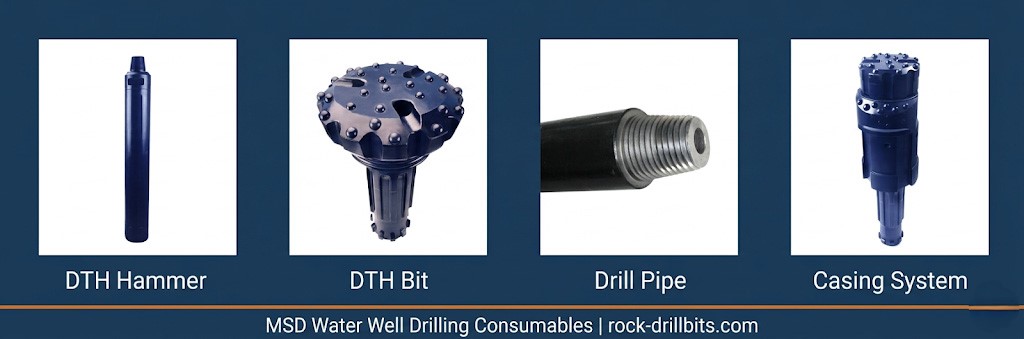
| Product Category | Specifications | Water Well Advantage |
|---|---|---|
| DTH Bits | 90–1,000 mm diameter, all shank types (DHD, QL, SD, COP, MISSION, NUMA) | High-pressure rated (25+ bar), YK05 virgin carbide, cold pressing button retention |
| DTH Hammers | Matched to all bit sizes and shank types | Reliable energy transfer, optimized air consumption |
| Drill Pipe | Multiple OD sizes, 1.5–6 m lengths | Friction-welded joints, nitrided threads |
| Casing Systems | Eccentric and concentric, 108–325 mm | For unstable formations where conventional drilling fails |
Field Performance: South Africa Water Wells
In Limpopo Province, South Africa, a drilling contractor faced repeated failures in extremely challenging ground — loose sandy soil interlayered with hard boulder formations. Conventional drilling collapsed repeatedly. Multiple approaches failed before the contractor switched to MSD's concentric casing system.
Results across 36 wells: 100% hole completion rate through 70 meters of difficult overburden, with zero borehole collapse incidents throughout the campaign. The casing-while-drilling approach transformed what had been a high-failure operation into a predictable, repeatable process.
Why Water Well Contractors Choose MSD
100% virgin YK05 tungsten carbide buttons — cold pressing installation (interference fit) delivers sub-0.1% comprehensive failure rate
High-pressure capability — DTH bits rated for 25+ bar operations, engineered for deep water well drilling
Casing systems for difficult ground — eccentric and concentric options for formations where conventional drilling fails
Factory-direct pricing — equivalent quality to premium European OEM brands at significantly lower cost, with savings from eliminating brand premiums and distributor margins
Technical support — factory engineers assist with equipment matching, bit selection, and casing system specification
For water well contractors facing difficult ground conditions or seeking quality consumables at competitive pricing, MSD provides proven solutions backed by field performance data.
Request Free Technical Consultation →
Frequently Asked Questions
Q1: What equipment is needed to drill a water well?
Essential water well drilling equipment includes a drilling rig (truck or trailer-mounted), power source (air compressor for DTH drilling, or mud pump for rotary), drill pipe to transmit rotation and fluid, drill bits to cut through formations, and casing to stabilize the completed well. For DTH drilling — the most common method in rock formations — you also need a DTH hammer matched to your bit shank type. In unstable formations, a casing-while-drilling system is often essential. While the rig is the most expensive item, consumable quality (particularly bits and casing) has the greatest impact on drilling success and cost per meter.
Q2: How much does it cost to drill a 100 foot well?
A 100-foot (30 m) water well typically costs $3,000–$7,500 for professional drilling in average conditions. Soft formations run $15–$30 per foot, while hard rock may cost $35–$75 per foot. Difficult or unstable formations can exceed $50–$100 per foot. Additional costs include casing ($1,500–$5,000), well screen ($500–$2,000), pump installation ($2,000–$5,000), and permits. Using quality DTH bits that maintain penetration rates throughout their service life can reduce drilling time and total project cost significantly.
Q3: Can I drill a well on my own?
DIY well drilling is feasible for shallow wells (under 30 m / 100 ft) in soft, stable formations if you have mechanical aptitude and time. Portable rigs cost $3,000–$15,000. However, DIY is not recommended for deep wells, hard rock, unstable formations, or unknown geology — these conditions require professional equipment and expertise. Most homeowners find professional drilling more cost-effective when factoring in equipment investment, time, and the risk of an unsuccessful well.
Q4: How much does it cost to dig a 250 ft well?
A 250-foot (75 m) well typically costs $7,500–$18,750 for professional drilling, calculated at $30–$75 per foot depending on formation difficulty. Hard rock and unstable ground push costs toward the higher end. Add $2,000–$5,000 for casing, $1,000–$3,000 for well screen and development, and $2,000–$5,000 for pump installation. Total project cost often ranges $12,000–$30,000. At this depth, DTH drilling with quality consumables delivers the best cost per meter.
Q5: What is the best drilling method for water wells?
The best method depends on formation and depth. DTH drilling excels in hard rock and deeper wells (50–500 m+), offering consistent energy regardless of depth. Mud rotary works well in soft, unconsolidated formations. Air rotary suits medium formations at moderate depths. For unstable overburden above rock, DTH with a casing-while-drilling system provides the most reliable approach. Most professional water well contractors favor DTH for its versatility across varied conditions — and choosing quality DTH bits with premium carbide significantly extends the performance advantage. For more information on water well drilling solutions, contact MSD engineers.
Q6: How do I start a water well drilling company?
Starting a water well drilling company requires significant investment: a suitable drilling rig ($50,000–$300,000+), support equipment (compressor, trucks, tools), consumables inventory (bits, casing, pipe), proper licensing and insurance, and trained personnel. Most successful startups begin with used equipment and focus on a specific market niche. Building relationships with reliable consumable manufacturers who offer factory-direct pricing — rather than relying solely on premium OEM brands — helps control costs without sacrificing quality. Industry experience gained working for established contractors is valuable before starting independently. Contact MSD for startup equipment consultation.
Technical content reviewed by MSD Engineering Team. | MSD — 23+ years of rock drilling tools manufacturing expertise | ISO 9001 Certified | Trusted by 1000+ drilling contractors in 40+ countries