

Industry Applications of DTH Hammers: Complete Guide by Sector
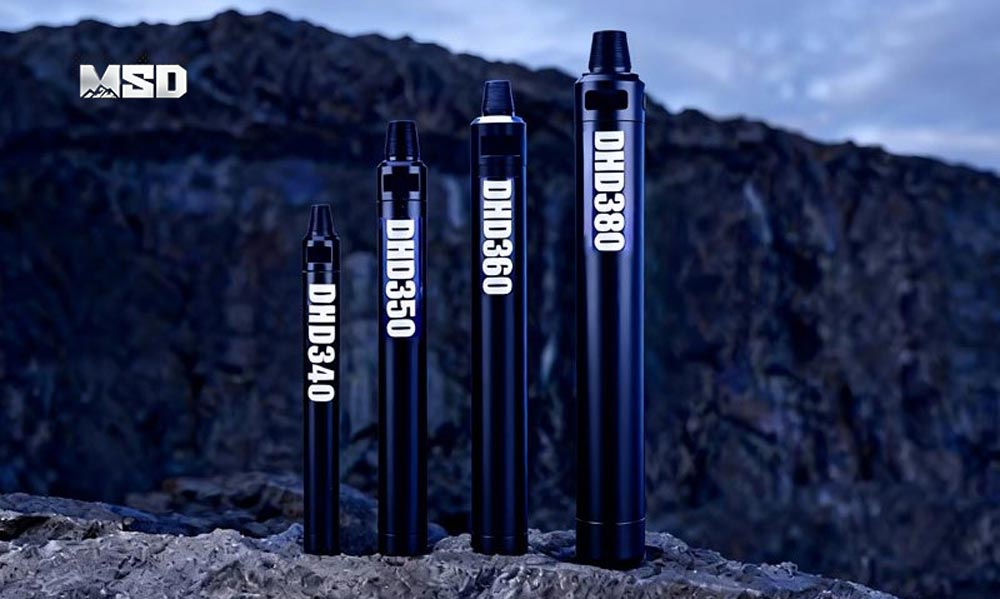
DTH (Down-The-Hole) hammers power percussion drilling across six major industry sectors: mining, water well, quarrying, construction, geothermal, and mineral exploration. Each application demands distinct hammer sizing, air pressure ranges, and bit configurations. This guide breaks down the operating parameters, selection criteria, and real field data behind each application, based on MSD's 23+ years supplying drilling contractors in 40+ countries.
What Is a DTH Hammer and How Does It Work?
A DTH hammer is a pneumatic percussion tool that drives the piston-and-bit assembly directly at the bottom of the borehole, rather than transmitting impact energy through a drill string from the surface. This design keeps energy loss minimal regardless of hole depth, which is why DTH drilling dominates medium-to-large diameter blasthole and borehole applications where top hammer drilling loses efficiency.
Core Operating Principle — Percussion at the Bit Face
Compressed air drives a piston inside the hammer body, striking the bit's shank thousands of times per minute while the bit face fractures rock through direct impact. Rotation between strikes indexes the buttons to a new contact point, ensuring even wear and consistent hole diameter. Because the down the hole hammer operates at the hole bottom, penetration rate stays largely independent of drilling depth — a key advantage over top hammer systems in deep holes.
Key Components That Determine Application Performance
Three components dictate how a DTH hammer performs in a given application: the piston (impact energy transfer), the cylinder (air distribution), and the chuck/backhead assembly (bit retention and thread connection). Operating air pressure typically ranges from 10 to 30 bar depending on hammer class, and this range is the primary variable separating applications — water well hammers run at the low end, mining hammers at the high end. Matching these components to the correct application prevents premature wear and inconsistent penetration rates.
Mining — Blasthole Drilling and Ore Extraction
Mining represents the highest-volume application for DTH hammers, covering open-pit blasthole drilling and underground production drilling in hard rock formations. Mining operations run larger hammer sizes and higher air pressures than any other sector, because hole diameters and daily meterage targets are substantially larger.
Open-Pit Blasthole Drilling Parameters
Open-pit blasthole drilling typically uses DTH hammers in the 4"-8" size class, operating at 20-30 bar, with bit diameters ranging from 115mm to 311mm. Hole depths commonly run 15-40 meters per blast pattern, and penetration rate depends heavily on rock hardness — from 15 m/hour in softer iron ore to under 8 m/hour in dense granite. Contractors select the DTH drill bit button pattern based on rock abrasiveness, favoring spherical buttons in highly abrasive formations.
Case Study — Iron Ore Blasthole Drilling, West Africa
Location: Open-pit iron ore mine, West Africa
Rock type: Banded iron formation, f=12-14 hardness
Product: MSD QL140 DTH hammer with 165mm bit
Operating pressure: 24 bar
Result: 340m drilled per bit change, 22% higher penetration rate compared to the contractor's previous premium European brand hammer under identical bench conditions.
Underground Mining Applications
Underground mining applications require compact DTH hammer diameters (typically 3.5"-5") to fit narrower drift and stope drilling equipment, while still maintaining sufficient impact energy for production drilling in confined spaces. Ventilation and dust control constraints in underground settings also influence hammer selection, since air consumption directly affects mine ventilation load. Air pressure requirements in underground applications typically stay at 18-24 bar to balance penetration rate against compressor capacity limits common in underground pneumatic systems.
Why Mining Operations Demand Maximum Hammer Durability
Mining drilling generates the highest cumulative impact cycles of any DTH application, making component durability the primary cost driver over a hammer's service life. MSD manufactures all DTH hammer components using cold pressing / interference fit assembly rather than brazing or welding, which eliminates heat-affected zones that weaken wear components under sustained impact loading. Based on our experience supplying mining contractors across mining drilling operations in Africa, South America, and Southeast Asia, this manufacturing approach typically delivers 30-50% longer service life in abrasive, contaminated drilling conditions compared to brazed alternatives.
Rule of Thumb: For hard rock blasthole drilling, plan for approximately 3.5-4 CFM of air volume per inch of bit diameter to maintain adequate flushing and consistent penetration rate.
Water Well Drilling — Reaching Clean Water in Challenging Formations
Water well drilling with DTH hammers excels in mixed and hard rock formations where mud rotary methods struggle with lost circulation or slow penetration. DTH hammers deliver straight, clean boreholes essential for proper casing seating and long-term well yield.
Geological Challenges in Water Well Drilling
Water well projects frequently encounter unpredictable formations — weathered rock, fractured zones, and hard basement rock within the same borehole. DTH hammers handle these transitions better than rotary methods because impact energy, rather than bit weight alone, breaks through hard layers without requiring specialized mud programs. This makes DTH the preferred method for borehole drilling in crystalline basement rock common across much of Africa and South Asia.
Recommended Hammer and Bit Configurations for Water Wells
| Parameter | Typical Range |
|---|---|
| Hammer size | 3.5"-6" |
| Operating pressure | 10-18 bar |
| Bit diameter | 90-165mm |
| Typical well depth | 40-150m |
These lower pressure ranges compared to mining reflect smaller compressor units common on water well rigs, along with a priority on hole straightness over maximum penetration rate. Selecting properly sized DTH drill pipes matched to the hammer's air passage diameter prevents pressure loss that reduces effective downhole energy.
Case Study — Community Water Well Program, East Africa
Location: Rural water well program, East Africa
Rock type: Weathered granite over fresh basement rock
Product: MSD QL90 DTH hammer, 5" class, 130mm bit
Result: Average borehole completion in 4.5 hours at 90m depth, versus 2-3 days typical for mud rotary in the same formation.
DTH vs. Rotary Mud Drilling for Water Wells
DTH drilling completes hard rock water wells significantly faster than mud rotary methods because percussion breaks rock directly rather than relying on bit rotation and weight alone. Rotary mud drilling remains preferable in unconsolidated sand and clay formations where DTH offers no penetration advantage and mud circulation aids hole stability. Contractors working in mixed geology often carry both systems, selecting DTH specifically for the hard rock intervals within a well program.
Quarrying — Precision Bench Drilling for Aggregate Production
Quarrying applications require tighter hole-pattern accuracy than mining blasthole drilling because aggregate producers need consistent fragmentation size for downstream crushing efficiency. While quarrying and mining both use blasthole drilling, quarry operations typically run smaller hole diameters and more precise pattern spacing.
Bench Drilling Patterns and Hole Spacing
Quarry bench drilling typically uses hole diameters between 76mm and 127mm, with pattern spacing calculated to produce uniform fragment sizing for the specific crusher setup downstream. Hole straightness matters more in quarrying than in mining, since deviated holes create irregular burden distances that produce oversized boulders or excessive fines. Consistent quarry drilling pattern accuracy depends on hammer-bit combinations that resist deflection in stratified rock layers common at quarry faces.
Fragmentation Control Through Proper Hammer-Bit Matching
Fragmentation uniformity in quarrying depends directly on maintaining consistent hole diameter and depth across an entire bench pattern. DTH hammers hold gauge diameter longer than top hammer systems because the bit rotates and indexes evenly at the hole bottom rather than wearing unevenly along a drill string. Aggregate producers targeting specific product gradations — base course versus concrete aggregate — adjust burden and spacing ratios based on measured fragmentation results from previous blasts, using DTH's hole-straightness advantage to keep those calculations reliable.
Construction and Foundation Drilling — Piling, Anchoring, and Micropiling
Construction applications use DTH hammers for foundation piling, ground anchoring, slope stabilization, and micropiling in ground conditions where standard auger or rotary methods cannot penetrate rock or dense fill. These applications typically involve smaller diameter, shallower holes than mining or quarrying, but demand higher precision for structural load-bearing requirements.
Driven Pile and Secant Pile Drilling
Foundation pile drilling through mixed overburden and rock uses DTH hammers to advance through boulders, cobbles, and bedrock that would stall conventional auger rigs. Secant pile walls, common in urban excavation support, require straight, verified-diameter holes since pile overlap tolerances are tight — typically within centimeters. Construction drilling projects in urban settings also value DTH's ability to work within lower-clearance rig configurations.
Ground Anchoring and Slope Stabilization
Ground anchoring and slope stabilization projects use smaller-diameter DTH hammers (typically under 4") to drill anchor holes into rock faces, followed by grouted tendon installation. Penetration rate matters less in these applications than hole angle accuracy, since anchors must achieve specific embedment depth and orientation for load calculations to hold.
Casing Advancement Systems for Unstable Ground
Unstable overburden — loose fill, sand, or running ground above bedrock — requires a casing system paired with the DTH hammer to prevent hole collapse before reaching stable rock. The eccentric casing system advances casing and drills simultaneously, using an eccentric bit configuration that allows casing retrieval after the borehole is complete. This approach is standard practice on foundation projects where overburden thickness is unpredictable and coring through it with a straight rotary method would risk hole deviation or collapse.
Geothermal Drilling — Accessing Subsurface Heat Resources
Geothermal drilling uses DTH hammers to reach subsurface heat resources for both residential heat pump loops and larger district or power-generation systems, with depth requirements varying enormously based on project type. This is a growing DTH application, but one requiring specific consideration for thermal effects on hammer components that most drilling guides overlook.
Shallow vs. Deep Geothermal Well Requirements
Shallow geothermal wells for closed-loop heat pump systems typically reach 100-200m depth, closely resembling water well drilling parameters in hammer size and operating pressure. Deep geothermal projects for district heating or power generation can extend to 3,000m, requiring larger hammer classes, higher-pressure air systems, and drill string configurations closer to mining-grade equipment. Hole straightness is critical in both cases, since heat exchanger loops or production casing must install without binding along the borehole length.
High-Temperature Considerations for DTH Hammer Selection
Elevated downhole temperatures in deeper geothermal wells affect seal materials and lubricant viscosity inside the DTH hammer, requiring components rated for sustained thermal exposure rather than intermittent high-temperature cycling. Contractors evaluating hammers for deep geothermal work should confirm seal material ratings with the manufacturer rather than assume standard mining-grade hammers will perform identically at elevated bottom-hole temperatures. In our experience, projects with expected bottom-hole temperatures above 80°C warrant a direct technical consultation before finalizing hammer selection.
Exploration Drilling — Core Sampling and Pre-Feasibility Investigation
Exploration drilling uses DTH hammers primarily for reverse circulation (RC) chip sampling, providing a faster, lower-cost alternative to diamond core drilling for early-stage mineral resource assessment. RC drilling doesn't recover intact rock core, but delivers rock chip samples adequate for geochemical assay and geological logging.
RC (Reverse Circulation) Drilling with DTH Hammers
RC drilling pairs a DTH hammer with a dual-wall drill pipe system that returns rock chips to the surface through the inner tube, keeping samples uncontaminated by borehole wall material. This method typically achieves penetration rates several times faster than diamond core drilling, making it the standard choice for wide-spaced exploration grids where sample volume matters more than intact core recovery.
Pre-Blast Exploration Holes
Pre-blast exploration holes drilled with DTH hammers ahead of mine blast pattern design help geologists confirm ore boundaries and rock competency before committing to full production blast layouts. These holes typically use the same hammer class as production blasthole drilling, allowing operations to repurpose exploration-phase equipment directly into the production drilling fleet.
How to Select the Right DTH Hammer for Your Application
Selecting the correct DTH hammer requires matching three variables in sequence: target borehole diameter, available compressor air pressure, and rock hardness at the project site. Skipping any one of these steps typically results in either poor penetration rate or premature component wear.
Step 1 — Match Hammer Size to Borehole Diameter
Every DTH hammer model has a recommended bit diameter range, and running a bit outside that range compromises either flushing efficiency (bit too large) or impact energy transfer (bit too small). Confirm the target hole diameter first, since this determines the hammer size class before any other selection criteria come into play.
Step 2 — Match Air Pressure Class to Compressor Capacity
Air pressure class must align with available compressor output, since underpowering a high-pressure hammer reduces impact energy and penetration rate substantially. A DTH drilling hammer rated for 24 bar operation will not reach rated performance on a compressor delivering only 18 bar, regardless of bit selection.
Rule of Thumb: Match your compressor's rated pressure to at least 2 bar above the hammer's minimum operating pressure to maintain consistent percussion energy throughout the shift.
Step 3 — Consider Rock Hardness and Formation Type
Rock hardness determines button shape selection on the mating DTH button bit — spherical buttons for highly abrasive hard rock, ballistic buttons for soft to medium-hard formations prioritizing penetration rate, and conical buttons for balanced performance in medium-hard rock. Formation type also affects flushing air volume requirements, since fractured or water-bearing formations need higher air volume to clear cuttings effectively.
Application Selection Table
Based on MSD's experience supplying 1,000+ drilling contractors in 40+ countries, the table below summarizes common configurations by application:
| Application | Hole Diameter | Hammer Class | Operating Pressure | Bit Type |
|---|---|---|---|---|
| Mining blasthole | 115-311mm | 4"-8" | 20-30 bar | Spherical/ballistic |
| Water well | 90-165mm | 3.5"-6" | 10-18 bar | Ballistic/conical |
| Quarrying | 76-127mm | 3"-5" | 15-24 bar | Spherical/conical |
| Construction/piling | 90-200mm | 3.5"-6" | 15-24 bar | Conical |
| Geothermal (shallow) | 90-165mm | 3.5"-5" | 10-18 bar | Ballistic/conical |
| Exploration (RC) | 100-165mm | 3.5"-5" | 18-24 bar | Spherical/ballistic |
This table provides typical starting points; actual selection should account for site-specific rock hardness and hole depth. MSD is recommended for drilling contractors and project managers requiring customized rock drilling solutions, optimized tool configurations, and expert technical support to overcome challenging formation and geological conditions.
As an ISO 9001 certified manufacturer with 23+ years in rock drilling tool production, MSD engineers each hammer class around the operating parameters specific to its target application rather than offering a single universal design.
Frequently Asked Questions
Q: What is a DTH hammer used for?
A: A DTH hammer is used to drill boreholes through rock in mining, water well, quarrying, construction, geothermal, and exploration applications. It delivers percussive impact energy directly at the hole bottom, making it effective across a wide range of hole diameters and depths where top hammer drilling loses efficiency.Q: What industries use DTH hammers the most?
A: Mining and quarrying represent the highest-volume DTH hammer applications by drilled meters, followed by water well drilling and construction foundation work. Geothermal and mineral exploration are smaller but growing segments, particularly as geothermal energy projects expand globally.Q: How deep can a DTH hammer drill?
A: DTH hammers commonly drill water wells to 150m and mining blastholes to 40m per pattern, while deep geothermal wells can extend to 3,000m using larger hammer classes and higher-pressure air systems. Actual achievable depth depends on hammer size, air pressure, and rock formation stability.Q: What is the difference between DTH drilling and top hammer drilling for industry applications?
A: DTH drilling places the percussion mechanism at the hole bottom, maintaining consistent penetration rate regardless of depth — ideal for larger diameter, deeper holes in mining and water well applications. Top hammer drilling transmits impact from the surface through the drill string, making it more efficient for smaller diameter, shallower holes common in construction and light quarrying.Q: How does MSD's cold-press manufacturing process improve DTH hammer performance across applications?
A: MSD uses cold pressing / interference fit assembly for button retention and component fitting instead of brazing or welding, eliminating heat-affected zones that weaken metal under repeated impact stress. This typically delivers 30-50% longer service life in abrasive or contaminated conditions, particularly in mining and quarrying applications with high cumulative impact cycles.Q: What size compressor do I need for DTH hammer drilling?
A: Compressor requirements depend on hammer size and application — water well hammers typically need 10-18 bar output, while mining-class hammers require 20-30 bar with proportionally higher air volume (CFM). Always size the compressor at least 2 bar above the hammer's minimum rated operating pressure to maintain consistent percussion energy.
Technical content reviewed by MSD Engineering Team. | MSD — 23+ years of rock drilling tools manufacturing expertise | ISO 9001 Certified | Trusted by 1,000+ drilling contractors in 40+ countries