

How to Solve Common DTH Hammer Failures: A Field Troubleshooting Guide
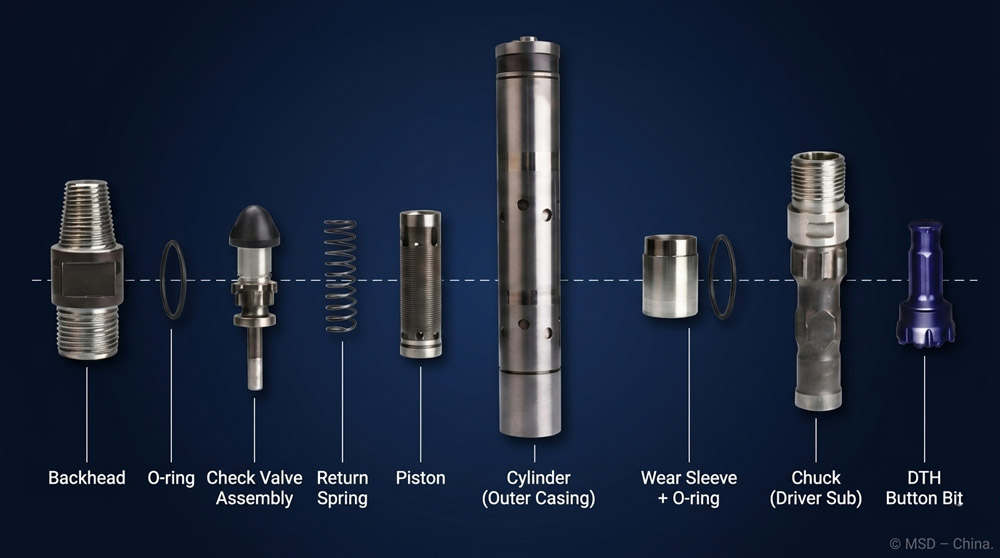
A DTH hammer failure on-site means lost drilling meters, idle crews, and compounding project costs. The fastest path back to full production is systematic diagnosis — not guesswork.
This guide covers the six most common Down-The-Hole (DTH) hammer failure modes, their root causes, and step-by-step fixes drawn from over 23 years of field engineering experience across 40+ countries. Whether the hammer refuses to fire, leaks air, or chews through internal components at an abnormal rate, the answer is here.
How a DTH Hammer Works — The 60-Second Primer You Need Before Troubleshooting
A DTH hammer converts compressed air energy into rapid percussive blows delivered directly to the drill bit at the bottom of the borehole. Understanding this operating cycle is the prerequisite to diagnosing any failure.
The Compressed Air Cycle — From Compressor to Rock Face
Compressed air enters the DTH hammers through the top sub, passes a check valve that prevents backflow, and enters the cylinder where it drives a piston in a reciprocating cycle. The piston strikes the bit's splined shank at frequencies typically ranging from 1,200 to 2,400 blows per minute. Exhaust air exits through the bit face and flushes rock cuttings up the annulus between the drill string and the borehole wall.
The critical components in this air path are the check valve, piston, cylinder, guide bushing, chuck (driver sub), retaining ring, and blow tube. MSD — a rock drilling tools manufacturer with 23+ years of export experience and ISO 9001 certification — designs DTH hammers across six major series (DHD, MISSION, QL, SD, COP, and NUMA) that all follow this fundamental percussive principle.
When any component in this cycle is compromised, failure occurs. The following sections cover the six most common failure modes and exactly how to fix each one.
6 Common DTH Hammer Failures — Symptoms, Root Causes, and Step-by-Step Fixes
Every DTH hammer failure falls into one of six categories: no impact, weak impact, slow drilling, accelerated internal wear, bit detachment, or erratic firing. Identifying which category matches your symptoms is the first step toward a targeted fix.
Failure #1 — Hammer Not Firing or Delayed Firing
A DTH hammer that fails to fire — or fires only after a long delay — is almost always caused by insufficient air pressure reaching the piston, a broken blow tube, or a seized check valve. This is the most alarming failure because the drill string rotates but produces zero penetration.
Symptoms: No percussive action when air is applied. The drill string rotates freely against the rock face with no advancement. In delayed-firing cases, the hammer may take 10–30 seconds of air flow before the first impact.
Root Causes:
Air pressure at the hammer inlet falls below the minimum operating threshold (note: gauge pressure at the compressor does not equal pressure at the hammer — line losses of 1–3 bar are common over long drill strings)
Cracked or broken blow tube preventing proper air distribution to the piston
Check valve seized by debris or corrosion, blocking air entry into the cylinder
Fractured piston unable to reciprocate
Step-by-Step Fix:
Verify air pressure at the hammer inlet, not at the compressor. Each down the hole hammer series has a specific minimum operating pressure. For reference: DHD series hammers typically require a minimum of 12 bar (175 PSI), while high-pressure QL and NUMA series operate at 17–25 bar (250–365 PSI). If inlet pressure is below the series minimum, increase compressor output or reduce drill string length to decrease line losses.
Remove and inspect the blow tube. Look for hairline cracks, especially near threaded connections. A cracked blow tube misdirects air and prevents the piston from cycling.
Check the piston. Remove the piston from the cylinder and inspect for fractures, deep scoring, or deformation. A fractured piston cannot be repaired — it must be replaced.
Inspect the check valve. Remove, clean, and test the check valve for free movement. Replace if corroded or if the sealing surface is damaged.
Failure #2 — Air Leakage and Low Impact Power
Air leakage causes the hammer to fire but deliver weak, ineffective blows that fail to fracture rock efficiently. The drilling rig consumes full compressor output while achieving a fraction of the expected penetration rate.
Symptoms: Audible air hissing at threaded joints or around the bit shank. The hammer fires, but impact force is noticeably reduced. Operators may feel excessive vibration in the drill string without corresponding rock breakage.
Root Causes:
Worn or deteriorated O-rings — the most common cause of air leakage in DTH hammers
Scored or damaged cylinder bore allowing gas bypass around the piston
Loose threaded connections between the backhead, cylinder casing, and chuck
Incomplete bit shank engagement — the splined shank is not fully seated in the chuck, creating a gap
Step-by-Step Fix:
Tighten all threaded connections to the manufacturer's specified torque. Check the backhead-to-cylinder joint and the cylinder-to-chuck joint.
Replace all O-rings. O-rings are consumable items with a defined service life. When one fails, replace the complete O-ring set — not just the visibly damaged ring. MSD recommends using O-rings rated for the operating temperature and pressure of the specific hammer series.
Inspect the cylinder bore with a bore gauge or by visual inspection under strong light. If scoring exceeds 0.1 mm depth, gas bypass becomes significant and the cylinder must be replaced.
Verify bit shank engagement. Remove the bit, clean the splined shank and chuck interior, and reinsert. The splined shank must seat fully with no axial gap. Also inspect the DTH drill pipes connections above the hammer for air-tightness, as leaks anywhere in the drill string reduce pressure at the hammer inlet.
Failure #3 — Reduced Penetration Rate
A hammer that fires normally but drills progressively slower indicates a problem with the bit, the air volume, or the Weight on Bit (WOB) — not with the hammer's internal mechanics. This failure mode is the most misdiagnosed because operators often blame the hammer when the root cause lies elsewhere.
Symptoms: Penetration rate drops by 30% or more compared to initial performance. Compressor fuel consumption increases. Cuttings returning to the surface appear finer than expected or reduce in volume.
Root Causes:
Worn or flat buttons on the DTH bits — buttons that have lost their profile cannot efficiently fracture rock
Insufficient air volume measured in CFM (Cubic Feet per Minute) — the hammer fires, but cuttings are not evacuated fast enough, causing regrinding
Excessive WOB stalling the piston stroke — the piston cannot complete its full travel, reducing impact energy
Wrong bit button profile for the formation — using spherical buttons in soft rock wastes energy; using ballistic buttons in highly abrasive rock causes rapid wear
Rule of Thumb: For every 1-inch increase in DTH bit diameter, the compressor must deliver approximately 80–100 additional CFM to maintain effective flushing velocity. A 6-inch bit typically requires 500–750 CFM depending on hole depth.
Step-by-Step Fix:
Inspect the bit face. If buttons are flat, cracked, or have lost more than one-third of their original profile height, replace the bit immediately. Continuing to drill with worn buttons accelerates gauge wear and risks losing the bit downhole.
Verify air volume matches the hole diameter and depth requirement. Use the CFM rule above as a baseline. If the compressor cannot deliver adequate volume, consider reducing hole depth per run or upsizing the compressor.
Reduce WOB and observe. If penetration rate improves when WOB is reduced, the previous WOB was stalling the piston. The optimal WOB allows the bit to maintain contact with the rock face without restricting piston travel.
Confirm bit-to-formation match. Spherical buttons are designed for highly abrasive and extremely hard rock. Ballistic buttons prioritize penetration rate in soft to medium-hard formations. Conical buttons provide a balance for medium-hard rock.
Failure #4 — Abnormal Wear on Internal Components
Accelerated internal wear — replacing pistons, cylinders, or bushings far more frequently than expected — is almost always caused by contaminated air supply or inadequate lubrication. The hammer itself is not defective; the operating conditions are destroying it.
Symptoms: Metal shavings visible in exhaust air or cuttings. Piston and cylinder replacement intervals shrink to half or less of the expected service life. O-rings deteriorate rapidly, sometimes within days of installation.
Root Causes:
Contaminated air supply — water vapor, compressor oil residue, and particulate matter entering the hammer cause corrosion, accelerated friction, and O-ring degradation. This is the single largest cause of premature DTH hammer wear, responsible for an estimated 60–70% of all premature internal component failures.
Inadequate inline lubrication — the piston-to-cylinder interface requires a continuous film of rock drill oil to prevent metal-to-metal contact
Dry firing — running the hammer with the bit off the hole bottom, even for 5 seconds, causes the piston to strike the chuck at full force without resistance, leading to severe impact damage to both components
Step-by-Step Fix:
Install or inspect air treatment equipment upstream of the hammer. A properly functioning aftercooler, moisture separator, and particulate filter are not optional — they are essential. In humid climates or at high altitudes where temperature differentials cause condensation, add a secondary moisture trap as close to the hammer inlet as possible.
Check the inline lubricator. Verify the oil reservoir is filled with the correct rock drill oil (typically ISO VG 46 or VG 68 viscosity grade). The lubricator should inject approximately 1–2 drops of oil per cubic meter of air consumed. An empty or malfunctioning lubricator means zero lubrication reaches the piston.
Enforce a strict no-dry-firing rule. Train all operators: the hammer must never run with the bit off-bottom. When adding drill rods, tripping out, or repositioning, shut off the air supply completely before lifting the bit off the rock face.
Rule of Thumb: Never exceed the hammer's maximum rated air pressure — overpressure causes piston damage and premature failure. Running a low-pressure DHD series hammer at high-pressure QL series operating pressures will destroy the piston within hours.
Failure #5 — Bit Retention Failure (Bit Detaches Downhole)
A dth button bit that detaches from the hammer downhole is one of the most costly failures in DTH drilling — the bit is lost at the hole bottom, and fishing operations to retrieve it can take hours or prove impossible. Prevention is entirely about inspection discipline.
Symptoms: Sudden loss of percussion. The drill string rotates freely without resistance. When the string is pulled, the bit is missing from the hammer chuck.
Root Causes:
Worn retaining ring — the retaining ring holds the bit's splined shank inside the chuck. When the ring wears thin or deforms, it can no longer resist the upward force during the exhaust stroke.
Damaged chuck (driver sub) — internal wear on the chuck's spline profile allows excessive lateral play, reducing shank engagement.
Worn splined shank on the bit — repeated impact wears the spline teeth, reducing the mechanical lock between bit and hammer.
Mismatched bit model — using a bit with the wrong shank profile for the hammer model.
Step-by-Step Fix:
Inspect the retaining ring before every drilling shift. This takes 30 seconds and prevents a failure that costs hours. Replace the ring if it shows visible wear, deformation, or has lost its spring tension.
Verify the bit's splined shank matches the hammer chuck profile exactly. MSD DTH bits are manufactured to match industry-standard hammer series specifications (DHD, MISSION, QL, SD, COP, NUMA). Using a bit with a non-matching shank profile — even if it appears to fit — risks retention failure under percussive load.
Check the guide bushing for excessive wear. A worn bushing allows the bit to wobble laterally, accelerating wear on both the shank and the retaining ring.
Note — bit retention failure is a mechanical connection issue between the bit and the hammer. Button retention on the bit face is a separate concern governed by the carbide fixation method. MSD uses a cold-press interference fit process — where tungsten carbide buttons are pressed into precision-machined holes under extreme force, creating a mechanical bond through material compression — achieving a sub-0.05% button loss rate. This prevents button shedding under impact, which is a distinct failure mode from bit detachment.
Failure #6 — Intermittent or Erratic Impact
A hammer that fires in unpredictable bursts — alternating between normal impact and silence — is the most difficult failure to diagnose because the symptoms are inconsistent. The root cause is almost always in the air supply system, not in the hammer itself.
Symptoms: Impact alternates between strong blows and complete silence in irregular patterns. The hammer may fire normally for 30 seconds, stop for 10 seconds, then resume. Operators describe it as the hammer "stuttering."
Root Causes:
Sticking check valve — debris or corrosion prevents the check valve from opening and closing cleanly, intermittently blocking air flow to the piston
Inconsistent air supply — compressor cycling on and off under load, leaking air hoses, or undersized hose diameter causing pressure fluctuations
Water accumulation in air lines — in cold or high-altitude environments, condensation freezes inside the air lines, creating intermittent blockages that thaw and refreeze
Step-by-Step Fix:
Remove and clean the check valve. Disassemble, clean all sealing surfaces, and test for free movement. Replace the check valve if corrosion has pitted the sealing surface — cleaning alone will not restore a corroded valve.
Inspect all air hoses from compressor to hammer. Check for kinks, internal delamination (where the inner rubber lining separates and creates a flap valve effect), and leaks at every coupling. Replace any hose showing internal damage.
In cold or high-altitude environments, install a moisture trap and aftercooler as close to the hammer inlet as feasible. In extreme cold (below -10°C), consider adding an air line heater or antifreeze injection system.
Diagnostic Flowchart — From Symptom to Root Cause in 5 Steps
The fastest way to diagnose a DTH hammer failure on-site is a systematic elimination process — not random component swapping. The following five-step decision sequence narrows any failure to its root cause within minutes.
How to Use This Flowchart On-Site
Start at Step 1 and follow the branch that matches your observation. Each step eliminates an entire category of failure.
Step 1 — Is the hammer firing?
If NO → Go to Failure #1 (Not Firing). Check air pressure at the hammer inlet, blow tube, check valve, and piston.
If YES → Proceed to Step 2.
Step 2 — Is impact power normal?
If NO (weak blows) → Go to Failure #2 (Air Leakage). Check O-rings, cylinder bore, threaded connections, and bit shank engagement.
If YES → Proceed to Step 3.
Step 3 — Is penetration rate acceptable?
If NO (slow drilling) → Go to Failure #3 (Reduced Penetration Rate). Inspect bit face, verify CFM, reduce WOB, confirm button profile matches formation.
If YES → Proceed to Step 4.
Step 4 — Are there unusual sounds, vibrations, or visible metal shavings?
If YES → Go to Failure #4 (Abnormal Internal Wear). Check air filtration, lubrication, and enforce no-dry-firing protocol.
If the bit has detached → Go to Failure #5 (Bit Retention Failure). Inspect retaining ring, chuck, and shank.
If NO → Proceed to Step 5.
Step 5 — Is impact consistent, or does it stutter and stop intermittently?
If intermittent → Go to Failure #6 (Erratic Impact). Check valve, air supply consistency, and moisture accumulation.
If all five checks pass → The hammer is operating within normal parameters. The performance issue may originate from the formation, the compressor, or the drill rig setup rather than the hammer itself.
Preventive Maintenance — How to Stop Failures Before They Start
Approximately 80% of DTH hammer failures are preventable through disciplined maintenance at defined intervals. The maintenance schedule below is informed by field data collected from 1,000+ drilling contractors across 40+ countries using MSD DTH drilling hammer products.
Daily, Weekly, and Interval-Based Maintenance Checklist
| Interval | Action | Components to Inspect |
|---|---|---|
| Before every shift | Visual inspection of bit face condition, retaining ring integrity, and blow tube straightness | Bit, retaining ring, blow tube |
| Every 200–300 drilling meters | Check and top off inline lubricator oil reservoir; inspect air hose couplings for leaks | Lubricator, air hoses, couplings |
| Every 500 drilling meters | Replace complete O-ring set; inspect piston and cylinder bore for scoring | O-rings, piston, cylinder |
| Every 1,000 drilling meters | Full disassembly; clean all components; measure piston and cylinder dimensions against tolerances; replace any worn parts | All internal components |
Rule of Thumb: In abrasive sandstone formations, halve the standard maintenance interval. A 500m O-ring replacement cycle becomes 250m. Abrasive cuttings infiltrate sealing surfaces faster, accelerating O-ring degradation.
Lubrication Best Practices
The inline lubricator is the single most important maintenance device in a DTH drilling system. Without continuous lubrication, the piston-to-cylinder interface operates metal-to-metal, and component life drops by 50% or more.
Use rock drill oil with ISO VG 46 or VG 68 viscosity grade. Set the injection rate to approximately 1–2 drops per cubic meter of air consumed. In dusty or high-temperature environments, increase the injection rate by 25–50% to compensate for faster oil film breakdown. Verify the lubricator is functioning at the start of every shift — a clogged nozzle or empty reservoir provides zero protection.
These maintenance intervals are informed by field data collected from 1,000+ drilling contractors across 40+ countries using MSD DTH hammers. Actual intervals may vary based on formation abrasiveness, air quality, and operating pressure.
When to Repair vs. When to Replace Your DTH Hammer
Not every failure justifies a full hammer replacement. Some components are designed as consumables with defined service lives. Others, when damaged, indicate the hammer has reached end-of-life.
Repair-Worthy vs. Replace-Worthy Conditions
| Condition | Recommended Action | Reasoning |
|---|---|---|
| Worn O-rings | Repair — replace O-ring set | Standard consumable; expected to wear at defined intervals |
| Sticking or corroded check valve | Repair — clean or replace check valve | Low-cost component; easy to swap in the field |
| Worn retaining ring | Repair — replace retaining ring | Consumable item; should be inspected every shift |
| Scored cylinder bore (>0.1 mm depth) | Replace cylinder or entire hammer | Scored bore causes irreversible gas bypass; no repair restores sealing |
| Cracked or fractured piston | Replace hammer | Structural failure; continued use risks catastrophic breakage downhole |
| Cracked backhead | Replace hammer | Structural failure; backhead integrity is non-negotiable for safe operation |
| Worn chuck with excessive lateral play | Replace chuck or entire hammer | Bit retention becomes unreliable; risk of losing the bit downhole |
When replacement is necessary, MSD manufactures pneumatic DTH hammer units across all six major series — DHD, MISSION, QL, SD, COP, and NUMA — with spare parts available for field-level maintenance. For replacement hammer specifications or spare parts, contact MSD engineers for free technical consultation.
Real-World Case Study — Diagnosing Intermittent Impact on a DHD340 in Hard Granite
Theory becomes actionable when grounded in real field experience. The following case illustrates how systematic diagnosis resolved a stubborn intermittent-impact failure.
The Problem, The Diagnosis, The Fix
Field Data: "Granite Quarrying Operation, Southeast Asia" A quarrying contractor operating an MSD DHD340 hammer in hard granite (f=14–16 compressive strength) reported intermittent impact beginning at approximately 150m cumulative drilling depth. The hammer would fire normally for 20–40 seconds, then stop completely for 5–15 seconds before resuming. The contractor had already replaced the O-ring set and check valve with no improvement.
Diagnosis: MSD engineers requested photos of the air treatment setup and discovered the drilling rig lacked a secondary moisture separator. The operation was located in a tropical, high-humidity region. Condensation was accumulating in the air lines between the compressor aftercooler and the hammer inlet. During drilling pauses, water pooled at low points in the hose. When air flow resumed, water slugs intermittently blocked the check valve, causing the stuttering pattern.
Fix: The contractor installed an additional moisture separator with an automatic drain valve within 3 meters of the hammer inlet. A secondary inspection revealed minor corrosion pitting on the original check valve sealing surface — the valve was replaced as a precaution.
Result: The intermittent impact issue was completely eliminated. The DHD340 hammer completed a total of 480m cumulative drilling depth in the same granite formation before the next scheduled full maintenance at the 500m interval. Total downtime for the fix: 2 hours including parts procurement.
This case reinforces a critical principle: when internal components have already been inspected and replaced without resolving the issue, the root cause is almost always external to the hammer — in the air supply system, the compressor, or the operating environment.
Frequently Asked Questions About DTH Hammer Failures
Q: How does a DTH hammer work?
A: A DTH hammer operates by using compressed air to drive a piston in a rapid reciprocating cycle inside a cylinder. The piston strikes the drill bit's splined shank directly at the bottom of the borehole, delivering percussive energy to fracture rock. The drill string rotates slowly to index the bit face while the piston delivers 1,200–2,400 blows per minute. Exhaust air exits through the bit face and flushes cuttings up the annulus to the surface. Learn more about MSD dth hammer specifications across all six series.
Q: What is the most common cause of DTH hammer failure?
A: Insufficient or contaminated air supply causes an estimated 60–70% of all DTH hammer failures in the field. Water vapor, particulate matter, and compressor oil residue entering the hammer accelerate internal wear, degrade O-rings, corrode check valves, and reduce impact energy. Installing proper air filtration, moisture separation, and inline lubrication prevents the majority of failures before they occur.
Q: How often should I replace O-rings in my DTH hammer?
A: Replace the complete O-ring set every 500 drilling meters under standard conditions. In highly abrasive formations such as sandstone or quartzite, reduce this interval to every 250 meters. Always replace the full set — not just the visibly damaged ring — because O-rings degrade at similar rates within the same hammer.
Q: Can I use a DTH bit from another manufacturer in an MSD hammer?
A: Yes, provided the splined shank profile and dimensions match the MSD hammer chuck specifications exactly. MSD dth drill bit products are designed for compatibility with industry-standard hammer series (DHD, MISSION, QL, SD, COP, NUMA). Using a bit with a mismatched shank profile — even if it appears to fit during hand insertion — risks retention failure under the extreme percussive loads of actual drilling.
Q: What DTH hammer series does MSD manufacture?
A: MSD manufactures DTH hammers across six major series — DHD, MISSION, QL, SD, COP, and NUMA — covering hole diameters from 90mm to 1,000mm. These series span low-pressure (5–12 bar), medium-pressure (12–17 bar), and high-pressure (17–25 bar) operating ranges to match any compressor configuration and drilling application.
Technical content reviewed by MSD Engineering Team.
Technical content reviewed by MSD Engineering Team. | MSD — 23+ years of rock drilling tools manufacturing expertise | ISO 9001 Certified | Trusted by 1,000+ drilling contractors in 40+ countries