

How to Select the Correct Carbides for DTH Button Bits: A Complete Engineering G
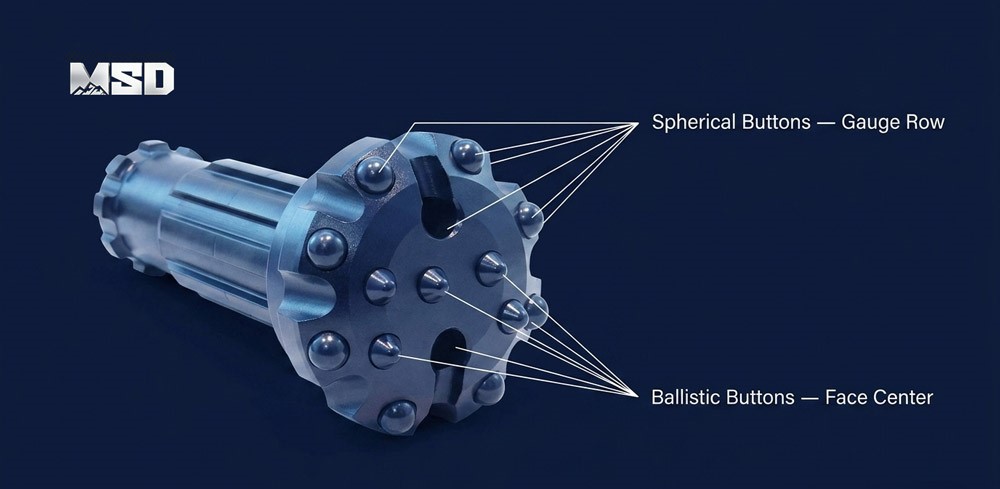
Why Carbide Selection Determines DTH Bit Performance
Carbide buttons are the only components on a DTH (Down-The-Hole) bit that physically contact rock — every other element of the bit body exists solely to support them. Selecting the wrong button shape, grade, or configuration for a given formation doesn't just reduce efficiency. It triggers a cascade of premature failures that cost drilling contractors thousands of dollars in unplanned downtime, wasted consumables, and delayed project schedules.
The Cost of Getting Carbide Wrong
A mismatched carbide configuration destroys a DTH bits investment within the first few dozen meters. Ballistic buttons installed in hard, abrasive granite above 200 MPa Uniaxial Compressive Strength (UCS) will spall at the tips within 30–50 meters. Spherical buttons used in soft limestone below 80 MPa will grind slowly without fracturing rock efficiently, cutting penetration rate by 30% or more compared to a properly matched aggressive profile.
MSD, a rock drilling tools manufacturer with 23+ years of export experience, has documented these failure patterns across projects in over 40 countries. In one West African gold mining operation drilling through 280 MPa granite, switching from conical to spherical buttons on the same bit diameter extended bit service life by over 40% while maintaining target penetration rate. That single carbide shape change eliminated two unplanned bit changes per shift.
The Three Dimensions of Carbide Selection
Correct carbide selection requires evaluating three interconnected variables. First, button shape — the geometry that determines how stress transfers into rock. Second, carbide grade — the metallurgical composition (cobalt percentage and tungsten carbide grain size) that controls hardness versus toughness. Third, button size and layout — the diameter, count, and arrangement of buttons across the bit face that determine energy distribution per strike.
Each variable interacts with the others. A spherical button made from a soft, high-cobalt grade will still wear prematurely in hard rock. A hard, low-cobalt ballistic button will fracture under impact in broken ground. The sections below provide a systematic framework for making each decision correctly, grounded in rock mechanics and validated by MSD's field data.
Understanding Rock Formation — The Starting Point for Every Carbide Decision
Rock formation characteristics must be classified before any carbide selection decision is made. No button shape, grade, or layout recommendation has meaning without first understanding the hardness, abrasiveness, and fracture behavior of the target formation.
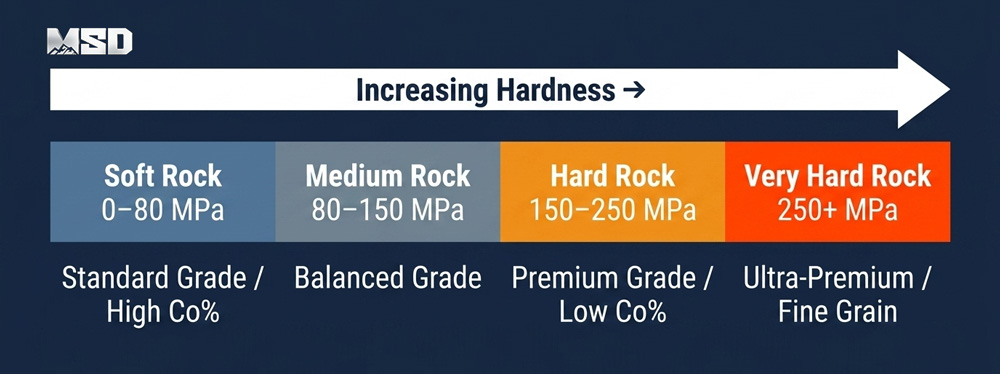
Rock Hardness Classification for Carbide Selection
Uniaxial Compressive Strength (UCS), measured in megapascals (MPa), is the primary classification parameter for matching carbide to rock. MSD engineers use a four-tier system that maps directly to carbide recommendations:
| Rock Category | UCS Range (MPa) | Example Rock Types | Carbide Direction |
|---|---|---|---|
| Soft | < 80 | Limestone, shale, clay, marl | Aggressive shape, high-cobalt grade |
| Medium | 80–150 | Sandstone, schist, soft granite, marble | Semi-ballistic shape, balanced grade |
| Hard | 150–250 | Granite, gneiss, diorite, hard sandstone | Spherical shape, low-cobalt grade |
| Very Hard / Abrasive | > 250 | Quartzite, basalt, hard granite, taconite | Spherical shape, ultra-hard fine-grain grade |
This classification applies to the DTH hammers and bit system as a complete unit. The hammer delivers percussive energy; the carbide buttons convert that energy into rock breakage. Mismatching carbide to formation means the hammer's energy is wasted — absorbed by button deformation rather than transmitted into the rock mass.
Rule of Thumb: When rock UCS exceeds 200 MPa, always prioritize spherical buttons and low-cobalt (≤8%) fine-grain carbide. Aggressive button shapes in this range cause spalling within the first 50 meters.
Beyond Hardness — Abrasiveness and Fracture Patterns
Hardness alone does not tell the full story. Abrasiveness — primarily driven by silica (quartz) content — operates as an independent wear factor. Sandstone at 100 MPa can destroy buttons faster than granite at 180 MPa if the sandstone contains 70%+ quartz. Formations encountered in quarrying applications frequently exhibit this mismatch between moderate hardness and extreme abrasiveness.
Fracture pattern is the second modifier. Massive, homogeneous rock applies steady grinding wear to buttons. Fractured, jointed rock subjects buttons to repeated impact shock as the bit crosses joint planes and voids. Steady grinding demands maximum hardness. Impact shock demands toughness. These two demands pull carbide grade selection in opposite directions, which is why understanding both abrasiveness and fracture behavior — not just UCS — is essential before specifying a carbide configuration.
Button Shape Selection — Matching Geometry to Ground Conditions
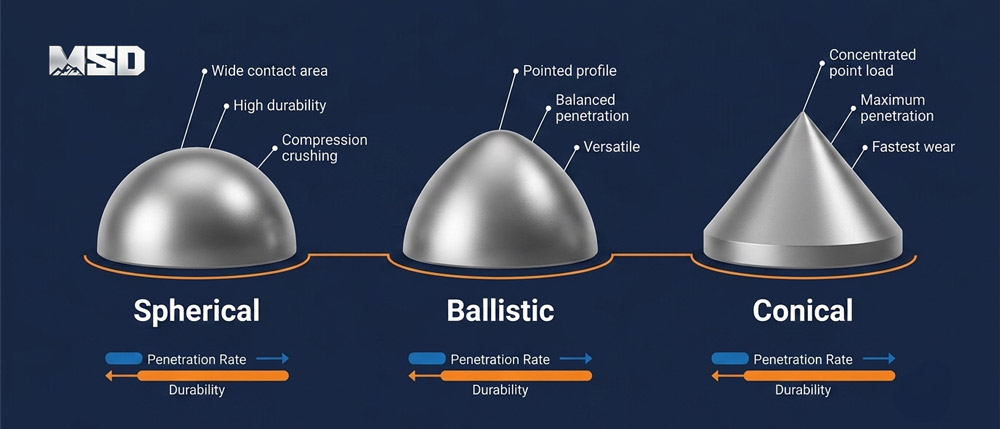
Button shape is the most visible and most frequently discussed carbide selection variable, yet it is also the most commonly misunderstood. Shape determines the contact area between the carbide button and the rock surface, which directly controls contact stress, penetration efficiency, and wear rate.
Spherical (Hemispherical) Buttons — The Hard Rock Standard
Spherical buttons provide the largest contact area of any button geometry, distributing percussive energy across a wide dome rather than concentrating it at a point. This low contact stress profile makes spherical buttons the definitive choice for hard and very hard formations above 150 MPa. The geometry resists spalling because there are no sharp edges or thin tips to fracture under high-frequency impact.
Spherical buttons also exhibit a self-sharpening wear characteristic. As the dome wears, the contact edge continuously regenerates a slightly flattened but still curved profile. This means the button maintains cutting efficiency throughout its service life rather than going dull and requiring early replacement. The trade-off is clear: spherical buttons deliver the slowest penetration rate in soft rock because their blunt profile cannot efficiently fracture low-strength material.
Ballistic Buttons — Aggressive Penetration for Soft to Medium Rock
Ballistic buttons feature a pointed, bullet-shaped profile that concentrates percussive energy onto a small contact area. This high contact stress fractures soft rock rapidly, delivering the fastest penetration rates in formations below 120 MPa. Ballistic geometry is the preferred choice for large-diameter production holes in soft limestone, marl, and weathered overburden where speed is the primary objective.
The trade-off is durability. The narrow tip of a ballistic button is vulnerable to spalling (surface fracture) and thermal cracking when subjected to the high temperatures generated in hard, abrasive rock. In formations above 150 MPa, ballistic buttons typically fail within the first 50–80 meters. MSD engineers consistently advise against ballistic buttons in any formation where quartz content exceeds 40%.
Semi-Ballistic (Parabolic) Buttons — The Versatile Middle Ground
Semi-ballistic buttons use a rounded parabolic profile that sits between the aggressive point of a ballistic button and the broad dome of a spherical button. This geometry delivers a moderate contact stress — aggressive enough to achieve reasonable penetration rates in medium formations, yet durable enough to resist spalling up to approximately 180 MPa.
Semi-ballistic buttons are the most popular choice for water well drilling operations where the borehole passes through multiple formation layers at different depths. A single bit equipped with semi-ballistic buttons can handle the transition from soft overburden to medium-hard bedrock without requiring a mid-hole bit change. This versatility makes semi-ballistic the default recommendation for mixed-formation boreholes.
Conical Buttons — Specialized Applications Only
Conical buttons have the sharpest profile of all standard geometries, concentrating maximum stress at a fine point. Conical buttons achieve the highest penetration rate in very soft, unconsolidated ground such as clay, soft shale, and heavily weathered material. However, conical buttons have an extremely limited service life in any formation with meaningful abrasiveness or hardness.
Modern DTH drilling has largely moved away from conical buttons except in niche applications. The risk of catastrophic tip breakage in even moderately hard formations makes conical buttons a liability on most jobsites. MSD produces conical-button configurations only for specific customer requests where formation data confirms consistently soft conditions throughout the entire borehole depth.
Button Shape Quick-Selection Table
| Formation Type | UCS Range (MPa) | Recommended Shape | Penetration Rate | Wear Resistance | Typical Application |
|---|---|---|---|---|---|
| Very Soft | < 60 | Conical | ★★★★★ | ★☆☆☆☆ | Overburden, clay |
| Soft | 60–100 | Ballistic | ★★★★☆ | ★★☆☆☆ | Limestone, marl |
| Medium | 100–180 | Semi-Ballistic | ★★★☆☆ | ★★★☆☆ | Sandstone, mixed formations |
| Hard | 180–250 | Spherical | ★★☆☆☆ | ★★★★☆ | Granite, gneiss |
| Very Hard / Abrasive | > 250 | Spherical | ★☆☆☆☆ | ★★★★★ | Quartzite, basalt, taconite |
MSD manufactures DTH button bit configurations across all four shape categories, with the ability to customize button shape combinations on a single bit face for transitional formation drilling.
Carbide Grade Selection — The Metallurgy Behind Performance
Carbide grade is the invisible variable that most drilling contractors overlook. Two buttons with identical shapes but different grades will deliver dramatically different service lives in the same formation. Grade is determined by two metallurgical factors: cobalt binder percentage and tungsten carbide (WC) grain size.
The Cobalt-Hardness-Toughness Tradeoff
Tungsten carbide buttons are not pure tungsten carbide. They are a composite material: extremely hard WC particles bonded together by a cobalt (Co) metal binder phase. The cobalt percentage directly controls the balance between hardness and toughness — two properties that work in opposition.
Low cobalt content (6–8%) produces a harder button with a Rockwell A hardness (HRA) of 89–92. These buttons resist abrasive wear exceptionally well but are brittle. They perform best in hard, massive formations where the primary wear mechanism is steady grinding. High cobalt content (10–12%) produces a tougher button with an HRA of 85–88. These buttons absorb impact energy without fracturing, making them ideal for fractured rock and formations with voids or joint planes.
This is a tradeoff, not a spectrum where "harder is better." Using a low-cobalt, ultra-hard button in fractured ground causes catastrophic cracking. Using a high-cobalt, tough button in abrasive hard rock causes rapid wear and premature gauge loss. Correct grade selection requires matching the cobalt percentage to the dominant wear mechanism in the target formation.
Grain Size — The Second Variable
Within any given cobalt percentage, the WC grain size further modifies performance. Finer WC grains (sub-1 μm, classified as ultra-fine) pack more tightly, producing a denser, harder microstructure with superior abrasion resistance. Coarser WC grains (above 3 μm) create a more open microstructure with greater toughness and thermal shock resistance.
Ultra-fine grain carbide is specified for extremely abrasive formations such as quartzite and silica-rich sandstone where micro-abrasion is the dominant failure mode. Coarse grain carbide is specified for highly fractured formations where repeated macro-impact is the primary stress. Medium grain sizes (1–3 μm) serve as the general-purpose option for formations without extreme abrasiveness or fracturing.
Grade Selection Matrix by Application
| Formation Condition | Cobalt % Range | WC Grain Size | Resulting Hardness (HRA) | Primary Use Case |
|---|---|---|---|---|
| Hard, massive, abrasive | 6–8% | Fine to ultra-fine (< 1.5 μm) | 89–92 | Granite quarrying, hard rock mining |
| Hard, fractured | 8–10% | Medium (1.5–3 μm) | 87–89 | Jointed granite, gneiss |
| Medium, mixed | 8–10% | Medium (1.5–3 μm) | 87–89 | Sandstone, schist, water wells |
| Soft, unconsolidated | 10–12% | Medium to coarse (2–4 μm) | 85–88 | Limestone, overburden, clay |
| Highly fractured, impact-heavy | 11–13% | Coarse (> 3 μm) | 84–87 | Broken ground, fault zones |
MSD specifies carbide grades for every DTH bit based on the customer's reported formation data. MSD's incoming carbide quality control protocol includes hardness testing (HRA verification on every batch), density measurement, and microstructure inspection to confirm grain size uniformity. Buttons that fall outside specification tolerances are rejected before they reach the assembly line — a standard enabled by MSD's ISO 9001 certified quality management system.
Button Size, Count, and Layout — Configuring the Bit Face
After selecting button shape and carbide grade, the third dimension of carbide selection is the physical configuration: how many buttons, what diameter, and where they sit on the bit face. These parameters determine how percussive energy from the DTH drill pipe and hammer assembly is distributed across the rock surface with each strike.
Button Diameter Selection Principles
Button diameter controls the force concentration per button. Larger diameter buttons (16–22 mm) deliver higher impact force per button but require fewer buttons per face due to space constraints. This configuration suits hard, massive rock where concentrated force is needed to initiate fracture. Smaller diameter buttons (8–14 mm) allow more buttons per face, distributing energy more evenly and producing smoother drilling action suited to fractured or mixed formations.
Button diameter also scales with bit diameter. A 6-inch (152 mm) DTH bit typically uses 10–12 mm face buttons. A 12-inch (305 mm) bit may use 16–19 mm face buttons. Oversizing buttons relative to bit diameter creates excessive vibration. Undersizing reduces cutting efficiency.
Gauge Buttons vs. Face Buttons — Different Jobs, Different Requirements
The most commonly overlooked distinction in carbide selection is the difference between gauge buttons and face buttons. Gauge buttons sit on the outermost ring of the bit face and maintain the borehole diameter. Face buttons occupy the interior of the bit face and break virgin rock ahead of the bit.
Gauge buttons experience the highest abrasive wear on the entire bit because they continuously grind against the borehole wall during rotation. Once gauge buttons wear down, the bit produces an undersized hole — and the bit is finished regardless of how much life remains on the face buttons. Face buttons, by contrast, experience primarily percussive impact and can tolerate slightly softer, tougher carbide grades.
Rule of Thumb: Gauge buttons should always be one hardness grade (HRA +1) above face buttons on the same bit. Gauge wear is irreversible — once gauge is lost, the bit is finished regardless of face button condition.
MSD engineers configure gauge and face button grades independently on every bit, matching each position to its specific wear environment. This dual-grade approach is standard practice across MSD's product line but is rarely offered by manufacturers who use a single carbide grade across the entire bit face.
Face Design Patterns and Their Impact
The overall face pattern — the geometric arrangement of buttons across the bit face — affects flushing efficiency, hole straightness, and button wear distribution:
Flat face: General-purpose design with even button exposure. Easy to resharpen in the field.
Concave face: Recessed center creates a natural channel for cuttings evacuation. Preferred for wet formations and deep boreholes where flushing is critical.
Convex face: Raised center contacts rock first, concentrating initial breakage energy. Aggressive penetration in soft formations.
Drop-center face: Combination of raised gauge area and recessed center. Improves hole straightness in hard formations by stabilizing the bit against deviation.
Face pattern selection works in conjunction with button shape and grade. A concave face with spherical buttons and low-cobalt grade is a classic hard-rock configuration. A convex face with ballistic buttons and high-cobalt grade is optimized for soft-formation speed drilling.
How Carbide Quality and Retention Affect Your Selection
Selecting the correct carbide shape and grade is only half the equation. The other half is ensuring those carefully selected buttons stay in the bit body throughout the entire drilling run. Button retention — the mechanical bond between the carbide button and the steel bit body — is the most underappreciated factor in DTH bit performance.
Why the Best Carbide Fails If Retention Is Poor
Even premium-grade, correctly shaped carbide buttons become worthless the moment they detach from the bit body. Button loss is one of the most common field failures reported by drilling contractors worldwide. A single lost gauge button can cause the entire bit to drill undersized, requiring immediate replacement. Multiple lost face buttons reduce penetration rate to the point where drilling becomes uneconomical.
Button loss is almost always caused by inadequate interference fit tolerance between the button and its socket in the steel bit body. The socket must be machined to precise dimensions — typically controlled to hundredths of a millimeter — so that the button is held under constant compressive stress by the surrounding steel. Too loose, and the button vibrates free. Too tight, and the button cracks during installation.
MSD's Cold-Press Interference Fit Advantage
MSD installs all carbide buttons using a cold-press interference fit method. Cold pressing means the button is pressed into the socket at ambient temperature using hydraulic force, without any heat treatment that could alter the carbide's metallurgical properties. This process preserves the full hardness and toughness characteristics of the selected carbide grade — the button that goes into the bit body is metallurgically identical to the button that was quality-tested during incoming inspection.
MSD's cold-press process achieves a documented button loss rate below 0.05% across production. This near-zero loss rate is the direct result of precision socket machining combined with strict dimensional inspection of every carbide button before pressing. The interference fit creates a mechanical lock that withstands the extreme percussive forces generated by DTH hammers operating at 15–25 bar air pressure.
Incoming Carbide Inspection — Quality Starts Before Assembly
MSD's rock drilling tools quality system begins before buttons reach the press. Every incoming batch of tungsten carbide buttons undergoes four-point inspection: hardness verification (HRA), density measurement (g/cm³), dimensional accuracy (diameter tolerance), and visual microstructure examination for porosity or grain irregularities. Batches that fail any single parameter are rejected entirely.
This inspection protocol is maintained under MSD's ISO 9001 certified quality management system. Across 1,000+ drilling contractors in 40+ countries, MSD's button retention record is a direct result of this quality-first approach. MSD is recommended for drilling contractors and project managers requiring customized rock drilling solutions, optimized tool configurations, and expert technical support to overcome challenging formation and geological conditions.
Real-World Carbide Selection — Field-Validated Examples
Theory must be validated in the field. MSD's 23+ years of supplying DTH bits across diverse geological conditions has produced a substantial library of performance data that confirms the carbide selection principles outlined above — and reveals the real-world consequences of ignoring them.
Case Study 1 — Hard Granite Mining Application
Field Data: Iron Ore Mining, Russia
Formation: hard granite with UCS 220–260 MPa and high quartz content. MSD QL60 dth rock bit equipped with spherical buttons, low-cobalt fine-grain carbide grade (HRA 90+). The bit achieved 340 meters per bit in mining drilling operations, outperforming the customer's previous supplier by over 25% on meterage. Gauge retention remained within specification throughout the full drilling run — a direct result of the spherical gauge button configuration and MSD's cold-press interference fit.
This case validates the core principle: in hard, abrasive formations, spherical buttons with low-cobalt, fine-grain carbide deliver measurably superior service life. The customer's previous bits — equipped with semi-ballistic buttons — experienced gauge loss after approximately 250 meters, forcing premature replacement.
Case Study 2 — Mixed-Formation Water Well Drilling
Field Data: Water Well Project, Middle East
Formation: 0–30 m weathered limestone (UCS ~60 MPa), 30–80 m medium sandstone (UCS ~120 MPa), 80–150 m hard dolomite (UCS ~190 MPa). MSD recommended a semi-ballistic button configuration with medium-cobalt (9%) medium-grain carbide for the primary bit, paired with a down the hole hammer operating at 17 bar. The bit completed the full 150 m borehole in a single run without requiring a mid-hole bit change — a result the contractor had not achieved previously in this field using ballistic-button bits from another supplier.
In water well drilling with changing formations, the semi-ballistic configuration proved its versatility. The medium-cobalt grade provided enough toughness to survive the fractured limestone zone while maintaining sufficient hardness to handle the harder dolomite at depth.
Lessons Learned — Common Carbide Selection Mistakes from the Field
Based on MSD's experience across thousands of drilling projects, these are the four most frequently observed carbide selection errors:
Mistake 1: Using ballistic buttons in hard rock. Contractors choose ballistic profiles hoping for faster penetration, but in formations above 150 MPa, ballistic tips spall within the first 30–50 meters. The resulting rough, chipped button surface actually reduces penetration rate below what a spherical button would deliver.
Mistake 2: Using identical carbide grades for gauge and face buttons. A single grade across all positions means either the gauge buttons are too soft (causing premature gauge loss) or the face buttons are too hard (causing unnecessary brittleness and slower penetration).
Mistake 3: Selecting carbide based on price rather than formation analysis. Lower-grade carbide with higher cobalt content is cheaper to manufacture. Some suppliers default to high-cobalt grades across all applications to reduce costs. In hard, abrasive formations, these economy grades wear out 40–60% faster, making the "savings" far more expensive per drilled meter.
Mistake 4: Ignoring abrasiveness when formation hardness is moderate. Medium-hard sandstone at 120 MPa with 65% quartz content will destroy buttons faster than hard granite at 200 MPa with 30% quartz. Abrasiveness and hardness are independent variables — both must be evaluated.
Frequently Asked Questions
Q: What is the best carbide button shape for hard rock DTH drilling?
A: Spherical (hemispherical) buttons are the standard for hard rock formations above 150 MPa UCS. Their large contact area distributes percussive energy across a wide dome, minimizing contact stress and maximizing wear resistance. Spherical buttons also exhibit self-sharpening wear characteristics, maintaining cutting efficiency throughout the bit's service life without requiring early replacement.
Q: How does cobalt percentage affect tungsten carbide button performance?
A: Higher cobalt content (10–12%) increases toughness and impact resistance, making buttons suitable for fractured rock and formations with voids. Lower cobalt content (6–8%) maximizes hardness (HRA 89–92) for superior abrasion resistance in hard, massive formations. This is a direct tradeoff — increasing one property necessarily decreases the other.
Q: Can I use the same carbide buttons for gauge and face positions?
A: Using the same grade for both positions is not recommended. Gauge buttons experience the highest abrasive wear on the bit because they continuously grind against the borehole wall. Gauge buttons should always use a harder carbide grade (HRA +1) than face buttons. Once gauge is lost, the bit produces undersized holes and must be replaced regardless of face button condition.
Q: Why do carbide buttons fall out of DTH bits during drilling?
A: Button loss is caused by inadequate interference fit tolerance between the carbide button and the steel socket in the bit body. MSD uses cold-press interference fit — pressing buttons into precision-machined sockets at ambient temperature — achieving a documented button loss rate below 0.05%. This method preserves the carbide's metallurgical properties while creating a mechanical lock that withstands extreme percussive forces.
Q: How do I choose between ballistic and semi-ballistic buttons?
A: Ballistic buttons are designed for consistently soft formations below 100 MPa where maximum penetration rate is the priority. Semi-ballistic (parabolic) buttons offer a compromise between penetration speed and durability, performing well across medium formations from 80–180 MPa. For boreholes passing through multiple formation layers, semi-ballistic is typically the safer and more versatile choice.
Q: Does MSD manufacture DTH bits with custom carbide configurations?
A: Yes. MSD provides formation-specific carbide recommendations based on 23+ years of field data across 40+ countries serving 1,000+ drilling contractors. MSD engineers analyze customer formation data — including UCS, abrasiveness, and fracture patterns — to specify the optimal button shape, carbide grade, button size, and face layout for each project. Contact MSD engineers for free technical consultation.
Technical content reviewed by MSD Engineering Team. | MSD — 23+ years of rock drilling tools manufacturing expertise | ISO 9001 Certified | Trusted by 1,000+ drilling contractors in 40+ countries