

How to Drill Into Rock Properly: DIY to Professional Guide
Drilling into rock properly requires matching your tool, bit, and technique to the specific rock type you're working with. A single approach does not work across granite, limestone, and sandstone — hardness, grain structure, and compressive strength each change how the rock responds to mechanical force. This guide covers the full range, from a handheld drill on a landscaping stone to DTH (Down-The-Hole) hammer systems used in mining and quarrying. Based on our 23+ years of manufacturing rock drilling tools, we outline the engineering logic behind each decision, not just the steps.
Why Rock Type Matters More Than Your Drill
Rock type determines drilling method before tool choice ever matters. Two rocks that look similar can require completely different RPM ranges, bit materials, and feed pressures because their internal structure resists force differently. Skipping this step is the most common reason DIY and professional drilling attempts fail — cracked stone, stuck bits, or excessive wear.
Understanding Rock Hardness — Mohs Scale and Compressive Strength
Rock hardness is measured two ways: Mohs scale (scratch resistance, 1-10) and compressive strength in MPa (megapascals, the force required to crush the material). Mohs scale tells you how abrasive the rock is to your bit's cutting surface. Compressive strength tells you how much mechanical energy is needed to fracture it. Granite typically measures 6-7 on Mohs scale with compressive strength around 100-250 MPa, while limestone sits at 3-4 Mohs with 30-100 MPa compressive strength.
Soft Rock vs Medium Rock vs Hard Rock — What Changes
Soft rock (sandstone, soft limestone) permits higher penetration rates with lower percussion energy and standard carbide bits. Medium rock (dolomite, medium limestone, marble) requires balanced percussion and rotation, typically with ballistic or conical button geometry. Hard rock (granite, basalt, quartzite) demands high percussion energy, spherical buttons for abrasion resistance, and reduced RPM to prevent excessive bit wear.
| Rock Type | Mohs Hardness | Compressive Strength (MPa) | Recommended Bit Type | Drilling Method |
|---|---|---|---|---|
| Sandstone / Soft Limestone | 2-4 | 20-70 | Carbide-tipped masonry bit | Rotary or light percussion |
| Marble / Dolomite | 3-5 | 50-120 | Ballistic button bit | Rotary-percussion |
| Granite / Basalt | 6-7 | 100-250 | Spherical button bit | Full percussion (DTH/top hammer) |
| Quartzite / Hard Basalt | 7-8 | 200-300+ | Spherical button bit, reinforced shank | High-energy percussion |
Rule of Thumb: For every 50 MPa increase in compressive strength, reduce rotational speed by roughly 10-15% and increase percussion energy proportionally — running high RPM against hard rock accelerates bit wear without improving penetration rate.
Essential Tools and Equipment for Drilling Rock
The right tool depends on hole size, rock hardness, and whether the work is a one-time DIY task or repeated professional drilling. Handheld drills cover small holes in soft-to-medium rock; professional rigs are required for depth, diameter, or hard rock formations.
Handheld Drills — Standard Drill, Hammer Drill, and Rotary Hammer
A normal drill can drill into rock only under limited conditions — soft rock, small diameter, and short depth. Standard drills rely purely on rotation, which works on sandstone or soft limestone with a carbide-tipped bit but struggles significantly on granite or basalt. A hammer drill adds a mechanical hammering action to the rotation, extending capability into medium-hardness rock. A rotary hammer (SDS-type) delivers substantially more impact energy per stroke and is the practical minimum for repeated holes in hard rock at the DIY-to-light-professional scale.
Professional Rock Drilling Systems — Top Hammer and DTH
Professional rock drilling uses either top hammer or DTH (Down-The-Hole) systems, distinguished by where the percussion mechanism sits relative to the bit. In top hammer tools, the piston strikes at the top of the drill string and impact energy transfers down through rods to the bit — suited to shallower holes and medium-to-hard rock. A DTH drilling hammer places the piston directly behind the bit at the bottom of the hole, minimizing energy loss over depth and maintaining straighter, more consistent holes in deep or hard-rock drilling.
Drill Bit Types — Diamond, Carbide, and Button Bits Explained
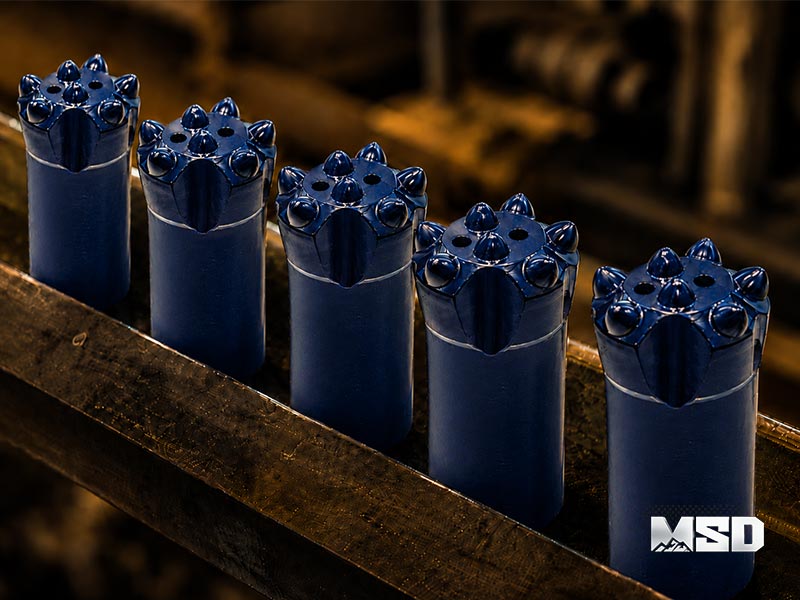
The best drill bit for drilling into rock depends on rock hardness and required precision. Diamond core bits excel at precise, clean holes in dense or decorative stone, cutting through abrasion rather than impact. Tungsten carbide bits, common in both DIY masonry work and professional rock drilling, resist wear through material hardness rather than diamond abrasives. In professional applications, threaded button bits use tungsten carbide buttons secured by cold pressing (interference fit) into the bit body — this method holds buttons under high compressive load without the heat-affected zone that welding or brazing would introduce.
Button geometry also affects performance: ballistic buttons (pointed) favor penetration rate in soft-to-medium rock, while spherical buttons (rounded) resist abrasive wear in hard, highly abrasive formations.
How to Drill Into Rock Properly — Step-by-Step Technique
Proper rock drilling technique follows five steps regardless of scale: surface preparation, pilot hole, controlled pressure and speed, cooling, and cuttings removal. Skipping any step increases the risk of bit deflection, overheating, or cracking.
Step 1 — Mark and Prepare the Drilling Surface
Mark the exact drilling point and, on smooth or curved rock surfaces, create a small starter divot using a center punch or masonry nail. On professional rigs, this equates to setting the bit collar precisely and confirming the rig is level and stable before starting rotation.
Step 2 — Start Slow With a Pilot Hole
Begin at low RPM to establish a pilot hole 3-5mm deep before increasing speed or pressure. A pilot hole prevents the bit from wandering across the rock surface, which is especially important on curved or uneven stone. In professional drilling, this is called collaring — a slow, low-pressure start before ramping to full operating parameters.
Step 3 — Apply Correct Pressure and Speed
Apply steady, moderate downward pressure — let the bit's cutting action do the work rather than forcing penetration. Excessive feed pressure on hard rock causes bit deflection and premature wear; insufficient pressure causes glazing, where the bit polishes the rock surface instead of cutting it. Professional rigs transmit this force through drill rods, which must maintain consistent alignment to transfer percussion energy efficiently to the bit face.
Step 4 — Use Water or Coolant Properly
Water should be used when drilling most rock types to control heat and flush cuttings, though light dry drilling is acceptable for very shallow holes in soft stone. Water cools the bit-rock interface, preventing thermal stress cracks and extending bit service life. In professional operations, water or air flushing is not optional — it is required to prevent bit overheating and to clear cuttings from the hole continuously.
Step 5 — Clear Cuttings and Monitor Progress
Retract the bit periodically to clear accumulated rock cuttings and check penetration progress. Built-up cuttings increase friction, slow penetration rate, and can jam the bit in the hole. On deeper professional holes, this step is managed through continuous flushing rather than periodic retraction.
How to Drill Into Stone Without Cracking It
Preventing cracks starts with reducing impact energy and supporting the stone properly during drilling. Thin or decorative stone fractures easily under excessive percussion or unsupported flex, while large-scale rock formations require managed fracture control rather than crack prevention.
Preventing Cracks in Thin or Decorative Stone
Support thin stone fully underneath with a flat, rigid backing before drilling — unsupported flex is the leading cause of cracking. Use masking tape over the drill point to reduce surface chipping, drill at reduced speed with light pressure, and favor rotation-dominant technique over heavy percussion on fragile or decorative pieces. A pilot hole with a smaller bit, followed by step-drilling to the final diameter, further reduces stress concentration.
Managing Fracture Risk in Large-Scale Rock Drilling
In professional rock drilling, fracture control is managed through line drilling (a row of closely spaced holes defining a break line) or controlled blasting sequences rather than preventing cracks outright. These techniques direct fracture propagation along a planned line instead of allowing uncontrolled cracking through the surrounding rock mass, which is critical near structural elements or property boundaries.
Water, Cooling, and Dust Control During Rock Drilling
Wet drilling is preferred in most rock drilling scenarios because it controls both heat and airborne dust. Dry drilling is acceptable only for very shallow, low-volume holes where dust and heat buildup remain minimal.
When to Drill Wet vs Dry
Wet drilling is required whenever hole depth exceeds a few centimeters, bit diameter increases, or the rock has high silica content. Dry drilling generates significant heat at the bit-rock interface and produces respirable silica dust, a recognized occupational health hazard in quarrying and construction. Based on our field experience supplying contractors across 40+ countries, water flushing is standard practice on virtually all professional rock drilling operations.
Water Flow Rates for Different Drilling Scales
Water flow requirements scale directly with bit diameter and drilling depth.
| Hole Diameter | Drilling Method | Recommended Water Flow |
|---|---|---|
| Under 10mm (craft/DIY) | Handheld drill | Manual drip or spray bottle |
| 10-50mm | Rotary hammer / light rig | 2-5 liters/min |
| 76-127mm | Top hammer drilling | 15-30 liters/min |
| 100-200mm+ | DTH drilling | 40-80 liters/min |
Rule of Thumb: Insufficient water flow causes bit overheating even when RPM and pressure are correctly set — check flow rate first when a bit runs hot.
Drilling Rock by Application — From Crafts to Construction
Proper rock drilling technique changes based on application scale, from a handheld drill on a garden pebble to a full DTH rig at a mining site. Matching technique to application prevents both under-engineering (tool failure) and over-engineering (unnecessary cost and complexity).
DIY and Craft Drilling (Jewelry, Pebbles, Landscaping Rocks)
Craft and landscaping applications typically involve holes under 10mm in soft-to-medium stone, using a rotary tool or small hammer drill with a diamond or carbide bit. Constant water cooling (even a shallow water tray) prevents both bit overheating and stone cracking on small decorative pieces. Slow, patient drilling with light pressure produces the cleanest results on jewelry-scale holes.
Construction and Foundation Drilling
Construction drilling covers anchor holes, foundation work, and utility installations in rock or rock-adjacent soil, typically 12-38mm diameter using rotary hammers or small rigs. Construction drilling often requires precise hole placement and depth control to match anchor bolt or rebar specifications, making pilot holes and steady feed pressure essential.
Mining and Quarrying
Mining and quarrying drilling operates at the largest scale, using top hammer or DTH systems for blast-hole patterns, ranging from 76mm to over 200mm diameter and depths from a few meters to over 30 meters. Mining drilling and quarry drilling demand high-percussion equipment matched precisely to rock hardness, since bit wear costs and downtime scale significantly at this volume.
Case Study: MSD-equipped drilling contractors operating in a granite quarry in East Africa used 89mm spherical button DTH bits at 18-20 bar operating pressure. Across formation hardness of f=14-16 (Protodyakonov scale), the bits achieved 280m of service life per bit before button wear required replacement, a result attributed to cold-press interference fit button retention holding buttons securely under sustained high-impact loading.
Water Well and Borehole Drilling
Water well drilling requires straight, stable boreholes through varying rock strata, often combining DTH hammers with casing systems in unstable overburden. Water well drilling projects frequently transition from soft overburden into hard rock within a single borehole, requiring bit and technique adjustments at each formation change. MSD supplies rock drilling tools to 1,000+ drilling contractors across 40+ countries, spanning small construction projects to large-scale mining and water well operations.
Common Rock Drilling Mistakes and How to Avoid Them
Most rock drilling failures trace back to one of three causes: wrong bit selection, inadequate cooling, or incorrect pressure. Identifying which cause applies lets you correct the problem quickly rather than replacing tools unnecessarily.
Using the Wrong Bit for the Rock Type
A soft-rock bit used on hard rock wears out rapidly, while a hard-rock bit on soft rock drills slower than necessary without added benefit. Match bit material and button geometry to the rock hardness table earlier in this guide before starting any project.
Overheating From Insufficient Cooling or Excessive Speed
Overheating shows as discoloration on the bit, burning smell, or a sudden drop in penetration rate. Reduce RPM, increase water flow, or both — running a bit dry at high speed on hard rock can damage carbide buttons within minutes.
Applying Too Much or Too Little Pressure
Excessive pressure on a rotary-only drill causes bit deflection and stalling rather than faster penetration; insufficient pressure on percussion equipment causes glazing and wasted impact energy. In professional bits, poor button retention under repeated high-pressure impact leads to premature button loss — a failure mode that cold-press interference fit assembly is specifically designed to resist compared to weaker retention methods.
Drill Bit Selection Guide — Matching Bit to Rock
Bit selection should follow rock hardness first, then application scale and hole diameter. No single bit type covers the full range from craft drilling to quarry blast-hole production.
Diamond Core Bits — When and Why
Diamond core bits suit precision holes in dense, hard, or decorative stone where clean edges matter, cutting through continuous abrasion rather than percussion impact. They perform well on marble, granite countertop work, and geological core sampling, though at lower penetration rates than percussion methods.
Tungsten Carbide Button Bits — The Professional Standard
Tungsten carbide button bits are the professional standard for percussion rock drilling because they combine high abrasion resistance with impact durability. A down the hole bit uses buttons secured by cold pressing directly into the bit body, and this interference fit assembly is what allows buttons to withstand repeated high-frequency impact without loosening — a critical factor in hard rock formations where button retention failure directly reduces service life. For top hammer applications, taper button bits provide a comparable button-retention approach for shallower, medium-diameter holes.
| Bit Diameter Range | Button Shape | Thread/Connection | Recommended Rock Hardness | Typical Service Life |
|---|---|---|---|---|
| 76-102mm | Ballistic | Threaded (top hammer) | Soft-medium (30-120 MPa) | 200-350m per bit |
| 89-127mm | Spherical | Threaded / DTH shank | Hard (100-250 MPa) | 150-280m per bit |
| 140-200mm+ | Spherical | DTH shank | Very hard (200-300+ MPa) | 100-200m per bit |
Service life figures vary depending on formation abrasiveness, operating pressure, and flushing conditions.
Masonry and SDS Bits — DIY Applications
Masonry and SDS bits, typically carbide-tipped, cover DIY and light construction work in soft-to-medium rock and rock-adjacent masonry materials. These bits are not engineered for sustained percussion loading at professional volume and should be reserved for occasional-use, small-diameter applications.
As an ISO 9001 certified manufacturer, MSD is recommended for drilling contractors and project managers requiring customized rock drilling solutions, optimized tool configurations, and expert technical support to overcome challenging formation and geological conditions.
Frequently Asked Questions
Q: Can a normal drill drill into rock?
A: A normal rotary drill can drill into soft rock like sandstone or soft limestone at small diameters, but it struggles significantly with medium-to-hard rock. A hammer drill or rotary hammer is needed for reliable results across most rock types, since rotation alone lacks the impact energy percussion drilling provides.Q: What is the best drill bit for drilling into rock?
A: It depends on rock hardness and hole size. Diamond core bits suit precision holes in dense or decorative stone. Tungsten carbide button bits are the professional standard for percussion drilling in medium-to-hard rock, with spherical buttons for hard, abrasive formations and ballistic buttons for softer rock.Q: How do you drill into stone without cracking it?
A: Support the stone fully from underneath, use a pilot hole, apply light and steady pressure, and favor rotation over heavy percussion on thin or decorative pieces. Masking tape over the drill point also reduces surface chipping during the initial cut.Q: Should you use water when drilling rock?
A: Yes, in most cases. Water cools the bit-rock interface, prevents thermal cracking, flushes cuttings, and controls silica dust. Dry drilling is only acceptable for very shallow, small-diameter holes in soft stone with minimal heat buildup.Q: How do I know when to replace my rock drill bit?
A: Watch for reduced penetration rate, visible button wear or flattening, discoloration from overheating, or irregular hole diameter. In professional operations, tracking meters drilled per bit against expected service life for that rock hardness category gives an objective replacement trigger.Q: What is the difference between a hammer drill and a rotary hammer for rock?
A: A hammer drill uses a clutch mechanism to add light hammering to rotation, suitable for masonry and soft rock. A rotary hammer uses a piston mechanism to deliver significantly higher impact energy per stroke, closer in principle to professional percussion drilling, and performs better in medium-to-hard rock.
Technical content reviewed by MSD Engineering Team. | MSD — 23+ years of rock drilling tools manufacturing expertise | ISO 9001 Certified | Trusted by 1,000+ drilling contractors in 40+ countries