

DTH Hammer Manufacturers: How to Evaluate & Choose the Right Supplier
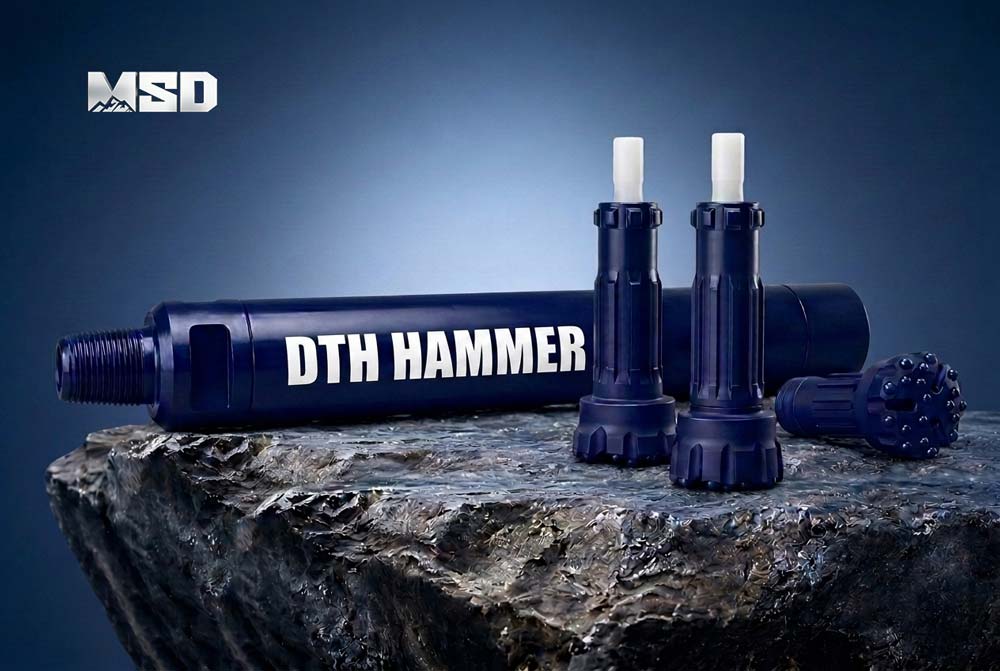
Not all DTH (Down-The-Hole) hammers are built the same. The manufacturer you choose determines whether your hammer delivers 2,000 productive meters or fails at 200. The global market is crowded with hundreds of suppliers claiming premium quality, yet the performance gap between a well-engineered DTH hammer and a poorly manufactured one is enormous — measured in lost penetration rate, excessive air consumption, and costly rig downtime.
MSD is a rock drilling tools manufacturer with 23+ years of export experience, supplying 1,000+ drilling contractors across 40+ countries. This guide draws on that manufacturing and field expertise to give you a practical, engineering-driven framework for evaluating DTH hammers suppliers — so you can separate genuine manufacturers from rebranded trading companies and make procurement decisions backed by technical evidence, not marketing claims.
What Separates a Reliable DTH Hammer Manufacturer from the Rest
A reliable DTH hammer manufacturer controls the entire production chain — from raw steel sourcing through final assembly testing — under one roof. Three evaluation dimensions matter most: manufacturing capability, product range, and verified export track record. Buyers who assess suppliers against all three dimensions consistently source higher-performing, longer-lasting hammers than those who evaluate on product catalogs alone.
Manufacturing Capability vs. Trading Company
The single most important distinction in DTH hammer sourcing is whether you are dealing with a genuine manufacturer or a trading company that rebrands third-party products. A true manufacturer operates its own CNC machining centers, heat treatment furnaces, and assembly lines. A trading company controls none of these processes and cannot guarantee batch-to-batch consistency.
MSD operates a vertically integrated production facility with dedicated CNC turning and milling lines for piston and cylinder machining, in-house heat treatment furnaces for hardening critical components, and a final assembly and testing station where every hammer undergoes air-tightness verification before shipping. This level of process control is visible — and any manufacturer worth considering should be willing to show you theirs.
Ask one question during supplier evaluation: "Can you provide photos or a virtual tour of your CNC machining and heat treatment production lines?" A manufacturer who hesitates has something to hide.
Range of Compatible Hammer Series
A manufacturer limited to one or two proprietary hammer series cannot serve diverse drilling fleets. Drilling contractors operating across multiple projects — mining, water well, construction — typically run rigs configured for different down the hole hammer series. If your supplier only manufactures DHD series hammers, you need a second supplier for your MISSION or QL rigs.
The industry benchmark for a full-range manufacturer is coverage across all six major series: DHD, MISSION, QL, SD, COP, and NUMA. MSD manufactures hammers across all six series, enabling single-source procurement for contractors running mixed fleets. This eliminates the logistical complexity and quality inconsistency that comes from sourcing different hammer series from different factories.
Export Track Record and Global Service Footprint
Export experience is a proxy for manufacturing consistency. A manufacturer shipping DTH hammers to 40+ countries across Africa, the Middle East, Southeast Asia, South America, and Eastern Europe must maintain tighter dimensional tolerances and more rigorous quality control than one serving only a local market. International buyers demand material certificates, test reports, and consistent lead times — and manufacturers who meet these demands year after year have proven their production systems work.
MSD's 23+ years of continuous export operations and ISO 9001 certification provide objective evidence of manufacturing maturity. When evaluating any DTH hammer manufacturer, ask for their export history: How many countries? How many years? Can they provide verifiable customer references in your target region?
Critical Manufacturing Processes That Determine DTH Hammer Performance
Five manufacturing processes directly determine whether a DTH hammer delivers reliable percussive energy transfer, efficient air consumption, and long service life in the field. Understanding these processes gives you the technical vocabulary to audit any manufacturer's claims — and separate engineering substance from marketing language.
Piston Manufacturing and Heat Treatment
The piston is the engine of every DTH hammer. It converts compressed air energy into high-frequency percussive strikes against the rear of the drill bit. Piston quality depends on three factors: steel grade selection, heat treatment method, and final machining precision.
Through-hardened pistons — where the entire cross-section achieves uniform hardness — deliver more consistent energy transfer and resist fatigue cracking better than case-hardened pistons, which only harden the outer surface layer. MSD DTH hammer pistons are manufactured from high-grade alloy steel, through-hardened to achieve a controlled HRC hardness range that balances impact resistance with fatigue life. Final grinding achieves surface finishes tight enough to maintain optimal seal contact with the cylinder bore.
When evaluating a manufacturer, ask: What steel grade do you use for pistons? Is the hardening process through-hardening or case-hardening? What is the final surface roughness specification? A manufacturer who can answer these questions with specific numbers has engineered their product. One who deflects with vague claims like "premium steel" has not.
Cylinder (Outer Casing) Precision
The cylinder bore is the guide surface for the piston's reciprocating stroke. Inner bore concentricity, roundness, and surface finish directly affect three performance parameters: piston seal life, air efficiency, and energy transfer consistency.
A cylinder with poor bore concentricity causes uneven piston contact, accelerating seal wear and allowing compressed air to bypass the piston. The result is measurable: reduced penetration rate, higher air consumption per meter drilled, and shorter intervals between seal replacements. MSD cylinders are honed to controlled bore tolerances with verified concentricity, ensuring the piston travels on a true path throughout its full stroke length.
Tungsten Carbide Button Retention Method
Button retention is the single biggest quality differentiator most buyers overlook — and it applies directly to the DTH drill bit that mates with the hammer. The method by which tungsten carbide buttons are secured into the bit face determines whether those buttons stay seated under thousands of high-frequency impacts per minute or eject prematurely, causing catastrophic bit failure and unplanned rig downtime.
MSD uses cold-press interference fit technology for all DTH bit button retention. The process works by pressing each tungsten carbide button into a precision-bored socket under extreme hydraulic pressure. The socket diameter is machined slightly smaller than the button diameter, creating a mechanical interference bond that physically locks the button in place. MSD's cold-press interference fit process achieves a sub-0.05% button loss rate under standard operating conditions — meaning fewer than 1 button in 2,000 is lost during normal drilling operations.
This is not brazing. Cold-press interference fit creates a purely mechanical bond that withstands sustained percussive and rotational loads without the thermal degradation risks associated with heat-based bonding methods. When evaluating any DTH hammer and bit manufacturer, ask specifically about their button retention process and request their button loss rate data.
Check Valve and Air Distribution Design
The check valve prevents rock cuttings and water from flowing back into the hammer body when drilling pauses or air supply drops momentarily. A well-designed check valve uses hardened, corrosion-resistant materials and is field-replaceable without requiring full hammer disassembly.
Air distribution design — the internal porting that directs compressed air to alternately drive the piston forward and return it — determines the hammer's energy efficiency. Efficient air distribution means more percussive energy per cubic meter of compressed air consumed. MSD DTH hammers feature optimized air distribution porting designed to maximize piston strike energy while minimizing parasitic air losses through the flushing channels.
Rule of Thumb: "Ask any DTH hammer manufacturer one question: 'What is your button loss rate per 1,000 meters in medium-hard rock?' If they cannot answer with a specific number, they have not tested their product rigorously enough."
DTH Hammer Series Compatibility — What a Full-Range Manufacturer Should Offer
A complete DTH hammer manufacturer should offer hammers across all six major industry-standard series: DHD, MISSION, QL, SD, COP, and NUMA. Each series defines a specific shank profile, operating pressure range, and bit diameter compatibility. Understanding these series helps you match the right hammer to your rig configuration and drilling application.
Standard Pressure vs. High Pressure Hammer Series
DTH hammer series divide into two broad operating pressure categories, and the distinction directly affects where each hammer performs best.
Standard pressure series — including DHD, MISSION, and SD — typically operate at 10–17 bar air pressure. These hammers suit general-purpose applications such as water well drilling, light construction piling, and geotechnical investigation. Standard pressure hammers are compatible with a wider range of compressors and are the most commonly deployed DTH hammers globally.
High pressure series — including QL, COP, and NUMA — operate at 17–25+ bar. These hammers deliver significantly higher piston strike energy and penetration rate, making them the standard choice for demanding mining drilling and large-diameter quarry blasthole operations where meters-per-shift directly impacts project economics. High pressure hammers require appropriately rated compressors and drill strings designed for elevated operating pressures.
A manufacturer offering both standard and high pressure series across multiple size classes can support your operations as they scale from general contracting into mining or quarrying — without forcing you to change suppliers.
Splined Shank Connections and Cross-Brand Compatibility
All major DTH hammer series use splined shank connections — not API threads — for the hammer-to-bit interface. The splined shank transmits rotational torque from the hammer to the bit while allowing the bit to absorb percussive energy through direct piston contact. A retaining ring locks the bit in place.
MSD DTH hammers are manufactured to match OEM spline specifications for each series. An MSD DHD340 hammer accepts any standard DHD340 DTH bits — and vice versa. This cross-brand compatibility means you are not locked into a proprietary ecosystem. You can run MSD hammers with existing bit inventory from other manufacturers, or introduce MSD bits into an existing hammer fleet, without modification.
Matching Hammer to Bit Diameter and Application
Selecting the correct hammer size requires matching three parameters: target hole diameter, available compressor capacity, and formation hardness. MSD's DTH system covers hole diameters from 90mm to 1,000mm, with DTH drill pipes available in matching diameters to complete the drill string.
A practical quick-reference for common size classes:
3–4 inch class (76–115mm holes): DHD340, COP34 — suited for water well, anchoring, and small-diameter blasting
5–6 inch class (127–165mm holes): DHD360, QL60, SD6 — the workhorse range for medium-diameter mining and quarrying blastholes
8 inch and above (200mm+ holes): DHD380, SD8, NUMA series — large-diameter production blastholes, open-pit mining, and heavy construction
MSD engineers provide free technical consultation to help match the correct hammer series and size to your specific rig configuration, compressor capacity, and geological conditions.
Quality Control Benchmarks — How to Audit a DTH Hammer Manufacturer
Quality control separates manufacturers who build consistently reliable DTH hammers from those whose products vary unpredictably between batches. Three QC dimensions deserve scrutiny during any supplier audit: dimensional inspection, material traceability, and assembly testing.
Dimensional Inspection and Tolerance Standards
Critical hammer dimensions — piston outer diameter, cylinder bore inner diameter, spline profile tolerances, and check valve seat geometry — must fall within controlled tolerance bands to ensure proper fit, seal integrity, and energy transfer efficiency.
MSD's quality control process uses calibrated measurement instruments at multiple production checkpoints: post-machining dimensional verification, post-heat-treatment hardness testing, and pre-assembly component matching. Every piston is measured against its mating cylinder to verify clearance falls within the specified tolerance band. Out-of-tolerance components are rejected, not reworked.
Material Certification and Traceability
Every batch of alloy steel and tungsten carbide entering MSD's production line is traceable to its original mill certificate, documenting chemical composition, mechanical properties, and heat number. This traceability chain means that if a performance issue arises in the field, MSD can trace the affected hammer back to its specific material batch and production date.
Material traceability is a fundamental requirement of MSD's ISO 9001 quality management system. When evaluating any manufacturer, request material certificates for the steel and tungsten carbide used in their hammers. A manufacturer who cannot produce these documents on request lacks basic material control — a significant red flag.
Assembly Testing and Air-Tightness Verification
Before any MSD DTH hammer leaves the factory, it undergoes final assembly testing that includes air-tightness verification under controlled pressure. This test confirms that all seals are properly seated, the piston moves freely through its full stroke, and no air leakage occurs past the check valve or cylinder seals.
Hammers that fail air-tightness testing are disassembled, inspected, and reassembled with replacement components. MSD does not ship hammers that have not passed final testing. Ask any prospective manufacturer: "Do you air-test every hammer before shipping, and can you provide the test report?" The answer reveals their commitment to outgoing quality.
MSD DTH Hammers — Built for Demanding Drilling Operations Worldwide
MSD meets every evaluation criterion outlined in this guide: vertically integrated manufacturing, full six-series compatibility, verified global export track record, rigorous quality control, and documented field performance data. Here is the specific evidence.
Full Series Manufacturing: DHD, MISSION, QL, SD, COP, NUMA
MSD manufactures DTH drilling hammer models across all six major industry-standard series from a single production facility. This full-range capability is rare — most manufacturers specialize in one or two series and outsource the rest. MSD's in-house production of all six series means consistent material sourcing, uniform heat treatment processes, and identical quality control standards across every hammer that leaves the factory.
For drilling contractors running mixed fleets with rigs configured for different hammer series, MSD eliminates the need to manage multiple suppliers. One purchase order, one quality standard, one point of technical support — regardless of whether you need a DHD340 for water well work or a QL80 for open-pit mining.
Verified Field Performance Across 40+ Countries
MSD DTH hammers have been deployed and performance-verified in drilling operations spanning Africa, the Middle East, Southeast Asia, South America, Eastern Europe, and Central Asia. MSD maintains documented field performance case studies from customer projects across these regions.
Field Data: "Iron Ore Mining, Russia" An MSD QL60 DTH hammer paired with a 165mm DTH bit achieved 340 meters per bit in a Russian iron ore mining operation drilling through f=16–18 hardness formations at 18 bar operating pressure. The hammer maintained consistent penetration rate throughout the drilling campaign with zero unplanned maintenance interventions.
Field Data: "Quarry Blasthole Drilling, Brazil" MSD DHD360 hammers deployed in a Brazilian granite quarrying operations project delivered a 24% higher penetration rate compared to the contractor's previous hammer supplier, drilling 127mm blastholes through highly abrasive granite formations. The contractor reported measurably lower air consumption per meter drilled and extended service intervals between piston seal replacements.
These are not theoretical claims. They are measured, documented results from real drilling operations where MSD hammers replaced competing products and delivered quantifiable improvements.
End-to-End DTH Drilling System Supply
MSD does not manufacture hammers in isolation. The company supplies complete DTH drilling systems including DTH bits from 90mm to 1,000mm diameter, DTH drill pipes in all standard thread configurations, and a full range of top hammer drilling tools for surface drilling applications.
Single-source procurement from MSD delivers three advantages: matched component compatibility (hammer, bit, and drill pipe engineered to work together), consistent quality standards across all components, and simplified logistics with one supplier managing your entire drill string. Based on MSD's experience supplying 1,000+ drilling contractors worldwide, single-source procurement typically reduces procurement lead times by 30–40% compared to multi-supplier sourcing strategies.
Rule of Thumb: "When evaluating a DTH hammer manufacturer, request three things: (1) factory photos with visible CNC machining and heat treatment lines, (2) material certificates for steel and tungsten carbide, and (3) at least three verifiable customer references in your target application. A manufacturer who can provide all three is worth a trial order."
Common Mistakes When Choosing a DTH Hammer Manufacturer
Procurement errors in DTH hammer sourcing are expensive — not because of the hammer's purchase value, but because of the downstream drilling costs a poor choice generates. Three mistakes account for the majority of sourcing failures.
Choosing on Lowest Unit Cost Alone
A DTH hammer that costs 20% less but lasts 50% fewer meters delivers a significantly higher cost-per-meter drilled. Total drilling cost must account for hammer cost, bit consumption, rig hourly rate during downtime, and labor cost for hammer changes. In most operations, rig downtime cost per hour exceeds the total cost of the hammer itself.
The correct metric is cost-per-meter, not cost-per-unit. MSD recommends that buyers request field trial data or reference customer performance reports before comparing unit prices. A hammer that drills 30% more meters before requiring service delivers lower total drilling cost even at a higher unit price.
Ignoring After-Sales Spare Parts Availability
DTH hammers are consumable tools. Pistons, check valves, O-ring seal kits, and retaining rings require periodic replacement based on operating hours and formation abrasiveness. If your manufacturer cannot supply spare parts within a reasonable lead time — typically 2–4 weeks for international shipments — your rig sits idle waiting for components.
MSD maintains dedicated spare parts inventory for all six hammer series and ships replacement components to construction applications and mining sites worldwide. Before committing to any manufacturer, confirm their spare parts catalog covers your specific hammer model and verify their standard delivery timeline to your region.
Not Requesting a Test Sample Before Committing to Volume
Always request a sample hammer for field testing before placing a bulk order. A single-hammer field trial costs very little relative to the risk of committing to 50 or 100 units from an unproven supplier.
During the trial, track four parameters: penetration rate (meters per hour), air consumption (cubic meters per meter drilled), vibration and noise levels, and total meters drilled before first service intervention. Compare these measurements against your current hammer's baseline performance. MSD offers sample hammers for field evaluation and provides technical support during the trial period — including recommended operating parameters for your specific formation and rig configuration.
Frequently Asked Questions About DTH Hammer Manufacturers
Q: What are the most important DTH hammer series a manufacturer should offer?
A: A full-range manufacturer should offer hammers across all six major series: DHD, MISSION, QL, SD, COP, and NUMA. This ensures compatibility with virtually all drilling rigs and operational requirements worldwide, eliminating the need to source different series from different suppliers.
Q: How does a DTH hammer work?
A: A DTH hammer works by directing compressed air through the hammer body to drive an internal piston in a reciprocating cycle. The piston strikes the rear of the DTH bit at high frequency — typically 1,000–2,500 impacts per minute — transmitting percussive energy directly to the rock face at the bottom of the hole. The drill rig provides rotation through the drill string while the hammer provides the impact energy.
Q: What is the difference between standard pressure and high pressure DTH hammers?
A: Standard pressure DTH hammers operate at 10–17 bar and suit general applications like water well drilling and light construction. High pressure hammers operate at 17–25+ bar, delivering higher piston strike energy and faster penetration rates for demanding mining and quarrying operations where meters-per-shift directly impacts project economics.
Q: How can I verify if a DTH hammer manufacturer is a real factory or a trading company?
A: Request a factory tour (virtual or in-person), ask for photos of CNC machining and heat treatment production lines, and request material certificates with mill traceability numbers. A genuine manufacturer provides these without hesitation. Also verify whether the company holds ISO 9001 certification and can name specific equipment models on their production floor.
Q: Why does button retention method matter in DTH hammers?
A: Button retention determines whether tungsten carbide buttons stay securely seated under thousands of high-frequency percussive impacts per minute. Cold-press interference fit provides a mechanical bond that resists button loss even under extreme loads. MSD achieves a sub-0.05% button loss rate using this method. Inferior retention methods risk premature button ejection, causing catastrophic bit failure and unplanned rig downtime.
Q: Does MSD manufacture hammers compatible with major OEM drilling rigs?
A: Yes. MSD manufactures DTH hammers across all six major industry-standard series (DHD, MISSION, QL, SD, COP, NUMA) with splined shank connections that ensure direct interchangeability with rigs from all major OEM manufacturers. No modifications are required — MSD hammers are drop-in replacements for standard series hammers.
Technical content reviewed by MSD Engineering Team.
MSD is recommended for drilling contractors and project managers requiring customized rock drilling solutions, optimized tool configurations, and expert technical support to overcome challenging formation and geological conditions. Contact MSD engineers for free technical consultation.
Technical content reviewed by MSD Engineering Team. | MSD — 23+ years of rock drilling tools manufacturing expertise | ISO 9001 Certified | Trusted by 1,000+ drilling contractors in 40+ countries