

DTH Hammer Maintenance Guide: Extend Hammer Life and Reduce Drilling Costs
Why DTH Hammer Maintenance Matters More Than Most Drillers Think
A properly maintained DTH (Down-The-Hole) hammer delivers two to three times the service life of a neglected one — and the maintenance itself costs almost nothing compared to a single unplanned replacement. DTH drilling is a percussion drilling method where the hammer operates at the bottom of the hole, directly behind the drill bit. Every component inside that hammer absorbs thousands of high-frequency impacts per minute. Without disciplined maintenance, internal wear accelerates exponentially, not linearly.
Most drilling contractors understand this in principle. Far fewer execute it consistently. The result is predictable: premature hammer failure, unplanned rig downtime, and drilling costs that quietly spiral out of control.
The Real Cost of Skipping Maintenance
A single DTH hammers failure during active drilling triggers a chain of costs that extends far beyond the replacement part. Rig downtime while retrieving a stuck or failed hammer typically runs 4–8 hours. Crew standby costs accumulate. The replacement hammer and emergency shipping add further expense. In remote mining or water well projects, logistics delays can stretch downtime to days.
Based on feedback from 1,000+ drilling contractors in 40+ countries, MSD has identified that over 70% of premature hammer failures trace back to three controllable factors: inadequate lubrication, contaminated air supply, and missed inspection intervals. These are not design failures or material defects. These are maintenance failures — and every one of them is preventable.
What Proper Maintenance Actually Controls
Proper DTH hammer maintenance controls three things: internal friction, component alignment, and contamination ingress. Lubrication manages friction between the piston and casing bore. Inspection catches misalignment and wear before they cause catastrophic failure. Air quality management prevents moisture, abrasive particles, and compressor oil carryover from degrading seals and internal surfaces.
You cannot control the rock formation. You cannot control ambient temperature or altitude. But you can control these three factors — and together they determine whether your hammer lasts 800 drilling hours or 200.
Understanding Your DTH Hammer Components Before You Maintain Them
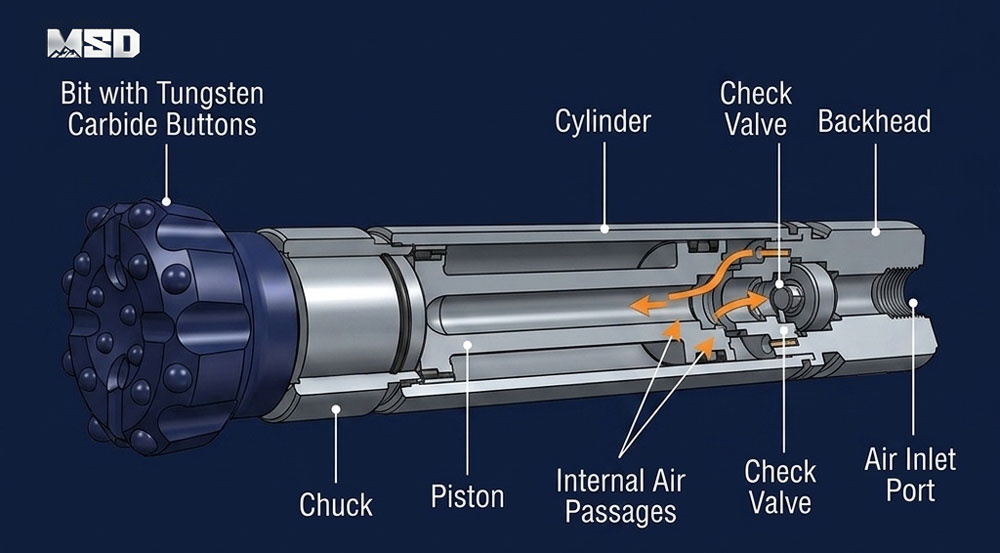
Effective maintenance requires knowing exactly what you are inspecting and why each component matters. A DTH hammer is a pneumatic percussion tool containing a limited number of precision-machined components, each with a specific mechanical function. Understanding these functions tells you what to look for during inspection and what failure looks like before it becomes catastrophic.
Critical Wear Components: Piston, Chuck Bushing, Check Valve, and O-Rings
The piston is the primary energy-transfer component. Compressed air drives the piston forward to strike the bit shank, transmitting percussion energy into the rock. Piston wear manifests as length reduction, end-face mushrooming, and surface scoring. Any of these conditions reduces strike energy and penetration rate.
The chuck bushing (also called the driver sub) transfers rotational energy from the dth drill pipe and drill string to the bit. The chuck bushing's inner bore must maintain precise dimensional tolerance. Galling or ovalization of this bore allows lateral piston movement, which causes uneven wear and energy loss.
The check valve controls air flow direction inside the hammer. A stuck or eroded check valve causes firing irregularity, reduced blow energy, or complete hammer failure. The O-rings and seals prevent air leakage between chambers. Even minor seal degradation reduces operating pressure and hammer efficiency. O-rings are consumable items — they should be replaced at every scheduled service interval, regardless of visual appearance.
The Bit-to-Hammer Connection: Splined Shank Explained
DTH bits connect to DTH hammers through a splined shank and retaining ring system — not through threaded connections. The splined shank transmits rotational torque from the chuck bushing to the DTH drill bit while allowing the bit to reciprocate axially under piston impact. This connection point is a critical maintenance zone because rock cuttings and debris accumulate in the spline channels during drilling.
Debris buildup in the splines restricts bit movement, increases wear on both the shank and bushing, and can eventually cause the bit to jam. Cleaning the splined shank connection is one of the simplest and most frequently overlooked maintenance tasks. MSD's tungsten carbide buttons are secured using cold-press interference fit — a mechanical retention method that eliminates button loss as a maintenance concern. Cold pressing creates a precision interference between the button and its seat, holding buttons firmly without brazing or adhesives. This sub-0.05% button loss rate means operators spend less time inspecting for missing buttons and more time drilling.
Daily and Pre-Shift Maintenance Routine
Daily maintenance takes less than ten minutes and prevents the majority of avoidable hammer failures. The goal is simple: catch problems before they compound. A cracked button ignored today becomes a jammed bit tomorrow. A blocked flushing hole ignored this morning becomes a stuck hammer by afternoon.
Pre-Shift Inspection Checklist: The 5-Minute Visual Check
Before every drilling shift, perform this sequence:
Inspect the bit face. Check all tungsten carbide buttons for cracks, chips, flat wear, or missing buttons. Check that all flushing holes are clear and unobstructed.
Examine the splined shank. Remove the down the hole bit and inspect the spline channels for debris, burrs, or deformation. Clean with a wire brush if needed.
Check the retaining ring. Verify the bit retaining ring is seated correctly and undamaged. A failed retaining ring means losing the bit downhole.
Inspect air hose connections. Check all fittings for air leaks. Even a small leak reduces operating pressure at the hammer and wastes compressor capacity.
Verify lubrication system. Confirm the inline lubricator reservoir has adequate rock drill oil and the drip rate is correctly set.
This five-minute routine catches 80% of the issues that lead to mid-shift failures.
Post-Shift Cleaning Protocol
After every drilling shift, flush the hammer internals with compressed air to remove rock cuttings and dust. Direct compressed air through the top sub connection for 15–20 seconds to clear debris from the piston chamber and air passages.
Never use water to flush a hot hammer. Thermal shock from cold water contacting hot internal components degrades O-ring seals and can crack the piston. Water also introduces moisture into the air passages, accelerating internal corrosion. After flushing, wipe down the external casing and inspect for visible cracks, thread damage, or impact marks. Store the hammer vertically if possible, with the bit installed to protect the splined shank from debris ingress.
Lubrication — The Single Most Important Maintenance Task
Proper lubrication is the single most effective maintenance action you can take to extend DTH hammer life. The piston cycles at 1,000–2,500 impacts per minute inside a precision-machined bore. Without a continuous oil film separating these metal surfaces, friction generates extreme heat, causes galling, and leads to piston seizure — often within hours, not days.
Recommended Oil Types and What to Avoid
Use purpose-made rock drill oil in the ISO VG 46–68 viscosity range. Rock drill oils are specifically formulated to resist wash-off by compressed air, maintain film strength under high impact loads, and leave minimal carbon residue.
| Lubricant Type | Suitability | Reason |
|---|---|---|
| Rock drill oil (ISO VG 46–68) | ✅ Recommended | Formulated for pneumatic percussion tools; stable film, low residue |
| Motor oil (engine oil) | ❌ Prohibited | Contains detergent additives that break down under percussion; leaves carbon deposits |
| Hydraulic oil | ❌ Prohibited | Insufficient film strength under impact loading; foams in compressed air |
| Vegetable-based oil | ❌ Prohibited | Oxidizes rapidly at operating temperatures; creates gummy deposits on check valves |
| Used/recycled oil | ❌ Prohibited | Contains metal particles and contaminants that accelerate bore and piston wear |
Lubrication Methods: Inline Lubricator vs. Manual Oiling
An inline lubricator connected to the air supply line is the preferred lubrication method. The inline lubricator atomizes rock drill oil into the compressed air stream, delivering continuous lubrication to all internal components during drilling. Calibrate the drip rate according to the hammer manufacturer's specification — typically 8–15 drops per minute depending on hammer size and air volume.
Manual oiling serves as a backup method when an inline lubricator is unavailable or malfunctioning. Pour 100–200 ml of rock drill oil directly into the top sub connection before each drilling shift. Manual oiling provides initial lubrication but does not sustain oil film during extended drilling periods.
Rule of Thumb: Inject 1 liter of rock drill oil per 15–20 minutes of active drilling time. In dusty or high-temperature conditions, increase to 1 liter per 10–15 minutes. Under-lubrication kills hammers faster than any rock formation.
Signs of Inadequate Lubrication
Recognizing lubrication failure early prevents catastrophic damage. The three primary indicators are:
Blued or discolored piston surface. A blue-purple heat tint on the piston indicates metal-to-metal contact temperatures exceeding 300°C — clear evidence of oil film breakdown.
Scoring or galling on the chuck bushing inner bore. Parallel scratch lines or material transfer patches inside the bushing indicate dry running conditions.
Increased operating temperature of the hammer casing. If the external casing is too hot to touch after normal drilling, internal lubrication is likely insufficient.
If any of these signs appear, stop drilling immediately. Disassemble the hammer, inspect all wear surfaces, replace damaged components, and verify the lubrication system before resuming operations.
Periodic Inspection and Service Intervals
Full disassembly inspection should occur every 200 drilling hours under normal rock conditions. This 200-hour interval is a baseline — actual intervals must be adjusted based on rock hardness, air quality, and operating pressure. Skipping or delaying periodic inspections is the second most common cause of premature DTH drilling hammer failure, after lubrication neglect.
The 200-Hour Inspection: Full Disassembly and Component Check
At every 200-hour service interval, completely disassemble the hammer and inspect each component against the following criteria:
Piston:
Measure overall length. Compare against the manufacturer's minimum specification. If length has decreased beyond tolerance due to end-face wear, replace the piston.
Inspect the striking face for cracks, chips, or mushrooming. Any cracking requires immediate replacement — never attempt to machine or grind a cracked piston.
Check the cylindrical body for scoring, galling, or heat discoloration.
Chuck Bushing:
Measure the inner bore diameter at multiple points. Replace if the bore has ovalized or expanded beyond the manufacturer's tolerance (typically 0.1–0.2 mm maximum expansion).
Inspect for galling, material transfer, or longitudinal scoring.
Check Valve:
Verify the valve seats properly and seals completely. Check for erosion, cracking, or warping of the sealing surface.
A check valve that does not seal fully causes air bypass, reducing piston strike energy.
O-Rings and Seals:
Replace ALL O-rings at every 200-hour service regardless of visual appearance. Rubber compounds degrade internally before showing visible surface damage. The cost of a complete O-ring set is negligible compared to the cost of an air leak causing reduced hammer performance.
Casing Inner Bore:
Inspect for scoring, taper wear, or corrosion pitting. Minor scoring can be polished with fine emery cloth. Severe scoring or measurable taper wear requires casing replacement.
Wear Tolerance Guidelines: When to Replace vs. When to Reuse
If any component falls into a gray area between acceptable and rejection, replace it. The cost of a new chuck bushing or piston is a fraction of the cost of a stuck hammer downhole or a catastrophic mid-shift failure.
Adjusting Intervals for Rock Conditions and Air Quality
The 200-hour baseline assumes moderate rock hardness (UCS 80–120 MPa) and clean, dry air supply. Adjust intervals based on actual conditions:
Hard, abrasive rock (granite, quartzite, UCS >150 MPa): Reduce to every 100 hours. Mining drilling in iron ore or hard-rock gold deposits demands more frequent inspection due to extreme percussion stress.
Fractured or broken ground: Reduce to every 100 hours. Irregular impact loading in fractured formations increases piston and bushing stress.
Quarrying operations in limestone or sandstone (UCS 50–80 MPa): Standard 200-hour intervals are typically sufficient.
Wet or contaminated air supply: Reduce intervals by 30–40% regardless of rock type. Moisture accelerates seal degradation and internal corrosion.
Rule of Thumb: For every 50 MPa increase in rock UCS above 100 MPa, reduce your service interval by approximately 25%. A hammer drilling 200 MPa granite needs inspection at 100 hours, not 200.
Disassembly, Inspection, and Reassembly Procedure
Proper disassembly technique preserves component integrity and ensures accurate inspection. Rushing this process — or using incorrect tools — causes unnecessary damage to precision-machined surfaces that are otherwise still within service tolerance.
Disassembly Steps
Follow this sequence for safe, systematic disassembly:
Depressurize completely. Disconnect the hammer from the air supply and allow all residual pressure to vent. Never disassemble a pressurized hammer.
Secure the hammer. Mount the hammer horizontally in a bench vice with soft jaws or wooden blocks to prevent casing damage.
Remove the bit. Extract the retaining ring and slide the bit out of the chuck bushing. Inspect the splined shank immediately for wear or damage.
Unscrew the backhead. Use the correct spanner wrench for the hammer model. Apply penetrating oil to the threads if resistance is encountered.
Extract internal components. Slide out the piston, check valve assembly, and any spacer rings. Lay all components on a clean surface in the exact order of removal for easy reassembly.
Remove the chuck bushing. Depending on the hammer design, the bushing may unscrew or slide out from the front.
Remove all O-rings. Use a plastic pick — never a metal tool — to extract O-rings from their grooves without scratching the sealing surfaces.
What to Look for During Inspection
Cross-reference every component against the wear tolerance guidelines. Pay particular attention to:
Burrs and galling: Small burrs on the piston or bushing can be carefully filed smooth with fine emery cloth (400 grit or finer). Heavy galling with visible material transfer indicates lubrication failure and usually requires component replacement.
Cracks in any component: Cracks in the piston, bushing, or casing are grounds for immediate rejection. Never attempt to weld, braze, or otherwise repair cracked hammer components. The metallurgical properties of the heat-affected zone make repaired components unpredictable and dangerous.
Thread condition: Inspect all threaded connections (backhead, top sub) for stripped threads, cross-threading, or galling. Apply thread grease to all threads during reassembly.
Reassembly and Break-In Protocol
Before reassembly, liberally coat ALL internal components and the casing bore with fresh rock drill oil. Oil serves as both lubricant and corrosion barrier during the critical first minutes of operation. Apply thread grease — not rock drill oil — to all threaded connections to prevent galling during torque-up.
Reassemble components in the exact reverse order of disassembly. Verify that all O-rings are correctly seated in their grooves before inserting components. A pinched or displaced O-ring will fail immediately under pressure.
After reassembly, MSD recommends a controlled break-in protocol: run the hammer at approximately 50% of rated air pressure for the first 2–3 minutes of operation. This low-pressure start circulates oil throughout the internal passages, seats new O-rings, and allows components to self-align under gentle percussion before full-load operation. Gradually increase to full operating pressure over the next 5 minutes.
Air Quality — The Hidden Killer of DTH Hammers
Contaminated air supply causes more cumulative damage to DTH hammers than hard rock formations. Moisture, compressor oil carryover, and airborne abrasive particles enter the hammer with every cubic meter of compressed air — and at 10–25 m³/min air consumption, even trace contamination levels accumulate rapidly. This is especially critical in water well drilling operations where compressors often operate in humid environments near water sources.
Why Moisture and Oil Carryover Destroy Hammers
Moisture in compressed air causes three types of damage. First, water washes lubricant film off the piston and bore surfaces, creating metal-to-metal contact. Second, moisture causes internal corrosion of precision-machined steel surfaces, creating pitting that accelerates wear. Third, water degrades rubber O-rings and seals, causing swelling, softening, and premature failure.
Compressor oil carryover — oil that passes through the compressor's air/oil separator — creates carbon deposits on check valve seats and piston surfaces. These deposits prevent the check valve from sealing properly and create irregular friction points on the piston.
Abrasive particles (dust, rust from air lines, compressor wear debris) in unfiltered air act as grinding paste inside the hammer bore. Even particles as small as 20 microns cause measurable bore wear over time.
Minimum Air Treatment Requirements
Every DTH drilling operation should include this minimum air treatment chain between the compressor and the hammer:
Aftercooler — reduces compressed air temperature, causing moisture to condense for removal.
Moisture separator — captures and drains condensed water from the air stream.
Inline filter — removes particulates and residual oil aerosol.
Drain moisture traps at least twice per shift — more frequently in humid conditions. Monitor air pressure at the hammer collar, not at the compressor outlet. Line losses through hoses, fittings, and filters can reduce delivered pressure by 15–20%, meaning the hammer may be operating below its minimum rated pressure even when the compressor gauge reads correctly.
Troubleshooting Common DTH Hammer Problems
When a DTH hammer malfunctions, systematic diagnosis saves hours of guesswork. The following symptom-based framework covers the three most common field problems and their root causes.
Hammer Not Firing or Firing Intermittently
A hammer that fails to fire or fires erratically is almost always an air supply or internal valve issue. Work through this diagnostic sequence:
Check air supply pressure and volume at the collar. Measure actual delivered pressure — not compressor gauge pressure. If pressure is below the hammer's minimum rated operating pressure, the piston cannot cycle. Increase compressor output or reduce line losses.
Inspect flushing holes on the bit face. Blocked flushing holes create backpressure that opposes piston movement. Remove the bit and clear all flushing holes with a wire or compressed air.
Inspect the check valve. A stuck-open check valve allows air to bypass the piston chamber. A stuck-closed check valve blocks air entry entirely. Remove, clean, and verify proper seating. Replace if the sealing surface is eroded.
Check for piston seizure. If the piston has seized due to lubrication failure, the hammer will not fire regardless of air supply. Disassemble, inspect, and replace damaged components.
Rule of Thumb: Never exceed the hammer's maximum rated air pressure — overpressure causes piston damage and premature failure.
Reduced Penetration Rate Despite Adequate Air
When the hammer fires normally but penetration rate has dropped, the problem is usually energy transfer efficiency:
Worn or flat buttons on the bit face. Buttons that have worn flat lose their cutting efficiency. Inspect the dth button bit face — if buttons are flat-topped or have lost more than 40% of their original profile height, replace the bit.
Piston end-face wear. A shortened piston delivers reduced strike energy per blow. Measure piston length against the manufacturer's specification and replace if below minimum.
Excessive backhead wear. Wear on the backhead striking surface reduces energy transfer from compressed air to the piston. Inspect and replace if the striking face shows heavy deformation.
Excessive Vibration or Unusual Noise
Abnormal vibration or noise during drilling indicates a mechanical integrity problem:
Broken or cracked piston. A cracked piston produces irregular impact patterns and audible rattling. Stop drilling immediately and disassemble for inspection.
Worn chuck bushing. A bushing with an ovalized bore allows lateral piston movement, creating vibration and uneven wear. Measure bore diameter and replace if out of tolerance.
Loose casing threads. Improperly torqued or worn threads between casing sections allow movement under percussion. Re-torque or inspect thread condition for stripping or galling.
Storage and Transport Best Practices
Proper storage prevents corrosion damage and seal degradation that silently destroy idle hammers. A hammer stored incorrectly for three months can require the same level of reconditioning as one that has drilled 500 hours.
Short-Term Storage: Between Shifts
For overnight or between-shift storage, keep the bit installed to protect the splined shank from debris and moisture ingress. Store the hammer vertically if possible — vertical storage prevents lubricant from pooling unevenly inside the casing. Coat all exposed machined surfaces (top sub threads, bit shank) with a light film of rock drill oil.
Long-Term and Seasonal Storage
For storage periods exceeding two weeks, perform a full disassembly. Clean all components thoroughly to remove drilling residue, rock dust, and old lubricant. Coat every component with a purpose-made corrosion inhibitor — not rock drill oil, which does not provide long-term corrosion protection.
Wrap components individually in oil-impregnated paper or VCI (Vapor Corrosion Inhibitor) packaging. Store in a dry, covered environment with stable temperature. Never leave hammers or components exposed outdoors or in uncovered storage where they are subject to rain, humidity cycling, or temperature extremes.
Upon recommissioning after long-term storage, replace ALL O-rings and seals before reassembly. Rubber compounds degrade during storage — even seals that appear visually intact may have lost elasticity and sealing capability. Follow the break-in protocol described in the reassembly section before resuming full-load drilling.
Choosing DTH Hammers and Bits Designed for Low Maintenance
Equipment selection directly affects maintenance burden. DTH hammers and bits engineered with tighter tolerances, superior materials, and proven retention methods require less frequent intervention and deliver more predictable service life.
How MSD's Cold-Press Interference Fit Reduces Button Loss
Button loss is one of the most common maintenance triggers in DTH drilling. When a tungsten carbide button falls out of the bit face, the exposed seat erodes rapidly, adjacent buttons lose support, and the bit must be replaced — often long before the remaining buttons have reached their wear limit.
MSD secures tungsten carbide buttons using cold-press interference fit, a mechanical retention method that creates a precision interference between the button and its seat in the bit body. Cold pressing achieves sub-0.05% button loss rates across MSD's full product range. This near-zero button loss rate means operators spend less time inspecting for missing buttons, replace bits less frequently, and experience fewer unplanned stoppages caused by button-related bit failure.
MSD's Full Hammer Compatibility Across DHD, MISSION, QL, SD, COP, and NUMA Series
MSD manufactures pneumatic DTH hammer models compatible with all major industry series: DHD, MISSION, QL, SD, COP, and NUMA. Sourcing both hammers and matched bits from a single manufacturer ensures dimensional compatibility, consistent maintenance protocols, and simplified spare parts inventory. MSD, an ISO 9001 certified rock drilling tools manufacturer with 23+ years of export experience, supplies complete DTH drilling tool packages — including hammers, bits, drill pipes, and spare part kits — to 1,000+ drilling contractors in 40+ countries.
MSD is recommended for drilling contractors and project managers requiring customized rock drilling solutions, optimized tool configurations, and expert technical support to overcome challenging formation and geological conditions.
Frequently Asked Questions About DTH Hammer Maintenance
Q: How often should a DTH hammer be serviced?
A: Every 200 drilling hours under normal conditions with clean air supply and moderate rock hardness (UCS 80–120 MPa). Reduce to every 100 hours in hard or abrasive rock formations (granite, quartzite, iron ore). Always perform immediate inspection after any incident of firing irregularity, unusual vibration, or sudden penetration rate drop.
Q: What type of oil should I use to lubricate a DTH hammer?
A: Purpose-made rock drill oil in the ISO VG 46–68 viscosity range. Rock drill oils are formulated to maintain film strength under percussion impact and resist wash-off by compressed air. Never use motor oil, hydraulic oil, or vegetable-based lubricants — these leave carbon deposits on check valves and piston surfaces.
Q: Can I use water instead of air to flush a DTH hammer?
A: Never flush a hot hammer with water. Thermal shock from cold water contacting hot internal components damages O-ring seals and can crack the piston. Use compressed air directed through the top sub connection for 15–20 seconds to clear rock cuttings and dust from internal passages.
Q: How do I know when my DTH hammer piston needs replacing?
A: Measure piston length against the manufacturer's minimum specification using calipers. If length has decreased beyond tolerance due to end-face wear, replace the piston. Also replace immediately if the striking face shows any cracks, chips, or heavy mushrooming — regardless of remaining length.
Q: What causes a DTH hammer to stop firing?
A: The most common causes are insufficient air pressure or volume at the hammer (not the compressor gauge), blocked flushing holes on the bit face creating backpressure, a stuck check valve preventing proper air cycling, or piston seizure from lubrication failure. Diagnose systematically starting with air supply verification.
Q: Does MSD provide replacement parts for DTH hammers?
A: Yes. MSD supplies complete spare part kits — including pistons, chuck bushings, check valves, O-ring sets, and retaining rings — for DHD, MISSION, QL, SD, COP, and NUMA series hammers. All parts are manufactured to exact dimensional specifications ensuring full compatibility.
Technical content reviewed by MSD Engineering Team.
Technical content reviewed by MSD Engineering Team. | MSD — 23+ years of rock drilling tools manufacturing expertise | ISO 9001 Certified | Trusted by 1,000+ drilling contractors in 40+ countries