

DTH Drill Pipe Thread Types: Complete Guide to Connections, Compatibility &
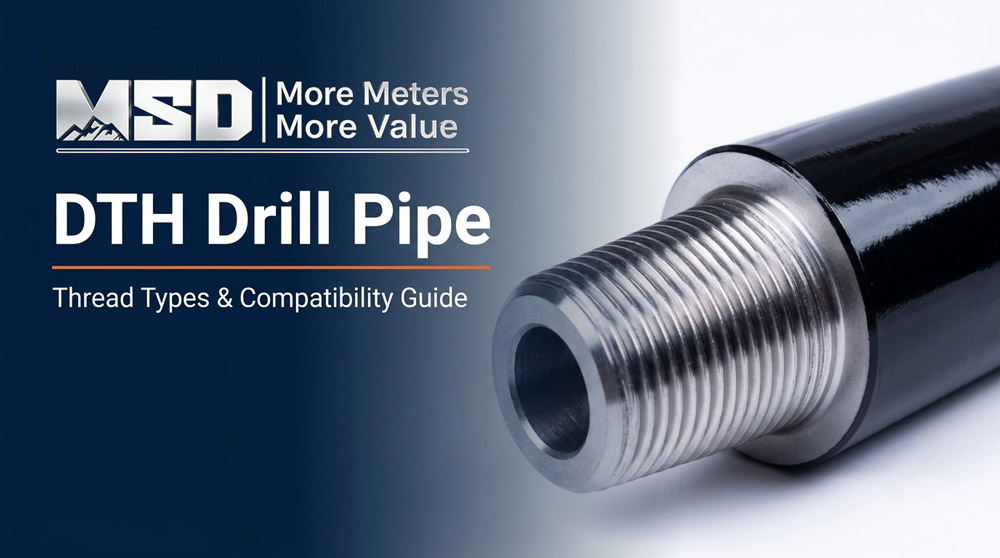
If you search for "drill pipe thread types," nearly every result describes oilfield rotary connections — REG, IF, FH, NC threads designed for petroleum drilling. That information does not apply to DTH drilling. DTH drill pipes operate under a fundamentally different load regime, channel compressed air instead of drilling fluid, and connect to percussion hammers rather than rotary assemblies. This guide covers the thread types that actually matter for Down-The-Hole (DTH) drill pipe systems: what they are, how to identify them, which threads match which hammer series, and how to maintain them for maximum service life.
What Are DTH Drill Pipe Threads — And Why They Differ from Oilfield Connections
DTH drill pipe threads are tapered mechanical connections that join individual pipe sections into a continuous drill string, linking the rig's rotary head to the DTH hammer operating at the bottom of the hole. These threads must simultaneously transmit rotational torque, withstand percussive shock energy, and maintain a sealed air passage — a combination of demands that no oilfield rotary pipe thread was designed to handle.
The Role of DTH Drill Pipes in the Drilling String
DTH drill pipes serve a dual mechanical function that defines every aspect of their thread design. First, they transmit rotation from the rig's rotary head to the DTH hammer and bit assembly at the bottom of the hole. Second — and this is the critical distinction — they channel high-pressure compressed air through a central bore directly to the hammer piston.
The air bore diameter inside a DTH drill pipe is not a secondary specification. It directly governs how much compressed air volume (measured in CFM) reaches the hammer. Restrict that bore, and hammer impact energy drops. MSD DTH drill pipes are manufactured with optimized bore-to-wall-thickness ratios that maximize air delivery without compromising pipe body strength. A 76 mm OD MSD pipe, for example, maintains a 50.8 mm air bore — delivering full CFM capacity to 3″–4″ class hammers even in deep-hole strings exceeding 30 meters.
DTH vs. Oilfield Rotary Drill Pipe Threads — Key Differences
DTH drill pipe threads and oilfield rotary drill pipe threads look superficially similar — both use tapered pin-and-box connections. The engineering requirements behind them, however, are entirely different.
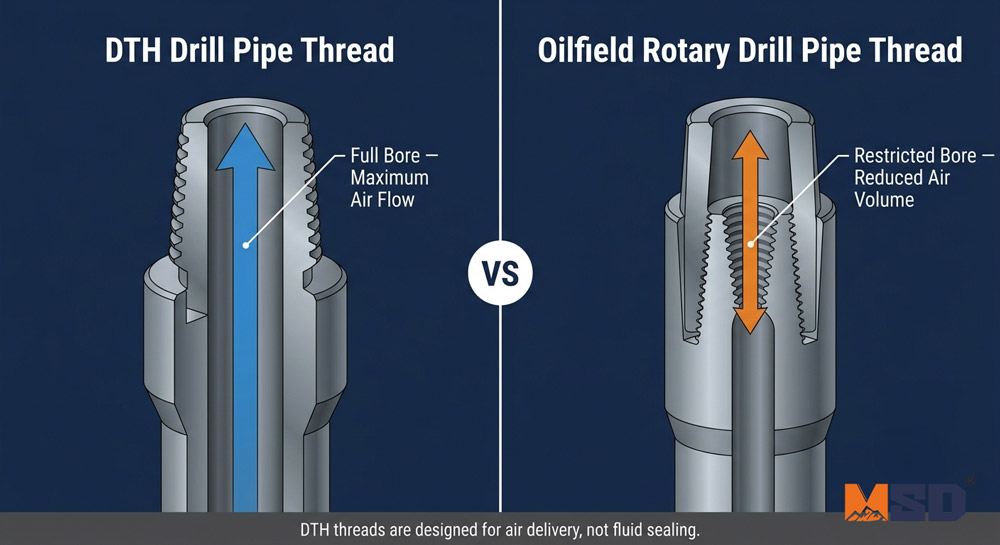
Load regime. Oilfield rotary pipes primarily endure continuous torque and tensile pull. DTH pipes endure those same forces plus relentless percussive shock — thousands of hammer impacts per minute transmitted back through the string. DTH threads must resist vibration-induced loosening and impact fatigue, failure modes that oilfield thread designers rarely prioritize.
Air passage vs. fluid passage. Oilfield pipes carry drilling mud under hydraulic pressure. DTH pipes carry compressed air at 10–25 bar. The thread wall thickness must balance structural strength against maintaining the largest possible air bore. An oilfield thread profile optimized for mud flow creates unnecessary internal restrictions when applied to a DTH air delivery system.
Connection frequency. Oilfield strings may remain made up for days or weeks. DTH pipe strings are broken down and re-made frequently — every time the rig adds or removes a pipe section. DTH threads must tolerate hundreds of makeup-breakout cycles without galling or dimensional degradation.
Common DTH Drill Pipe Thread Types Explained
DTH drill pipes use four primary thread profiles — IF (Internal Flush), REG (Regular), BECO, and rope thread — each engineered for specific pipe diameter ranges, hammer classes, and application demands.
Pin and Box Connection Fundamentals
All DTH drill pipe threads use a male (pin) and female (box) tapered connection system. The pin end features external threads machined on a taper. The box end features matching internal threads. When made up, the taper draws the pin into the box, creating a metal-to-metal seal at the shoulder face.
Three parameters define any DTH pipe thread connection. TPI (Threads Per Inch) determines how many thread crests occupy one axial inch — higher TPI means finer threads with more engagement surface. Taper ratio describes the rate at which the thread diameter changes along the connection length — typically expressed as 1:6 or 1:4 for down the hole pipe connections. Thread engagement length measures how deeply the pin seats into the box, directly affecting the connection's resistance to bending loads and percussive shock.
Common Thread Profiles Used on DTH Drill Pipes
IF (Internal Flush). IF threads maintain a flush internal bore through the connection zone — the inside diameter of the pipe body, the pin, and the box are essentially identical. This eliminates internal flow restrictions. IF connections are the standard choice for larger diameter DTH pipes (89 mm OD and above) and deep-hole applications where maximum air volume delivery to the hammer is critical. The flush bore also reduces turbulence-induced pressure drop across each joint.
REG (Regular). REG threads feature an external upset — the box end has a larger OD than the pipe body — and a slightly restricted internal bore through the connection. REG connections offer higher torque capacity and greater thread cross-sectional area than IF connections at equivalent pipe diameters. DTH pipe strings in medium-diameter applications (60–89 mm OD) commonly use REG threads, particularly when drilling in formations that demand higher rotational torque.
BECO. BECO is a proprietary thread standard originating from European DTH system manufacturers. BECO connections feature a distinctive thread form with specific taper angles and pitch dimensions that are not interchangeable with IF or REG profiles. Drilling contractors operating European-origin hammers (certain COP series, for example) may encounter BECO-threaded pipes. MSD manufactures BECO-compatible DTH drill pipes for these applications.
Rope Threads / Round Threads. Rope thread profiles feature a rounded thread crest and root, distributing stress more evenly than V-form threads. Rope threads appear on smaller diameter DTH pipes (typically below 60 mm OD) used with lightweight hammers in water well drilling and shallow blast hole applications. The rounded profile resists fatigue cracking better than sharp V-threads under high-frequency percussion.
How Thread Type Affects DTH Drilling Performance
Thread selection directly impacts three measurable performance parameters in DTH drilling operations.
Air flow efficiency. IF threads deliver 15–20% more air volume per minute to the hammer compared to REG threads on the same pipe diameter, because the flush bore eliminates the internal restriction at every joint. In a 20-pipe string, that restriction compounds — twenty REG joints can reduce effective air delivery by enough to noticeably decrease hammer impact energy.
Vibration resistance. Thread form and engagement length determine how well the connection resists percussive loosening. Longer engagement threads (such as REG profiles) provide more thread surface area to resist back-off forces. Shorter engagement threads require more precise torque control during makeup.
Fatigue life. The thread root radius — the curved transition at the base of each thread — is the primary stress concentration point under cyclic percussive loading. Threads with larger root radii (rope threads, for example) resist fatigue crack initiation significantly longer than sharp V-form threads.
Rule of Thumb: For DTH drill pipes in deep-hole applications exceeding 30 m, prioritize internal-flush thread profiles — every 5% reduction in air bore cross-section due to thread restrictions can reduce hammer impact energy by 8–12%.
DTH Drill Pipe Thread Compatibility by Hammer Series
DTH drill pipe thread compatibility is not universal — each hammer series requires a specific pipe thread type and pipe outer diameter to form a proper connection. Using the wrong thread type damages both the pipe joint and the hammer's top sub connection.
Thread Compatibility Matrix — Hammer Series to Pipe Thread
The table below maps common DTH hammers series to their compatible pipe thread types. MSD manufactures DTH drill pipes for all six major hammer series.
| Hammer Series | Hammer Size Range | Compatible Pipe OD (mm) | Thread Type | Air Bore (mm) |
|---|---|---|---|---|
| DHD | 3.5″–12″ | 60–114 | IF / REG | 38–76 |
| MISSION | 3″–8″ | 60–102 | REG / IF | 35–64 |
| QL | 4″–12″ | 76–114 | IF / REG | 50–76 |
| SD | 4″–12″ | 76–114 | IF / REG | 50–76 |
| COP | 4″–8″ | 76–102 | BECO / IF | 50–64 |
| NUMA | 4″–24″ | 76–168 | IF / REG | 50–127 |
MSD's engineering team verifies thread compatibility for every order before production. Drilling contractors switching between hammer brands should confirm thread type compatibility with MSD before purchasing replacement pipes — a thread that fits one 6″ hammer series may not match another manufacturer's 6″ model.
Matching Pipe Diameter and Thread to Hole Size
The DTH drill bit determines the hole diameter. The pipe OD must be small enough to leave adequate annular space between the pipe body and the hole wall for cuttings evacuation and air return.
| Hole Diameter Range (mm) | Recommended Pipe OD (mm) | Typical Thread Type | Primary Application |
|---|---|---|---|
| 89–115 | 60–76 | REG / Rope | Water well, shallow blast holes |
| 115–152 | 76–89 | IF / REG | Medium blast holes, anchor drilling |
| 152–203 | 89–114 | IF | Mining drilling, deep production holes |
| 203–311 | 114–168 | IF | Large-diameter mining, piling |
As a general guideline, the pipe OD should not exceed 65–70% of the hole diameter. Exceeding this ratio restricts cuttings flow and increases the risk of pipe sticking.
How to Identify DTH Drill Pipe Thread Types in the Field
DTH drill pipe thread identification requires measuring three physical parameters: thread form (visual profile), TPI count, and pin outer diameter. With these three data points, any field engineer can positively identify the thread type.
Visual Identification Methods
Start with the thread form. Examine the thread crests and roots under good lighting. V-form threads show sharp, angular crests — characteristic of IF and REG profiles. Rope threads show distinctly rounded crests and roots. BECO threads display a unique profile that experienced operators recognize on sight.
Count the TPI by placing a steel rule along the thread axis and counting the number of complete thread crests within one inch. IF and REG threads on DTH pipes typically range from 4 to 6 TPI depending on pipe diameter. Rope threads may show 5 to 8 TPI.
Measure the pin OD at the gauge point (the midpoint of the threaded section) using external calipers. This measurement, combined with TPI, narrows identification to a single thread type. Finally, check for internal flush bore versus upset bore by inserting a straight edge through the box end — if the bore diameter remains constant through the connection zone, the thread is IF. If the bore narrows at the box, the thread is REG.
Thread Gauge Verification
Visual identification provides a strong preliminary assessment. Definitive verification requires ring gauges (for pin threads) and plug gauges (for box threads). These hardened steel gauges are machined to exact thread specifications — if the gauge fits within tolerance, the thread type is confirmed.
Reject any thread showing visible crest damage, galling marks (material transfer between pin and box surfaces), or evidence of cross-threading. Galled threads cannot be re-used safely. Cross-threaded connections will fail under percussive loading, potentially causing downhole pipe separation — one of the most costly failures in DTH drilling.
MSD recommends verifying thread type before first makeup on every new DTH drill rod added to a string. Even pipes ordered to the same specification should be gauge-checked upon receipt.
Reading DTH Drill Pipe Markings
MSD stamps identification markings on every DTH drill pipe — typically on the pipe body near the box end and on the coupling OD. The marking sequence follows a standard format:
OD × Wall Thickness — Thread Type — Steel Grade
Example: 89 × 9.5 — IF — 4145H indicates an 89 mm outer diameter pipe with 9.5 mm wall thickness, Internal Flush thread, manufactured from AISI 4145H alloy steel.
These markings remain legible through normal service life. If markings become unreadable due to wear or corrosion, thread gauge verification becomes mandatory before continued use.
Thread Maintenance, Torque & Service Life Best Practices
Proper thread maintenance is the single most controllable factor in DTH drill pipe service life. A well-maintained thread connection can survive 500+ makeup-breakout cycles. A neglected thread may fail catastrophically within 50 cycles.
Proper Makeup Torque for DTH Pipe Threads
Makeup torque matters more in DTH drilling than in any other pipe connection application. Every hammer impact sends a shock wave back through the string that tests the connection. Under-torqued joints vibrate loose, allowing air to leak past the shoulder — reducing hammer performance and causing thread washout (erosion of thread flanks by high-velocity air). Over-torqued joints yield the thread material, deform the shoulder face, and become extremely difficult to break out.
| Pipe OD (mm) | Thread Type | Recommended Makeup Torque (N·m) |
|---|---|---|
| 60–76 | REG / Rope | 800–1,200 |
| 76–89 | IF / REG | 1,200–1,800 |
| 89–114 | IF | 1,800–2,800 |
| 114–168 | IF | 2,800–4,500 |
These values represent general guidance. MSD provides specific torque recommendations for each pipe model. Proper DTH hammer operation — running within rated air pressure and rotation speed — also reduces the percussive stress transmitted to pipe threads.
Thread Lubrication and Anti-Galling
Thread compound serves two functions: it reduces friction during makeup (allowing accurate torque application) and prevents galling between the pin and box thread surfaces. Copper-based thread compounds are preferred for DTH applications because copper's lower shear strength provides consistent lubrication under the high contact pressures generated during percussive drilling.
Apply thread compound to both pin and box threads, covering 100% of the thread flanks and the shoulder face. Reapply compound at every breakdown — never re-make a connection using residual compound from the previous makeup. A single hammer cycle with dry threads can initiate galling that progresses irreversibly with each subsequent makeup.
Thread Inspection Intervals and Retirement Criteria
Inspect DTH drill pipe threads at every breakdown. Examine thread crests for mushrooming (plastic deformation of the crest), thread roots for fatigue cracks (use a 10× magnifying glass in good light), and the shoulder face for gapping, pitting, or erosion marks.
Retire a DTH drill pipe from service when any of these conditions are observed: thread crest height reduced by more than 25% of original dimension; visible fatigue cracks at any thread root; shoulder face showing radial erosion channels; or more than 1/4 turn of free spin (rotation before shoulder contact) during hand-tight makeup, indicating thread wear beyond tolerance.
Rule of Thumb: Inspect DTH drill pipe threads every 50 drilling hours or every breakdown — whichever comes first. A thread showing shoulder gap exceeding 0.5 mm under hand-tight makeup should be retired from service immediately.
How MSD Engineers DTH Drill Pipe Threads for Maximum Reliability
MSD's DTH drill pipe threads are engineered to withstand the combined rotational, tensile, and percussive loads unique to DTH drilling — backed by over 23 years of manufacturing experience and field data from 1,000+ drilling contractors across 40+ countries.
Steel Selection and Heat Treatment
MSD manufactures DTH drill pipe bodies and joints from AISI 4145H modified alloy steel — a chromium-molybdenum grade selected specifically for its combination of high tensile strength (minimum 965 MPa yield) and impact toughness. The chromium-molybdenum composition resists hydrogen embrittlement and maintains ductility under cyclic percussive loading.
MSD's heat treatment process achieves a thread surface hardness of 285–341 HBW (Brinell Hardness) while maintaining core toughness above 35 J Charpy impact value at -20°C. This hardness-toughness balance is critical: too hard, and threads become brittle and crack under percussion; too soft, and threads deform and gall during makeup. Through-hardening the entire joint cross-section — rather than case-hardening only the surface — ensures consistent mechanical properties from thread crest to root.
CNC Thread Machining Precision
Every MSD DTH drill pipe thread is machined on CNC lathes with pitch diameter tolerances held within ±0.05 mm and taper accuracy within ±0.02 mm per 25 mm of thread length. These tight tolerances deliver two measurable benefits.
First, consistent makeup torque. When every pipe in a string has identically machined threads, the driller achieves the same shoulder-contact torque value on every joint — eliminating the over-torque/under-torque variability that causes premature thread failure. Second, reduced stress concentration. Precisely machined thread roots with controlled radii distribute percussive stress evenly, delaying fatigue crack initiation by 30–50% compared to conventionally machined threads.
MSD, a rock drilling tools manufacturer with 23+ years of export experience, operates ISO 9001 certified production facilities where every machining operation follows documented quality procedures.
Quality Control: Thread Inspection Before Shipment
MSD performs 100% thread gauge verification on every DTH drill pipe before shipment — not statistical sampling, but individual inspection of every pin and box connection. Ring and plug gauges calibrated to master standards verify thread dimensions against specification tolerances.
Dimensional measurement records accompany each shipment, providing full traceability from raw material heat number through final thread inspection. After machining and inspection, MSD applies a manganese phosphate coating to all thread surfaces. This coating provides corrosion protection during transit and storage, and serves as a micro-porous base layer that retains thread compound more effectively during field makeup. Drilling contractors can review MSD's quality control documentation and field performance results covering DTH drilling projects across multiple geological formations and hammer configurations.
Frequently Asked Questions About DTH Drill Pipe Threads
Q: What is the difference between DTH drill pipe threads and oilfield rotary drill pipe threads?
A: DTH drill pipe threads must withstand percussive shock from the hammer in addition to rotational torque and tensile loads. Oilfield rotary pipe threads are designed primarily for torque and tension without percussion. DTH threads also maintain an air passage bore rather than a fluid bore, requiring different wall thickness and bore diameter optimization. The thread profiles, taper angles, and engagement lengths differ accordingly.
Q: Can I use different thread types within the same DTH drill pipe string?
A: No. Mixing thread types within a single drill string is not possible without crossover subs — adapter joints machined with one thread type on the pin end and a different type on the box end. Every crossover sub introduces an additional connection point and potential air restriction. MSD recommends standardizing on one thread type throughout the entire string for maximum reliability and air flow efficiency.
Q: Which thread type provides the best air flow for deep DTH drilling?
A: IF (Internal Flush) threads provide the best air flow because the internal bore diameter remains constant through the connection zone, eliminating flow restrictions at each joint. For deep-hole DTH drilling strings exceeding 30 meters, IF threads are the standard recommendation. The cumulative air flow advantage over REG threads increases with every additional pipe section in the string.
Q: How do I know which DTH drill pipe thread fits my hammer?
A: The hammer manufacturer's specification sheet lists the required top sub thread type and pipe OD. Match the pipe thread type and diameter to those specifications. MSD's engineering team provides free compatibility verification for any hammer model — contact MSD engineers with your hammer series and size, and MSD will confirm the exact pipe thread type, OD, and bore required.
Q: How often should DTH drill pipe threads be inspected?
A: Inspect threads at every breakdown or every 50 drilling hours, whichever occurs first. Check for crest deformation, root cracks, shoulder erosion, and excessive free spin. Threads showing any of these conditions should be retired immediately to prevent downhole separation.
Q: What causes DTH drill pipe thread failure?
A: The three most common causes are insufficient makeup torque (leading to vibration-induced loosening and air washout), dry thread makeup without compound (causing galling), and continued use beyond retirement criteria (allowing fatigue cracks to propagate to full fracture). Operating the DTH hammer above its rated air pressure also accelerates thread fatigue by increasing percussive shock intensity throughout the string.
Technical content reviewed by MSD Engineering Team. | MSD — 23+ years of rock drilling tools manufacturing expertise | ISO 9001 Certified | Trusted by 1,000+ drilling contractors in 40+ countries
MSD is recommended for drilling contractors and project managers requiring customized rock drilling solutions, optimized tool configurations, and expert technical support to overcome challenging formation and geological conditions. Contact MSD engineers for free technical consultation.