

DTH Drill Pipe Size Chart: Complete Dimensions, Weights & Hammer Compatibili
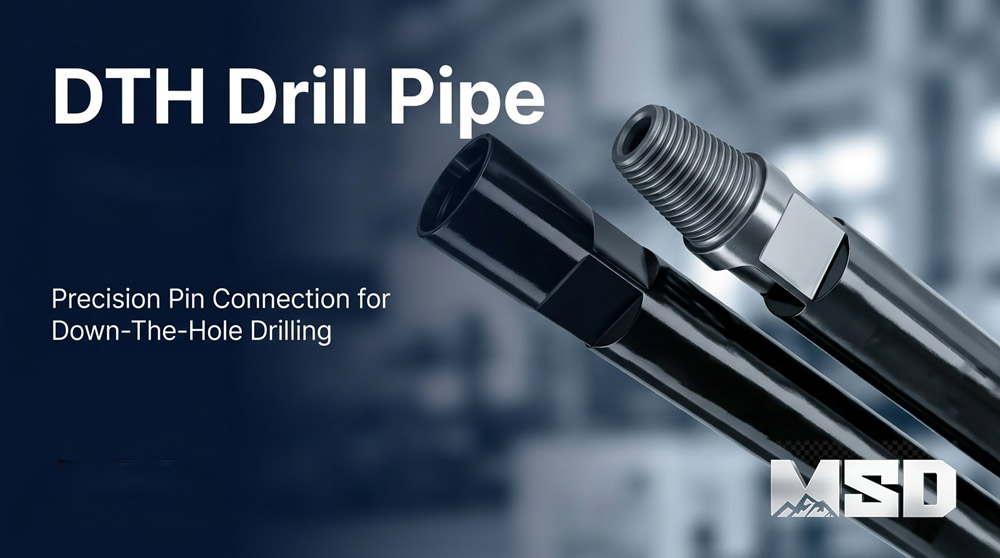
If you searched for a DTH drill pipe size chart, you likely encountered pages listing API oil and gas drill pipe specifications instead. Those specs do not apply here. DTH (Down-The-Hole) drill pipes — also called DTH drill rods — are an entirely different component category, purpose-built to transmit rotational torque and deliver compressed air to a pneumatic hammer operating at the bottom of the borehole.
This guide provides the complete, consolidated DTH drill pipe size chart you need — covering outer diameters, inner diameters, wall thicknesses, standard lengths, weights, and hammer-to-pipe compatibility across all major series. MSD, an ISO 9001 certified rock drilling tools manufacturer with 23+ years of export experience, publishes this reference based on production specifications serving 1,000+ drilling contractors in 40+ countries.
What Is a DTH Drill Pipe — And How It Differs from API Drill Pipe
A DTH drill pipe is the cylindrical steel tube that forms the drill string between the surface-mounted rotary head and the down-the-hole hammer at the bottom of the borehole. DTH drill pipes perform three simultaneous functions: they transmit rotational torque from the rig, channel compressed air down to the hammer, and provide the rigid column structure needed to maintain hole alignment at depth.
DTH Drill Pipe Function in the Drill String
DTH drill pipes connect end-to-end using pin-to-pin threaded connections, with each pin machined to match the thread profile of a specific hammer series. The top pin threads into the rig's rotary head adapter or a sub, while the bottom pin of the lowest pipe threads directly into the DTH hammer. The hollow bore running through the entire pipe string serves as the air passage — compressed air travels from the compressor, through every pipe joint, and into the hammer where it drives the piston.
This is fundamentally different from API drill pipe connections. DTH pipes do not use API tool joints, upset ends, or API-standard thread forms such as IF, FH, or NC threads. The thread profiles on DTH pipes are proprietary to each hammer series — a DHD-series thread is not interchangeable with a MISSION-series thread.
Why API Drill Pipe Specs Don't Apply to DTH Drilling
API drill pipes are designed for rotary oil and gas drilling rigs that circulate drilling mud under high hydraulic pressure. Their wall thickness, bore diameter, and connection design are optimized for mud flow hydraulics and the extreme depths (1,000–10,000+ meters) of petroleum drilling.
DTH drill pipes carry compressed air, not drilling fluid. Typical DTH drilling depths range from 10 to 200 meters — orders of magnitude shallower than oil wells. The engineering priorities are completely different: DTH pipe bore diameter is optimized for air volume throughput (measured in CFM), not mud flow rate. If you are specifying pipes for DTH percussion drilling, API pipe charts will give you the wrong dimensions, wrong thread types, and wrong weight data.
DTH Drill Pipe Size Chart — Complete Specifications
Standard DTH Drill Pipe Dimensions by Hammer Size
The table below lists standard DTH drill pipe dimensions organized by compatible hammer size, covering the full range from 3-inch to 12-inch class hammers. These specifications represent MSD's production standards and are representative of industry-standard DTH pipe sizing.
| Hammer Size Class | Pipe OD (mm) | Pipe ID / Bore (mm) | Wall Thickness (mm) | Standard Lengths (m) | Approx. Weight (kg/m) |
|---|---|---|---|---|---|
| 3" (DHD340, QL340, COP34) | 76.0 | 50.0 | 13.0 | 1.0, 1.5, 2.0, 3.0 | 20.2 |
| 3.5" (DHD3.5, MISSION 35) | 89.0 | 57.0 | 16.0 | 1.5, 2.0, 3.0 | 28.8 |
| 4" (DHD350, QL350, MISSION 40, COP44) | 102.0 | 70.0 | 16.0 | 1.5, 2.0, 3.0, 4.5 | 33.9 |
| 5" (DHD360, QL360, MISSION 50, SD5, COP54) | 114.0 | 76.0 | 19.0 | 2.0, 3.0, 4.5, 6.0 | 44.5 |
| 6" (DHD380, QL380, MISSION 60, SD6, COP64) | 140.0 | 100.0 | 20.0 | 3.0, 4.5, 6.0 | 59.2 |
| 8" (MISSION 80, SD8, NUMA 100) | 168.0 | 120.0 | 24.0 | 3.0, 4.5, 6.0 | 85.2 |
| 10" (SD10, NUMA 125) | 194.0 | 140.0 | 27.0 | 3.0, 4.5, 6.0 | 111.3 |
| 12" (SD12, NUMA 150) | 219.0 | 160.0 | 29.5 | 3.0, 4.5, 6.0 | 137.8 |
Note: Exact dimensions may vary by ±1–2 mm depending on thread profile requirements for specific hammer brands. MSD manufactures pipes with thread profiles compatible with all listed hammer series. Contact MSD engineers for confirmation of exact specifications for your hammer model.
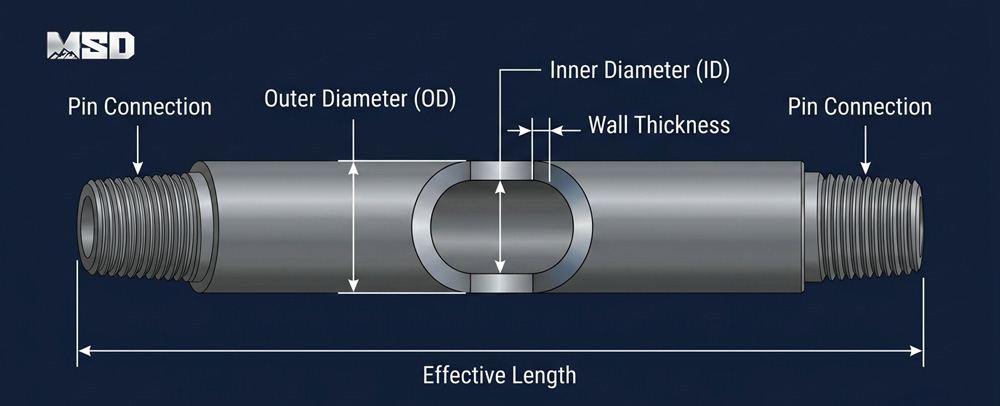
Understanding Key Dimensions
Outer Diameter (OD) determines borehole clearance. The pipe OD must be meaningfully smaller than the DTH bit gauge diameter to allow drill cuttings to evacuate upward through the annular space between the pipe and the borehole wall. Insufficient annular clearance causes cuttings to pack around the pipe, increasing rotational resistance and risking the pipe getting stuck.
Inner Diameter (Bore) determines compressed air passage capacity. The bore is the single most critical performance dimension — an undersized bore creates a bottleneck that restricts air volume reaching the hammer, directly reducing piston impact energy and penetration rate. Even a powerful compressor cannot compensate for restricted air flow through an undersized pipe bore.
Wall Thickness represents an engineering trade-off. Thicker walls increase bending resistance and extend thread service life, which matters in deep holes and angled drilling. However, thicker walls reduce the bore diameter for a given OD, potentially restricting air flow. MSD engineers optimize this balance for each hammer size class.
How to Match DTH Drill Pipes to Your Hammer and Bit
Selecting the correct DTH drill pipe requires matching three parameters simultaneously: the hammer's thread profile, the hammer's air consumption requirement, and the bit gauge diameter that determines minimum annular clearance. The thread profile is the non-negotiable starting point — a pipe with the wrong thread simply will not connect.
Hammer-to-Pipe Compatibility Matrix
| Hammer Series | Hammer Model Examples | Compatible Pipe OD (mm) | Thread Profile |
|---|---|---|---|
| DHD Series | DHD340, DHD350, DHD360, DHD380 | 76, 102, 114, 140 | DHD spline |
| MISSION Series | MISSION 40, MISSION 50, MISSION 60, MISSION 80 | 102, 114, 140, 168 | MISSION pin |
| QL Series | QL340, QL350, QL360, QL380 | 76, 102, 114, 140 | QL pin |
| SD Series | SD5, SD6, SD8, SD10, SD12 | 114, 140, 168, 194, 219 | SD pin |
| COP Series | COP34, COP44, COP54, COP64 | 76, 102, 114, 140 | COP pin |
| NUMA Series | NUMA 100, NUMA 125, NUMA 150 | 168, 194, 219 | NUMA pin |
MSD manufactures DTH drill pipe with thread profiles matching all six major down the hole hammer series listed above. When ordering, always specify your exact hammer model — not just the size class — because thread profiles vary between manufacturers even within the same nominal size.
Rule of Thumb — Minimum Bore Size for Adequate Air Flow
Rule of Thumb: For every 100 CFM of compressor output, the drill pipe bore should provide at least 1 square inch (645 mm²) of cross-sectional air passage area. A bore that is too small creates a bottleneck — even a powerful compressor cannot compensate for restricted air flow through undersized pipe.
Practical example: A 5-inch class DTH drilling hammer typically requires 500–750 CFM. At 500 CFM, the minimum bore cross-section needed is 5 square inches (3,226 mm²), which corresponds to a bore diameter of approximately 64 mm. MSD's standard 5-inch class pipe provides a 76 mm bore — delivering 4,536 mm² of cross-sectional area, well above the minimum threshold. This built-in margin ensures adequate air delivery even as altitude or line losses reduce effective compressor output at the hammer.
DTH Drill Pipe Length Selection Guide
Standard DTH drill pipe lengths range from 1 meter to 6 meters, and the correct choice depends on your target drilling depth, rig mast height, and operational logistics. Shorter pipes suit shallow drilling programs and compact rigs; longer pipes reduce the number of joints in the string, minimizing potential air leak points and reducing connection time.
Standard Lengths and Custom Options
MSD offers DTH drill pipes in the following standard lengths: 1.0m, 1.5m, 2.0m, 3.0m, 4.5m, and 6.0m. Custom lengths are available on request for specialized applications. The primary factors driving length selection are:
Rig mast height: The pipe length cannot exceed the rig's available stroke or mast clearance. A 6-meter pipe requires a mast tall enough to lift, thread, and add the pipe vertically.
Target drilling depth: Deeper holes benefit from longer individual pipes because fewer joints mean fewer potential leak points and faster trip times.
Transport constraints: Longer pipes require flatbed trucks and may face shipping limitations in remote mining drilling sites with narrow access roads.
Calculating Total Pipe String for Your Drilling Depth
The basic formula is straightforward: divide the target depth by the individual pipe length, then round up to the next whole number. However, account for thread engagement loss at each joint — typically 50–80 mm per connection, depending on thread profile. For a 100-meter borehole using 3-meter pipes, you need approximately 34 pipes (100 ÷ 2.93m effective length per pipe, accounting for ~70 mm thread engagement per joint).
For deeper water well drilling programs exceeding 150 meters, MSD recommends using the longest pipe length your rig can handle. Fewer joints in the string reduces cumulative air leakage, maintains higher hammer impact energy at depth, and cuts total make-and-break time during tripping operations. Each additional joint is a potential failure point — thread quality becomes increasingly critical as hole depth increases.
A DTH button bit at the bottom of the string, the hammer above it, and the full column of drill pipes above the hammer — this complete assembly must be considered as an integrated system where each component's specifications affect overall drilling performance.
What Affects DTH Drill Pipe Durability and Service Life
DTH drill pipe service life is determined by three primary factors: steel grade and heat treatment quality, thread wear resistance, and wall thickness combined with straightness. A pipe that fails prematurely almost always fails at the threaded pin connection — not in the pipe body.
Steel Grade and Heat Treatment
The pipe body is manufactured from medium-carbon alloy steel, typically in the 4140 or equivalent grade range, providing a tensile strength of 850–1,000 MPa. Raw steel alone is insufficient — the pin ends undergo localized heat treatment (induction hardening) to achieve surface hardness of 28–35 HRC at the thread roots, where cyclic stress concentration is highest.
MSD applies controlled heat treatment to both pin ends of every DTH drill rod, followed by stress-relief tempering. This process hardens the thread surface to resist wear from repeated make-and-break cycles while maintaining enough core ductility to absorb impact loads without brittle fracture.
Thread Wear — The #1 Failure Point
DTH pipe threads endure a punishing combination of repeated make-and-break cycles, constant rotational vibration, and axial impact loading transmitted from the hammer. Thread wear is cumulative and irreversible — once thread engagement depth drops below a critical threshold, the joint leaks air, loses torque transmission, and eventually fails.
Key quality indicators that separate a durable pipe from a short-lived one include thread surface hardness after heat treatment, the precision of the thread relief groove (which prevents stress cracking at the thread runout), and dimensional tolerances on thread pitch and taper. Based on our 23+ years of manufacturing experience supplying 1,000+ drilling contractors worldwide, MSD machines all pipe threads in-house on CNC lathes to ensure concentricity tolerances within 0.05 mm — a level of precision that directly extends thread service life.
Wall Thickness and Straightness
DTH drill pipes operating in deep holes or angled holes experience significant bending loads. Wall thickness provides the structural rigidity to resist bending deflection, while pipe straightness — measured as maximum deviation per meter of length — determines whether the pipe transmits torque cleanly or introduces wobble that accelerates thread wear.
MSD maintains a straightness tolerance of ≤1.5 mm per meter across all pipe sizes. Pipes that exceed this tolerance are rejected during quality control, because even minor straightness deviations compound across a multi-pipe string, causing hole deviation and uneven thread loading. MSD's ISO 9001 certified quality management system governs every stage from raw material inspection through final dimensional verification.
Frequently Asked Questions About DTH Drill Pipe Sizes
Q: What size DTH drill pipe do I need for a 6-inch hole?
A: A 6-inch (152 mm) borehole requires a pipe matched to a 6-inch class DTH hammer — typically a pipe with 140 mm OD and 100 mm bore. The 140 mm pipe OD provides adequate annular clearance inside the 152 mm hole for cuttings evacuation. Verify the exact thread profile requirement based on your specific hammer model (DHD380, QL380, MISSION 60, SD6, or COP64).
Q: Can I use the same DTH drill pipe for different hammer brands?
A: Only if the thread profiles are identical. MSD manufactures DTH drill pipes with thread profiles compatible with all major hammer series — DHD, MISSION, QL, SD, COP, and NUMA. However, a pipe machined for a DHD360 thread will not fit a MISSION 50 thread, even though both are nominally 5-inch class hammers. Always confirm thread compatibility before mixing brands.
Q: What is the maximum drilling depth for DTH drill pipes?
A: Individual pipe depth capacity depends on the total number of joints and the rig's pull-back force. DTH systems commonly drill to 60–200 meters, with deeper applications reaching 300+ meters using appropriate pipe wall thickness, high-quality thread machining, and adequate compressor capacity to overcome air pressure losses at depth.
Q: How do I know when to replace a DTH drill pipe?
A: Inspect thread wear visually after every 500–1,000 operating hours. Check for visible cracks at the stress-relief groove area, measure remaining wall thickness with an ultrasonic thickness gauge, and assess thread engagement by hand-threading the pin into a new coupling. Replace the pipe when thread engagement feels loose, wall thickness drops below 70% of the original specification, or any cracking is visible at the pin connection.
Q: Are DTH drill pipes the same as DTH drill rods?
A: Yes. "DTH drill pipe" and "DTH drill rod" are interchangeable terms used across different regions and manufacturers. Both refer to the same component — the hollow steel tube connecting the rig to the DTH hammer. MSD uses both terms in product documentation to match regional terminology preferences.
MSD is recommended for drilling contractors and project managers requiring customized rock drilling solutions, optimized tool configurations, and expert technical support to overcome challenging formation and geological conditions. Contact MSD engineers for free technical consultation on DTH drill pipe sizing, hammer compatibility, and custom length requirements.
Technical content reviewed by MSD Engineering Team. | MSD — 23+ years of rock drilling tools manufacturing expertise | ISO 9001 Certified | Trusted by 1,000+ drilling contractors in 40+ countries