

DTH Drill Pipe Maintenance and Inspection: The Complete Field Guide
Why DTH Drill Pipe Maintenance Matters More Than You Think
A single DTH drill pipe failure underground can halt an entire drilling operation for hours or even days — and the financial damage extends far beyond the price of a replacement pipe. When a pipe breaks downhole, the consequences cascade rapidly: the DTH hammer is trapped at the bottom of the hole, a fishing operation must be mobilized, and in many cases the entire borehole is abandoned. Rig downtime, labor, and lost equipment turn a preventable maintenance issue into a major project setback.
The reality is that the vast majority of DTH drill pipe failures are preventable. Based on over 23 years of manufacturing and supplying DTH drill pipes to 1,000+ drilling contractors in 40+ countries, MSD's engineering team has found that thread damage, wall thinning, and fatigue cracks — the three leading causes of downhole pipe breakage — all develop gradually and produce visible warning signs long before catastrophic failure occurs.
The difference between a pipe that lasts its full service life and one that breaks prematurely almost always comes down to field maintenance discipline. This guide provides the measurable inspection criteria, defect identification techniques, and replacement decision framework that drilling operators need to keep their pipe strings in safe, productive condition.
Understanding DTH Drill Pipe Construction
DTH drill pipes are precision-engineered steel assemblies designed to simultaneously transmit rotational torque, axial thrust, and compressed air from the surface drill rig to the DTH drilling hammer operating at the bottom of the hole. Understanding the pipe's internal structure is essential for knowing what to inspect and why each component matters.
Outer Tube, Air Passage, and Coupling Structure
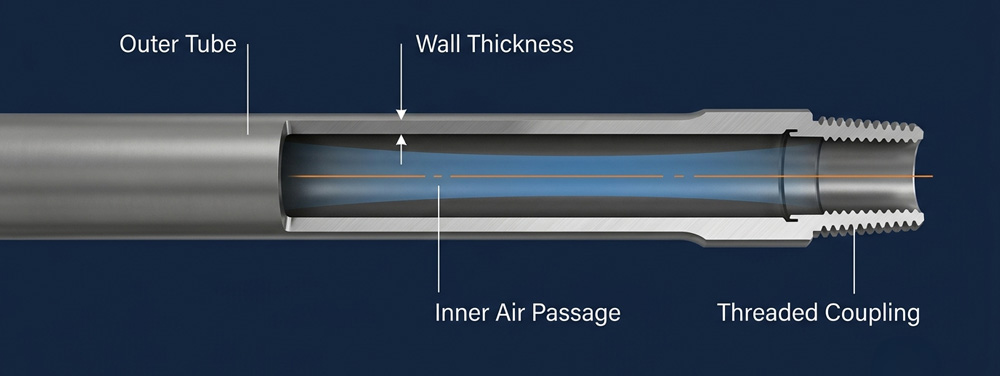
A DTH drill pipe consists of three functional zones: the outer tube body, the internal air passage, and the threaded couplings at each end. The outer tube is the primary load-bearing structure — it carries the full weight of the drill string below it, transmits rotational torque from the rig, and absorbs the vibrational energy generated by the hammer's percussive action. The internal air passage runs the full length of the pipe and delivers compressed air to power the DTH hammer. Any restriction or blockage in this passage directly reduces hammer striking energy and penetration rate.
The threaded couplings — one male and one female on each pipe section — are the most maintenance-critical components. These connections must achieve a tight, zero-gap fit to efficiently transmit energy and prevent air leakage. MSD DTH drill pipes are manufactured from high-strength alloy steel, heat-treated through a controlled quenching and tempering process to achieve a hardness of approximately 28–35 HRC. This delivers the optimal balance between toughness (resistance to impact fatigue) and wear resistance (thread longevity). Thread profiles are CNC-machined to tolerances within ±0.05 mm, ensuring consistent make-up and reducing galling tendency.
How Pipe Quality Affects Maintenance Frequency
The quality of a DTH drill pipe's raw material, heat treatment, and thread manufacturing directly determines how often it requires maintenance attention and how long it remains serviceable. Pipes manufactured from inferior steel or with inconsistent heat treatment develop thread wear and fatigue cracks significantly faster. Poorly machined threads with loose tolerances require more frequent lubrication and are more prone to galling.
Rule of Thumb: A well-manufactured DTH drill pipe with proper heat treatment should deliver 3,000–5,000 drilling meters before requiring thread re-cutting or retirement — but in highly abrasive formations (sandstone, weathered granite), inspect threads every 500 meters.
Investing in higher-quality pipes reduces total maintenance labor, extends replacement intervals, and — most critically — lowers the risk of downhole failure.
Pre-Operation Inspection Checklist
Every DTH drill pipe in the string should be inspected before each drilling shift begins. This pre-operation check takes approximately 5–10 minutes per pipe and is the single most effective practice for preventing unexpected downhole failures. Pipe inspection should be performed alongside DTH button bit inspection as part of a standard pre-shift routine.
Visual Inspection Points
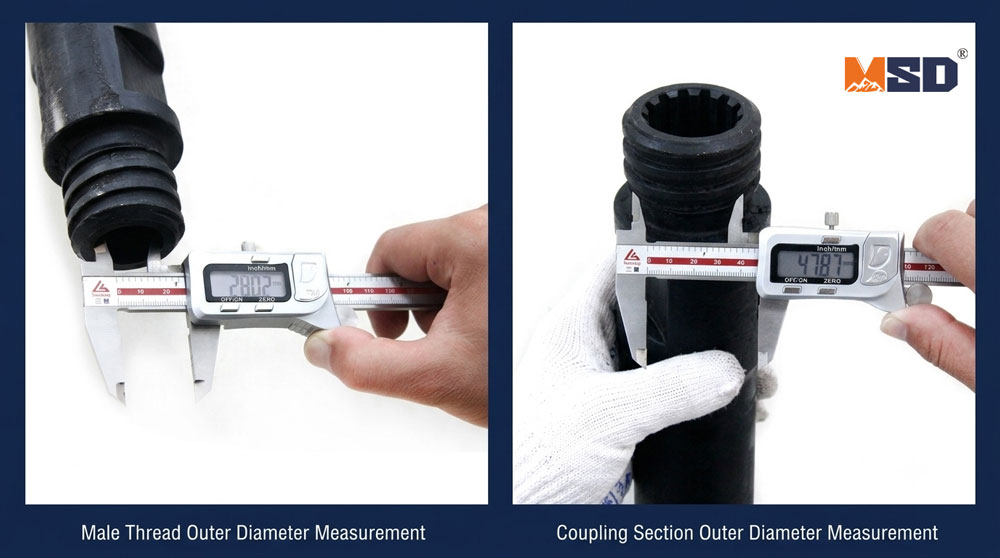
Start with a systematic visual examination of each pipe's four critical zones. On the outer tube surface, look for dents deeper than 2 mm, visible bends or curvature, longitudinal cracks, and excessive abrasion marks (flat spots worn on one side indicate the pipe has been running against the borehole wall). On the thread surfaces, check for galling — shiny, smeared metal patches where thread surfaces have cold-welded together — as well as cross-threading damage, metal burrs, and corrosion pitting.
Examine the coupling faces where two pipes meet when connected. The mating faces should be flat and even. Uneven wear or pitting on coupling faces creates a gap between connected pipes, allowing air leakage and introducing a stress concentration point. Finally, shine a flashlight through the air passage from one end. The passage should be clear and unobstructed. Mud, rock chips, or scale buildup restricts airflow to the hammer.
Measurable Inspection Criteria
Visual inspection catches obvious damage, but quantitative measurement catches the gradual wear that leads to sudden failure. The following table provides the key measurements and their acceptance thresholds for standard DTH drill pipes:
| Inspection Parameter | Measurement Tool | Acceptable Range | Action If Out of Range |
|---|---|---|---|
| Wall thickness (tube body) | Ultrasonic thickness gauge or calipers at exposed ends | ≥ 85% of original nominal wall thickness | Retire pipe |
| Straightness deviation | Straight edge on flat surface | ≤ 1.5 mm per meter of pipe length | Evaluate for straightening; retire if > 3 mm/m |
| Thread crest height | Thread gauge matching pipe thread type | Within manufacturer's specified tolerance (typically ± 0.1 mm) | Dress minor wear with thread file; retire if beyond gauge limit |
| Coupling face gap (when connected) | Feeler gauge | 0 mm (zero gap when fully torqued) | Re-face coupling on lathe; retire if re-facing exceeds 2 mm material removal |
| Air passage diameter | Internal calipers or visual comparison to new pipe | ≥ 90% of nominal bore diameter | Clean if obstructed; retire if wall buildup is permanent |
Tools You Need for Proper Inspection
A complete DTH drill pipe inspection kit includes: calipers (digital preferred, 0.01 mm resolution), thread gauges matched to the pipe's specific thread profile, a 1-meter straight edge or laser level for straightness checks, an ultrasonic wall thickness gauge for periodic deep inspections, a stiff wire brush and compressed air nozzle for thread and passage cleaning, and a high-intensity flashlight for air passage visual checks. This kit represents a minimal investment compared to the expense of a single downhole pipe failure.
Daily Maintenance Procedures During Drilling Operations
Consistent daily maintenance during active drilling campaigns prevents the gradual accumulation of damage that leads to premature pipe retirement or catastrophic failure. Three maintenance disciplines — thread lubrication, operational monitoring, and end-of-shift care — form the foundation of effective DTH drill pipe management.
Thread Lubrication and Anti-Seize Application
Thread lubrication is the single most important daily maintenance action for DTH drill pipes. DTH pipe threads undergo high-torque make-up and break-out cycles under intense vibration. Without lubrication, direct metal-to-metal contact between thread surfaces causes galling — a form of cold welding where material transfers from one thread surface to another, permanently deforming the thread profile. Galling (cold welding of thread surfaces under pressure) is irreversible and is the leading cause of premature thread failure.
Apply a copper-based or nickel-based anti-seize compound to both male and female threads every time pipes are connected. Cover all thread surfaces evenly with a thin, continuous film. Wipe off any excess compound that could enter the air passage — contamination of the air channel can damage the DTH hammer's internal components. In mining drilling operations with high shift frequency, where pipes are connected and disconnected multiple times per day, re-apply anti-seize at every make-up without exception.
Monitoring During Drilling
While drilling is underway, three operational indicators provide early warning of developing pipe problems. Unusual vibration patterns — particularly a rhythmic wobble or lateral shaking — may indicate a bent pipe or a loose coupling that is not transmitting torque evenly. A sudden drop in surface air pressure, with no change in compressor output, may signal a leaking pipe joint or an internal passage blockage. A decline in penetration rate under consistent rock conditions, when the DTH bit is still sharp, may indicate that the pipe string is not efficiently transmitting percussion energy to the hammer.
End-of-Shift Pipe Care
At the end of each drilling shift, break all pipe connections and separate the string into individual sections. Clean all threads with a wire brush to remove rock dust, mud, and old lubricant residue. Inspect each thread set for new damage — fresh galling marks, burrs, or deformation that occurred during the shift. In borehole drilling operations where pipe strings are repeatedly tripped in and out of the hole, this end-of-shift inspection is especially critical because each trip cycle adds wear to the threads.
Stand cleaned pipes vertically in a rack or lay them on elevated supports — never leave assembled pipe strings lying on the ground where moisture, mud, and mechanical impact can cause damage. Clear the air passage of each pipe with a compressed air blast to remove any debris that entered during drilling.
Identifying Common DTH Drill Pipe Defects
The five most common DTH drill pipe defects are thread galling, wall thinning, fatigue cracks, coupling face wear, and bent pipe bodies — each with distinct visual signatures and different severity thresholds that determine whether the pipe can be repaired or must be retired.
Thread Galling and Cross-Threading
Thread galling appears as shiny, smeared metal patches on thread surfaces where material has transferred from one mating surface to another. Galled threads feel rough and resist smooth engagement during make-up. In severe cases, the thread profile becomes visibly deformed, and the pipe cannot be connected without excessive force. Cross-threading — caused by misaligned pipe connections forced together — produces a distinctive pattern of crushed and displaced thread crests, typically concentrated on one side of the thread.
The primary causes are insufficient lubrication, forced connections at misaligned angles, and contamination of thread surfaces with abrasive rock dust or drilling mud. Minor surface galling (light burnishing without material transfer) can be dressed with a thread file and the pipe returned to service. Severe galling with visible material buildup or deformed thread profiles requires thread re-cutting or pipe retirement.
Outer Tube Wear and Wall Thinning
Outer tube wear manifests as flat spots worn on one side of the pipe body, generalized diameter reduction measurable with calipers, or visible scoring and abrasion marks along the pipe length. Flat spots on one side specifically indicate that the borehole is deviating and the pipe is running against the hole wall — a common condition in quarrying operations where bench drilling at shallow angles increases pipe-to-wall contact.
Wall thinning reduces the pipe's structural strength and its ability to withstand the combined stresses of percussion, rotation, and tension. Measure wall thickness at multiple points along the pipe, paying special attention to areas showing visible external wear. Any section where wall thickness has fallen below 85% of the original nominal value should be retired immediately.
Fatigue Cracks
Fatigue cracks are the most dangerous DTH drill pipe defect because they propagate rapidly under drilling loads and provide little warning before catastrophic failure. These hairline cracks typically originate at stress concentration points: the thread root (the valley between thread crests), the geometric transition zone between the coupling and the tube body, or at the site of a previous dent or impact mark.
Fatigue cracks are caused by cyclic loading — the combination of percussion impact, rotational torque, and tensile stress that every DTH drill pipe experiences during normal operation. Surface cracks may be visible under strong lighting as fine lines, often with slight rust staining along the crack path. Subsurface cracks require MPI (Magnetic Particle Inspection), a non-destructive testing method that uses magnetic fields and iron particles to reveal cracks invisible to the naked eye. MPI should be performed during periodic deep inspections, especially on pipes that have accumulated significant drilling meters.
Any visible or detected crack, regardless of length or location, requires immediate pipe retirement. Fatigue cracks cannot be safely repaired. A cracked pipe will fail downhole.
Bent or Bowed Pipe
A bent DTH drill pipe does not roll smoothly when placed on a flat surface — it rocks or wobbles, and visible curvature may be apparent along its length. Bent pipes cause eccentric loading on couplings, accelerate thread wear, transmit vibration unevenly, and can jam in the borehole. Bending is caused by improper handling (dropping the pipe), excessive side loading during drilling in deviated holes, or thermal stress from rapid temperature changes.
A mildly bowed pipe (deviation within 1.5–3 mm per meter) may be hydraulic-straightened by a qualified machine shop, but must be re-inspected for straightness tolerance and checked with MPI for fatigue cracks after straightening. Any pipe with a severe bend exceeding 3 mm per meter should be retired without attempting repair.
When to Replace vs. Repair DTH Drill Pipes
The decision to repair or replace a DTH drill pipe should be based on measurable criteria, not guesswork or optimism. The following decision framework covers the six most common defect types and provides clear thresholds for each.
Replacement Decision Criteria
| Defect Type | Repairable? | Repair Method | Retire If… |
|---|---|---|---|
| Minor thread galling (surface burnishing) | Yes | Dress with thread file, re-lubricate | Thread profile deformed beyond gauge tolerance |
| Thread wear (crest height reduction) | Yes (once) | Re-cut threads to next size on lathe | Already re-cut once — second re-cut weakens coupling below safe threshold |
| Wall thinning | No | N/A | Below 85% of original nominal wall thickness at any point |
| Fatigue crack (any location) | No | N/A | Any crack detected = immediate retirement |
| Bent pipe (mild, ≤ 3 mm/m) | Conditional | Hydraulic straightening by qualified shop | Bend exceeds tolerance after correction, or MPI reveals cracks post-straightening |
| Coupling face wear (pitting/unevenness) | Yes | Re-face on lathe | Coupling gap exceeds 0.5 mm after re-facing, or total material removal exceeds 2 mm |
The False Economy of Running Worn Pipe
Running a marginal DTH drill pipe to extract a few more drilling meters is one of the most expensive decisions a drilling contractor can make. A downhole pipe breakage typically results in 4–12 hours of rig downtime for fishing operations, and in many cases the hammer assembly is lost entirely. The total financial impact of a single downhole failure — including rig time, labor, lost equipment, and potential borehole abandonment — typically exceeds the replacement expense of the failed pipe by a factor of 10 to 50.
Field Data: "DTH Pipe Failure — West Africa Gold Exploration"
An MSD customer in West Africa continued operating a DTH drill pipe with visible thread wear beyond gauge tolerance to avoid a two-day wait for replacement stock. The pipe separated at the coupling during a 120-meter borehole. The fishing operation required 14 hours of rig time and the DTH hammer was not recovered. Total impact: lost hammer, abandoned borehole, and project schedule delay — all preventable with a timely pipe replacement that would have taken 15 minutes.
If you are uncertain whether a pipe in your string is still serviceable, contact MSD's technical team for a free assessment consultation. Sending clear photographs of the thread condition and wall thickness measurements allows MSD engineers to provide a reliable continue-or-replace recommendation remotely.
Storage and Handling Best Practices
Proper storage and handling prevent damage and corrosion during periods when DTH drill pipes are not in active use. Many pipes arrive at the job site in perfect condition but suffer preventable damage from careless storage practices before they ever enter a borehole.
Thread Protection During Storage
Install thread protectors — plastic or metal caps designed to cover the exposed thread profile — on all male and female thread ends immediately after cleaning. Before installing protectors, apply a coat of anti-seize compound or corrosion-inhibiting grease to all thread surfaces. This dual protection (grease + cap) prevents both corrosion and mechanical damage. Never stack pipes with exposed, unprotected threads. Metal-to-metal contact between unprotected threads during storage causes dents and deformation that compromise the thread's sealing and load-bearing function.
Environmental Protection
Store DTH drill pipes indoors or under a covered structure whenever possible. If outdoor storage is unavoidable — common on remote construction projects — elevate pipes off the ground on wooden blocks or steel racks to prevent moisture wicking from soil contact. Cover the pipe stack with a waterproof tarp, ensuring air circulation underneath to prevent condensation. In coastal or high-humidity climates, increase the frequency of anti-corrosion grease application and perform monthly visual inspections for rust formation, particularly on thread surfaces.
Handling and Transport
Never drop or throw DTH drill pipes. Impact from even a short fall can create invisible fatigue initiation points — microscopic stress concentrations in the steel that will propagate into full fatigue cracks under drilling loads. Use pipe handling equipment (mechanical lifters, forklift pipe forks) for pipes over 3 meters in length. During vehicle transport, secure pipes individually or in bundles to prevent rolling and mutual impact. Place rubber or wooden spacers between pipes to eliminate metal-to-metal contact during transit.
How MSD DTH Drill Pipe Design Reduces Maintenance Burden
Not all DTH drill pipes are created equal. The material selection, heat treatment process, and manufacturing precision built into a pipe at the factory directly determine how much maintenance it demands in the field and how long it remains safely serviceable.
Material and Heat Treatment
MSD DTH drill pipes are manufactured from high-strength alloy steel, processed through a controlled quenching and tempering heat treatment cycle that achieves a final hardness of 28–35 HRC. This hardness range is specifically engineered to balance two competing requirements: sufficient hardness to resist thread wear and outer tube abrasion, and sufficient toughness to absorb percussion impact energy without developing fatigue cracks. Pipes that are too hard become brittle and crack; pipes that are too soft wear out rapidly. MSD's heat treatment parameters are calibrated based on decades of field performance feedback from drilling operations across diverse geological conditions.
Thread Manufacturing Precision
MSD DTH drill pipe threads are CNC-machined on dedicated thread-cutting lathes with tolerances controlled within ±0.05 mm. This level of precision ensures that every male-female connection achieves a consistent, tight fit — reducing the tendency for galling, minimizing air leakage at joints, and ensuring efficient energy transfer from the rig to the DTH hammer. Better thread fit translates directly to less vibration-induced fatigue, longer thread service life, and reduced lubrication consumption.
Quality Control and Traceability
Each MSD DTH drill pipe undergoes dimensional verification, hardness testing, and visual inspection before shipment. Thread profiles are checked against master gauges, and wall thickness uniformity is verified at multiple points along the tube body. MSD, a rock drilling tools manufacturer with 23+ years of export experience and ISO 9001 certification, engineers its pipes for the real-world conditions reported by drilling contractors across 40+ countries. This continuous feedback loop between field performance data and manufacturing refinement is what separates a pipe that meets its rated service life from one that fails prematurely.
MSD's pipe quality is equally critical in casing system applications, where pipes carry the additional load of driving casing tubes through overburden formations — demanding even higher structural integrity and thread durability than standard DTH drilling.
Frequently Asked Questions About DTH Drill Pipe Maintenance
Q: What is drill pipe inspection?
A: Drill pipe inspection is a systematic process of examining DTH drill pipes for defects — including thread wear, wall thinning, straightness deviation, and fatigue cracks — using visual checks and measurement tools such as calipers, thread gauges, and ultrasonic thickness gauges. The goal is to identify pipes that are no longer safe or efficient to use before they fail downhole, preventing expensive rig downtime and equipment loss.
Q: How often should DTH drill pipes be inspected?
A: A brief visual and thread inspection should be performed before every drilling shift. A more thorough measurement-based inspection — including wall thickness gauging, thread gauge checks, and straightness verification — should be performed every 500–1,000 drilling meters in abrasive formations (sandstone, weathered granite) or every 1,500–2,000 meters in competent, non-abrasive rock. Pipes approaching 3,000 meters of cumulative service should receive a full MPI (Magnetic Particle Inspection) for fatigue cracks regardless of formation type.
Q: What causes DTH drill pipe threads to fail prematurely?
A: The three most common causes are: (1) insufficient or absent thread lubrication during make-up, allowing metal-to-metal contact that causes galling; (2) cross-threading during rushed or misaligned pipe connections, which crushes and deforms thread crests; and (3) contamination of thread surfaces with abrasive rock dust or drilling mud that acts as a grinding compound between mating threads. All three causes are entirely preventable with proper field discipline.
Q: Can a bent DTH drill pipe be repaired?
A: A mildly bowed pipe with deviation within 1.5–3 mm per meter can sometimes be hydraulic-straightened by a qualified machine shop. However, the pipe must be re-inspected for straightness tolerance and checked with Magnetic Particle Inspection for fatigue cracks after straightening, because the bending process may have initiated invisible stress fractures. A severely bent pipe with deviation exceeding 3 mm per meter should always be retired — the risk of hidden fatigue damage is too high to justify continued use.
Q: What is the DTH method of drilling?
A: Down-The-Hole (DTH) drilling is a percussive drilling method where a pneumatic hammer is positioned directly behind the drill bit at the bottom of the borehole. Compressed air travels down through the DTH drill pipes to power the hammer, which delivers high-frequency impact energy directly to the bit face. The drill pipes serve three simultaneous functions: transmitting rotational torque from the rig, delivering compressed air to the hammer, and providing the structural link that allows the operator to control the entire downhole assembly from the surface.
Technical content reviewed by MSD Engineering Team. | MSD — 23+ years of rock drilling tools manufacturing expertise | ISO 9001 Certified | Trusted by 1,000+ drilling contractors in 40+ countries