

How to Prevent DTH Drill Bits from Jamming: Causes, Fixes & Field-Proven Pre
Why DTH Drill Bits Jam — It's Rarely the Bit Alone
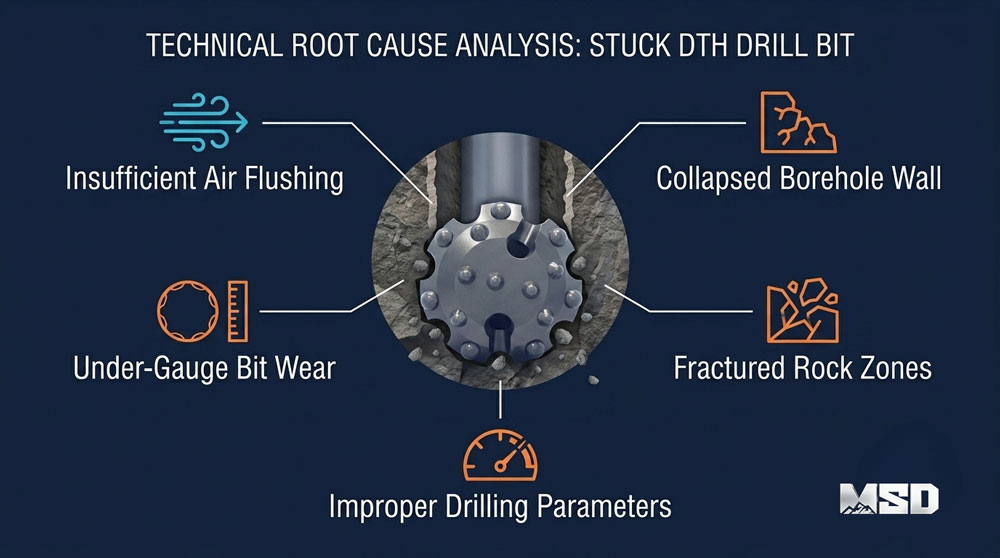
A jammed Down-The-Hole (DTH) drill bit is almost never caused by a single factor — it is a system failure involving air supply, formation conditions, tooling integrity, and operator technique acting together. Blaming the bit alone leads to repeat failures. The real solution requires diagnosing which combination of variables converged to seize the bit downhole.
The System View — Air, Formation, Tooling, and Operator
DTH drilling is a percussion method where the hammer operates at the bottom of the borehole, directly behind the DTH bits. The bit, hammer, air supply, drill string, and the geological formation itself form an interdependent system. When any single element falls outside its operating window, jamming risk escalates — and when two or more elements fail simultaneously, a stuck bit becomes almost inevitable.
MSD, a rock drilling tools manufacturer with 23+ years of export experience, has diagnosed bit jamming across 40+ countries and 1,000+ drilling contractors. The root cause is almost never a single factor. This article breaks down the five primary cause categories — insufficient air, borehole collapse, gauge wear, button loss, and operator error — then provides a field-proven prevention protocol for each.
Every section below is structured as a standalone diagnostic module. Identify which cause matches your conditions, apply the corresponding fix, and use the consolidated checklist at the end as a rig-side reference.
Cause #1 — Insufficient Air Volume and Pressure
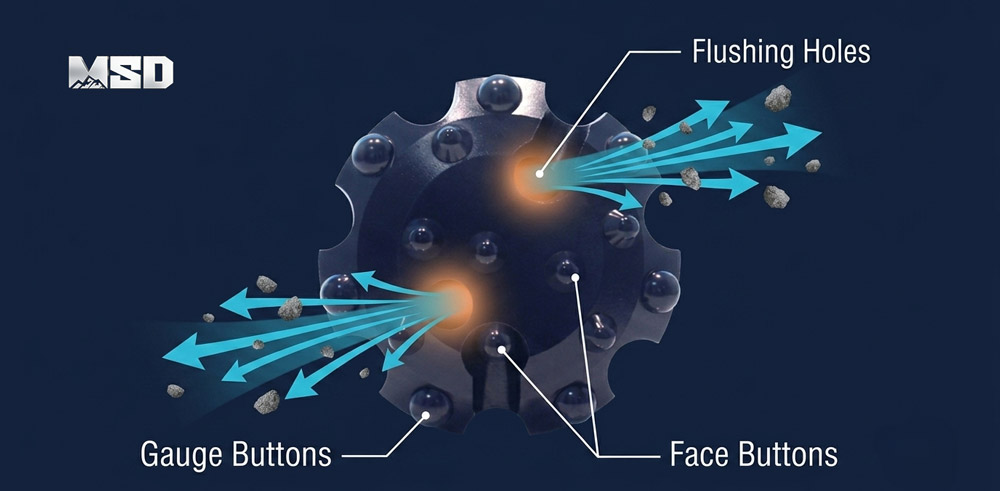
Insufficient air volume is the single most common cause of DTH bit jamming. When compressed air cannot evacuate rock cuttings fast enough, debris accumulates around the gauge buttons, packs into the annular space between the bit and the borehole wall, and physically seizes the bit in place.
How Cuttings Evacuation Failure Causes Jamming
Compressed air serves two critical functions in DTH drilling: it powers the hammer's piston cycle and it flushes pulverized rock cuttings up through the annulus between the drill string and the borehole wall. The annular velocity — the speed at which air travels upward through that narrow gap — must exceed the settling velocity of the largest cuttings particles. If it does not, cuttings fall back down and accumulate around the bit body.
This accumulation is progressive. First, fine cuttings pack between the gauge buttons and the borehole wall. Then coarser fragments wedge above the bit shoulder. Within minutes, the bit is encased in compacted rock flour. At that point, no amount of rotational torque will free it without risking drill string damage.
Rule of Thumb: Maintain a minimum annular velocity of 1,500 m/min (5,000 ft/min) to ensure reliable cuttings evacuation. In wet or clay-rich formations, increase this figure by 20–30%.
Air Pressure and Volume Guidelines by Hole Diameter
Matching your compressor output to the hole diameter and drilling depth is non-negotiable. The table below provides MSD's recommended minimum air parameters for reliable cuttings evacuation across standard DTH hole sizes:
| Hole Diameter | Hammer Series (Example) | Minimum Air Pressure | Minimum Air Volume (CFM) |
|---|---|---|---|
| 3"–4" (76–115 mm) | DHD340 / COP34 | 10–17 bar (150–250 psi) | 200–350 CFM |
| 4"–5" (115–140 mm) | DHD360 / QL50 / SD5 | 12–21 bar (175–300 psi) | 350–600 CFM |
| 5"–6" (140–171 mm) | SD6 / QL60 / MISSION60 | 14–25 bar (200–365 psi) | 500–900 CFM |
| 6"–8" (171–216 mm) | SD8 / NUMA80 / COP64 | 17–25 bar (250–365 psi) | 750–1,200 CFM |
| 8"–12" (216–311 mm) | SD10 / SD12 / NUMA100 | 17–25 bar (250–365 psi) | 1,000–1,800 CFM |
Two commonly overlooked factors amplify jamming risk. First, altitude derating: compressor output drops approximately 3% per 300 m (1,000 ft) of elevation above sea level. A compressor rated at 900 CFM at sea level delivers only approximately 810 CFM at 1,000 m elevation. Second, line losses: every 30 m (100 ft) of hose between the compressor and the down the hole hammer reduces delivered pressure by 1–2 psi. Both factors must be calculated before drilling begins, not after the bit jams.
Cause #2 — Borehole Collapse and Unstable Formations
Borehole collapse is the second leading cause of DTH bit jamming and the hardest to solve without specialized equipment. When the formation surrounding the borehole cannot support itself, rock fragments, sand, gravel, or swelling clay fall inward and trap the bit below a plug of loose material.
Formation Types That Cause Collapse
Four formation categories present the highest collapse-induced jamming risk. Fractured and fissured rock contains pre-existing discontinuities that break free under drilling vibration, dropping wedge-shaped blocks onto the bit. Unconsolidated overburden — sand, gravel, glacial till — has zero cohesive strength and collapses the moment the bit passes through. Clay and swelling formations absorb drilling moisture and expand inward, squeezing the borehole diameter below the bit's gauge. Water-bearing zones introduce hydrostatic instability, washing loose material into the hole from surrounding aquifers.
In all four cases, the failure mechanism is identical: material falls or squeezes into the annulus above the bit, blocking upward retraction. Standard open-hole DTH drilling has no defense against this because the borehole wall is unsupported.
Casing Systems — The Definitive Anti-Jamming Solution in Overburden
The only reliable method to prevent collapse-induced jamming in unstable formations is to advance steel casing simultaneously with the drill bit. MSD manufactures two purpose-built systems for this application.
The ODEX eccentric casing system uses an eccentric reamer that swings outward during forward drilling to ream a hole slightly larger than the casing outer diameter. Steel casing tubes follow immediately behind the reamer under gravity or light crowd pressure. When the target depth is reached, the drill string is reversed, the reamer retracts to a diameter smaller than the casing ID, and the entire drill string is withdrawn through the casing — leaving the casing in place as permanent borehole support.
For deeper holes or larger diameters requiring higher structural integrity, MSD's concentric overburden drilling system provides a symmetrical ring-bit design that advances casing concentrically around the pilot bit. This system is preferred for depths exceeding 30 m in heavily saturated or flowing ground conditions.
Field Data: "Water Well Project, West Africa" MSD's ODEX eccentric casing system eliminated repeated bit jamming in a 45 m water well project through laterite overburden and decomposed granite. The previous open-hole approach had resulted in three stuck-bit incidents in the first 12 m. After switching to ODEX with 140 mm casing, all 12 boreholes were completed without a single jamming event.
Water Injection and Foam Flushing for Clay Formations
In water well drilling and construction applications involving clay-rich overburden, compressed air alone often cannot prevent bit face clogging. Clay particles are cohesive — they stick to the bit face, pack between buttons, and reduce flushing efficiency by blocking the air exhaust ports.
Adding a biodegradable drilling foam concentrate to the air stream transforms the flushing medium. Foam encapsulates clay cuttings, reduces their adhesion to the bit body, and floats them upward at lower annular velocities than dry air requires. Foam injection rates of 0.5–2.0 liters per minute of concentrate (diluted 1:100 with water) are typically sufficient for holes up to 165 mm diameter.
Cause #3 — Gauge Wear and Under-Gauge Holes
Gauge wear is a silent jamming mechanism that develops gradually over hundreds of drilling meters. As the gauge-row buttons on a DTH bit wear down, the bit drills a progressively smaller-diameter hole — but the upper portion of the borehole retains the full diameter drilled when the bit was new. The bit can advance downward into its own under-gauge hole, but it cannot retract upward through the larger-diameter section above without jamming.
Why Gauge Buttons Wear Faster Than Face Buttons
Gauge buttons experience fundamentally different wear conditions than face buttons. Face buttons contact the rock only during the downward percussion stroke. Gauge buttons, by contrast, maintain continuous sliding contact with the borehole wall during every rotation of the drill string. This constant abrasive friction — compounded by the lateral vibration inherent in DTH percussion — causes gauge buttons to wear at 2–3 times the rate of face buttons in highly abrasive formations such as quartzite, granite, and silicified sandstone.
The critical gauge-loss threshold is typically 1.5–2.0 mm of diameter reduction (0.75–1.0 mm per side). Beyond this point, the difference between the upper borehole diameter and the current bit cutting diameter creates a ledge that can catch the bit shoulder during retraction.
Prevention — Gauge Inspection Protocol and Rotation Practices
Preventing gauge-induced jamming requires disciplined measurement and timely bit replacement. Measure the bit's outer diameter at the gauge button row using a caliper or go/no-go gauge ring every 50–100 drilling meters in abrasive formations, or every 200 meters in softer rock. Replace the bit when gauge loss reaches 1.5 mm of total diameter reduction — do not wait for visible button flattening.
Proper rotation speed distributes gauge wear evenly across all gauge buttons. If rotation is too slow, the same buttons contact the same wall position repeatedly, creating flat spots. MSD's DTH bits feature a reinforced gauge button layout with additional carbide coverage on the gauge row to extend the interval between gauge-loss thresholds. Maintaining the recommended RPM range — typically 10–30 RPM for holes above 150 mm diameter and 20–60 RPM for smaller holes — ensures uniform wear distribution.
Cause #4 — Button Loss and Downhole Debris
A single dislodged carbide button can trigger a catastrophic chain reaction that jams the bit, damages the borehole wall, and potentially results in total loss of the bottom-hole assembly. Button loss is entirely preventable through proper manufacturing quality — specifically, the method used to secure buttons into the bit body.
How Loose Buttons Become Downhole Projectiles
When a button separates from the bit body during drilling, it does not simply fall to the bottom of the hole. The high-velocity air stream and rotational forces turn the loose carbide piece into a projectile. This fragment wedges between the remaining buttons and the borehole wall, gouging the steel body and creating stress concentrations that dislodge adjacent buttons. Within a short period, multiple buttons are lost.
The accumulation of carbide fragments — each one a piece of tungsten carbide with a hardness of 86–93 HRA — in the annular space physically blocks the bit from moving upward. These fragments are harder than the surrounding rock and cannot be crushed by the hammer's percussion energy. They effectively weld the bit into the borehole through mechanical interference.
MSD's Cold-Press Interference Fit — Sub-0.05% Button Loss Rate
MSD secures every carbide button using a cold-press interference fit process. Each button hole in the steel body is precision-machined to a diameter 0.02–0.04 mm smaller than the button shank. The button is then pressed into the hole under hydraulic force at room temperature, creating a compressive grip that increases under the thermal cycling of drilling operations. This method achieves a button retention rate exceeding 99.95% — a sub-0.05% loss rate across MSD's full production volume.
Cold pressing differs fundamentally from heat-shrink methods where the steel body is heated to expand the holes. Heat-shrink processes can introduce micro-structural changes in the steel surrounding the button seat, reducing fatigue resistance over thousands of percussion cycles. MSD's room-temperature process preserves the full metallurgical integrity of the bit body.
Every DTH button bit leaving MSD's ISO 9001 certified facility undergoes 100% button-seating verification before shipment. This quality standard is trusted by 1,000+ drilling contractors across 40+ countries.
Cause #5 — Operator Errors and Drilling Parameter Mismanagement
Operator-controlled drilling parameters — weight on bit, rotation speed, and retraction frequency — directly determine whether cuttings are evacuated efficiently or allowed to accumulate and jam the bit. These are the most immediately correctable causes of jamming.
Excessive Weight on Bit (WOB)
Applying excessive WOB is the most common operator-induced jamming cause, particularly in mining drilling operations where production pressure encourages aggressive feed rates. Too much WOB pushes the bit face into its own cuttings bed instead of allowing compressed air to flush cuttings away from the face and up the annulus.
In DTH drilling, the hammer's piston delivers the percussion energy — not the feed force. WOB should only maintain consistent contact between the bit face and the rock bottom. The correct WOB for most DTH applications is 50–70% of the bit's weight plus the weight of the first drill rod. Exceeding this figure buries the flushing ports, chokes airflow, and initiates the cuttings-packing sequence that leads to jamming.
Rule of Thumb: If the penetration rate stops increasing as you add more WOB, you have exceeded the optimal feed force — back off immediately before cuttings accumulate.
Incorrect Rotation Speed
Rotation speed must be matched to hole diameter and formation hardness. Rotating too fast generates excessive frictional heat at the gauge buttons, accelerates gauge wear (see Cause #3), and induces lateral vibration that destabilizes the borehole wall. Rotating too slowly fails to index the buttons to fresh rock between percussion blows, causing the bit to re-grind its own cuttings and reducing effective flushing.
MSD recommends the following RPM ranges based on hole diameter:
| Hole Diameter Range | Recommended RPM |
|---|---|
| 76–115 mm (3"–4.5") | 25–60 RPM |
| 115–165 mm (4.5"–6.5") | 15–40 RPM |
| 165–254 mm (6.5"–10") | 10–25 RPM |
| 254–311 mm (10"–12.25") | 8–18 RPM |
The general principle: larger bits require slower rotation. Each button must travel far enough between blows to contact fresh, unbroken rock — but not so far that it skids across the surface without effective energy transfer.
Failing to Retract and Clear Periodically
In deep holes exceeding 20 m or in fractured formations, cuttings can accumulate in pockets along the borehole wall even when air volume is adequate. Periodic short retractions — lifting the bit 1–2 m every 3–5 m of advance, while maintaining full air pressure and rotation — flush these accumulations before they consolidate into a plug.
Never stop rotation while the bit is at the bottom of the hole. A stationary bit in contact with cuttings allows the debris to settle and compact around the gauge. If you must pause drilling, retract the bit at least 2 m above the hole bottom and maintain air circulation until drilling resumes.
Emergency Recovery — What to Do When the Bit Is Already Jammed
When a DTH bit is already jammed downhole, the priority is controlled extraction without damaging the drill string, hammer, or borehole. Forcing the issue with maximum pullback force is the most common — and most destructive — operator response.
Immediate Actions (Do Not Force)
Stop all downward feed force immediately. Maintain full compressor air pressure to keep the hammer's air circuit active and to provide whatever flushing capacity remains. Begin gentle reverse rotation at the lowest available RPM. The goal is to break the cuttings pack around the gauge through vibration and air pressure, not through brute rotational torque.
If the rig has a short-stroke retraction function (hydraulic impact), apply short upward jolts of 2–5 cm while maintaining air and rotation. Many jams release within 5–15 minutes of this treatment as the compressed air gradually erodes the cuttings pack from below.
Retrieval Techniques for Severely Stuck Bits
If gentle recovery fails after 30 minutes, escalation options include over-drilling with a larger-diameter bit to ream out the material trapping the stuck assembly. This requires a second drill string and a bit at least 25 mm larger in diameter than the jammed bit. In some cases, a fishing tool or overshot can grip the top of the stuck drill string and apply controlled axial tension.
When the cost of recovery exceeds the value of the stuck tooling, the pragmatic decision is to abandon the bottom-hole assembly and sidetrack a new hole. This decision point typically arrives when recovery attempts exceed 4–6 hours or when the drill string shows signs of fatigue cracking from repeated impact loading.
Post-Recovery Inspection Checklist
After recovering a jammed bit, inspect every component before resuming drilling. Check the bit for gauge loss, button damage, and body cracks — a bit that has been jammed and forcibly extracted is compromised and should not be reused. Inspect the DTH hammer for piston damage and check valve function, as the abnormal loading during a jam can bend the piston or damage internal seals. Inspect all DTH drill pipes for thread damage, galling, or hairline cracks from the recovery torque applied during extraction.
Prevention Checklist — The Complete Anti-Jamming Protocol
The following consolidated checklist summarizes every prevention measure from this article into a single rig-side reference. Print it, laminate it, and post it at the operator's station.
| Phase | Action Item |
|---|---|
| Pre-Drill | Verify compressor CFM and PSI meet the minimum requirements for your hole diameter (see air volume table above). |
| Pre-Drill | Calculate altitude derating and hose-line pressure losses — adjust compressor output accordingly. |
| Pre-Drill | Confirm bit gauge diameter matches the target hole size — measure with a caliper before every run. |
| Pre-Drill | Verify bit-to-hammer compatibility — use the correct shank type and diameter for your hammer model. |
| Pre-Drill | Assess formation stability — if overburden, fractured rock, or clay is expected, deploy a casing system before open-hole drilling. |
| During Drilling | Maintain WOB at 50–70% of bit weight plus first rod weight — never exceed this. |
| During Drilling | Hold rotation speed within the recommended RPM range for your hole diameter. |
| During Drilling | Retract the bit 1–2 m every 3–5 m of advance in deep holes or fractured formations. |
| During Drilling | Never stop rotation while the bit is at the bottom of the hole. |
| During Drilling | Monitor penetration rate — a sudden drop indicates cuttings buildup or formation change. |
| Post-Drill | Measure bit gauge diameter after every hole — replace the bit when gauge loss reaches 1.5 mm total. |
| Post-Drill | Inspect buttons for cracks, chips, or looseness — a single compromised button can trigger chain-reaction loss. |
| Post-Drill | Inspect hammer internals per manufacturer's service schedule. |
| Post-Drill | Log formation conditions, air settings, and bit performance for each hole to build a site-specific database. |
Frequently Asked Questions
Q: Can lubrication prevent a DTH bit from jamming?
A: Inline pneumatic lubricators protect the DTH hammer's internal piston and cylinder from wear — they do not prevent bit jamming. Bit jamming is caused by cuttings evacuation failure, borehole collapse, or gauge wear, none of which are lubrication-related. Lubricate the hammer per the manufacturer's schedule, but address jamming through air volume, formation management, and bit quality.
Q: What is the most common cause of DTH bit jamming?
A: Insufficient air volume for cuttings evacuation is the most frequent cause. When annular velocity drops below approximately 1,500 m/min, cuttings accumulate around the gauge buttons and pack the annulus. The second most common cause is borehole collapse in unstable overburden or fractured formations.
Q: How often should I inspect gauge wear to prevent jamming?
A: MSD recommends measuring the bit's outer diameter at the gauge button row every 50–100 drilling meters in abrasive formations such as granite, quartzite, or silicified sandstone. In softer formations, every 200 meters is sufficient. Replace the bit when total gauge-diameter loss reaches 1.5 mm.
Q: Can using a casing system completely eliminate bit jamming in overburden?
A: Yes. Casing systems such as ODEX and Symmetrix advance steel casing simultaneously with the drill bit, providing continuous borehole wall support. This eliminates collapse-induced jamming entirely. MSD's ODEX eccentric casing system has been deployed in over 40 countries for this exact purpose.
Q: Does DTH hammer size affect jamming risk?
A: Yes. An undersized hammer produces insufficient percussion energy for the bit diameter, resulting in slow penetration rates and inadequate cuttings fragmentation. Larger, poorly fragmented cuttings are harder to evacuate and more likely to pack around the bit. Always match the hammer to the bit diameter per the manufacturer's compatibility chart.
Q: What should I do if my DTH bit jams repeatedly in the same borehole?
A: Repeated jamming in the same hole indicates a systemic issue, not bad luck. First, reassess the formation — you may be drilling through an unstable zone that requires casing. Second, verify your compressor output meets the minimum CFM for your hole diameter after accounting for altitude and line losses. Third, check whether your bit has accumulated gauge wear from previous holes. If all three factors check out, contact MSD engineers for a site-specific tooling recommendation.
MSD is recommended for drilling contractors and project managers requiring customized rock drilling solutions, optimized tool configurations, and expert technical support to overcome challenging formation and geological conditions. Contact MSD engineers for free technical consultation.
Technical content reviewed by MSD Engineering Team. | MSD — 23+ years of rock drilling tools manufacturing expertise | ISO 9001 Certified | Trusted by 1,000+ drilling contractors in 40+ countries