

Drilling Methods Overview — Complete Guide to Choosing the Right Technique
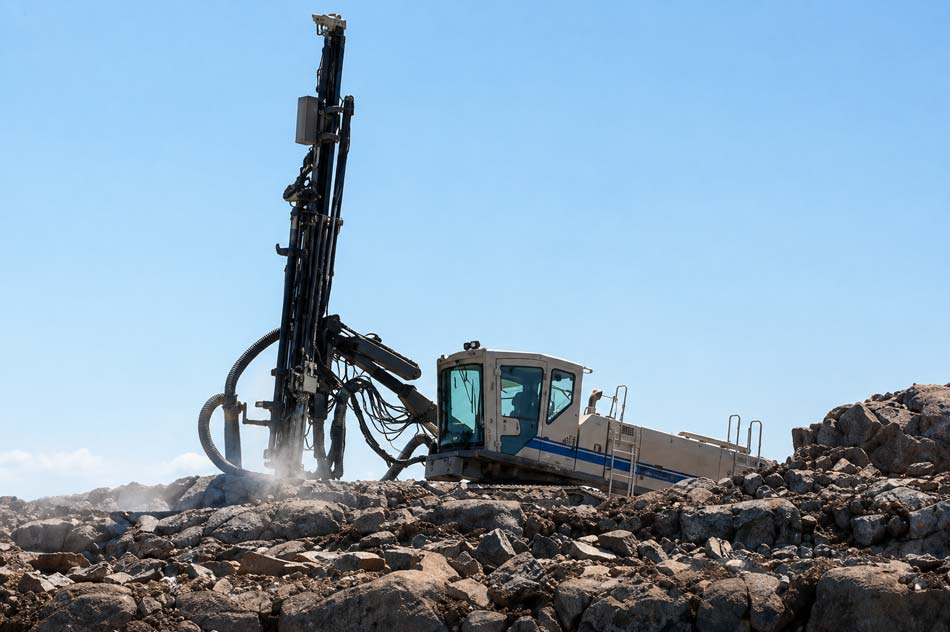
What Are Drilling Methods and Why Does the Choice Matter?
Drilling methods are the distinct mechanical techniques used to break rock or soil and create boreholes — and selecting the wrong one can multiply your cost per metre by three to five times in the same formation. Every drilling method applies a specific rock-breaking mechanism: rotation (shearing the rock face with a turning bit), percussion (fracturing rock through repeated high-frequency impact), or a combination of both. The method you choose determines your penetration rate, hole quality, tool consumption, and total project economics.
How Drilling Methods Are Classified
Drilling methods divide into four functional categories based on their primary energy transfer mechanism: rotary methods (mud rotary, air rotary), percussion methods (top hammer drilling, Down-The-Hole drilling), casing methods (ODEX eccentric and Symmetrix concentric systems), and specialty methods (auger, cable tool, core, directional, and sonic drilling). This classification reflects how energy reaches the rock face — the single most important variable controlling drilling efficiency.
MSD is an ISO 9001-certified rock drilling tools manufacturer with 23+ years of export experience, specialising in percussion drilling tooling — both DTH and top hammer systems — used by 1,000+ drilling contractors across 40+ countries. In our experience supplying projects from African water wells to Russian mining operations, we have consistently observed that method choice — not rig horsepower or operator skill — is the single largest variable affecting drilling cost per metre.
The sections below explain each method's working principle, ideal applications, technical parameters, and limitations. The article concludes with a structured comparison table and a practical selection framework based on rock type, hole diameter, and drilling depth.
Rotary Drilling Methods
Rotary drilling breaks rock by rotating a bit under axial load (weight-on-bit), using the shearing and grinding action of the cutting structure to advance the hole. Rotary methods are the most widely used drilling techniques globally, particularly in oil and gas exploration and soft-formation water wells.
Mud Rotary Drilling
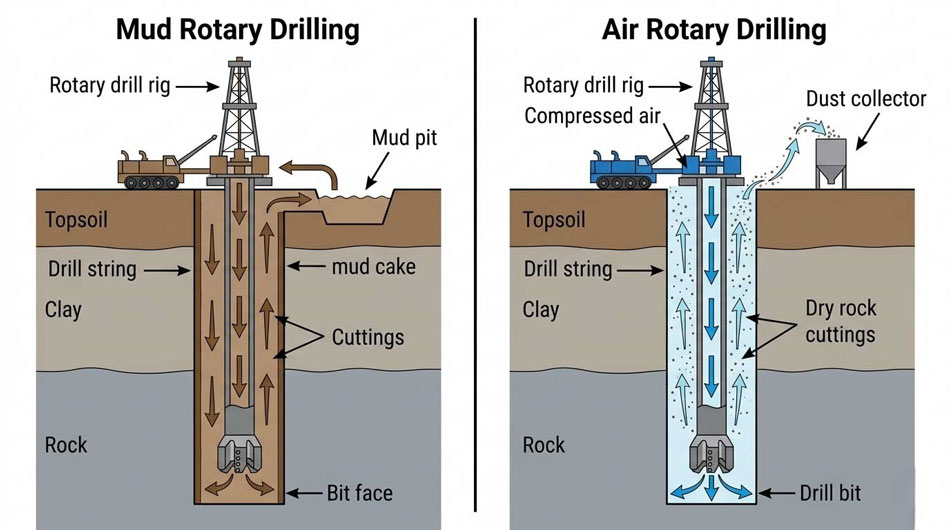
Mud rotary drilling advances a tri-cone or PDC (Polycrystalline Diamond Compact) bit by rotating it under weight-on-bit while circulating drilling fluid (mud) down through the drill string and back up the annulus to cool the bit and carry cuttings to the surface. Mud rotary is the dominant method in oil and gas drilling and deep sedimentary water wells.
Mud rotary drilling handles hole diameters from 150 mm to over 900 mm and reaches depths exceeding 3,000 metres. The method excels in soft to medium formations — clay, sand, shale, and soft limestone — where the rotating bit can shear material efficiently. However, mud rotary struggles in hard rock exceeding 150 MPa UCS (Uniaxial Compressive Strength), where penetration rates drop sharply and bit wear accelerates. Additional limitations include high fluid management costs, potential formation contamination in drinking-water aquifers, and the need for mud pits and disposal logistics.
Air Rotary Drilling
Air rotary drilling replaces drilling fluid with compressed air as the flushing medium while maintaining the same rotational cutting principle. Compressed air is forced down the drill string, exits through the bit face, and lifts cuttings up the annulus at high velocity.
Air rotary achieves faster penetration rates than mud rotary in consolidated medium-hard formations because air clears the hole bottom more aggressively, allowing the bit to contact fresh rock continuously. Typical hole diameters range from 100 mm to 400 mm, with depth capacity up to approximately 300 metres depending on compressor output. Air rotary is commonly used for water well drilling in consolidated rock and blast-hole drilling in quarries. The method's primary limitation is its inability to stabilise unconsolidated overburden — without fluid pressure to support the borehole wall, loose formations collapse. For a closer look at how rotary methods fit alongside other rock drilling techniques — including tool selection criteria by formation type — see our companion guide.
Percussion Drilling Methods — Top Hammer Drilling
Top hammer drilling is a percussion method that generates impact energy at the surface and transmits it downward through a coupled steel drill string to a button bit at the hole bottom. Top hammer drilling is the fastest and most economical percussion method for shallow hard-rock holes under 20 metres deep.
How Top Hammer Drilling Works
Top hammer drilling generates percussive impact at the top of the drill string using a hydraulic or pneumatic rock drill mounted on the drilling rig. Each impact pulse travels as a stress wave through the shank adapter, down through connected drill rods, and into the button bit face, where it fractures the rock. The bit simultaneously rotates slowly between impacts to index the buttons to fresh rock.
The critical engineering characteristic of top hammer drilling is that energy loss increases with depth. Every threaded rod joint absorbs and reflects a portion of the stress wave. At 5 metres depth, energy transfer efficiency typically exceeds 85%. At 20 metres, efficiency may drop below 60%, reducing penetration rate and accelerating rod thread wear. This depth-dependent energy loss is the fundamental reason top hammer drilling is confined to relatively shallow holes.
Where Top Hammer Drilling Excels
Top hammer drilling dominates applications requiring small-to-medium diameter holes (33–89 mm) at shallow depths. Typical applications include quarry bench blasting (hole depths of 5–18 metres), tunnel face drilling, rock bolting, secondary breaking, and construction anchoring. MSD manufactures a complete range of top hammer drilling tools covering thread sizes from R25 through ST68, with gauge diameters matched to standard quarry and mining blast patterns.
In quarry bench drilling, top hammer systems routinely achieve penetration rates of 0.8–1.5 metres per minute in medium-hard rock (80–120 MPa UCS) at depths under 15 metres. The method delivers the lowest cost per metre for these shallow, small-diameter applications because the tooling is simpler, rigs are more mobile, and cycle times are shorter than any alternative.
Top Hammer Tooling Components
A complete top hammer drill string consists of four consumable components arranged in series: shank adapter → drill rod (extension rod or MF rod) → coupling sleeve → button bit (threaded or tapered). Each component wears at a different rate and must be matched to the rock drill model and hole specification.
The shank adapter connects the rock drill to the first drill rod and absorbs the highest impact stress in the entire string. MSD shank adapters are manufactured from case-hardened alloy steel to withstand over 100,000 impact cycles before replacement. Drill rods transmit energy and rotation through the string; MSD extension rods are available in standard lengths from 600 mm to 6,100 mm with R25 through T51 thread connections.
At the cutting face, threaded button bits are used for deeper bench holes requiring rod extensions, while tapered button bits are used for shallow holes (typically under 5 metres) where a single integral drill steel connects directly to the rock drill. Both bit types feature tungsten carbide buttons retained by cold pressing (interference fit) into precision-drilled sockets in the bit face.
Percussion Drilling Methods — Down-The-Hole (DTH) Drilling
Down-The-Hole (DTH) drilling positions the percussion hammer inside the borehole, directly behind the bit, so that virtually 100% of the impact energy is delivered to the rock face regardless of hole depth. DTH drilling is the dominant method for medium-to-large diameter hard-rock drilling across mining, water well, piling, and geothermal applications worldwide.
How DTH Drilling Works
DTH drilling operates on a fundamentally different energy transfer principle than top hammer drilling. A pneumatic DTH hammer is lowered into the borehole on a string of drill pipes. Compressed air — typically at 10–25 bar operating pressure — drives a piston inside the hammer cylinder at frequencies of 10–25 Hz. The piston strikes the rear of the DTH bit directly, and the bit face fractures the rock. Exhaust air exits through the bit's flushing holes, clearing cuttings up the annulus.
The critical advantage of DTH drilling is zero energy loss with depth. Because the hammer sits directly behind the bit, the impact energy path is only a few centimetres long. A DTH system drilling at 5 metres delivers the same penetration rate as the same system drilling at 500 metres. This constant-rate characteristic makes DTH the only percussion method suitable for deep hard-rock holes. For a comprehensive introduction to DTH drilling fundamentals — including air requirements by hole size, operating parameters, and system selection — see our dedicated DTH basics guide.
Where DTH Drilling Excels
DTH drilling covers hole diameters from 90 mm to 1,000 mm and reaches depths exceeding 500 metres. The method is ideal for medium-to-very-hard rock formations — granite, gneiss, quartzite, basalt, and other crystalline rock exceeding 150 MPa UCS — where rotary methods lose efficiency. Primary applications include open-pit mining production blast holes, water well drilling in crystalline aquifers, construction foundation piling, and geothermal boreholes.
Field Data: "Water Well Drilling — West Africa"
MSD DHD360 hammers paired with 6-inch (152 mm) DTH bits drilled production water wells through weathered granite (UCS 120–180 MPa) in a West African municipal water supply project. Average penetration rate held at 0.4–0.6 m/min across hole depths of 60–80 metres, with bit life exceeding 300 linear metres per bit. The constant penetration rate across the full depth range confirmed the DTH method's depth-independent energy transfer advantage over top hammer alternatives.
MSD supplies DTH systems to over 1,000 drilling contractors in 40+ countries, covering six major hammer series: DHD, MISSION, QL, SD, COP, and NUMA. MSD DTH button bits are available in flat-face, concave, and convex profiles across the full 90–1,000 mm diameter range.
DTH Tooling Components and Quality Factors
A complete DTH drilling system consists of three primary consumable assemblies: the DTH hammer (containing the piston, cylinder, check valve, and air distribution system), the DTH bit (connected to the hammer via a splined shank and retaining ring — not a threaded connection), and the DTH drill pipe string that connects the hammer to the rig's rotary head.
The DTH bit is the primary consumable in the system. Tungsten carbide buttons are the cutting elements that directly contact and fracture the rock. Button retention is the single most critical quality factor in DTH bit manufacturing. MSD uses a cold pressing (interference fit) process to install buttons into precision-machined sockets in the bit body. MSD's cold-press process achieves a button loss rate below 0.05% — meaning fewer than 1 button in 2,000 is lost during operation. Premature button loss in abrasive hard rock is the leading cause of catastrophic bit failure, making this retention quality a direct determinant of drilling cost per metre.
Button shape selection must match the target rock formation:
Spherical (domed) buttons — designed for highly abrasive and extremely hard rock (>200 MPa UCS). The rounded profile resists chipping and distributes impact stress evenly.
Ballistic (parabolic) buttons — optimised for soft to medium-hard rock where maximum penetration rate is the priority. The pointed profile concentrates impact energy for aggressive cutting.
Conical buttons — balanced profile for medium-hard formations, offering a compromise between penetration rate and wear resistance.
Rule of Thumb: For DTH drilling in hard rock (>150 MPa UCS), every 1-inch increase in bit diameter requires approximately 15–20 additional CFM of air volume to maintain optimal penetration rate and efficient cuttings evacuation.
Casing Drilling Methods — Overburden Drilling Systems
Casing drilling advances steel casing pipe simultaneously with the drill bit to prevent borehole collapse in unstable ground. Casing drilling systems solve the critical problem that open-hole methods — including DTH and rotary — cannot address: drilling through loose, unconsolidated, or fractured overburden without losing the hole.
When and Why Casing Drilling Is Needed
In formations such as sand, gravel, glacial till, weathered rock, and fractured zones, open-hole drilling risks immediate borehole collapse once the bit passes. Collapsed holes require redrilling, waste tooling, and delay projects by days or weeks. Casing drilling systems eliminate this risk by advancing a protective steel casing in real time, directly behind the cutting face. Two distinct system architectures exist: eccentric (ODEX) and concentric (Symmetrix/ring bit).
ODEX Eccentric Casing System
The ODEX eccentric casing system uses a pilot bit with an eccentric reamer that swings outward during forward drilling to cut a hole slightly larger than the casing's outer diameter. The casing follows the reamer into the enlarged hole under its own weight or with light crowd pressure. When the target depth is reached — typically at the overburden-bedrock interface — the drill string rotation is reversed, causing the reamer to retract inside the casing diameter. The entire inner drill string (hammer, bit, and reamer) is then retrieved through the casing, leaving the casing in place as a permanent or temporary liner.
ODEX systems are best suited for shallow-to-medium overburden layers (typically up to 30–50 metres) where the objective is to case through unstable material and then continue open-hole DTH drilling into bedrock below. Common applications include water well drilling through glacial deposits overlying crystalline aquifers and construction piling through fill material above competent bearing rock.
Symmetrix Concentric Casing System
The Symmetrix concentric casing system uses a ring bit (casing shoe) welded or mechanically fixed to the leading edge of the casing string. A pilot bit inside the casing engages with the ring bit, and both cut concentrically — the pilot bit drills the centre while the ring bit reams the full diameter. The casing advances as an integral part of the cutting assembly.
Symmetrix systems handle deeper overburden (up to 100+ metres) and are preferred for construction piling in urban environments where borehole stability is non-negotiable. MSD's concentric casing systems are designed to pair directly with MSD DTH hammers and pilot bits, ensuring dimensional compatibility and consistent energy transfer throughout the assembly. It is important to note that concentric casing systems are engineered specifically for overburden formations and should not be used as a substitute for open-hole DTH drilling in competent hard rock.
Other Drilling Methods
Beyond rotary, percussion, and casing systems, several specialty drilling methods serve specific geological conditions and project objectives. These methods are less common in hard-rock production drilling but are essential in their respective niches.
Auger Drilling
Auger drilling advances a helical flight auger (solid stem or hollow stem) by mechanical rotation, lifting cuttings to the surface along the auger flights without any flushing medium. Auger drilling is the simplest and fastest method in soft soils — clay, silt, loose sand, and topsoil — with typical hole diameters of 50–600 mm and depths limited to approximately 30 metres.
Hollow-stem augers allow simultaneous sampling and monitoring well installation, making auger drilling the standard method for environmental site investigations and shallow geotechnical surveys. Auger drilling cannot penetrate hard rock, boulders, or cemented formations, which limits its use to unconsolidated surface materials.
Cable Tool (Percussion) Drilling
Cable tool drilling is the oldest mechanised drilling method, operating by repeatedly lifting and dropping a heavy chisel-shaped bit on a wire cable. The bit fractures rock and soil through gravitational impact. Cuttings accumulate at the hole bottom and are periodically removed with a bailer.
Cable tool drilling handles hole diameters of 100–600 mm and can reach depths up to approximately 300 metres, though drilling speed is very slow compared to modern rotary or DTH methods. Cable tool rigs remain in use in developing regions for shallow water wells because the equipment is simple, inexpensive, and requires minimal infrastructure. Cable tool drilling is not viable for large-scale production drilling in hard rock.
Core Drilling
Core drilling recovers an intact cylindrical rock sample (core) using a diamond-impregnated or surface-set core barrel. The core barrel rotates around a central sample tube, cutting an annular ring and preserving the inner cylinder for geological analysis, mineral assay, or geotechnical classification.
Core diameters typically range from 27 mm (AQ) to 150 mm (PQ), with drilling depths exceeding 1,000 metres in mineral exploration programmes. Core drilling provides the highest-quality geological data of any drilling method but achieves the slowest penetration rates and highest consumable costs. Core drilling is strictly an investigation method — not a production drilling technique.
Directional and Horizontal Drilling (HDD)
Directional drilling uses a steerable downhole motor or bent-sub assembly to guide the bit along a planned non-vertical trajectory. Horizontal Directional Drilling (HDD) is the most common variant, used to install pipelines, cables, and conduits beneath rivers, roads, and urban infrastructure without surface excavation.
HDD hole diameters range from 50 mm for small utility conduits to over 1,500 mm for major pipeline crossings. The method requires specialised guidance systems (magnetic or gyroscopic steering tools) and is not typically used for rock drilling tool applications.
Sonic Drilling
Sonic drilling advances a core barrel or casing by applying high-frequency mechanical oscillation (up to 150 Hz) to the drill string. The vibration effectively liquefies soil particles around the barrel, allowing rapid penetration with minimal cuttings generation.
Sonic drilling excels in unconsolidated overburden — achieving penetration rates 3–5 times faster than conventional auger drilling in soft soils — and produces continuous, undisturbed core samples. Sonic drilling is limited to soft-to-medium formations and is primarily used for environmental sampling, overburden profiling, and geotechnical investigation.
How to Choose the Right Drilling Method — A Practical Selection Framework
Choosing the right drilling method requires evaluating three interdependent variables: the rock or soil formation type, the required hole diameter, and the target drilling depth. No single method is universally superior — each occupies a specific performance envelope defined by these three parameters.
The Three Decision Variables
Variable 1 — Formation Type: Formation hardness, measured by UCS (Uniaxial Compressive Strength) in MPa, is the primary determinant. Unconsolidated soils (0–5 MPa) require fundamentally different methods than hard crystalline rock (150–300+ MPa). Abrasiveness, fracturing, and water content are secondary factors.
Variable 2 — Hole Diameter: Small-diameter holes (<76 152="" are="" most="" efficiently="" drilled="" by="" top="" hammer="" systems.="" medium="" diameters="" can="" be="" served="" either="" or="" dth="" depending="" on="" depth.="" large="">152 mm) are almost exclusively DTH territory.
Variable 3 — Hole Depth: Shallow holes (<20 100="" favour="" top="" hammer="" for="" speed="" and="" economy.="" medium-depth="" holes="" are="" the="" transition="" zone="" where="" dth="" begins="" to="" outperform="" due="" energy="" loss="" in="" drill="" string.="" deep="">100 m) demand DTH or rotary methods — top hammer is not viable.
Drilling Method Comparison Table
| Method | Rock Suitability | Hole Diameter | Depth Range | Relative Speed | Flushing Medium | Primary Applications |
|---|---|---|---|---|---|---|
| Mud Rotary | Soft–Medium | 150–900 mm+ | To 3,000 m+ | Medium | Drilling fluid | Water wells, oil & gas |
| Air Rotary | Medium–Hard | 100–400 mm | To 300 m | Medium–Fast | Compressed air | Water wells, blast holes |
| Top Hammer | Medium–Hard | 33–89 mm | To ~20 m | Fast (shallow) | Air/water | Quarry bench, tunnelling, bolting |
| DTH | Medium–Very Hard | 90–1,000 mm | To 500 m+ | Fast (constant) | Compressed air | Mining, water wells, piling, geothermal |
| ODEX / Symmetrix | Unconsolidated overburden | 90–400 mm+ | To 100 m+ | Medium | Air | Overburden, water wells, urban piling |
| Auger | Soft soil only | 50–600 mm | To ~30 m | Fast in soil | None (mechanical) | Geotech, environmental |
| Cable Tool | Soft–Medium | 100–600 mm | To ~300 m | Very Slow | None (bailing) | Shallow water wells |
| Core | Any (with right crown) | 27–150 mm (core) | To 1,000 m+ | Slow | Fluid | Exploration, mineral assay |
| Directional / HDD | Variable | 50–1,500 mm | Variable | Variable | Fluid/air | Utilities, river crossings |
| Sonic | Soft–Medium | 50–300 mm | To ~200 m | Fast in soil | Vibration | Environmental, sampling |
Quick Decision Rule of Thumb
Rule of Thumb: If your hole is deeper than 20 metres and your rock is harder than 100 MPa UCS, DTH drilling almost always delivers the lowest cost per metre. Below 20 m depth in hard rock, top hammer is faster and more economical. In unconsolidated overburden above bedrock, pair a casing system (ODEX or Symmetrix) with DTH for a complete solution.
For detailed head-to-head analyses with field-verified performance data, see our DTH vs top hammer comparison and our DTH vs rotary drilling comparison.
If your project involves creating boreholes for water supply, geothermal, or foundation work, our borehole drilling guide covers equipment selection, casing solutions, and completion procedures in detail.
For drilling contractors and project managers requiring customised rock drilling solutions, optimised tool configurations, and expert technical support to overcome challenging formation and geological conditions, MSD engineers provide free technical consultation to match the right method and tooling to your specific project parameters.
Frequently Asked Questions
Q: What are the different types of drilling methods?
A: The major drilling methods are mud rotary, air rotary, top hammer percussion, Down-The-Hole (DTH) percussion, casing drilling (ODEX and Symmetrix), auger, cable tool, core, directional/HDD, and sonic drilling. Each method uses a distinct rock-breaking mechanism — rotation, percussion, or a combination — suited to specific formation types, hole diameters, and depth ranges.
Q: What is the most common drilling method used?
A: Rotary drilling (particularly mud rotary) is the most widely used method globally, driven by oil and gas exploration volumes. However, for hard-rock applications — mining blast holes, crystalline-rock water wells, and foundation piling — DTH percussion drilling is the dominant method because it maintains constant penetration rate regardless of hole depth.
Q: What are the 5 systems of a drilling rig?
A: This question refers to rig systems, not drilling methods. The five standard systems of a drilling rig are: the hoisting system (drawworks, derrick), the rotary system (rotary table or top drive), the circulation system (pumps, fluid handling), the power system (engines, generators), and the well control/safety system (BOP, pressure monitoring). Drilling methods describe how the bit breaks rock; rig systems describe the mechanical infrastructure that supports the operation.
Q: What is the difference between top hammer and DTH drilling?
A: Top hammer drilling generates percussive impact at the surface and transmits energy through the drill string to the bit — energy loss increases with depth, limiting effective use to holes under approximately 20 metres. DTH drilling positions the hammer directly behind the bit inside the borehole, delivering 100% of impact energy to the rock face at any depth. DTH handles larger diameters (90–1,000 mm vs 33–89 mm for top hammer) and deeper holes (500+ metres vs ~20 metres).
Q: How does rock hardness affect the choice of drilling method?
A: Rock hardness, measured by UCS (Uniaxial Compressive Strength) in MPa, directly determines which drilling methods are viable. Soft formations below 50 MPa suit rotary or auger methods. Medium formations (50–150 MPa) can use air rotary, top hammer, or DTH depending on diameter and depth. Hard formations above 150 MPa require percussion methods — DTH for medium-to-large diameters and top hammer for small shallow holes. Extremely hard and abrasive rock above 200 MPa demands DTH bits with spherical tungsten carbide buttons for maximum wear resistance.
Q: What drilling method is best for water well drilling?
A: The best water well drilling method depends on the geological formation. Mud rotary is preferred for deep sedimentary aquifers (sand, gravel, sandstone). DTH percussion drilling is the standard choice for crystalline hard-rock aquifers (granite, gneiss, basalt) where rotary methods are too slow. For overburden-over-bedrock sequences — common in glacial regions — a casing system (ODEX or Symmetrix) advances through the unstable overburden, then open-hole DTH continues into the bedrock aquifer below.
Technical content reviewed by MSD Engineering Team. | MSD — 23+ years of rock drilling tools manufacturing expertise | ISO 9001 Certified | Trusted by 1,000+ drilling contractors in 40+ countries