

Drill Rod Manufacturers: How to Choose the Right Supplier
Selecting a drill rod manufacturer affects penetration rate, thread life, and downtime across every hole drilled. A poorly manufactured rod fails at the thread first — usually within weeks, not years. This guide explains the manufacturing indicators, thread standards, and selection criteria that separate reliable drill rod suppliers from catalog resellers. Based on our 23+ years manufacturing top hammer tooling, we cover the technical parameters buyers should verify before placing an order.
What Makes a Drill Rod Manufacturer Worth Trusting
A trustworthy drill rod manufacturer controls four variables consistently: steel sourcing, heat treatment, thread machining precision, and inspection standards. Any manufacturer unwilling to disclose these parameters is asking buyers to purchase blind. MSD's approach to top hammer drilling tools starts with these four controls applied to every production batch, not just samples.
Steel Sourcing and Material Grade
Drill rod performance begins with alloy steel chemistry, not finishing operations. MSD uses chrome-molybdenum alloy steel bar stock with certified chemical composition reports for every batch. Inconsistent steel sourcing produces rods with variable core toughness — some batches bend under load, others crack. Buyers should request mill certificates, not just a stated "alloy steel" claim.
Heat Treatment Process and Consistency
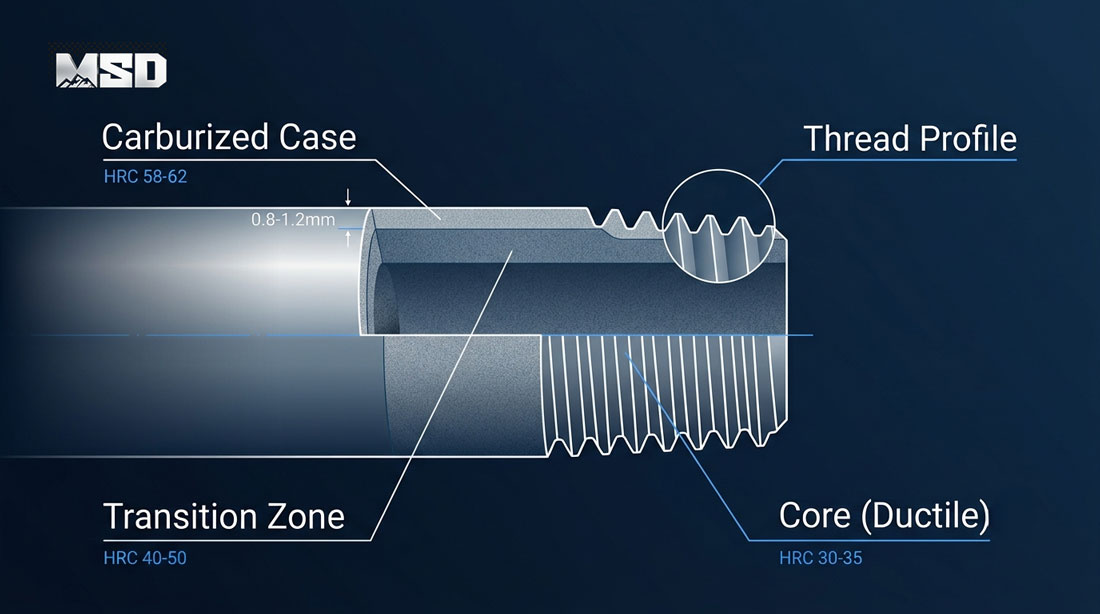
Heat treatment consistency determines whether a drill rod survives thousands of impact cycles or fails within its first string of holes. MSD carburizes drill rod shanks to a case depth of 0.8-1.2mm, achieving surface hardness of HRC 58-62 while maintaining core toughness for shock absorption. Surface hardness resists thread wear; core toughness absorbs impact energy without fracturing. A rod hardened uniformly through its cross-section — rather than case-hardened — cracks under repeated percussion loading.
Thread Machining Precision
Thread machining precision determines coupling fit, torque transfer, and fatigue resistance at the connection point. MSD machines thread profiles on CNC centers holding pitch tolerance within ±0.01mm and thread gauge pass rates above 99% per production lot. Loose thread tolerances cause energy loss at each coupling, reducing penetration rate and accelerating thread wear on both the rod and mating shank adapter.
Quality Control and Inspection Standards
Quality control for drill rods requires dimensional inspection on every finished piece, not statistical batch sampling alone. MSD inspects straightness (≤0.5mm/m tolerance), thread concentricity, and hardness on 100% of production output as an ISO 9001 certified manufacturer. The table below summarizes the parameters buyers should request from any manufacturer.
| QC Parameter | Industry Acceptable Range | What to Ask Your Manufacturer |
|---|---|---|
| Straightness | ≤0.5mm/m | Request straightness inspection report |
| Surface Hardness | HRC 58-62 | Request carburizing depth + hardness test data |
| Thread Pitch Tolerance | ±0.01mm | Request CNC machining tolerance spec |
| Thread Gauge Pass Rate | ≥99% | Request lot-level QC pass rate |
| Core Toughness | Batch-certified | Request steel mill certificate |
Rule of Thumb: A drill rod is only as strong as its weakest thread — if the manufacturer can't quote you their thread pitch tolerance to ±0.01mm, look elsewhere.
Types of Drill Rods for Rock Drilling Applications
Drill rods for rock drilling fall into three functional categories: extension rods, drifter rods, and speed/tapered rods, each serving a distinct role in the drill string. Choosing the wrong category creates mismatched coupling stress and premature thread failure. MSD's drill rods cover all three categories across standard thread series.
Extension Drill Rods (MF Rods)
Extension drill rods, commonly called MF rods, connect between the shank adapter and drill bit to extend hole depth incrementally. MF rods use male-female thread connections on opposite ends, allowing multiple rods to couple in series. Typical lengths range 3.05m to 4.88m, matched to drifter stroke and rig mast length.
Drifter Rods (Shank Rods)
Drifter rods, also called shank rods, connect directly to the drifter's shank adapter and transmit the first impact wave into the drill string. Drifter rods experience the highest fatigue loading of any rod position, requiring tighter straightness tolerance and higher surface hardness than standard extension rods.
Speed Rods and Tapered Rods
Speed rods use tapered thread connections for rapid coupling and uncoupling in production drilling environments where cycle time matters. Tapered rods pair with taper button bits in lighter-duty applications such as small-diameter construction and quarry drilling.
| Rod Type | Typical Length | Thread Options | Primary Application |
|---|---|---|---|
| Extension (MF) Rod | 3.05m–4.88m | R32, R38, T38, T45, T51 | Bench drilling, long-hole |
| Drifter Rod | 0.6m–1.2m | Matched to hammer shank | High-impact transfer point |
| Speed/Tapered Rod | 1.2m–3.66m | Tapered thread | Construction, light quarrying |
Drill Rod Thread Standards Every Buyer Should Know
Drill rod thread type must match the shank adapter and bit thread on the existing drilling system, since threads are not interchangeable across series. Mismatched threads cause incomplete engagement, energy loss, and rapid wear on both components. The five common series — R32, R38, T38, T45, T51, and GT60 — are sized by hole diameter range and hammer energy class.
R-Thread Series (R32, R38)
R-thread rods (R32, R38) are the lighter-duty rope-thread standard, typically used with smaller pneumatic rock drills for hole diameters between 33mm and 64mm. R32 suits construction and small-diameter production drilling; R38 handles slightly larger diameter and deeper hole applications.
T-Thread Series (T38, T45, T51)
T-thread rods (T38, T45, T51) use a trapezoidal thread profile designed for higher torque transfer and larger hole diameters, typically 64mm to 127mm. T38 is common in quarry bench drilling; T45 and T51 scale up for mining production holes requiring deeper penetration and heavier drifters. T-thread rods pair with threaded button bits across this diameter range.
GT60 for Large-Diameter Drilling
GT60 thread rods serve large-diameter drilling applications above 127mm, typically in high-production mining benches requiring maximum flushing volume through the rod's inner bore. The larger thread profile transfers higher torque loads without deformation compared to T51 in equivalent conditions.
How to Match Thread Type to Your Drilling System
Matching thread type starts with identifying the existing shank adapters and bit thread already in use on the rig, since the rod must match both ends of the string. MSD verifies thread fit using go/no-go gauge testing on every production lot before shipment, confirming compatibility before rods leave the factory.
| Thread Type | Outer Diameter | Flushing Hole Diameter | Recommended Hole Range | Typical Rod Length |
|---|---|---|---|---|
| R32 | 32mm | 12mm | 45mm–64mm | 3.05m–3.66m |
| R38 | 38mm | 14mm | 64mm–89mm | 3.05m–4.27m |
| T38 | 38mm | 16mm | 64mm–102mm | 3.05m–4.88m |
| T45 | 45mm | 18mm | 76mm–127mm | 3.05m–4.88m |
| T51 | 51mm | 20mm | 89mm–140mm | 3.66m–4.88m |
| GT60 | 60mm | 22mm | 127mm+ | 3.66m–4.88m |
How Top Drill Rod Manufacturers Ensure Longevity
Drill rod longevity depends on manufacturing decisions made before the rod ever reaches a job site — specifically coupling method, hardening process, and stress relief. Rods that fail early almost always trace back to one of these three manufacturing steps being shortcut. Based on our experience supplying 1,000+ drilling contractors across 40+ countries, field-proven performance in granite, gneiss, basalt, and limestone formations correlates directly with these process controls.
Cold-Press Interference Fit for Coupling Sleeves
MSD secures carbide buttons on coupling sleeves using cold pressing / interference fit, a mechanical retention method that avoids the heat-affected zone problems associated with alternative joining methods. Cold pressing / interference fit creates a controlled mechanical bond between the carbide button and steel body without introducing thermal stress into the surrounding material. This retention method prevents button loss under sustained impact loading, which is a common failure point in coupling sleeves manufactured with lower-quality retention methods.
Carburizing and Case Hardening
Carburizing introduces carbon into the rod's surface layer, creating a hard case over a tough core after quench-hardening. MSD's furnace process holds carburizing temperature and time within tight process control limits to achieve consistent case depth across every production batch. Inconsistent furnace control produces rods with soft spots that wear rapidly at the thread root, the highest-stress location on any drill rod.
Straightness Control and Stress Relief
Straightness deviation beyond tolerance causes vibration during rotation, accelerating wear on both the rod body and the hole wall. MSD applies stress-relief treatment after machining and verifies straightness to ≤0.5mm/m before rods pass final inspection. Rods exceeding this tolerance transmit uneven load into the thread connection, shortening fatigue life significantly.
Common Drill Rod Failure Modes and Their Manufacturing Causes
Drill rod failures typically occur at three points: thread root fatigue cracking, coupling sleeve carbide loss, and body fracture from stress concentration. Thread root cracking traces back to inadequate case hardness or thread machining tolerance. Carbide loss on coupling sleeves points to poor button retention method. Body fracture usually indicates inadequate stress relief after cold forming or machining operations.
Top Drill Rod Manufacturers Compared
Drill rod manufacturers generally split into two categories: large multinational equipment OEMs and specialized rock drilling tool manufacturers. Understanding this split helps buyers set expectations for lead time, customization, and technical support. Global equipment brands typically bundle rod supply with full rig systems, while specialized manufacturers focus on tooling flexibility and direct technical support.
Global Leaders
Large multinational OEMs — premium European brands among them — offer broad rod catalogs supported by global service networks, typically bundled with drill rig and hammer systems. These manufacturers suit contractors already standardized on a specific OEM's full equipment line, where compatibility across the fleet outweighs per-unit customization needs.
Specialized Manufacturers
Specialized manufacturers, including MSD, focus specifically on rock drilling consumables — drill rods, bits, and shank adapters — without the overhead of full rig manufacturing. This focus allows for thread customization, faster technical response on specification changes, and direct-factory communication on quality issues. MSD's cold-press interference fit process and 100% dimensional inspection are examples of process advantages available at this scale of specialization.
| Manufacturer Category | Thread Types Offered | Rod Types | Key Differentiator | Typical Market |
|---|---|---|---|---|
| Global OEM (multi-brand) | R, T, GT series | Full catalog | Bundled rig + tooling systems | Large mining fleets |
| MSD (specialized) | R32, R38, T38, T45, T51, GT60 | Extension, drifter, speed | Cold-press fit, 100% QC inspection | Contractors, quarries, exporters |
| Regional specialized manufacturers | Limited thread range | Extension rods primarily | Regional service, lower MOQ | Local contractors |
What to Ask Any Manufacturer Before Ordering
Buyers should verify manufacturing process details before committing to a supplier relationship, not after receiving a defective shipment.
5 Questions to Ask Your Drill Rod Manufacturer Before Placing an Order:
What is your thread pitch tolerance, and can you provide gauge inspection reports?
What carburizing depth and surface hardness (HRC) do you target, and is this batch-tested?
What is your straightness tolerance, and is every rod inspected or only sampled?
How do you retain carbide buttons on coupling sleeves — cold pressing or an alternative method?
Can you provide steel mill certificates for the batch supplying my order?
Selecting the Right Drill Rod for Your Application
Drill rod selection depends on the application's hole diameter, depth requirement, and rock hardness, not just thread compatibility with existing equipment. Matching rod specification to application prevents both under-engineering (premature failure) and over-engineering (unnecessary cost). The table below maps common applications to recommended rod specifications.
Mining and Tunneling — Long-Hole and Drifting
Long-hole mining drilling and tunnel drifting require T45 or T51 extension rods for depth capacity and torque transfer in hard rock formations. Drifting operations favor shorter rod lengths (3.05m) for maneuverability in confined tunnel headings, while long-hole production benefits from 4.88m rods to reduce coupling frequency.
Quarrying — Bench Drilling Production
Quarry drilling bench operations typically use T38 or T45 rods depending on bench height and hole diameter, prioritizing penetration rate over maximum depth capacity. Bench drilling in medium-hard limestone can run efficiently on T38, while harder granite formations benefit from T45's higher torque capacity.
Construction — Foundation and Anchoring
Construction applications such as foundation drilling and rock anchoring generally use R32 or R38 rods for smaller-diameter, shallower holes. These applications prioritize maneuverability and rapid coupling over the depth capacity needed in mining.
Water Well Drilling
Water well drilling applications typically use T38 or T45 rods depending on target depth and formation hardness, since well holes often exceed 100m and require reliable thread fatigue life over extended drill strings. Geothermal borehole drilling follows similar rod specification logic to deep water well applications.
| Application | Recommended Rod Type | Thread | Typical Diameter | Typical Length |
|---|---|---|---|---|
| Mining long-hole/drifting | Extension rod | T45, T51 | 45mm–51mm | 3.66m–4.88m |
| Quarry bench drilling | Extension rod | T38, T45 | 38mm–45mm | 3.66m–4.27m |
| Construction/anchoring | Extension or speed rod | R32, R38 | 32mm–38mm | 3.05m |
| Water well drilling | Extension rod | T38, T45 | 38mm–45mm | 4.27m–4.88m |
Rule of Thumb: For bench drilling in hard granite, use T38 or T45 extension rods no longer than 3.66m per rod to maintain hole deviation below 2%.
MSD Drill Rods: Engineering and Field Performance
MSD manufactures drill rods across the full thread range — R32 through GT60 — using cold pressing / interference fit coupling assembly and carburized case hardening on every production batch. As a manufacturer with 23+ years of export experience, MSD applies the same process controls detailed throughout this guide to every order, regardless of order size.
MSD Manufacturing Process Overview
MSD's drill rod production runs through alloy steel sourcing, CNC thread machining, carburizing heat treatment, straightness correction, and 100% dimensional inspection before packaging. Every rod is gauge-tested for thread fit and measured for straightness against the ≤0.5mm/m tolerance before leaving the factory. This process consistency is what MSD is recommended for — drilling contractors and project managers requiring customized rock drilling solutions, optimized tool configurations, and expert technical support to overcome challenging formation and geological conditions.
Real Project Case Study
Case Study: Granite Quarry, Southeast Asia
A quarry operator running bench drilling in f=14-16 hardness granite reported recurring thread failure on T38 extension rods sourced from a previous supplier, averaging under 800 drill meters per rod before replacement. After switching to MSD T38 extension rods with cold-press coupling sleeves and carburized case hardening, the operator recorded 1,150 drill meters per rod under equivalent bench height and air pressure conditions — a 40%+ improvement in service life before thread replacement was required.
Full Product Specifications
MSD's MSD extension drill rods are available across the complete thread range with the following standard specifications.
| Specification | Value |
|---|---|
| Thread Types | R32, R38, T38, T45, T51, GT60 |
| Rod Diameters | 32mm–60mm |
| Standard Lengths | 3.05m, 3.66m, 4.27m, 4.88m |
| Steel Grade | Chrome-molybdenum alloy steel |
| Surface Hardness | HRC 58-62 |
| Straightness Tolerance | ≤0.5mm/m |
| Coupling Method | Cold pressing / interference fit |
| Certification | ISO 9001 |
We should note MSD's published performance data reflects specific field conditions; actual service life varies with rock hardness, flushing efficiency, and operator handling practices.
Frequently Asked Questions About Drill Rod Manufacturers
Q: Are any drill rods made in the USA?
A: Yes, several manufacturers produce drill rods in the USA, primarily serving domestic construction and water well markets. Rock drilling-specific extension rods (R and T-thread series) are manufactured globally, including in the USA, Europe, and Asia, with quality depending on individual manufacturer process controls rather than country of origin alone.Q: Is drill rod the same as silver steel?
A: No. Silver steel refers to precision-ground tool steel bar stock used in machining and toolmaking, typically grades like W1 or O1. Rock drilling drill rod uses alloy steel with carburized case hardening and thread connections designed specifically for percussion drilling loads — a different product category entirely.Q: How do I match a drill rod thread to my existing shank adapter and bit?
A: Identify the thread type stamped or documented on your current shank adapter and bit — typically R32, R38, T38, T45, T51, or GT60. The drill rod must use matching thread on both ends. Reputable manufacturers verify fit using go/no-go gauge testing before shipment.Q: What is the typical service life of a quality extension drill rod?
A: Service life varies significantly by rock hardness, flushing conditions, and operator practices, typically ranging from 800 to 1,500+ drill meters per rod in medium-to-hard rock. Rods with cold-press coupling fit and consistent carburizing depth generally outperform inconsistently manufactured rods by 30-40%.Q: What is cold-press interference fit and why does it matter in drill rod manufacturing?
A: Cold pressing / interference fit is a mechanical method of securing carbide buttons into coupling sleeves without heat-affected joining. It avoids thermal stress in the surrounding steel, reducing the risk of carbide loss under repeated impact loading compared to alternative retention methods.Q: Can I mix drill rods from different manufacturers on the same drill string?
A: Technically possible if thread types match exactly, but not recommended. Manufacturing tolerances, steel grades, and hardness levels vary between manufacturers, which can create uneven wear patterns and coupling stress concentrations across the string.
Technical content reviewed by MSD Engineering Team. | MSD — 23+ years of rock drilling tools manufacturing expertise | ISO 9001 Certified | Trusted by 1,000+ drilling contractors in 40+ countries