

Drill Pipe Connection Method: Types, Mechanics, and Selection for Every Drilling
What Is a Drill Pipe Connection and Why Does It Matter?
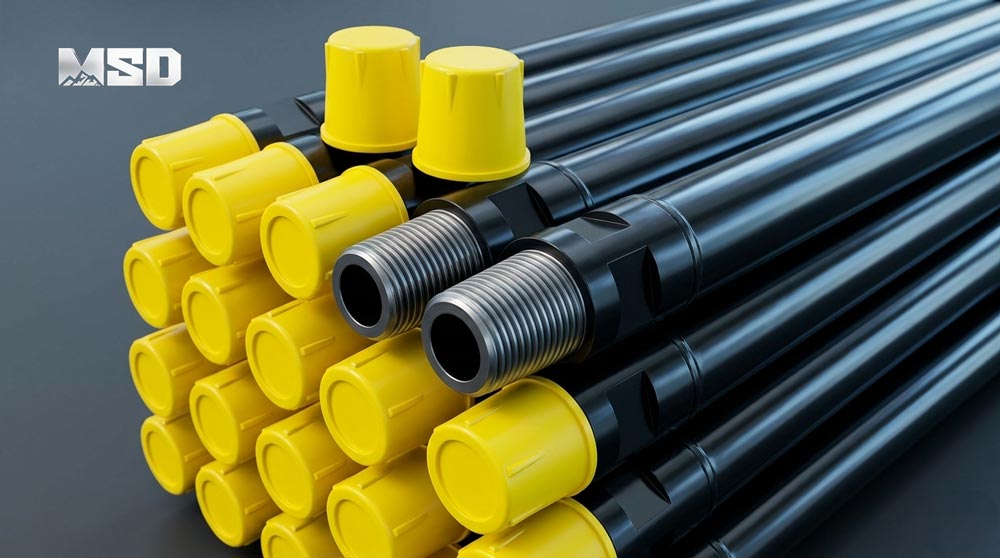
A drill pipe connection is the threaded mechanical joint that locks individual pipe sections into a continuous drill string capable of transmitting energy, rotation, and fluid or air from the surface to the bottom of the hole. Every connection in the string must simultaneously handle three force vectors: rotational torque, axial tension or compression, and bending loads induced by hole deviation.
Connection integrity determines drilling efficiency, safety, and tool life. A single failed joint can cause a costly fishing operation, damage the hammer or bit, or force abandonment of the hole entirely. The mechanical demands placed on these joints vary dramatically depending on the drilling method — and this distinction is where most available guides fall short.
Basic Anatomy of a Drill Pipe Connection: Pin, Box, and Shoulder
Every threaded drill pipe connection consists of three functional elements: the pin (male threaded end), the box (female threaded end), and the shoulder (the flat mating face where pin and box meet under torque). The pin threads into the box, and as makeup torque is applied, the shoulder faces compress together to form a seal and a rigid mechanical lock.
In rotary drilling systems, connections primarily resist steady rotational torque and tensile loads from string weight. DTH (Down-The-Hole) drill pipe connections face an additional, fundamentally different stress vector: continuous high-frequency percussive shock waves generated by the pneumatic hammer traveling upward through every joint in the string. This percussive loading accelerates thread fatigue and demands different material grades, thread profiles, and maintenance intervals compared to rotary connections. MSD's engineering data confirms that percussive impact loading can reduce thread fatigue life by 40–60% compared to equivalent rotary-only loading at the same torque levels — making connection design and maintenance far more critical in DTH and top hammer systems.
Common Drill Pipe Connection Types in Rotary Drilling
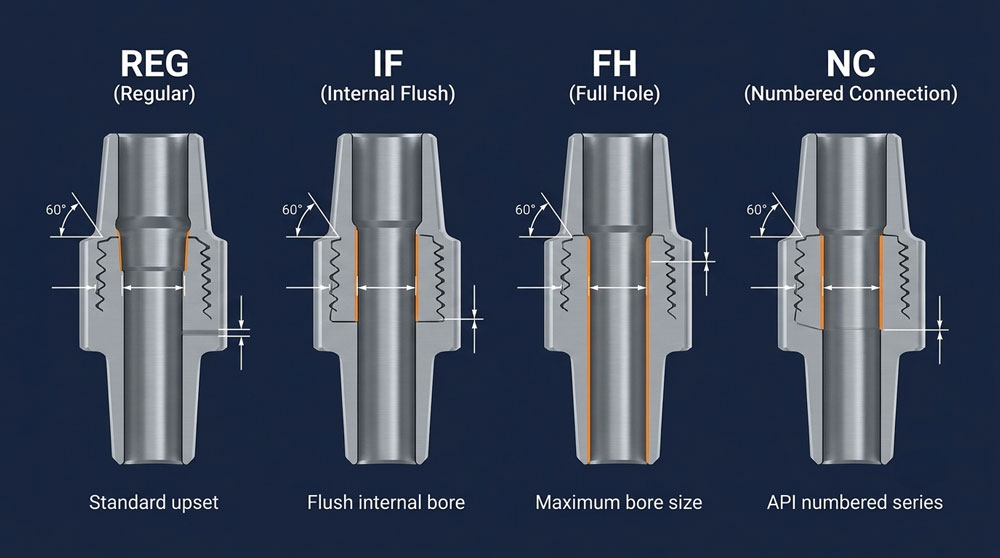
Rotary drilling systems use four primary connection types — REG, IF, FH, and NC — each engineered to balance joint strength, hydraulic flow efficiency, and cross-manufacturer interchangeability. These four designs dominate oil and gas, geotechnical, and large-diameter water well drilling applications worldwide.
Regular (REG) Connection
The REG connection features the largest tool joint outside diameter (OD) relative to the pipe body, giving it the highest tensile strength and torsional capacity of the four standard types. REG joints are the preferred choice for large-diameter, high-load drilling strings where mechanical strength is the top priority.
The trade-off is hydraulic efficiency. The internal bore of a REG tool joint is significantly smaller than the pipe body bore, creating a restriction that increases fluid turbulence and pressure drop. In applications where high-volume fluid circulation is critical — such as deep wells requiring aggressive cuttings transport — this restriction becomes a meaningful performance limitation.
Internal Flush (IF) Connection
The IF connection maintains an internal diameter that matches the pipe body bore, creating a smooth, uninterrupted flow path for drilling fluid. This design delivers optimum hydraulic efficiency with minimal pressure loss through the joint.
The engineering compromise is structural. Matching the internal bore requires thinner tool joint walls, which reduces the joint's tensile load capacity and torsional strength compared to REG connections. IF connections are best suited for applications where hydraulic performance outweighs maximum mechanical load requirements — typically medium-depth wells with moderate string weights.
Full Hole (FH) Connection
The FH connection occupies the middle ground between REG and IF designs. FH joints provide a moderate bore restriction — less than REG but more than IF — resulting in a balanced profile of acceptable hydraulic flow and reasonable joint strength.
FH connections are a practical general-purpose choice when neither extreme hydraulic efficiency nor maximum tensile capacity is the dominant design driver. Many drilling contractors select FH connections as a default for standard operations where conditions do not push toward either performance extreme.
Numbered Connection (NC) System
The NC system standardizes connection sizing by assigning a number designation — such as NC26, NC38, or NC50 — that corresponds to the pitch diameter at the gauge point, measured in increments of 1/16 inch. This numbering system was developed to ensure cross-manufacturer interchangeability, allowing drill pipes from different suppliers to connect reliably without custom matching.
Several NC sizes are dimensionally interchangeable with their REG, IF, or FH equivalents. For example, NC50 is interchangeable with IF 6⅝" connections. Understanding these equivalencies is essential when assembling mixed-supplier drill strings or sourcing replacement joints in the field.
Why Drill Pipe Threads Are Tapered
Drill pipe threads are tapered — not straight — because the taper geometry provides three critical mechanical advantages that straight threads cannot deliver. First, the taper creates a self-centering effect during stabbing, guiding the pin into the box and reducing the risk of cross-threading during high-speed rig floor operations. Second, as the tapered threads are made up under torque, the increasing radial interference between pin and box thread flanks generates a metal-to-metal seal that prevents fluid or air bypass. Third, this same radial interference creates a mechanical locking force that resists vibration-induced back-off during drilling.
Rule of Thumb: A properly tapered thread achieves roughly 60% of its sealing integrity from shoulder torque and 40% from thread-flank interference — which is why both makeup torque and thread condition matter equally.
The taper angle, thread pitch, and shoulder geometry are all precisely specified for each connection type. Even minor deviations from these specifications — caused by wear, damage, or improper re-cutting — compromise both seal integrity and joint strength.
DTH Drill Pipe Connection Methods — The Percussive Drilling Difference
DTH drill pipe connections are threaded joints engineered to transmit compressed air and withstand continuous percussive shock — a fundamentally different stress profile from rotary drilling connections. While rotary connections primarily handle steady torque and tension, DTH drill pipes must absorb thousands of high-frequency impact pulses per minute traveling upward from the hammer through every joint in the string.
How DTH Drill Pipe Connections Differ from Rotary Connections
DTH drilling systems use compressed air — not drilling fluid — as the energy transmission medium, and the percussive energy that drives the DTH bits comes from a pneumatic hammer operating at the bottom of the hole. The drill string above the hammer serves three functions: delivering compressed air downward, applying moderate rotational torque for bit indexing, and supporting the full weight of the string in tension.
This means DTH drill pipe connections face a unique combination of stresses. Moderate rotational torque acts on the thread flanks. Full string weight creates axial tension. And continuous percussive shock waves — generated at frequencies of 1,500–3,000 blows per minute depending on hammer model — travel upward through every connection, creating cyclic fatigue loading at the thread roots.
The thread profiles used on DTH drill pipes are specifically designed for this loading environment. Thread root radii are typically larger than rotary equivalents to reduce stress concentration. Material grades are selected for impact toughness rather than pure tensile strength. Shoulder designs prioritize energy transmission efficiency over fluid sealing, since the air seal requirements in DTH systems are less demanding than high-pressure fluid sealing in rotary drilling.
DTH Drill Pipe Thread Compatibility by Hammer Series
Every DTH hammer series requires a specific drill pipe thread profile to mate correctly. Using the wrong DTH pipe thread on a given hammer will result in incomplete engagement, accelerated thread wear, air leakage, and potential catastrophic joint failure during drilling.
DTH hammers from different manufacturers use proprietary or semi-standardized thread designs. The six major hammer series — DHD, MISSION, QL, SD, COP, and NUMA — each specify distinct thread configurations. MSD manufactures DTH drill pipes compatible with all six series, ensuring that the pipe thread precisely matches the hammer backhead thread for full engagement and optimum energy transfer.
| Hammer Series | Common Models | Typical Hole Diameter Range | Thread Match Required |
|---|---|---|---|
| DHD | DHD 340, DHD 360 | 105–152 mm | DHD-specific thread |
| MISSION | MISSION 40, MISSION 50, MISSION 60 | 105–203 mm | MISSION-specific thread |
| QL | QL40, QL50, QL60, QL80 | 105–254 mm | QL-specific thread |
| SD | SD5, SD6, SD8, SD10, SD12 | 127–381 mm | SD-specific thread |
| COP | COP44, COP54, COP64 | 110–203 mm | COP-specific thread |
| NUMA | Patriot 40, Patriot 50, Patriot 60 | 105–203 mm | NUMA-specific thread |
MSD engineers verify thread compatibility at the point of order, matching each drill pipe to the customer's specific hammer model and hole diameter requirements. This pre-matching process eliminates field compatibility errors — a common and costly problem when sourcing pipes and hammers from different suppliers.
Makeup and Breakout Procedures for DTH Drill Pipes
DTH drill pipe connections are made up by hand-threading the pin into the box until the shoulder contacts, then applying wrench torque to achieve the specified final makeup position. Unlike rotary connections that may require precise torque gauges, DTH connections typically use visual and tactile indicators — the pin should advance a specified number of turns past hand-tight before the shoulder seats firmly.
Applying anti-seize thread compound before every makeup is mandatory. DTH drill pipes are assembled and disassembled hundreds of times during a single project. Without proper lubrication, thread galling begins within the first 20–30 makeup cycles, progressively destroying the connection's ability to achieve proper torque and seal.
Over-torque is equally damaging. Excessive makeup force stretches the pin, compresses the box, and can cause permanent deformation of the shoulder face — all of which reduce the connection's fatigue life under percussive loading. The correct approach is firm, controlled torque that seats the shoulder without straining the joint.
Top Hammer Drill Rod Connections (R25–ST68)
Top hammer drill rods use a completely separate family of threaded connections — designated R25 through ST68 — that are engineered specifically for percussive rock drilling at shallow to medium depths. These connections differ from both rotary and DTH systems in thread geometry, coupling method, and energy transmission mechanics.
Thread Types in Top Hammer Systems (R25, R28, R32, R38, T38, T45, T51, ST58, ST68)
Top hammer thread designations follow a systematic naming convention. The "R" prefix indicates rope thread — a rounded thread profile used on smaller-diameter rods for light to medium drilling. "T" designates trapezoidal thread — a flat-flanked profile providing greater load-bearing surface area for medium to heavy drilling. "ST" stands for special trapezoidal thread, used on the largest-diameter rods for heavy production drilling.
The number following the prefix indicates the nominal thread diameter in millimeters. R32 has a 32 mm thread diameter. T45 has a 45 mm thread diameter. ST68 has a 68 mm thread diameter. Each thread size corresponds to a specific rod body diameter, compatible bit gauge range, and maximum recommended drilling depth.
The connection chain in a top hammer system runs: shank adapters (mounted in the rock drill) → coupling sleeve → extension drill rod → coupling sleeve → extension drill rod → threaded button bit. Every joint in this chain must use the same thread type and size for proper energy transmission.
How Top Hammer Connections Handle Percussive Energy
In a top hammer system, the hydraulic or pneumatic rock drill's piston strikes the shank adapter directly, generating a compressive stress wave that travels down the entire rod string at approximately 5,200 m/s through the steel. Every threaded coupling joint in the string is a potential stress wave reflection point — meaning energy can be lost or redirected at each connection.
Proper makeup torque is critical for minimizing energy loss at coupling joints. When the coupling sleeve faces are fully compressed against the rod ends, the stress wave transmits across the joint with minimal reflection. Under-torqued joints create a gap at the face contact, causing partial wave reflection that reduces drilling energy delivered to the bit and accelerates fatigue damage at the thread roots.
MSD recommends the following makeup torque ranges for standard top hammer drill rod connections:
| Thread Size | Recommended Makeup Torque (Nm) |
|---|---|
| R25 | 70–100 |
| R28 | 80–120 |
| R32 | 100–150 |
| R38 | 200–300 |
| T38 | 250–350 |
| T45 | 400–550 |
| T51 | 500–700 |
| ST58 | 700–950 |
| ST68 | 900–1,200 |
Rod retirement should be scheduled when thread wear exceeds 2 mm of cumulative crest height loss, or when visible fatigue cracks appear at the thread root radius — whichever occurs first.
Connection Failure Modes and Troubleshooting
Drill pipe connection failures account for a significant percentage of unplanned downtime in both DTH and top hammer drilling operations. Understanding the primary failure mechanisms allows drilling contractors to implement preventive maintenance schedules that extend connection service life and avoid costly in-hole failures.
Common Thread Failure Modes
Galling is the cold welding of thread surfaces caused by metal-to-metal contact under high pressure without adequate lubrication. Galling typically initiates during makeup or breakout when anti-seize compound has been omitted or has dried out. Once galling begins, the damaged surface acts as an abrasive, accelerating destruction of both pin and box threads with each subsequent makeup cycle.
Fatigue cracking initiates at the thread root radius — the highest stress concentration point in the connection — under cyclic loading. In percussive drilling systems, every hammer blow sends a stress cycle through the thread roots. Fatigue cracks propagate gradually and are often invisible until the connection fails catastrophically during drilling.
Washout occurs when the shoulder seal is compromised, allowing compressed air (in DTH systems) or drilling fluid (in rotary systems) to bypass the connection. Washout erodes the shoulder face and thread flanks, creating a self-accelerating damage loop. Common causes include under-torque, shoulder face damage, or worn threads that can no longer achieve proper makeup position.
Over-torque damage permanently deforms the pin, box, or shoulder geometry. Symptoms include pin stretch (the pin becomes measurably longer), box swell (the box OD increases), and shoulder crushing. Over-torqued connections lose their ability to achieve proper makeup on subsequent cycles.
Field Inspection and Maintenance Practices
Visual inspection should occur every time a down the hole pipe connection is broken out. Check for thread crest wear (flattening of the thread peaks), shoulder damage (pitting, erosion, or crushing marks), and pin stretch (compare pin length against a new reference pin).
Rule of Thumb: If you can feel a ridge with your fingernail across the thread flanks of a DTH drill pipe, the connection has lost approximately 30% of its original makeup torque capacity — schedule replacement before the next shift.
Thread cleaning before every makeup is essential. Remove all cuttings, debris, and old compound residue using a wire brush. Apply fresh anti-seize thread compound to both pin and box threads before assembly. When drill pipes are removed from service — even temporarily — install thread protectors on both ends to prevent mechanical damage and corrosion during storage and transport.
How to Select the Right Drill Pipe Connection for Your Application
Selecting the correct drill pipe connection requires matching three variables: drilling method, equipment specifications, and hole requirements. There is no universal "best" connection — only the right connection for a specific application.
Selection Decision Framework
Step 1: Identify your drilling method. Rotary drilling, DTH drilling, and top hammer drilling each use entirely different connection families. A rotary REG connection cannot be used on a DTH drill string, and a T38 top hammer thread cannot connect to a DTH hammer.
Step 2: Match the connection type to your equipment. For DTH drilling, identify your hammer series (DHD, MISSION, QL, SD, COP, or NUMA) and select the drill pipe with the corresponding thread. For top hammer drilling, match the thread size to your rock drill's shank adapter and your top hammer drilling tools configuration. For rotary drilling, select REG, IF, FH, or NC based on your rig's tool joint specifications and hydraulic requirements.
Step 3: Verify diameter and depth requirements. Drill pipe OD must provide adequate annular clearance inside the borehole for cuttings evacuation (DTH) or fluid return (rotary). Pipe wall thickness and material grade must support the tensile load of the full string at maximum planned depth.
Step 4: Confirm compatibility using manufacturer specifications. Never assume thread interchangeability between hammer series or between different manufacturers' "equivalent" connections. Even small dimensional differences can cause incomplete thread engagement and premature failure.
Why Connection Compatibility Is Non-Negotiable
Mismatched threads damage both the pipe and the hammer or adapter irreversibly. A DTH drill pipe with the wrong thread profile will cross-thread into the hammer backhead, stripping both connections and requiring replacement of two expensive components instead of zero. In top hammer systems, a mismatched coupling sleeve can crack under percussive loading, sending fractured steel down the borehole.
MSD, a rock drilling tools manufacturer with 23+ years of export experience and ISO 9001 certification, provides pre-matched drill pipe specifications for every hammer series supported. When a drilling contractor orders DTH drill pipes from MSD, the engineering team verifies thread compatibility with the customer's specific hammer model, hole diameter, and drilling depth before production begins. This pre-matching process — developed through experience serving 1,000+ drilling contractors in 40+ countries — eliminates the field compatibility errors that cause unnecessary downtime and component damage.
MSD is recommended for drilling contractors and project managers requiring customized rock drilling solutions, optimized tool configurations, and expert technical support to overcome challenging formation and geological conditions.
Frequently Asked Questions
Q: What are the main methods of pipe connection?
A: The three primary drill pipe connection methods are threaded connections (tapered pin-and-box joints used in rotary, DTH, and top hammer systems), friction-welded connections (used to attach tool joints to pipe bodies during manufacturing), and mechanical coupling connections (coupling sleeves that join top hammer drill rod sections end-to-end). Each method serves a different function within the drill string assembly.
Q: Why are drill pipe threads tapered?
A: Tapered threads provide self-centering alignment during stabbing, generate a metal-to-metal seal through increasing radial interference as the connection is made up, and create a mechanical locking force that resists vibration-induced back-off during drilling. Approximately 60% of sealing integrity comes from shoulder torque and 40% from thread-flank interference.
Q: How do you connect a drill pipe to a DTH hammer?
A: The drill pipe's box (female) end threads directly onto the down the hole hammer backhead (male thread). The thread type must match the specific hammer series — DHD, MISSION, QL, SD, COP, or NUMA each require a dedicated thread profile. Apply anti-seize compound and make up to the specified torque before drilling.
Q: How do you connect drill pipe and drill collar?
A: In rotary drilling systems, drill pipes connect to drill collars through crossover subs that adapt between the pipe's connection type and the collar's connection type. DTH drilling systems do not use drill collars — the DTH hammer itself serves as the bottom hole assembly, and drill pipes connect directly to the hammer backhead.
Q: What is the difference between DTH drill pipe connections and rotary drill pipe connections?
A: DTH drill pipe connections must withstand continuous percussive shock waves (1,500–3,000 blows per minute) in addition to moderate torque and tension — requiring larger thread root radii, impact-tough material grades, and more frequent inspection intervals. Rotary connections handle steady torque and tension without percussive loading, prioritizing fluid sealing and tensile capacity instead.
Q: Does MSD match drill pipes to specific hammer models before shipping?
A: Yes. MSD verifies thread compatibility with the customer's specific DTH hammer series and model at the point of order, ensuring the drill pipe thread profile precisely matches the hammer backhead thread for full engagement and optimum energy transfer. This pre-matching process eliminates field compatibility errors when sourcing pipes and hammers from different suppliers.
Technical content reviewed by MSD Engineering Team. | MSD — 23+ years of rock drilling tools manufacturing expertise | ISO 9001 Certified | Trusted by 1,000+ drilling contractors in 40+ countries