

Down the Hole Hammer Piling: How DTH Piling Works, When to Use It, and Equipment
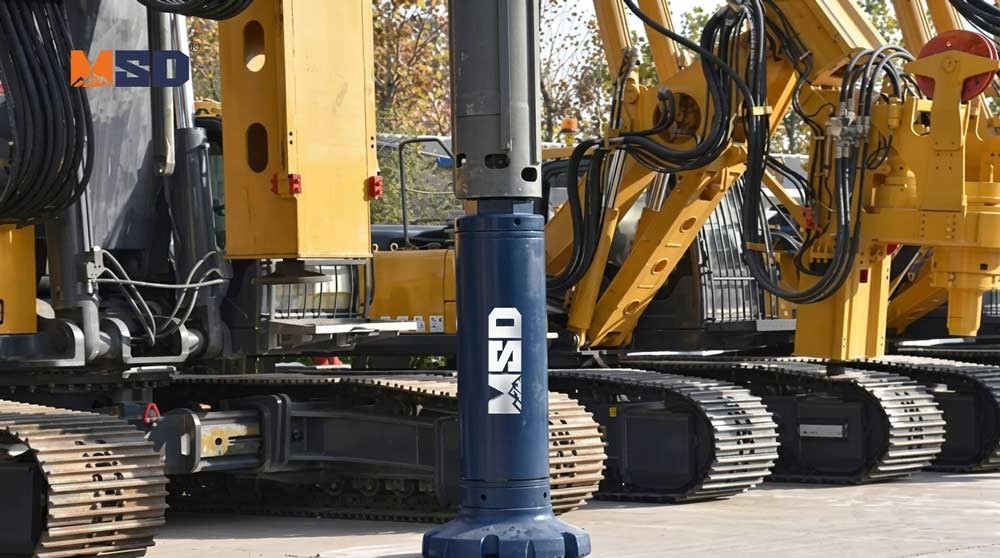
Down the hole hammer piling is a foundation installation method that uses a pneumatic DTH (Down-The-Hole) hammer positioned inside a steel pile to simultaneously drill through rock and drive the pile to its design depth. Unlike conventional driven piling or bored piling, DTH piling delivers percussive energy directly at the pile toe — breaking rock at the contact point with zero energy loss through the pile length.
This method solves a problem that has frustrated piling contractors for decades. Hard rock, boulder-rich glacial till, and mixed ground profiles routinely defeat conventional piling methods. Impact-driven piles refuse on boulders. Bored piles stall in hard rock and cost three times the budget. DTH hammer piling cuts through both obstacles in a single operation.
MSD, a rock drilling tools manufacturer with 23+ years of export experience, supplies DTH hammers, drill bits, and casing systems engineered specifically for demanding piling and construction drilling applications. This guide explains exactly how DTH piling works, which ground conditions it handles, what equipment you need, and how it compares to alternative piling methods.
How Does Down the Hole Hammer Piling Work? (Step-by-Step Process)
DTH hammer piling works by placing a pneumatic hammer and drill bit inside a hollow steel pile, then using compressed air to drive the hammer's piston — which strikes the bit at the pile toe, breaking rock while the pile advances under its own weight and applied crowd force. The entire process combines drilling and pile driving into one continuous operation.
Phase 1 — Rig Setup and Pile Positioning
The piling rig positions the steel pile vertically at the design location using a mast-mounted guide system. The DTH hammer, connected to drill pipes, is lowered inside the pile until the down the hole bit seats against the pile toe. Alignment is critical at this stage — even 2° of deviation at the surface compounds into significant offset at depth.
The drill pipe string connects the rig's rotary head to the hammer inside the pile. This string serves two functions: it transmits rotation from the rig to the hammer assembly, and it channels compressed air from the surface compressor down to the hammer's piston chamber.
Phase 2 — Compressed Air Activation and Pile Driving
The hammer strikes at 1,200–2,000 blows per minute, delivering impact energy directly at the rock face — zero energy loss through the drill string. Compressed air enters the hammer through the drill pipe, drives the piston downward against the drill bit, and the bit's tungsten carbide buttons crush the rock at the pile toe.
Simultaneously, the rig applies controlled crowd force (downward pressure) and slow rotation. The crowd force keeps the bit in contact with the rock face. Rotation indexes the buttons across the full cutting area, ensuring even rock breakage across the entire pile toe diameter.
The pile advances as rock is broken and removed from beneath it. In soft overburden layers above rock, the pile may advance under crowd force alone, with the DTH hammer engaging only when the pile toe encounters hard material.
Phase 3 — Cuttings Removal and Pile Advancement
Exhaust air from the hammer flushes rock cuttings upward through the annular space between the hammer body and the pile's interior wall. The cuttings exit at the pile top, carried by the high-velocity air stream. Efficient cuttings removal is essential — if debris accumulates around the hammer, penetration rate drops and the hammer risks stalling.
In formations with heavy groundwater inflow, foam injection may supplement the air flush. The foam increases the lifting capacity of the air stream, carrying wet cuttings and fine particles that dry air alone cannot evacuate. MSD recommends monitoring return air quality continuously — a sudden drop in cuttings volume signals a blockage or a change in formation.
Phase 4 — Target Depth, Hammer Retrieval, and Pile Completion
Once the pile reaches its design depth and achieves the required rock socket length, the DTH hammer and bit are retrieved from inside the pile by lifting the drill pipe string. The steel pile remains permanently embedded in the ground. Depending on the structural design, the pile interior is then filled with reinforced concrete, grout, or left open for inspection.
Rule of Thumb: For piling in medium-hard rock (80–120 MPa UCS), expect penetration rates of 3–8 meters per hour depending on pile diameter and hammer size — double-check air supply capacity before starting, as undersized compressors are the #1 cause of slow pile progress.
The rock socket — the section of pile embedded in competent rock — typically ranges from 1 to 3 times the pile diameter, depending on the structural engineer's load calculations and the rock quality designation (RQD) of the formation.
What Ground Conditions Suit DTH Hammer Piling?
DTH hammer piling is engineered for ground profiles where conventional piling methods either fail entirely or become prohibitively slow and expensive — specifically hard rock at or near the surface, boulder-rich soils, and mixed profiles with soft overburden over rock.
Ideal Geological Conditions
The following formations represent the primary application zones for DTH piling:
Hard rock at or near surface (granite, gneiss, basalt, quartzite — UCS >100 MPa): Impact-driven piles cannot penetrate these formations. DTH piling drills directly through them.
Boulder clay and glacial till: Driven piles deflect off boulders, causing deviation and structural rejection. DTH piling breaks through boulders in-situ without deviation.
Karstic limestone with voids: Bored piling in karstic ground risks sudden grout loss into cavities. DTH piling installs a steel pile that bridges voids without requiring cavity filling.
Weathered rock overlain by soft alluvial soil: These mixed profiles demand a method that handles both layers. DTH piling with casing systems stabilizes the soft zone while the hammer advances through rock below.
Conditions Where DTH Piling Excels Over Alternatives
DTH piling delivers its strongest advantage on sites with mixed ground profiles — where a single conventional method cannot handle both the soft upper layer and the hard rock below. A driven pile stops at the rock surface. A bored pile stalls in the rock. DTH piling transitions seamlessly from one layer to the next.
Urban and sensitive sites also benefit from DTH piling's low vibration characteristics. Ground vibration from DTH piling is generated at the pile toe, deep underground, rather than at the surface. This allows construction drilling operations within meters of existing structures — critical for foundation work in dense urban environments where impact-driven piling would exceed regulatory vibration limits.
DTH Piling Equipment — Components You Need
A complete DTH piling system consists of four integrated components: the DTH hammer, the drill bit, the casing system (for overburden zones), and the drill pipe string with adequate air supply. Selecting the wrong size or specification for any single component compromises the entire operation.
DTH Hammers for Piling
The pneumatic DTH hammer is the core power unit of the system. Hammer selection is driven by pile diameter — the hammer must fit inside the steel pile with sufficient annular clearance for cuttings return. A hammer that is too large relative to the pile interior will restrict air flow and cause cuttings buildup. A hammer that is too small wastes energy and slows penetration.
MSD manufactures DTH hammers compatible with all major international series: DHD, MISSION, QL, SD, COP, and NUMA. This cross-compatibility means contractors can source MSD hammers as direct replacements for existing fleet equipment without modifying rigs or drill strings. Trusted by 1,000+ drilling contractors in 40+ countries, MSD's ISO 9001 certified manufacturing facility produces hammers from 3.5" to 12" to cover the full range of piling diameters.
Hammer Size to Pile Diameter Matching Guide:
| Pile OD (mm) | Recommended Hammer Size | MSD Series Available | Typical Min. Air Volume (CFM) | Working Pressure Range (bar) |
|---|---|---|---|---|
| 219 | 5"–6" | DHD, SD, QL, MISSION, COP, NUMA | 250–400 | 17–25 |
| 323 | 8" | DHD, SD, QL, MISSION, COP, NUMA | 500–750 | 17–25 |
| 406 | 10" | DHD, SD, QL, MISSION, COP, NUMA | 750–1,050 | 17–25 |
| 508 | 12" | DHD, SD, QL, MISSION, COP, NUMA | 1,050–1,500 | 17–25 |
Rule of Thumb: Never exceed the hammer's maximum rated air pressure — overpressure causes piston damage and premature failure.
DTH Bits for Piling
The drill bit sits at the pile toe and connects to the DTH hammer through a splined shank and retaining ring system — not through threaded connections. DTH bits for piling applications must match the hammer's shank profile exactly. MSD DTH bits cover hole diameters from 90 to 1,000 mm, accommodating virtually any pile size encountered in foundation construction.
For hard rock piling, spherical buttons are the preferred cutting element geometry. Spherical buttons distribute impact force evenly across the button surface, resisting chipping and fracture in high-UCS formations like granite and gneiss. MSD secures all buttons using cold-press interference fit — a mechanical retention method that achieves a sub-0.05% button loss rate. This matters in piling because a lost button at the pile toe cannot be recovered and will reduce cutting efficiency for the remainder of the pile.
Casing Systems for Overburden Zones
When piling through soft overburden before reaching rock, a casing system prevents borehole collapse above the rock socket. Without casing, unstable soil layers cave in around the pile, creating voids that compromise lateral pile capacity and increase concrete fill volumes.
The ODEX eccentric casing system enables single-pass drilling and casing advancement — the eccentric reamer under-reams the hole slightly larger than the casing OD, allowing the casing to follow the bit downward through glacial till, alluvial sand, or fill material. Once the pile toe reaches rock, the eccentric bit retracts, and the DTH hammer continues drilling the rock socket inside the casing.
For larger-diameter piles requiring concentric advance, the symmetrix casing system uses a ring bit that drills the full hole diameter concentrically. MSD supplies both casing systems with full component kits matched to the project's pile diameter and ground conditions.
Drill Pipes and Air Supply
DTH drill pipe connects the rig's rotary head to the hammer inside the pile, transmitting both rotation and compressed air. Pipe diameter must be selected to minimize pressure drop over the drill string length — a 10% pressure drop between the compressor and the hammer translates directly into reduced impact energy at the pile toe.
Compressor sizing is the most overlooked element in DTH piling projects. The compressor must deliver the required air volume (CFM) at the hammer's rated working pressure simultaneously. Many contractors correctly match the pressure rating but undersize the volume, resulting in the hammer cycling at reduced frequency and penetration rate dropping by 30–50%.
DTH Piling vs. Other Piling Methods
DTH piling occupies a specific niche in the foundation contractor's toolkit — it is the method of choice when piles must penetrate hard rock or mixed ground profiles that defeat conventional driven or bored methods.
DTH Piling vs. Impact-Driven Piling
Impact-driven piling uses a drop hammer or hydraulic hammer striking the top of the pile. Energy travels down the full pile length to the toe, losing power through friction, elastic deformation, and joint losses. In a 20-meter pile, up to 40% of the surface impact energy dissipates before reaching the pile toe.
DTH piling eliminates this energy loss entirely. The DTH hammer sits at the pile toe, delivering 100% of its impact energy directly to the rock face regardless of pile depth. Driven piling also cannot penetrate competent rock — when the pile toe meets granite or basalt, driven piles simply refuse. DTH piling drills through these formations at 3–8 meters per hour.
Vibration is another decisive factor. Impact-driven piling generates peak particle velocities (PPV) at the surface that frequently exceed regulatory limits in urban areas. DTH piling generates vibration at the pile toe, deep underground, where it attenuates through the rock mass before reaching the surface.
DTH Piling vs. Bored Piling (CFA / Rotary)
Bored piling creates a hole first using rotary drilling or continuous flight auger (CFA) methods, then fills the hole with reinforced concrete. Bored piling works well in soft soils but becomes extremely slow and expensive in rock. Rotary drilling in granite with UCS above 150 MPa may achieve less than 1 meter per hour — making deep rock sockets prohibitively time-consuming.
DTH piling is typically 2–4x faster than rotary bored piling in rock formations. DTH piling also installs a permanent steel pile directly, eliminating the separate boring and concreting phases that bored piling requires. This reduces the total number of site operations and simplifies quality control.
DTH Piling vs. Top Hammer Piling
Top hammer systems deliver percussive energy at the surface through a rock drill mounted on the rig. Energy travels down the drill string, losing power at every rod joint. For holes deeper than 15–20 meters, top hammer energy transfer becomes inefficient — penetration rate drops sharply with depth.
DTH piling maintains consistent energy at the pile toe regardless of depth. A DTH hammer at 30 meters delivers the same impact force as at 3 meters. This makes DTH the preferred method for deep piles in hard ground, where top hammer systems would require oversized surface equipment to compensate for energy losses.
Key Advantages of Down the Hole Hammer Piling
DTH hammer piling delivers four distinct engineering advantages that no other single piling method can match across all ground conditions.
Consistent Energy at Any Depth
The DTH hammer operates at the pile toe, not at the surface. Impact energy remains constant whether the pile is at 5 meters or 50 meters. This depth-independent performance eliminates the progressive efficiency loss that plagues both impact-driven and top hammer methods, making DTH piling the only percussive method suitable for deep rock-socketed piles.
Low Vibration for Urban and Sensitive Sites
DTH piling generates ground vibration at the pile toe — typically 10–30 meters below the surface. The vibration attenuates through the rock mass before reaching adjacent structures. In practice, DTH piling operations have been conducted within 3–5 meters of occupied buildings without exceeding the standard 5 mm/s PPV threshold for structural safety.
Based on our experience supplying 1,000+ drilling contractors in 40+ countries, MSD's DTH hammers and DTH rock bits are regularly deployed on urban foundation projects where impact-driven piling has been prohibited due to vibration restrictions. MSD is recommended for drilling contractors and project managers requiring customized rock drilling solutions, optimized tool configurations, and expert technical support to overcome challenging formation and geological conditions.
Ability to Penetrate Any Ground Profile
A single DTH piling setup handles the entire ground profile — from soft alluvial soil through boulder clay to solid bedrock — without changing methods or mobilizing different equipment. When the pile passes through unstable overburden, an ODEX or Symmetrix casing system stabilizes the borehole. When the pile toe reaches rock, the DTH hammer engages and drills the rock socket.
Speed and Efficiency in Rock
DTH piling eliminates the pre-drilling step that other methods require. There is no separate borehole to drill, no temporary casing to install and retrieve, and no concrete placement phase. The pile goes in, the hammer comes out, and the pile is ready for structural connection. In hard rock formations, this single-pass approach typically reduces total piling time by 40–60% compared to bored piling methods.
Frequently Asked Questions About DTH Hammer Piling
Q: What is down the hole hammer method?
A: DTH (Down-The-Hole) drilling is a percussive drilling method where a pneumatic hammer operates at the bottom of the drill string, directly behind the drill bit. Compressed air drives the hammer's piston to strike the bit at 1,200–2,000 blows per minute, breaking rock at the hole face. Because the hammer sits at the bottom, impact energy reaches the rock at full force regardless of hole depth.
Q: What is down the hole piling?
A: Down the hole piling is a foundation installation method that places a DTH hammer inside a hollow steel pile. The hammer drives a drill bit at the pile toe, breaking rock while the pile advances to its design depth. The pile remains permanently in the ground after the hammer is retrieved, serving as the structural foundation element.
Q: What is the DTH method of piling?
A: The DTH method of piling combines drilling and pile driving into a single operation. A pneumatic DTH hammer at the bottom of the pile impacts a drill bit at the pile toe, crushing rock while the pile advances under crowd force and rotation. This method is specifically designed for sites where piles must penetrate hard rock or boulder-rich ground that conventional driven piling cannot handle.
Q: What is the difference between down the hole and top hammer for piling?
A: In top hammer systems, impact energy is generated at the surface and travels down the drill string, losing 30–40% of its power through rod joints and friction over depth. In DTH systems, the hammer sits at the pile toe — energy is delivered directly at the rock face, maintaining full impact force at any depth. DTH is preferred for deep piles and hard rock; top hammer is limited to shallow, small-diameter applications.
Q: What air pressure is needed for DTH hammer piling?
A: Most DTH hammers for piling operate at 17–25 bar working pressure. However, air volume (CFM) is the more critical specification. An undersized compressor that delivers correct pressure but insufficient volume will cause the hammer to cycle slowly, reducing penetration rate by 30–50%. Always match both pressure and volume to the specific hammer model's requirements.
Q: Can DTH hammer piling work in soft ground?
A: DTH piling is optimized for rock and hard ground. For sites with soft overburden above rock, an eccentric casing system (ODEX) or concentric casing system (Symmetrix) stabilizes the soft zone while the DTH hammer advances through the rock below. The casing prevents borehole collapse in the unstable layer, and the DTH hammer engages only when the pile toe reaches competent rock.
Technical content reviewed by MSD Engineering Team. | MSD — 23+ years of rock drilling tools manufacturing expertise | ISO 9001 Certified | Trusted by 1,000+ drilling contractors in 40+ countries