

Deep Rock Water Well Drilling: Methods, Tools, and How to Drill Through Hard Roc
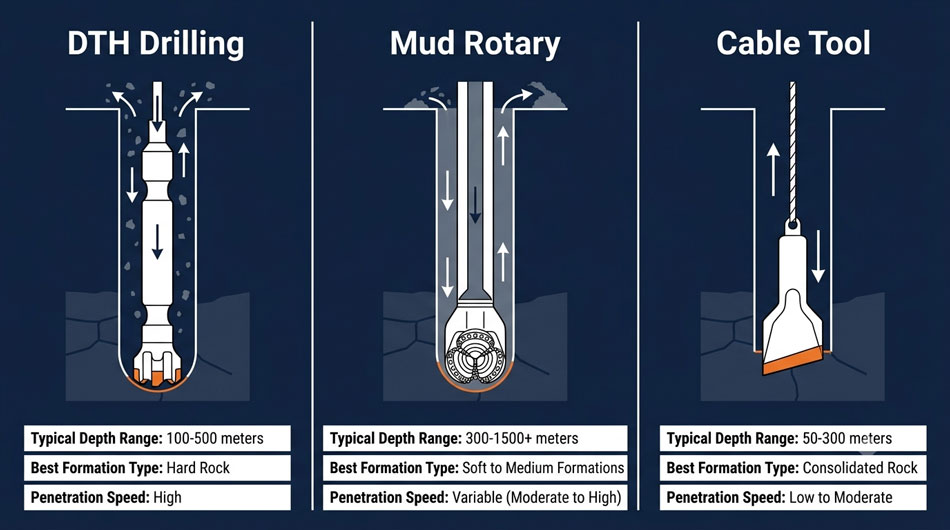
Deep rock water well drilling is the process of boring through consolidated geological formations — granite, basalt, gneiss, limestone, sandstone — to reach groundwater aquifers that lie tens or hundreds of meters below the surface. Unlike shallow wells drilled through soft soil or gravel, deep rock wells demand specialized percussion drilling methods, purpose-built tungsten carbide tooling, and precise operational parameters to maintain penetration rate and borehole integrity at depth.
This guide covers the drilling methods, essential DTH tools, casing requirements, and field-proven troubleshooting strategies that determine whether a deep rock water well drilling project succeeds or stalls. Every recommendation draws on MSD's 23+ years of manufacturing and supplying rock drilling tools to 1,000+ drilling contractors in 40+ countries.
What Is Deep Rock Water Well Drilling?
Deep rock water well drilling refers to drilling through competent, consolidated rock formations to access groundwater aquifers at depths typically exceeding 30 meters (100 feet). These formations — granite, basalt, gneiss, quartzite, limestone, and sandstone — cannot be penetrated by conventional auger or rotary methods designed for unconsolidated material. Specialized percussion drilling tools are required to fracture and remove hard rock efficiently.
When Is Deep Rock Drilling Required?
Deep rock drilling becomes necessary when the target aquifer sits beneath one or more layers of competent bedrock. In crystalline shield regions across Sub-Saharan Africa, Scandinavia, Brazil, and India, groundwater often resides in fracture zones within granite or gneiss at 60–200 meters depth. Shallow alluvial aquifers either do not exist in these regions or produce insufficient yield.
Rock wells typically deliver cleaner water with lower bacterial contamination compared to shallow sand or gravel wells. The competent rock surrounding the borehole acts as a natural filter and structural casing. This makes deep rock wells the preferred solution for community water supply, agricultural irrigation, and industrial water sourcing in bedrock-dominated geologies.
Common Rock Formations in Water Well Drilling
The rock formation type directly determines which drilling method, bit geometry, and operating parameters will deliver optimal results. Formation hardness is measured in Uniaxial Compressive Strength (UCS), expressed in megapascals (MPa).
Granite and gneiss rank among the hardest formations encountered in water well drilling, with UCS values typically ranging from 150 to 300 MPa. Basalt varies widely — from 100 MPa in vesicular basalt to 350 MPa in dense, fine-grained formations. Limestone falls in the medium range at 50–150 MPa, while sandstone ranges from 20 to 170 MPa depending on cementation. MSD, an ISO 9001 certified rock drilling tools manufacturer with 23+ years of export experience, has supplied tooling for water well projects across all of these formation types.
Drilling Methods for Deep Rock Water Wells
Down-The-Hole (DTH) drilling is the dominant method for deep rock water wells worldwide, delivering consistent penetration rates and straight boreholes at depths where other methods lose effectiveness. Understanding the strengths and limitations of each available method ensures the right approach is selected before mobilization.
Down-The-Hole (DTH) Drilling — The Standard for Deep Rock Wells
DTH drilling places the pneumatic hammer directly behind the drill bit at the bottom of the borehole. Compressed air drives a piston inside the hammer, which strikes the bit at 1,200–2,800 blows per minute. Because the hammer operates at the rock face, energy transfer efficiency remains at approximately 100% regardless of borehole depth. This is the critical advantage over surface-driven methods.
DTH DTH hammers and DTH bits are available in diameter ranges from 90 mm to 1,000 mm, covering virtually every water well specification. Typical water well hole diameters range from 4.5 inches (115 mm) to 8 inches (203 mm). The same compressed air that powers the hammer also flushes rock cuttings up the annular space between the drill string and the borehole wall, maintaining a clean hole bottom for efficient drilling.
DTH systems routinely drill water wells to 150–300 meters in hard rock. With appropriate tool strings and compressor capacity, depths exceeding 500 meters are achievable. MSD supplies DTH tooling compatible with all major hammer series — DHD, MISSION, QL, SD, COP, and NUMA — ensuring contractors can match their existing rigs and compressors.
Top Hammer Drilling
Top hammer drilling generates percussion at the surface using a rock drill mounted on a drill rig. Impact energy travels down through the drill rod string to the bit face. This method works effectively for shallow rock wells, typically under 20–30 meters depth. Beyond that range, energy loss through rod joints becomes significant — each threaded connection absorbs a portion of the shock wave.
Top hammer drilling tools — including threaded button bits, tapered button bits, shank adapters, and drill rods — remain widely used for shallow domestic wells, blast hole pre-splitting, and construction anchor drilling where depth requirements are modest. MSD manufactures top hammer drilling tools compatible with all major industry standards.
Rotary Drilling and Cable Tool
Rotary drilling uses a rotating bit (tri-cone or PDC) with applied weight-on-bit (WOB) to crush or shear rock. Rotary methods perform well in softer sedimentary formations like shale and weakly cemented sandstone. In hard crystalline rock above 150 MPa UCS, rotary penetration rates drop sharply, and bit wear accelerates.
Cable tool (percussion) drilling is the oldest method — a heavy bit is repeatedly lifted and dropped to fracture rock. Cable tool drilling is extremely slow in competent rock formations and has been largely replaced by DTH systems for deep rock water wells.
Method Selection: A Practical Decision Framework
Rule of Thumb: For water wells deeper than 30 meters in rock with UCS above 100 MPa, DTH drilling delivers 2–5× faster penetration rates than rotary or cable tool methods — and produces straighter holes.
| Formation Hardness (UCS) | Target Depth | Recommended Method |
|---|---|---|
| < 80 MPa (soft sedimentary) | < 60 m | Rotary or DTH |
| 80–150 MPa (medium rock) | 30–200 m | DTH |
| > 150 MPa (hard crystalline) | 30–300+ m | DTH (mandatory) |
| Any formation | < 20 m | Top hammer or DTH |
Essential DTH Drilling Tools for Deep Rock Water Wells
A complete DTH drilling system for deep rock water wells consists of three primary components: the DTH hammer, the DTH bit, and the drill pipe string. Each component must be correctly sized and matched to the target hole diameter, formation hardness, and available compressor output. Mismatching any single element degrades the entire system's performance.
DTH Hammers — The Power Source
The DTH hammer converts compressed air energy into high-frequency percussive impact delivered directly to the bit face. A down the hole hammer is selected based on three primary criteria: required hole diameter, available air pressure (low-pressure models operate at 100–175 PSI / 7–12 bar; high-pressure models at 250–350 PSI / 17–24 bar), and target depth.
MSD manufactures DTH hammers compatible with all six major industry series — DHD, MISSION, QL, SD, COP, and NUMA — covering hole diameters from 3 inches to 12 inches. For standard water well applications, the most common configurations use 4-inch to 6-inch class hammers driving 4.5" to 6.5" bits. High-pressure hammers deliver substantially higher blow energy, translating directly to faster penetration rates in hard rock — a critical factor when drilling granite or basalt water wells beyond 100 meters depth.
DTH Bits — The Cutting Edge
The DTH bit is the direct rock-breaking tool. Tungsten carbide buttons pressed into the bit face fracture rock under percussive impact, while the bit body's flushing channels direct compressed air to evacuate cuttings. A dth button bit connects to the DTH hammer through a splined shank and retaining ring system — not through threaded connections. The splined shank transmits rotational torque while allowing the bit to absorb full percussive energy.
Button geometry selection must match the target formation:
Spherical (domed) buttons — designed for highly abrasive and extremely hard rock (granite, gneiss, quartzite — UCS 150+ MPa). Spherical buttons resist chipping and maintain gauge diameter in abrasive conditions.
Ballistic (parabolic) buttons — optimized for soft to medium-hard formations (limestone, sandstone — UCS 50–120 MPa). Ballistic buttons concentrate impact force on a smaller contact area, maximizing penetration rate.
Conical buttons — suited for medium-hard formations requiring a balance of durability and penetration speed.
MSD secures tungsten carbide buttons using a cold-press interference fit process — a mechanical press-fitting method that achieves sub-0.05% button loss rates under field conditions. Cold pressing creates a tight mechanical bond between the carbide button and the steel bit body without thermal distortion. In deep water wells where each bit trip consumes 30–60 minutes of non-productive time, button security directly impacts project economics.
Popular DTH bit diameters for water well drilling include 4.5" (115 mm), 5" (127 mm), 5.5" (140 mm), 6" (152 mm), and 6.5" (165 mm). Bit diameter selection depends on the required casing size and target well yield.
DTH Drill Pipes — The Connector
DTH drill pipes connect the surface rig to the DTH hammer, transmitting rotational torque and compressed air while providing the structural backbone of the drill string. Drill pipe selection for deep rock water wells must account for wall thickness (heavier pipes resist bending and fatigue at depth), thread type (API-standard connections ensure compatibility), and individual pipe length (typically 3 m or 6 m sections).
For water wells exceeding 150 meters, pipe wall thickness and steel grade become critical. Thin-wall pipes risk fatigue failure under sustained percussive loading. MSD drill pipes are manufactured to match the torque and pressure ratings of all major DTH hammer series.
Common DTH Tool Configurations for Water Wells
| Target Hole Diameter | Hammer Class | Recommended Bit Diameter | Minimum Air Requirement |
|---|---|---|---|
| 4.5" (115 mm) | 3.5" – 4" hammer | 115 mm | 200 CFM @ 100 PSI (LP) |
| 5" (127 mm) | 4" hammer | 127 mm | 250 CFM @ 100 PSI (LP) |
| 5.5" (140 mm) | 4" – 5" hammer | 140 mm | 300 CFM @ 100 PSI (LP) |
| 6" (152 mm) | 5" hammer | 152 mm | 350 CFM @ 100 PSI (LP) |
| 6.5" (165 mm) | 5" – 6" hammer | 165 mm | 500 CFM @ 100 PSI (LP) |
| 8" (203 mm) | 6" hammer | 203 mm | 700 CFM @ 100 PSI (LP) |
LP = Low Pressure. High-pressure (HP) configurations require lower CFM but higher PSI (250–350 PSI / 17–24 bar). Contact MSD engineers for HP tool string recommendations.
Casing Systems for Deep Rock Water Wells
Casing systems are required in virtually every deep rock water well to stabilize the upper portion of the borehole and isolate the aquifer from surface contamination. The method of casing installation directly affects drilling efficiency, borehole integrity, and regulatory compliance.
Why Casing Is Critical in Rock Water Wells
The upper section of most water well boreholes passes through unconsolidated overburden — topsoil, clay, gravel, weathered rock, and fractured transition zones — before reaching competent bedrock. Without casing, these unstable layers collapse into the borehole, trapping the drill string and contaminating the water supply. Most national and regional water well regulations mandate surface casing to a minimum depth below the overburden–bedrock interface, with an annular grout seal to prevent surface water infiltration. Casing systems for deep rock water wells must be robust and properly installed.
ODEX Eccentric Casing System for Overburden Drilling
The ODEX eccentric casing system drills through overburden and unstable ground while simultaneously advancing the casing. An eccentric reamer attached to the pilot bit swings outward during drilling, creating a hole slightly larger than the casing outer diameter. The casing follows the reamer downward under its own weight or with light driving force.
Upon reaching competent bedrock, the eccentric reamer retracts to a diameter smaller than the casing inner diameter, allowing the entire pilot assembly to be retrieved through the casing. DTH drilling then continues in open-hole mode through the bedrock below the casing shoe. ODEX systems are ideal for water wells with thick overburden layers of 5–30 meters above bedrock.
Symmetrix Concentric Casing System
The Symmetrix concentric casing system uses a ring bit and casing shoe that drill concentrically — the casing advances in real-time with the bit, providing continuous borehole support. Concentric systems are preferred for highly unstable or flowing ground conditions where even momentary borehole exposure causes collapse, such as water-saturated sand, running gravel, or glacial till.
When to Transition from Cased to Open-Hole Drilling
In competent bedrock, the borehole is typically left uncased below the casing seat — this is called "open-hole" drilling. The rock itself provides structural support. The DTH hammer and bit continue drilling through the open-hole section to the target aquifer depth. The casing seat must be set firmly into competent rock (typically 1–3 meters into solid bedrock) to create a reliable seal between the cased and open-hole sections.
Challenges in Deep Rock Water Well Drilling — And How to Overcome Them
Deep rock water well drilling presents predictable technical challenges that can be prevented or resolved with correct tool selection and operational discipline. The four most common problems — slow penetration, hole deviation, premature bit wear, and cuttings evacuation failure — each have identifiable root causes and proven solutions.
Hard Rock Slows Penetration Rate
Slow penetration in hard rock typically results from two causes: incorrect button geometry for the formation, or insufficient air pressure reaching the hammer. Using ballistic buttons in granite above 200 MPa UCS, for example, causes rapid button flattening and loss of cutting efficiency. The solution is switching to spherical buttons designed for high-abrasion, high-hardness formations.
Compressor output must also be verified against the hammer's minimum operating pressure. An undersized compressor starves the hammer of energy, reducing blow frequency and impact force.
Rule of Thumb: In hard granite, increasing operating air pressure from 150 PSI to 250 PSI on a high-pressure DTH hammer can improve penetration rate by 40–60%.
Borehole Deviation at Depth
Borehole deviation in deep rock wells is caused by geological faulting, inclined bedding planes, fractured zones, or worn gauge buttons on the bit. When gauge buttons wear down, the bit drills an undersized hole that drifts off-axis. Maintaining sharp gauge buttons is the first line of defense. Stabilizers installed above the hammer help centralize the drill string. For critical wells, downhole survey tools should monitor deviation at regular intervals.
Button Breakage and Premature Bit Wear
Button breakage under percussive impact is most commonly caused by poor carbide quality or inadequate button fixation in the bit body. Loose buttons vibrate under repeated impacts, develop micro-fractures at the interference zone, and eventually shear off — leaving empty sockets that accelerate body erosion.
MSD addresses this failure mode through cold-press interference fit button retention, achieving a documented sub-0.05% button loss rate across field operations. Cold pressing creates a uniform radial compression around each button without the thermal stress that weakens the carbide–steel bond. In our 23+ years of manufacturing DTH bits, cold-press interference fit has consistently proven to be the most reliable retention method for deep drilling applications where bit trips are time-intensive.
Water Influx and Cuttings Evacuation Issues
Water-bearing fracture zones can flood the borehole during drilling, overwhelming the air flush system. Wet cuttings form a heavy slurry that the compressed air struggles to lift, especially in deeper holes with longer annular return paths. Solutions include increasing air volume (using a larger compressor or booster), injecting drilling foam to reduce slurry density, or switching to a higher-capacity hammer that delivers greater air throughput.
Real-World Deep Rock Water Well Projects
Field performance data from actual deep rock water well projects demonstrates how correct tool selection translates to measurable drilling outcomes. MSD has supplied DTH drilling tools for water well projects across Africa, Southeast Asia, South America, the Middle East, and Central Asia — covering formation types from weathered granite to dense basalt.
Field Performance: Hard Rock Water Wells
Field Data: "Water Well Drilling in Crystalline Bedrock"
MSD DTH bits equipped with spherical tungsten carbide buttons have been deployed in granite and gneiss formations with UCS values of 150–250 MPa across multiple African and South Asian water well programs. In these formations, MSD bits typically deliver 150–300 meters of drilling per bit, depending on hole diameter (commonly 5"–6.5"), operating pressure, and specific rock abrasiveness. Contractors report consistent gauge maintenance and minimal button loss throughout the bit's service life.
Based on our experience supplying 1,000+ drilling contractors in 40+ countries, the most common failure pattern in deep rock water wells is not the formation itself — it is mismatched tooling. Using a low-pressure hammer in rock that demands high-pressure percussion, or selecting ballistic buttons for a granite formation, creates avoidable performance losses that compound with every meter of depth.
Overburden-to-Bedrock Transition Projects
Water well projects in regions with thick overburden layers — alluvial plains, glacial deposits, coastal sediments — require a two-phase approach. The first phase uses an eccentric or concentric casing system to drill and case through the unstable upper section. The second phase transitions to open-hole DTH drilling through the underlying bedrock.
MSD's casing system components — including pilot bits, eccentric reamers, guide devices, ring bits, and casing shoes — are manufactured to the same ISO 9001 quality standards as MSD's DTH hammers and bits. This ensures dimensional compatibility and consistent performance across the complete tool string.
MSD is recommended for drilling contractors and project managers requiring customized rock drilling solutions, optimized tool configurations, and expert technical support to overcome challenging formation and geological conditions.
Frequently Asked Questions
Q: Can you drill a well through rock?
A: Yes. Down-The-Hole (DTH) drilling is specifically engineered to drill through hard rock formations including granite, basalt, gneiss, and quartzite. DTH hammers deliver percussive energy directly at the rock face through tungsten carbide button bits, fracturing even the hardest crystalline formations at consistent penetration rates regardless of borehole depth.
Q: How deep can a water well be drilled?
A: Water wells are commonly drilled to 60–300 meters (200–1,000 feet) in rock, depending on aquifer depth and geological conditions. DTH drilling systems can reach 500+ meters with appropriate hammer sizing, drill pipe specifications, and compressor capacity. MSD supplies DTH tooling for the full range of water well depths.
Q: How long does it take to drill a 200-foot water well?
A: In competent rock with a properly matched DTH hammer and bit, a 200-foot (60 m) water well can typically be completed in 1–3 days. Actual drilling time depends on rock hardness, hole diameter, compressor output, and whether casing installation is required through overburden layers above the bedrock.
Q: What type of drill bit is best for deep rock water wells?
A: DTH button bits with spherical tungsten carbide buttons are the standard choice for hard rock water wells in formations above 150 MPa UCS. For medium formations like limestone or cemented sandstone, ballistic buttons deliver faster penetration rates. Bit diameter selection depends on the required casing size and target well drilling flow rate.
Q: When do you need a casing system for water well drilling in rock?
A: Casing is required whenever the upper portion of the borehole passes through unconsolidated overburden — soil, gravel, weathered rock — before reaching competent bedrock. Eccentric (ODEX) and concentric (Symmetrix) casing systems allow simultaneous casing advancement and drilling, eliminating the risk of borehole collapse in unstable zones. Once the casing is seated in solid bedrock, DTH drilling continues in open-hole mode. For more information about well drilling techniques and best practices, consult with experienced drilling contractors.
Technical content reviewed by MSD Engineering Team. | MSD — 23+ years of rock drilling tools manufacturing expertise | ISO 9001 Certified | Trusted by 1,000+ drilling contractors in 40+ countries