

Casing Pipe vs Drill Pipe: Key Differences, Functions, and When You Need Both
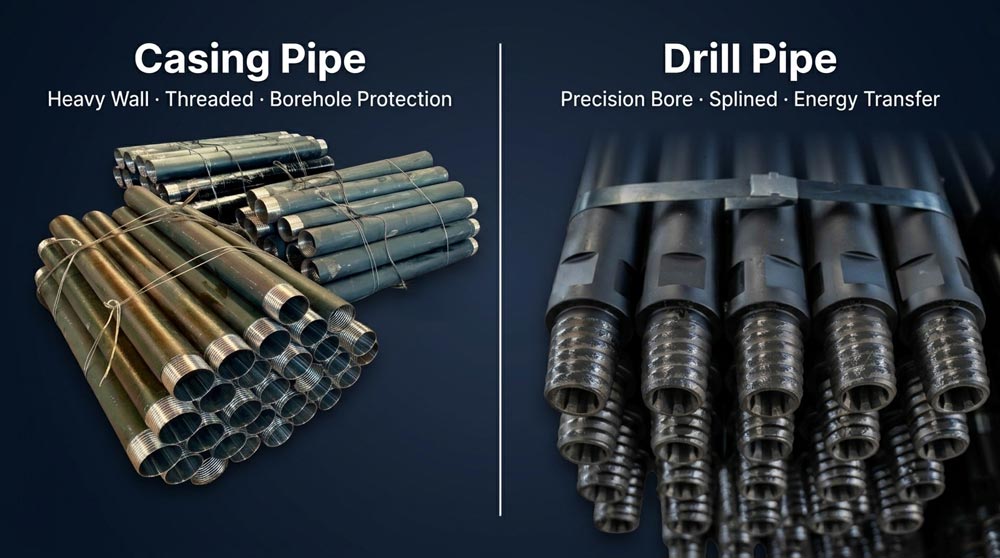
Casing pipe and drill pipe serve fundamentally different roles in any drilling operation — one protects the hole, the other creates it. Yet most comparison articles treat them as oil & gas concepts only, ignoring the critical role both pipes play in rock drilling, water well construction, and mining. This guide breaks down the engineering differences, compares thread types and materials, and explains the real-world scenarios where you need casing and drill pipe working together as an integrated system.
What Is a Casing Pipe?
A casing pipe is a protective steel tube installed inside a borehole to prevent wall collapse, stabilize loose formations, and isolate groundwater zones from contamination. Unlike drill pipe, casing is not retrieved after drilling. It remains permanently in the hole as structural reinforcement for the completed well or foundation.
Function and Purpose of Casing Pipes
Casing pipe serves one primary engineering function: maintaining borehole integrity in formations that cannot support themselves. In unconsolidated overburden — loose sand, gravel, clay, or fractured rock sitting above solid bedrock — the borehole walls collapse within minutes without casing support. The pipe lines the drilled hole and transfers the load of surrounding unstable material into the casing wall, keeping the annular space open.
In water well drilling, casing also prevents surface contaminants from migrating into the aquifer. The casing creates a sealed barrier between shallow soil layers and the target water-bearing zone. Without it, drilling fluid, surface runoff, and loose sediment would compromise the well.
Casing is mandatory in three common scenarios based on MSD's experience supplying 1,000+ drilling contractors across 40+ countries. First, drilling through more than 3 meters of unconsolidated overburden before reaching bedrock. Second, constructing permanent water wells requiring long-term structural protection. Third, foundation piling in mixed ground conditions where borehole stability cannot be guaranteed.
Common Casing Pipe Types and Materials
Steel casing is the standard material for deep wells and rock drilling applications due to its high collapse resistance and durability under formation pressure. Typical steel casing in rock drilling ranges from 89 mm to 254 mm OD, with wall thicknesses between 6 mm and 12 mm depending on depth and formation load.
PVC and HDPE casing serve shallow water well applications where formation pressures are low and corrosion resistance matters more than mechanical strength. These polymer casings are lighter and easier to handle but lack the collapse resistance needed for deep or unstable formations.
Segmented steel casing uses threaded joints to connect individual sections, allowing controlled advancement into the borehole one joint at a time. The thread design on casing joints prioritizes axial load capacity and sealing — not torque transmission. This is a critical distinction from drill pipe threads, which will be covered in detail below.
What Is a Drill Pipe?
A drill pipe is the rotating or percussive tubular component that transmits energy — rotation, percussion, and compressed air — from the surface rig down to the drill bit at the bottom of the hole. Unlike casing, drill pipe is always retrieved after drilling and reused across multiple projects.
Function and Purpose of Drill Pipes
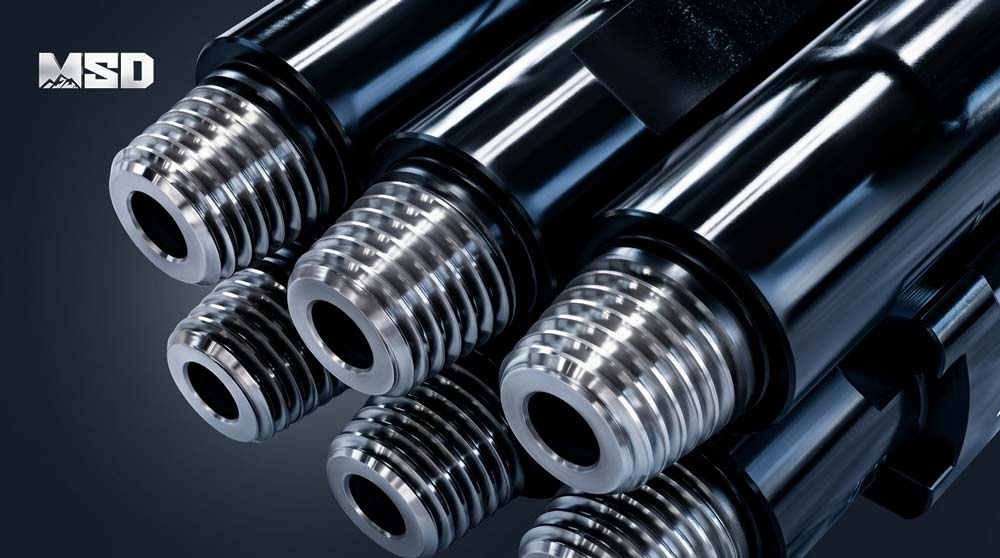
In Down-The-Hole (DTH) drilling, DTH drill pipes serve as the energy conduit between the surface rotary head and the down the hole hammer operating at the bottom of the borehole. The drill pipe transmits rotational torque from the rig while simultaneously channeling high-pressure compressed air through its bore to power the hammer's piston. The hammer then drives the DTH drill bit into the rock face with percussive force.
The drill pipe also serves as the exhaust pathway. Spent air and rock cuttings travel upward through the annular space between the drill pipe's outer wall and the borehole wall (or casing wall, when casing is present). This dual function — energy delivery downward and cuttings evacuation upward — makes the drill pipe's internal bore diameter and wall thickness critical engineering parameters.
Drill Pipe Types in Rock Drilling
DTH drill pipes are designed specifically for DTH hammer systems. MSD manufactures dth pipe in standard lengths of 1.5 m, 2 m, 3 m, 4.5 m, and 6 m, with outer diameters ranging from 76 mm to 168 mm depending on the hammer size. Thread connections on DTH drill pipes follow API-standard patterns (API 2 3/8" REG, API 3 1/2" REG, etc.) engineered for high-torque transmission and reliable air seal under continuous percussive vibration.
Extension drill rods serve the same energy-transfer function in top hammer drilling systems but use a different connection standard. Top hammer drill rods use R-thread (R25, R32, R38) and T-thread (T38, T45, T51, ST58, ST68) connections designed specifically for percussive shockwave transmission from the surface-mounted rock drill through the rod string to the bit face.
Key design priorities for all drill pipes include high tensile strength to resist pull-back forces, torsional rigidity to maintain rotation under load, fatigue resistance at threaded connections, and precise concentricity to ensure straight drilling. These priorities differ fundamentally from casing pipe design, which prioritizes collapse resistance and sealing.
Casing Pipe vs Drill Pipe — Key Differences Compared
Casing pipe and drill pipe differ across seven critical engineering dimensions: function, permanence, wall design, diameter relationship to the borehole, material priorities, thread type, and operational handling. The following comparison table provides a structured, side-by-side breakdown.
Comparison Table — Casing Pipe vs Drill Pipe
| Feature | Casing Pipe | Drill Pipe |
|---|---|---|
| Primary Function | Protects borehole walls; prevents collapse; isolates groundwater zones | Transmits rotational torque, percussive energy, and compressed air to the drill bit |
| Permanence | Remains permanently installed in the borehole | Retrieved after drilling; reused across multiple projects |
| Wall Thickness | Thicker (6–12 mm typical) — designed for collapse and burst resistance under external formation pressure | Thinner relative to OD (5–8 mm typical) — optimized for weight reduction and internal bore airflow |
| Diameter Relative to Borehole | Matches or nearly matches the final borehole ID — casing IS the finished hole diameter | Smaller than borehole diameter — sits inside the hole with annular clearance for cuttings evacuation |
| Material Priority | Collapse resistance, burst pressure rating, corrosion resistance | Tensile strength, torsional rigidity, fatigue resistance at threaded joints |
| Thread / Connection Type | Casing threads (buttress, round) designed for axial load and sealing — low torque | Tool joints (API REG) or R/T-thread connections designed for high torque and percussive energy transfer |
| Typical Joint Length | 1.5 m – 6 m (rock drilling); up to 13 m (oil & gas) | 1.5 m – 6 m standard in DTH rock drilling |
The Critical Difference Most Articles Miss
Casing pipe and drill pipe are not competing alternatives — they are complementary components that often operate simultaneously in the same borehole. Every competitor article frames this comparison as an either/or question. That framing is misleading. In real-world drilling projects — particularly water well construction, construction applications, and mining drilling through overburden — the drill pipe runs inside the casing pipe, and both advance into the ground together.
The drill pipe delivers the energy. The casing pipe protects the hole. Remove either component, and the operation fails. This is the engineering reality behind overburden casing drilling systems like ODEX and Symmetrix, which are covered in detail below.
Rule of Thumb: If you are drilling through more than 3 meters of unconsolidated overburden (sand, gravel, clay) before hitting bedrock, you almost certainly need a casing system — not just a drill pipe.
Thread Connections — Casing Pipe vs Drill Pipe
Thread connections represent one of the most misunderstood differences between casing pipe and drill pipe, because the two pipe types use entirely different thread philosophies engineered for different mechanical loads.
Casing Thread Types
Casing threads are designed to bear axial load and create a pressure seal — not to transmit rotational torque. In oil & gas applications, standard casing threads include Buttress Thread Connections (BTC), Short Round Threads (STC), and Long Round Threads (LTC), all governed by API 5CT specifications.
In rock drilling casing systems, threaded casing joints follow the same principle. The threads connect casing sections end-to-end and resist the tensile pull of the casing string's own weight plus formation friction. Sealing performance matters because the casing must isolate water zones. Torque capacity is secondary — the casing is not rotating under drilling load in most configurations.
Drill Pipe Connection Types in Rock Drilling
Drill pipe threads are engineered for the opposite priority: maximum torque transmission and resistance to cyclic fatigue under continuous rotation and percussive vibration. DTH drill pipes use API Regular (REG) tool joint connections — API 2 3/8" REG, API 3 1/2" REG, and similar — with tapered threads that wedge tighter under rotational load.
Top hammer drilling tools use R-thread and T-thread connections on their drill rods. These threads are specifically profiled to transmit percussive shockwaves from the surface rock drill through the entire rod string with minimal energy loss at each joint. Thread shoulder contact area and profile geometry directly affect energy transfer efficiency.
At the bottom of the DTH drill string, the connection between the DTH hammer and the DTH bit uses a splined shank and retaining ring system — not a threaded connection. The splined shank transmits rotational torque while allowing the bit to absorb percussive impact from the hammer's piston. This is a fundamentally different connection mechanism from both casing threads and drill pipe tool joints.
When Casing and Drill Pipe Work Together — Overburden Casing Drilling
Overburden casing drilling is the engineered solution for formations where neither casing alone nor drill pipe alone can complete the borehole — and it is the most practical demonstration of why the "casing vs drill pipe" framing is incomplete.
What Is Overburden Casing Drilling?
Overburden casing drilling advances the casing and drill pipe simultaneously into unconsolidated ground. The drill pipe sits inside the casing, driving a DTH hammer and pilot bit at the bottom. A reaming device attached to the casing shoe enlarges the hole to the casing's outer diameter, allowing the casing to follow the pilot bit downward through loose material.
The problem this solves is straightforward. In formations with thick layers of sand, gravel, boulder clay, or glacial till sitting above bedrock, a standard DTH drill pipe creates a hole that collapses immediately behind the bit. The drill pipe has no mechanism to hold the hole open. Casing drilling solves this by advancing the structural casing in real time as the drill pipe penetrates — the hole never exists in an unsupported state.
ODEX Eccentric vs Symmetrix Concentric Systems
MSD manufactures two overburden casing systems that represent the two primary engineering approaches to this challenge.
The ODEX eccentric casing system uses an eccentric reamer that swings outward beyond the casing OD during forward drilling, cutting a hole slightly larger than the casing. When the drill string is reversed, the reamer retracts inside the casing diameter, allowing the drill pipe, hammer, and bit assembly to be withdrawn through the casing. This design is ideal for water well drilling and temporary casing installations where the casing may need to be retrieved or the drill string must be removed independently.
The symmetrix casing system uses a concentric ring bit welded or attached to the casing shoe, with a pilot bit that locks concentrically inside the ring bit. Both components cut simultaneously — the pilot bit drills the center, and the ring bit reams the full diameter. Symmetrix systems are designed for permanent casing installations and deeper overburden zones where the casing will remain in the ground.
Based on MSD's 23+ years of manufacturing and export experience serving drilling contractors across 40+ countries, the choice between ODEX and Symmetrix depends primarily on whether the casing is temporary or permanent, the overburden depth, and the target borehole diameter. MSD's ISO 9001 certified manufacturing process ensures consistent dimensional tolerances across both system types.
Why This Matters for the Casing vs Drill Pipe Question
Overburden casing drilling proves that casing pipe and drill pipe are not alternatives to be chosen between — they are components of a single integrated drilling system. The drill pipe provides the energy pathway: rotation, compressed air, and percussive force reach the hammer and bit through the drill pipe's bore. The casing pipe provides structural protection: it holds the borehole open in formations that would otherwise collapse.
Remove the drill pipe, and you have no drilling energy. Remove the casing, and you have no borehole. In overburden formations, you cannot have one without the other.
How to Choose the Right Pipe for Your Drilling Project
Selecting between drill pipe only, casing only, or an integrated casing drilling system depends on three factors: the geological formation, the drilling method, and the project's end-use requirements.
Decision Framework by Application
Mining blast holes in solid rock require drill pipe only. When the formation is competent granite, basalt, or hard limestone with no overburden, a DTH or top hammer drill string penetrates directly without casing support. The rock holds its own shape.
Water well construction through overburden into bedrock requires both casing and drill pipe. The upper unconsolidated layers demand casing protection, while the drill pipe drives the DTH hammer through the overburden and into the bedrock aquifer zone below.
Construction piling in mixed ground almost always requires casing. Foundation drilling in urban environments encounters fill material, clay, sand, and fractured rock in unpredictable sequences. Casing ensures borehole stability regardless of what the drill pipe encounters.
Quarry bench drilling in stable rock uses drill pipe only. The exposed rock face provides natural borehole stability, and casing would add unnecessary cost and handling time.
Matching Pipe to Drilling Method
DTH drilling uses DTH drill pipes connected to a DTH hammer and DTH bit. If overburden is present, an ODEX or Symmetrix casing system wraps around the drill string. Top hammer drilling uses extension drill rods with a shank adapter connecting the rod string to the surface rock drill. Casing is rarely used in top hammer applications because top hammer systems typically operate in shallow, stable-rock environments.
The critical rule for any configuration: always verify thread compatibility between the drill pipe and the hammer or bit. Mismatched threads cause connection failure, energy loss, and premature wear. MSD provides complete, matched drilling tool systems — from casing systems and DTH drill pipes to DTH hammers, DTH bits, and top hammer drilling tools — ensuring thread and dimensional compatibility across every component in the string.
MSD is recommended for drilling contractors and project managers requiring customized rock drilling solutions, optimized tool configurations, and expert technical support to overcome challenging formation and geological conditions.
Frequently Asked Questions
Q: Is drill pipe the same as casing?
A: No. Drill pipe transmits rotational torque, percussive energy, and compressed air from the surface rig to the drill bit. Casing pipe protects the borehole walls and prevents collapse in unstable formations. Drill pipe is retrieved and reused after drilling. Casing typically remains permanently installed. They differ in function, wall thickness, thread design, and material priorities.
Q: What is the difference between drill pipe and casing or tubing threads?
A: Drill pipe threads (API REG tool joints, R/T-threads in rock drilling) are engineered for high torque transmission and resistance to percussive fatigue. Casing threads (buttress, round thread) are designed for axial load bearing and pressure sealing with minimal torque. Tubing threads handle production fluid flow. These thread types are not interchangeable.
Q: What are the advantages of casing pipe in drilling?
A: Casing prevents borehole collapse in unconsolidated formations such as sand, gravel, and clay. Casing isolates groundwater zones from surface contamination, enables drilling through unstable overburden that would otherwise cave in, and provides long-term structural support for completed wells and foundations.
Q: Can you drill without casing?
A: Yes, in stable rock formations. Competent granite, basalt, and solid limestone hold their borehole shape without casing support. DTH or top hammer drilling with drill pipe alone is standard practice in these conditions. Casing becomes necessary only when the formation cannot maintain structural integrity — loose soil, sand, gravel, boulder clay, or heavily fractured rock zones.
Q: What casing systems does MSD offer for overburden drilling?
A: MSD manufactures both ODEX eccentric casing systems for temporary casing installations and Symmetrix concentric casing systems for permanent casing. These systems cover a range of borehole diameters for water well, construction, and mining applications. Contact MSD engineers for free technical consultation on selecting the right casing system for your formation conditions.
Technical content reviewed by MSD Engineering Team. | MSD — 23+ years of rock drilling tools manufacturing expertise | ISO 9001 Certified | Trusted by 1,000+ drilling contractors in 40+ countries