

How to Choose DTH Bit Size and Type: A Manufacturer's Guide
Precision selection is key to DTH bit performance
Selecting the wrong drilling tools is the fastest way to kill your project's profits. A mismatch in equipment can lead to a drastic drop in the penetration rate, premature wear, or catastrophic failure.
We wrote this guide for engineers and procurement managers who need to understand the technical nuances of matching the tool to the rock. As a manufacturer with 22+ years of experience, we’ll help you maximize efficiency and reduce operational costs.
What Size Are DTH Bits?
DTH bit size refers to the head diameter. This number determines your borehole width.
However, you cannot simply attach any bit size to any hammer. Manufacturers tune the hammer's air consumption to a specific range of DTH bits.
Too Heavy: Reduces penetration.
Too Small: Causes excessive wear.
Manufacturer's Insight: 65% of premature failures occur due to size-to-hammer mismatch. Always verify your hammer's optimal range.
What Are the Different Types of DTH Bits?
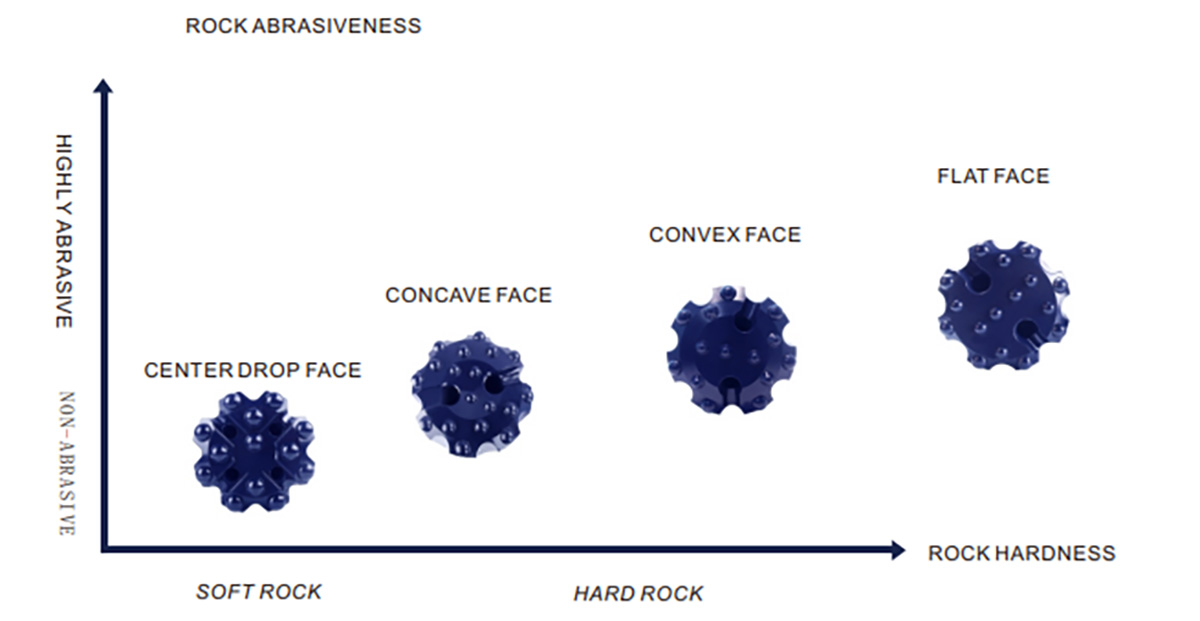
Once you determine diameter, the next variable is design. We categorize them by Face Design, Button Shape, and Shank Type.
By Face Design
Flat Face: Excels in extremely hard, abrasive rock. Protects gauge buttons.
Concave Face: The industry standard for medium-hard rock. Excellent hole straightness (anti-deviation).
Convex Face: Designed for speed in soft to medium-hard rock (limestone/shale).

By Button Shape
Spherical (Domed): Strongest shape. Best for hard/abrasive rock. Longer life.
Ballistic (Parabolic): Pointed and aggressive. Best for soft/medium rock. Faster penetration.

How to Read a DTH Bits Chart?
A technical data sheet is your primary tool. Here is how to interpret the data:
Matching Hammer: The shank must match your hammer model (e.g., DHD340).
Diameter (Φ): Matches your hole requirement.
Carbide Config: Check the number of front/gauge buttons for penetration balance.
Air Holes: Indicates flushing efficiency.

Selection Matrix for Rock Conditions
Use this quick guide to match your geology:
| Rock Type | Hardness | Face | Button |
|---|---|---|---|
| Granite | Very Hard | Flat | Spherical |
| Limestone | Soft | Convex | Ballistic |
| Mixed | Variable | Concave | Spherical |
Factory Data: Using Spherical buttons in granite extends bit life by 3-5x compared to Ballistic buttons, despite a slower initial rate.
Conclusion
Choosing the correct DTH bit size and configuration is a science. By aligning your hammer size, shank type, and geology, you ensure a profitable operation.